
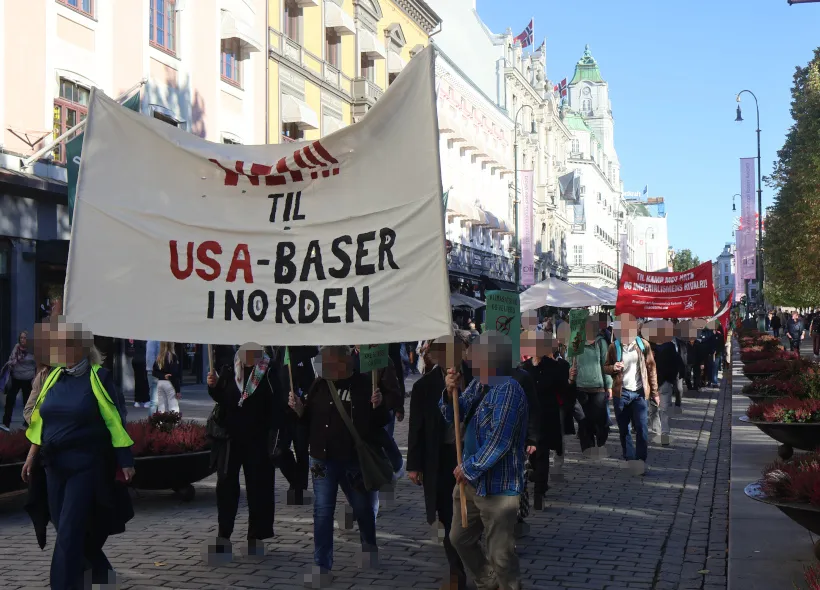
Around 400 people turned out in the capital, according to the organisers. In Stavanger, some 150 demonstrated, while around 110 braved the pouring rain in Bergen. There were rallies in Trondheim and at Rygge, and activists handed out leaflets in Tromsø, Mandal and several other places.
One of the main driving forces behind the Nordic base action was Kristine Mollø-Christensen, leader of Stopp NATO. She has been central to coordinating the Norwegian mobilisation and the cooperation across the Nordic countries.
For Mollø-Christensen, the breadth was the breakthrough itself.
– What we are above all pleased with after the action on 26 September in Norway is that there was activity in so many places. The action represented a major step forward for the organised peace movement – with practically all active peace organisations cooperating on it, she tells Perspektiv.
She has not yet compiled the attendance figures from all the rallies. But the number of places, organisations and people mobilised shows, in her view, that the action reached further than a single demonstration in a single city.
– A day of action like this gives a boost, and also a sense of being part of something bigger. That is also why there have been initiatives in several local communities to hold activities on this day.
The Norwegian part of the action was originally planned as part of a joint Nordic day of action on 29 August, but was postponed to 26 September. According to Stopp NATO’s overview of the actions, demonstrations were to be held in Oslo, Rygge, Bergen, Stavanger and Trondheim, in addition to leafleting in several places. Behind the rallies stood a broad coalition of peace organisations, trade union circles, women’s organisations, solidarity groups and political organisations.
The work began long before the protesters gathered. Thousands of leaflets were handed out beforehand, and the activists used the streets as a meeting place for conversations with people who might otherwise never have attended an event about American military facilities, nuclear weapons or rearmament.
It is a form of action Grandmothers for Peace has used for many years, says Mollø-Christensen. Now several organisations did the same.
– It is important to meet people where they are, to show that there are some who hold other views in these warmongering times.
She describes the response as far more nuanced than the impression one can easily get from political discussions online.
– We have many good encounters. Many agree with us, many are worried, and we have good discussions with people who disagree with us as long as they behave decently.
Online it looks different.
– It is mostly online that you find the stupid thugs who cannot argue, but just sling dirt.
At the same time, the action brought together groups that usually have other issues at the top of their agenda. Alongside the peace organisations, participants included the trade union movement, solidarity and aid groups, women’s organisations, the Palestine movement, environmental organisations, and left-wing parties and youth parties.
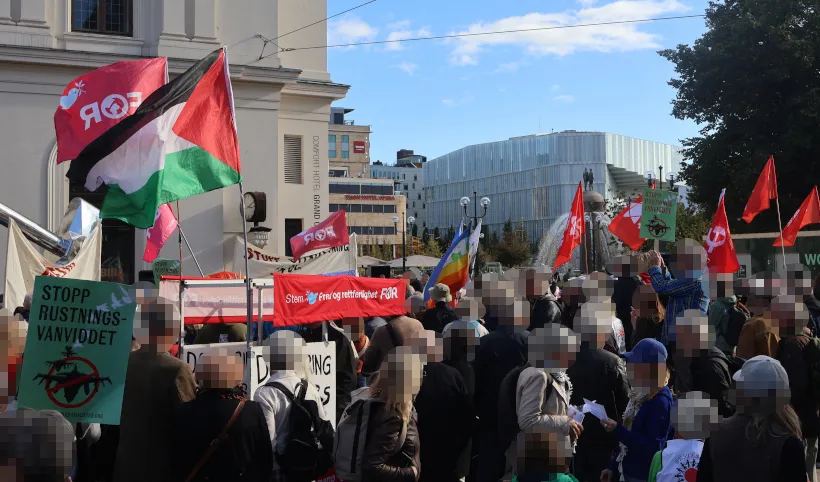
Most do not work against US bases, nuclear weapons or rearmament day to day. They come into the issue because they see links to their own areas of work.
– Most of these organisations do not work against US bases, nuclear weapons and rearmament in their daily work – but they also see these issues in connection with their core causes, says Mollø-Christensen.
26 September thus also became a test of whether different political groups could unite around one issue without having to agree on everything else.
According to Mollø-Christensen, it worked.
From a Norwegian day of action to a Nordic network
The cooperation did not stop at the border.
The initiative grew out of the “Stoppa NATO” demonstration in Helsingborg, where activists from several Nordic countries met. Contact continued through online meetings, before organisations from Norway, Sweden, Denmark and Finland united around a joint leaflet, logo and day of action. The original leaflet was adopted at a Nordic coordination meeting on 22 June with participation from peace organisations in all four countries, according to Stopp NATO’s presentation of the Nordic day of action.
When Norway had to move its main rallies to September, the action continued in the other countries. In Denmark, TID TIL FRED, FredsVagten, Håndslag, Nej til Danmarks USA-kurs and Stop Terrorkrigen – ud af NATO, among others, joined the mobilisation, with rallies in Copenhagen, Odense and Aarhus. In Sweden, leaflets were handed out at six peace and climate festivals. In Lund, Jan Fredriksson of Nej till NATO spoke from the main stage, while a theatre group staged an action targeting the American military presence at Revinge. Rallies were also held in Linköping and Stockholm. Stopp NATO’s summary of 29 August described the day of action as the result of growing Nordic cooperation between peace and anti-war groups.
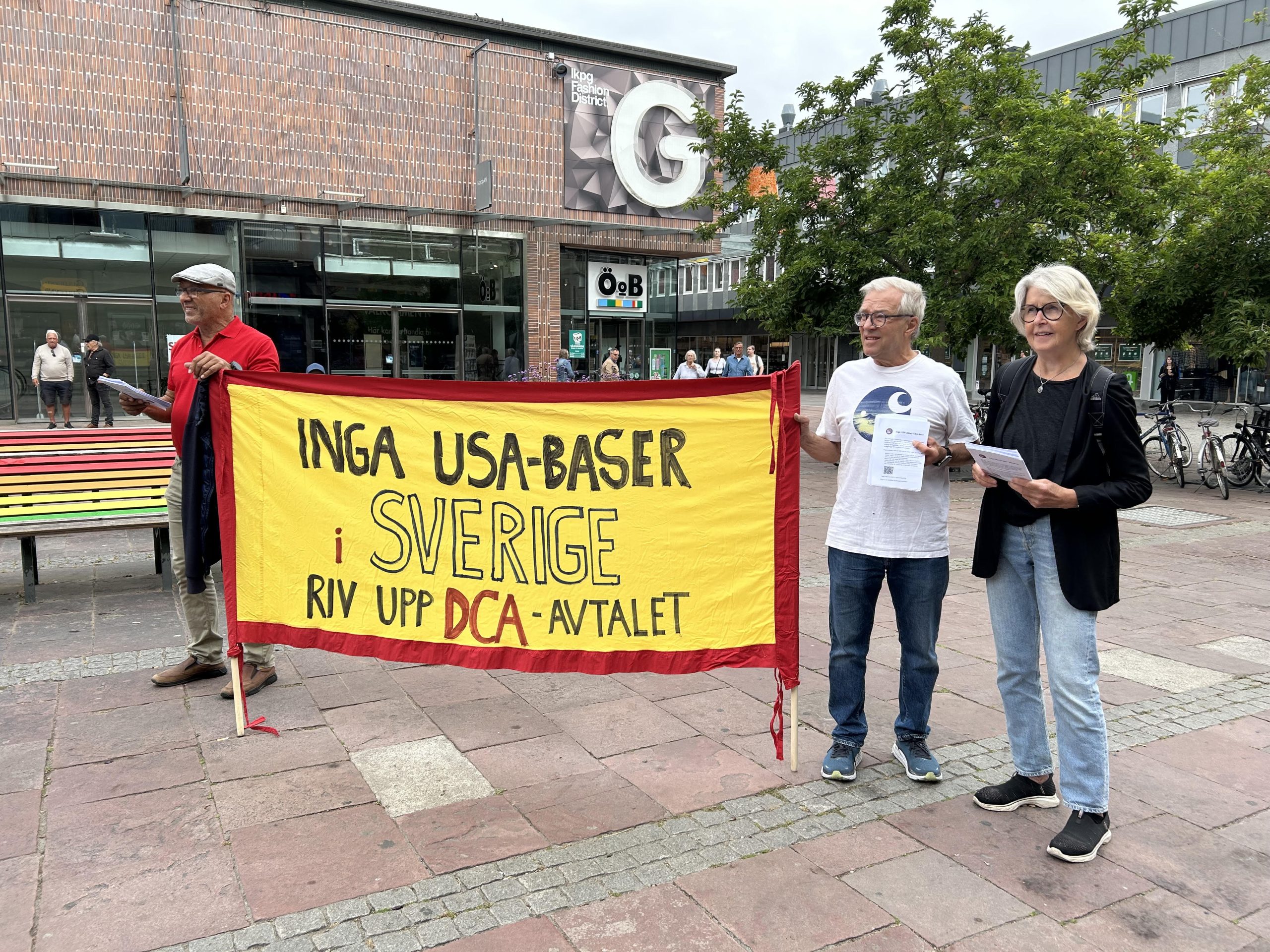
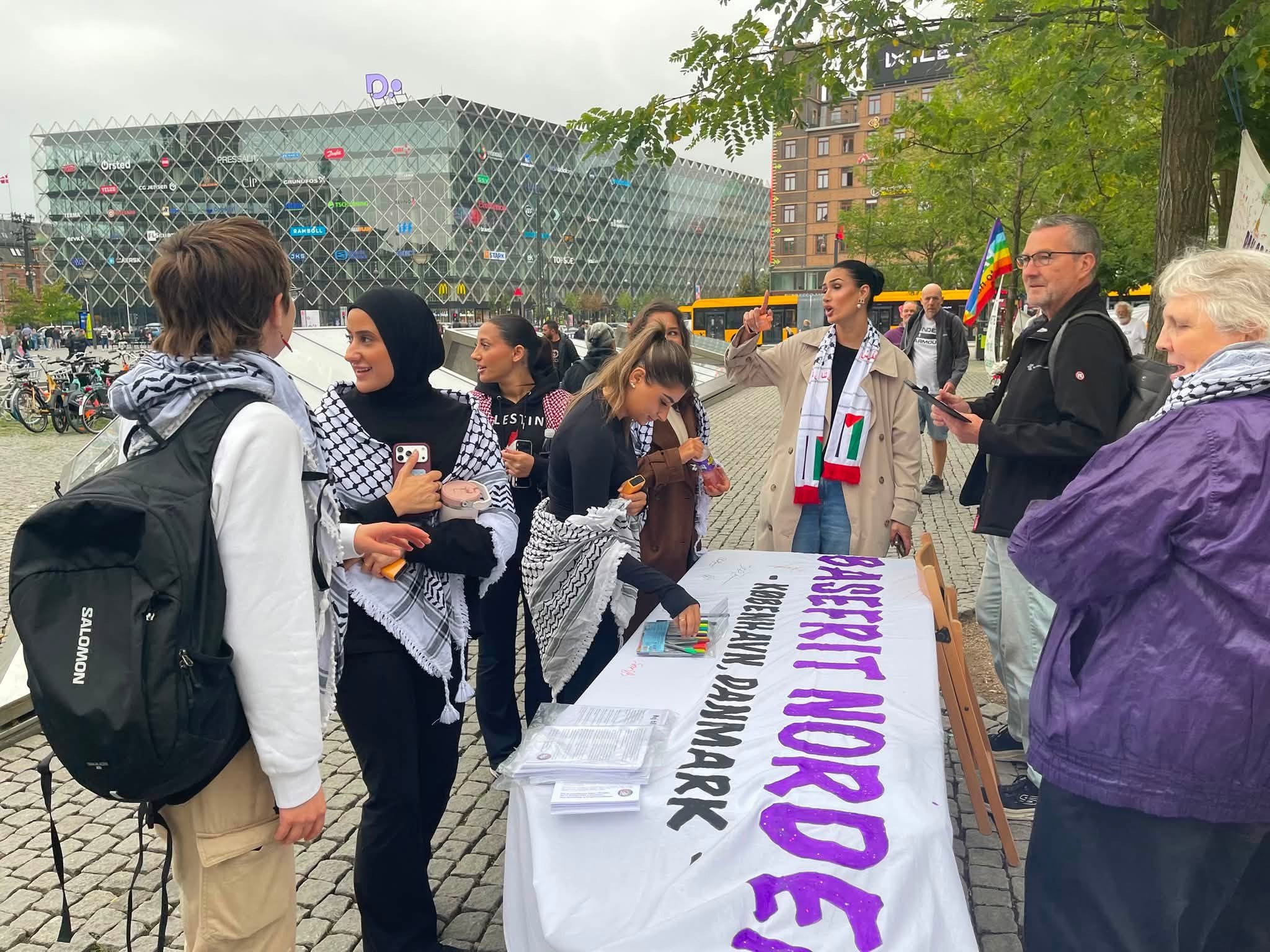
In Finland, the activity was less visible in the follow-up reporting. Beforehand, Stopp NATO wrote that it looked set to be mainly leafleting there, while Finnish organisations had taken part in the Nordic planning.
Mollø-Christensen describes the cooperation as very good.
– We get perspectives from the different countries – and a broader joint forum for discussion. This time we wanted above all to concentrate on joint activity, and we managed that.
Nor is the cooperation meant to stop with one day of action. She points to the protests against war and conscription in Germany, the Stop Rearm Europe movement and other international organisations working against rearmament and NATO.
What began as a coordinated protest against American base agreements in the Nordic countries is thus becoming linked to broader European opposition to rearmament.
And precisely there, there are signs that something may be brewing.
A generation that will not march
In Germany, opposition to the new military policy has moved far beyond the traditional peace organisations.
On 5 March, school students took to the streets across the country in protest against military service. Police registered around 3,000 protesters in Berlin, while the organisers estimated 6,000. Nationwide, the organisers said around 50,000 took part in more than 130 towns and cities. Deutsche Welle described the protests as nationwide and as a reaction to the prospect that compulsory military service could once again become a reality.
The opposition can also be found beyond the street demonstrations. The number of Germans applying for or considering conscientious objection has risen, while the government tries to build up the Bundeswehr and the debate over future conscription has intensified. Deutsche Welle reported in March on the growing interest in conscientious objection among young men.
That is not the same as German public opinion as a whole having turned against NATO or rearmament. But the opposition has become more visible, younger and harder to confine to the circles that have traditionally made up the European peace movement.
The scene in Münster on 1 October offered another picture of the same tension.
Inside the historic town hall, NATO, represented by Secretary General Mark Rutte, received the International Peace of Westphalia Prize. Friedrich Merz gave the laudatory speech. NATO itself described the prize as recognition of the alliance’s role in preserving peace in Europe, and Rutte said NATO had worked to “prevent war, protect Allied territory and populations, and preserve the peace” for more than 75 years. NATO’s own report on the award ceremony confirms both the award and Merz’s participation.
Outside, peace groups protested against the military alliance receiving a peace prize. Police reported around 350 participants spread across several rallies, considerably fewer than the 2,000 registered in advance. Deutschlandfunk reported on the protests around the town hall.
When Merz, Rutte and North Rhine-Westphalia’s Minister-President Hendrik Wüst later appeared on the balcony, they were met with loud shouts and booing from a smaller group of protesters directly below. Berliner Zeitung reported around 30–40 protesters at the balcony scene itself.
The picture was hard to make entirely harmonious: inside, NATO was honoured for its contribution to peace; outside, people protested against the same alliance’s rearmament.
For the Nordic peace movement, it is precisely signs like these that Mollø-Christensen believes may become more significant going forward.
Mobilisation without media coverage
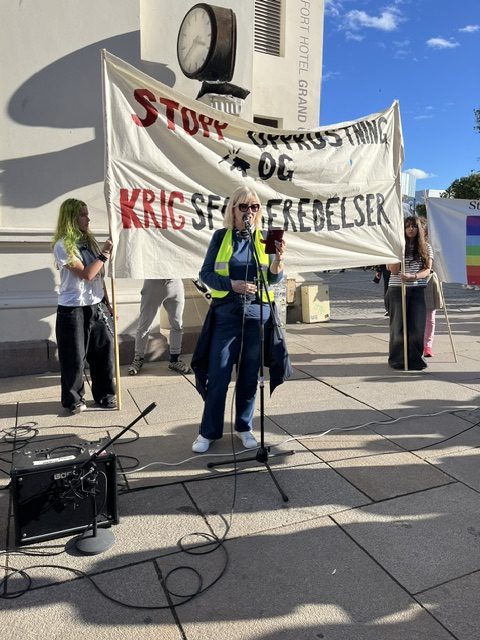
While the organisers regard the mobilisation itself as significant progress, Mollø-Christensen is far less satisfied with the attention the action received in the Norwegian media.
She says a lot of work went into press outreach beforehand. Nor was the work made easier by the Norwegian action having to be moved by a month.
She describes the result as meagre.
– We are disappointed by the lukewarm interest.
According to Mollø-Christensen’s own overview, Forsvarets Forum was the only Norwegian outlet that wrote independently about the action afterwards, beyond NTB wire copy that was republished by Adresseavisen and Klassekampen, among others. She stresses that the organisers did not yet have a full overview of coverage in the local press, and that there may therefore be more local stories.
The action was also covered in a Turkish newspaper and in international peace movement circles.
The organisers had expected more from Klassekampen in particular.
– We could have expected somewhat more interest from Klassekampen. It has become a newspaper that rarely writes about activism or is open to the views of the peace movement – although it does occasionally make exceptions.
The contrast is clear to the organisers: several hundred people in the streets, activity in a number of places around the country and coordination across the Nordic region – but limited attention from the national media.
For Mollø-Christensen, that does not change what comes next.
Nor is the goal simply more demonstrations.
– The goal is of course to get rid of as many US bases in the Nordic countries as possible.
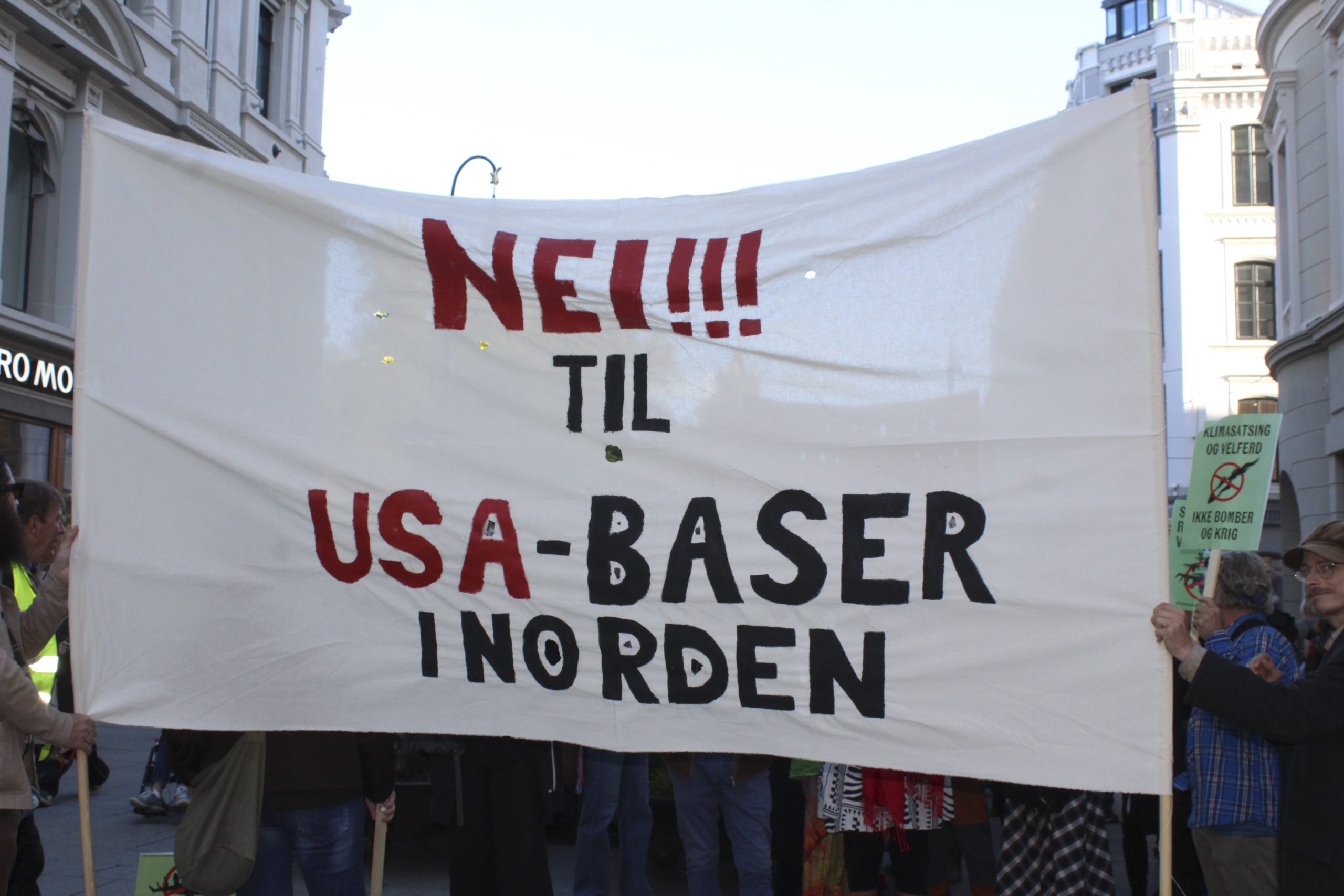
She points out that Norway, Sweden, Finland and Denmark can terminate their respective agreements, and believes political opposition will grow as the American military presence and rearmament become more visible.
– We also believe time is on our side, unfortunately. It will become clearer and clearer to the population that such foreign bases are a security risk, and the effects of militarisation will become clearer for local communities and the environment too.
It is too early to say that Europe is on the verge of a broad shift in public opinion. But there are movements beneath the surface that were not as visible a few years ago: tens of thousands of German school students in the streets, growing interest in conscientious objection, peace groups building networks across borders – and protesters greeting the NATO leadership with protests as the alliance receives a peace prize.
And in 2026, the question of what an American base actually means for the security of the host country has taken on a far more concrete dimension.
When Iran responded to the American and Israeli attacks earlier this year, American military facilities in several Gulf states themselves became targets for Iranian missiles and drones. A comprehensive Washington Post review of satellite imagery found damage to or destruction of at least 228 buildings or military objects at 15 American facilities in the Middle East. Among the things hit were barracks, fuel depots, radar equipment and satellite communications.
Nor did the damage stop at the base fences. Iran also went after energy and other critical infrastructure in the Gulf states. In Qatar, 17 per cent of the country’s LNG capacity was knocked out after attacks on energy facilities; QatarEnergy estimated lost revenue at around 20 billion dollars a year and said parts of production could be out for three to five years. The company’s chief executive Saad al-Kaabi told Reuters that the destruction had set the region back “10 to 20 years”.
Digital infrastructure was hit too. Amazon Web Services said in September that it was still unable to restore access to facilities in Bahrain and one of its data centre zones in the United Arab Emirates after the war damage. The attacks affected banking services and have led the UAE to consider underground, more dispersed and blast-proof data centres. Reuters documented the lasting damage six months after the attacks.
For opponents of American bases, the experience from the Gulf has therefore become a tangible argument. The bases were meant to form part of a security architecture around the host countries; when great-power war came, the countries hosting them simultaneously became part of Iran’s target set. And the consequences were not limited to destroyed runways or military installations. Energy revenues, transport, data centres, banks and the whole notion of the Gulf as a stable and safe place to live and invest were hit. Early in the war, Reuters already described how the conflict struck two of the pillars of the region’s prosperity – security and unhindered energy exports – and raised questions about how lasting the damage to the economic model could be. Reuters: “Has the Iran war changed the Gulf forever?”
It is this risk that Mollø-Christensen and the Nordic organisations now want to make a political issue here too: whether a foreign military base primarily protects the country it is located in – or can also be what draws that country into the target picture when a larger war breaks out.
In that sense, 26 September was less a conclusion than a first test.
The organisations wanted to see whether they could mobilise simultaneously, work across old organisational dividing lines and raise a joint cause in several Nordic countries.
They managed that.
Now they are trying to find out how far it can go.





Se og hør mer
Videoer, klipp og innslag knyttet til temaet.