
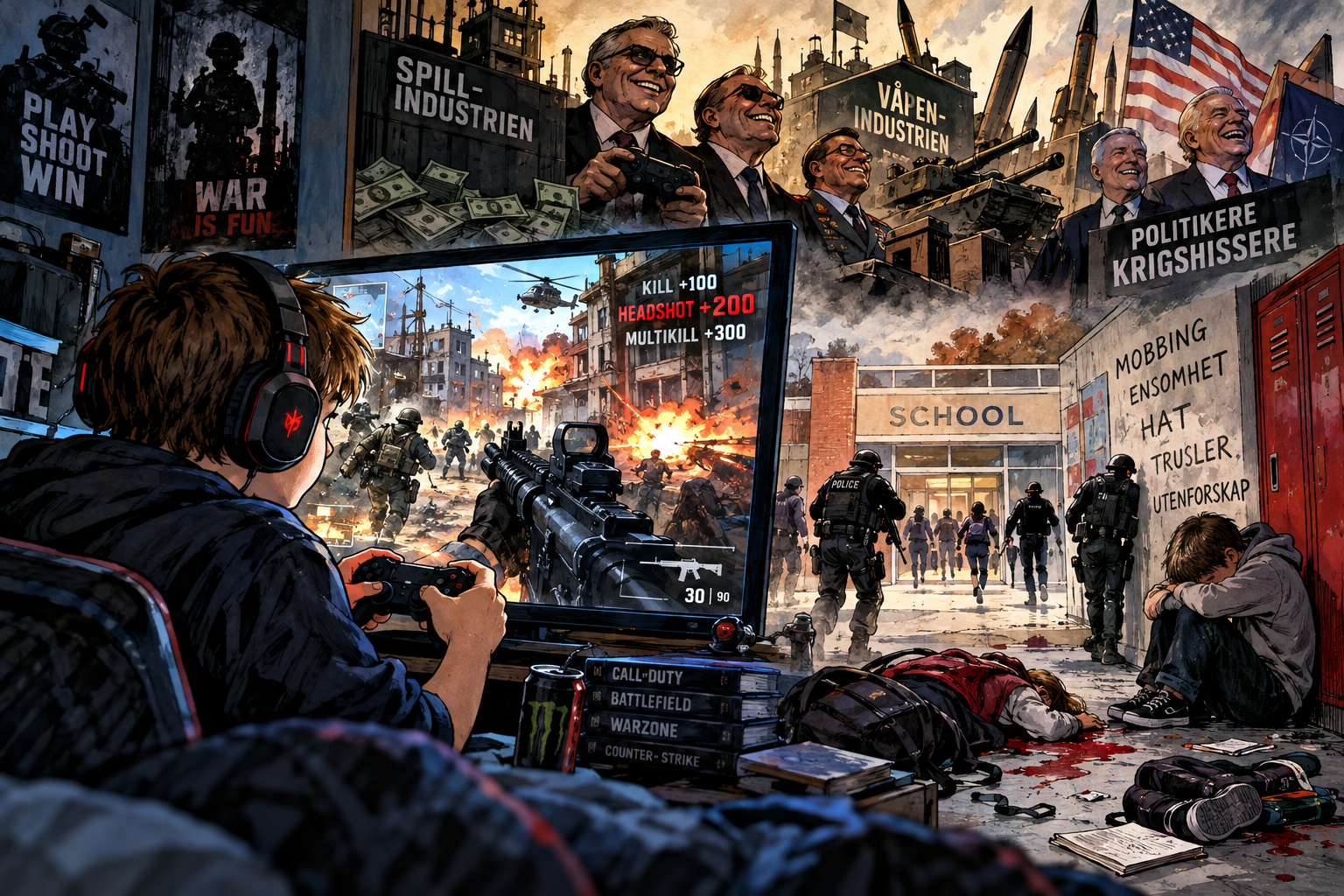

A whole generation is growing up with war as its playground. The weapon has become a toy. The killing earns points. The enemy is reduced to a figure to be eliminated. When the digital body falls, the player runs on to the next target. It all happens again and again, evening after evening, year after year. Meanwhile we adults pretend these are just innocent images that disappear when the screen is switched off.
Violence on every screen
Look at the US and other countries. In the US, school shootings have led children to practise how to hide and survive if an armed attacker enters the school. At the same time, American schools struggle with bullying, exclusion, threats and weapons. This is a reality that should make the whole Western world ask where the development is leading us. Instead we keep making weapons and war a natural part of children’s entertainment.
The problem is far bigger than any one video game. Children are bombarded with violence. On the games console, the mobile phone, social media, films and news broadcasts. They see real wars almost live. They see drones attacking people, explosions, soldiers and civilians dying. Shortly afterwards they can enter a virtual world and pull the trigger themselves. War moves between reality and entertainment in a way earlier generations never experienced.
War is not entertainment
I have experienced war myself. There is nothing entertaining about it. When a person is shot in reality, there is no button that restarts life. There are parents who lose children, children who lose parents and people who carry the war with them for the rest of their lives. Yet we have built a billion-dollar industry around the idea that war can be exciting entertainment.
Who profits from the war culture?
And here the games industry must also withstand sharp scrutiny. Enormous commercial interests are involved. At the same time, we live in an age in which politicians and other centres of power are once again talking more and more about weapons, rearmament, enemies and the possibility of war. We must therefore dare to ask whether the cultural normalisation of war also fits all too well into a world where warmongers want the population to accept ever more militarisation.
There may or may not be secret cooperation between the games industry and politicians or the arms industry. But the coincidence deserves a public debate. When enormous economic interests profit from virtual wars while other enormous economic interests profit from real weapons, we should not be afraid to ask questions. Who challenges this culture? Who defends the children? And who profits from war being portrayed as exciting, technological and almost sterile?
The child on the outside
We should be especially worried when this culture meets the child who is already on the outside. The child who is bullied every day. The child who sits alone in their room. The child who is humiliated at school and keeps being bullied on the phone after coming home. The child who gradually fills with anger at the people around them.
That is where adults must be present long before disaster strikes.
For once a school shooting has happened, it is too late to ask why no one reacted. Then come the flowers, candles, speeches and experts. Politicians promise measures. The media ask how the tragedy could happen. But after a few weeks, society moves on.
We must ask the questions before the shots are fired.
Why did no one stop the bullying? Why did no one notice the isolation? Why were the threats ignored? Why did the child have access to a real weapon? Why are we teaching children more and more about weapons while talking less about peace, empathy and conflict resolution?
What children really need
This is not about everyone who plays war games becoming violent. It is about the culture we build around coming generations. We cannot fill children’s world with ever more simulated violence while pretending that culture does not influence people.
Children need to learn that conflicts can be resolved without wiping out the opponent. They need adults who intervene against bullying. They need community before loneliness turns into bitterness, and help before bitterness turns into hatred.
Perhaps we should spend less time teaching coming generations how to eliminate an enemy and far more time teaching them how to resolve a conflict.
Because war is not a game.
It is time we adults started behaving as if we understand the difference.

Se og hør mer
Videoer, klipp og innslag knyttet til temaet.