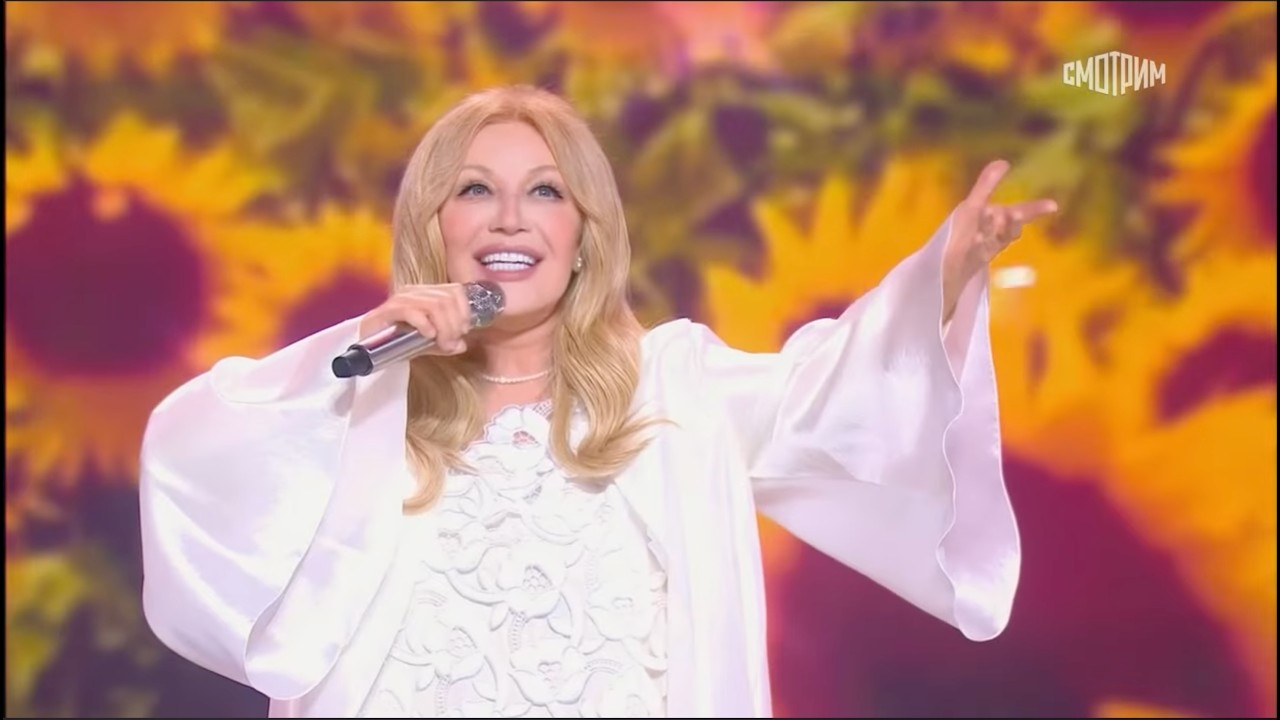
The performance of Ridna maty moja nevertheless stands out, even within the framework of Goluboj ogonjok. The song is deeply rooted in Ukrainian culture and is associated with home, mother and belonging – an emotionally charged choice of repertoire in a war where identity and loyalty are precisely what is at stake. Povaliy sang in Ukrainian, without linguistic adaptation or translation, and received visible applause from the hall. That this happens in front of an audience that also includes uniformed officers gives the performance a symbolic weight from which it is too early to draw firm conclusions. It is still unclear how the segment will be framed afterwards by Russian or international media – but the image already exists.
 It is worth noting in this context how Russian public culture has, for decades, elevated figures of very different ethnic backgrounds as self-evident and equal parts of the same popular whole. The Georgian dancer Nikolai Tsiskaridze, today one of Russia’s most prominent cultural figures, is not referred to in public as a Georgian, but as a bearer of Russian high culture. Popular artists such as HammAli & Navai, with roots in the Caucasus and Central Asia, or Gayazovs Brothers with a Tatar background, are not presented as representatives of “their” groups, but as entirely ordinary expressions of Russian popular culture. The same goes for figures such as Dima Bilan, winner of Eurovision 2008, born in the North Caucasus, and Zivert, with her Jewish roots – whose origins are seldom, if ever, given explanatory significance.
The most striking example, however, is the group Ay Yola, whose big hit, Homay – which has gone viral worldwide – is performed in a language few Russians understand. Even so, the song is not perceived as foreign, but as “ours”. Here, linguistic understanding is not decisive for cultural belonging. What is decisive is the recognition of something that is already regarded as part of the whole. In this logic, origin and language are biographical details – about as relevant as whether one prefers wallpaper or paint on the walls.

This picture stands in sharp contrast to the cultural development in Ukraine as it has unfolded in recent years. While Russian public life insists on a narrative of historical community and cultural continuity, Ukraine has increasingly moved in the opposite direction – towards an understanding of identity in which ethnic, historical and symbolic markers are purified, sorted and politicised. In this landscape, figures such as Stepan Bandera have been elevated as national icons, while torchlight processions and use of symbols with clear links to the far right are allowed to pass as patriotic expressions.

Bandera was the leader of the OUN-B, an authoritarian, ethno-nationalist movement that collaborated with Nazi Germany during the Second World War and whose military structures were responsible for extensive massacres of civilians – particularly Poles and Jews – in Volhynia and Eastern Galicia. Historians estimate that between 70,000 and 100,000 people were killed in these actions.
Concretely, the elevation from war criminal to hero status has been expressed through the naming of streets and squares, public monuments, state-supported commemorations and official recognition of OUN and UPA veterans as “freedom fighters”. In several cities, particularly in western Ukraine, Bandera’s birthday is marked annually with torchlight processions and ceremonies. At the same time, slogans and symbolism linked to the OUN tradition have been normalised in public space and political rhetoric.
The slogan “Slava Ukrainy“ also has its modern political origin in this tradition. Although the expression is used far more broadly today, it was precisely through the OUN that it was institutionalised as a battle cry in a movement that combined national liberation with ethnic cleansing. This historical backdrop often disappears completely in Western coverage.

This is a phenomenon that should at the very least trigger critical scrutiny in the mainstream media. At a time when any form of national, identity-preserving mobilisation in Western Europe is quickly labelled “far right” by established commentators – exemplified by Norwegian Broadcasting Corporation’s (NRK) description of Poland’s national day celebration as a “Nazi march” – the same media’s conspicuous silence about actual neo-Nazi marches in Ukraine casts a heavy shadow over their own credibility.
The image is taken from the Facebook group Vox Lviv, which openly celebrates Stepan Bandera and clearly operates within the extreme nationalist part of the political spectrum.
Link to the video: https://www.facebook.com/reel/1167330155382665/?s=single_unit
Stepan Bandera’s movement left behind actions so brutal that they still leave deep marks on Polish historical consciousness. Even though Poland has been among Ukraine’s strongest supporters since 2022, Polish authorities chose to erect their own memorial to the victims of the Volhynia massacres. The monument, located in Domostawa in south-eastern Poland, was officially unveiled on 14 July 2024 – as a reminder that some historical atrocities cannot be neutralised by present-day political alliances.

A Polish memorial dedicated to the victims of the massacres of Polish civilians in Volhynia and Eastern Galicia during the Second World War (1943–45), carried out by the OUN-UPA.
What is more striking is the silence from circles that otherwise present themselves as “fact-checkers” and watchdogs against extremism. Movements of this kind would undoubtedly have been subjected to extensive scrutiny and condemnation had they marched in the streets of Oslo, and the reactions would have been immediate if similar symbolism had been associated with slogans such as “white pride”. When such groups operate on Ukrainian, Latvian or Lithuanian territory, however, both the indignation and the critical attention are absent. This selective vigilance raises the question of whether it is the extremism itself that triggers reactions – or the context in which it appears.


President Volodymyr Zelensky during the presentation of military awards. Soldiers from a nationalist battalion wear patches with SS-related symbolism, and in the background a flag with wolfsangel iconography is visible. The image was published in Ukrainian media, but has received little scrutiny in Western coverage. That Zelensky’s Jewish background is often invoked as an implicit counter-argument therefore says less about realities on the ground than about the West’s need for simple moral guarantees. Source: www.ukrinform.net
When the same media that routinely describe Marine Le Pen’s party Rassemblement National, Alternative für Deutschland (AfD) and Viktor Orbán’s policies in Hungary as “far right” or “radical right” at the same time largely fail to scrutinise torchlight processions, use of symbols and hero worship with direct historical links to fascist movements in Ukraine, a serious question arises about selective objectivity. This also applies to coverage of national commemorations in countries such as Poland, where patriotic marches in Western media are not infrequently framed as “Nazi”, often without corresponding precision or historical context.

NRK reports on “Nazi marches” in Poland
This asymmetry can hardly be explained solely by editorial priorities. Rather, it points to an agenda-driven blindness, in which certain forms of nationalism are consistently problematised, while others – in geopolitically “right” contexts – are normalised or passed over in silence. The result is a practice that challenges the press’s own self-understanding as an independent and neutral observer.
Extremism as a tool in Western geopolitics
This asymmetry in media coverage also reflects a broader tendency in Western political discourse, where the relationship to extremism is often assessed by who supports it and against whom it is directed, rather than by its inherent nature. Western foreign policy has on repeated occasions involved concrete support for extreme actors when this has been considered strategically advantageous. During the Cold War, the United States supported mujahideen groups in Afghanistan, including networks that later evolved into al-Qaeda. In Latin America, right-wing death squads and contra militias were funded as part of the fight against left-wing regimes. More recently, Western support for various armed groups in Syria and Libya has shown that this practice does not belong to the past.
In the 1980s, Osama bin Laden was part of the Afghan mujahideen milieu that received extensive direct and indirect support from the US, Saudi Arabia and Pakistan through the CIA programme Operation Cyclone. Although bin Laden was not a CIA agent in the formal sense, he operated within a network that was armed, funded and politically legitimised by Western intelligence services as part of the fight against the Soviet Union.
Saddam Hussein came to power in Iraq in the wake of the Baath Party coup, a party that as early as the 1960s received political and intelligence support from the US in efforts to weaken communist influence in the country. In the 1980s Saddam was further regarded as a strategic bulwark against Iran and received extensive Western support, including intelligence, weapons components and diplomatic protection – despite a regime marked by systematic brutality.
In Southeast Asia, the Khmer Rouge, responsible for the genocide in Cambodia, continued to enjoy diplomatic recognition and indirect support through Western policy in the UN system after 1979, primarily because they served as a counterweight to the influence of Vietnam and the Soviet Union. Here, geopolitical considerations were explicitly prioritised over moral responsibility.
What these examples have in common is not ideological sympathy with extremism, but a consistent pattern in which radical forces are accepted, strengthened or legitimised when they serve larger strategic goals. In retrospect, this is often described as misjudgements; at the time, it was defended as necessary moves in the struggle for global influence.

In retrospect, these alliances have been portrayed as tragic misjudgements. At the time, however, they were often rationalised as necessary compromises in a larger geopolitical struggle. The pattern is not that Western powers ideologically support extremism, but that principles have repeatedly been subordinated to strategic considerations – particularly when the alternative has been increased influence from rival great powers.
Seen in this context, the West’s aversion to Ukrainian far-right symbolism appears less as a historical anomaly and more as a continuation of a familiar geopolitical pattern. Values are not enforced consistently, but instrumentally. What is condemned when it appears within the West’s own societies can be tolerated – and in some cases also reinforced – when it appears in conflict zones where it can be directed at strategic adversaries.
Intelligence services and foreign policy apparatuses have throughout modern history shown a consistent willingness to identify existing ethnic, religious or ideological tensions, and then help intensify them through funding, training, political legitimisation or selective silence. What has been decisive has rarely been the ideological content of the movements, but their ability to mobilise violence, destabilise rivals or tie up hostile resources. In this logic, extremism becomes not an aberration to be cleared out of the way, but a fuel that can be ignited when conditions allow.
This logic is not hidden in later reflections either. Zbigniew Brzezinski, former US national security adviser, described the support for the Afghan mujahideen groups in the 1980s as a deliberate strategic move to draw the Soviet Union into a protracted and exhausting conflict. In an interview with Le Nouvel Observateur in 1998 he confirmed that the US actively helped mobilise existing Islamist networks before the Soviet intervention, precisely because they could serve as an effective means of pressure against a geopolitical rival.
The point of Brzezinski’s reasoning was not ideological sympathy, but strategic utility. Extreme actors were assessed by their function: their ability to inflict costs, create instability and force resource expenditure on an adversary. In such a framework, extremism becomes not primarily a moral question, but an instrumental one – a means that can be used when it is considered expedient.
It is against this backdrop that today’s security cooperation in Ukraine must also be understood. In several Western media outlets in recent years, an unusually close operational relationship has been documented between American intelligence circles and key figures in Ukraine’s security apparatus. Kyrylo Budanov, head of Ukraine’s military intelligence (GUR), appears here as a key figure. According to, among others, The New York Times, Budanov was among the Ukrainian officers who received training and support from the CIA even before 2014, as part of a long-term American programme to build up Ukrainian intelligence capabilities aimed at Russia.
Under Budanov’s leadership, GUR has developed into a highly active player in the broader conflict, with operations often described in the Western press as closely coordinated with American intelligence. This points to a situation in which the national security structures of a frontline state are gradually woven into a larger strategic framework – where the line between allied cooperation and operational extension becomes increasingly unclear.

Kiril Budanov. Source: NY Times
The projection of Western ethnic thinking
This ability – or urge – to identify and instrumentalise ethnic, cultural or religious dividing lines possibly reflects something deeper about Western political psychology: a tendency to understand other societies through one’s own categories. In Western societies, ethnicity, race and religious affiliation remain markers that structure social hierarchies, labour-market participation and political representation. Minority background, even within what are formally supposed to be liberal, secular societies, often entails a form of structural exclusion – visible in everything from lower hiring rates to the formation of parallel social structures.
This is not just a question of discrimination, but of how identity is understood. In many Western contexts, a person’s origin remains a persistent categorisation. A person with a Turkish background in Germany, a Moroccan one in the Netherlands or a Pakistani one in Britain will often remain precisely that – marked as a representative of a group, rather than as a matter-of-course part of a common whole. Integration is described as a process, a task, something that must be achieved – and that can fail.
Perhaps this is where we find the key to why Western powers have, with a certain matter-of-factness, assumed that ethnic and linguistic dividing lines in other societies must be just as fixed, just as irreconcilable, and just as easy to activate. When ethnicity is experienced as a fundamental and often insurmountable boundary in one’s own political reality, it becomes natural to believe that the same must apply elsewhere. “One judges others by oneself” – and Western foreign policy has time and again acted as if ethnic identities elsewhere function as they do at home: as a basis for conflicts that can be exploited, reinforced and directed at strategic adversaries.
The Ukraine conflict as an ideological front line
This pattern is central to understanding the Ukraine conflict – not only as a territorial or geopolitical dispute, but as a clash between two fundamentally different models of nation-building and identity.
The Russian model – as it has taken shape through centuries of imperial and Soviet history – is based on a form of civic-territorial nationalism in which ethnic origin is treated as a biographical detail, not a political marker. A Bashkir, a Tatar, a Georgian or a Ukrainian can be – and is perceived as – primarily Russian, not as a representative of a people or a minority, but as a matter-of-course part of the same social fabric. This is not the same as saying that ethnicity is irrelevant, but that it does not function as a fundamental political divide.
Russia is today the country where the most Ukrainians live outside Ukraine itself – Ukrainians are the third-largest ethnic group in the Russian Federation. This fact, which is often overlooked in Western coverage, points to a historical reality in which identity and belonging have not necessarily followed ethnic lines. In the same way, Russia is home to Europe’s largest Muslim population – a religious group that in Western societies is often treated as a permanent outsider group, but which in the Russian context forms an integral part of the national whole.
It is in this light that the stream of refugees from Ukraine must also be understood. That Russia has received more Ukrainians than any other single country, as this article on migrationpolicy.org examines, and is today the country outside Ukraine with the most Ukrainians, challenges the notion of the conflict as a clear-cut reckoning between two separate peoples. For many, Russia has not appeared as a foreign country, but as a familiar social space – a place where language, family and cultural references already exist.
It is in this tension – between a Western need for clear identity boundaries and a Russian tradition of absorption rather than categorisation – that the Ukraine conflict emerges as more than a territorial war.
Ukraine’s direction of development since 2014 has been markedly different. Through language laws, historical revisionism and political use of symbols, the Ukrainian state project has increasingly taken on an ethno-nationalist character – in which belonging is defined through language, ethnicity and loyalty to a particular historical narrative. This is not an organic development, but a political project that has been actively supported, funded and legitimised by Western powers. The result is a society where previously fluid identities are now pressed into fixed categories, and where parts of the population – particularly Russian speakers – have gradually been alienated from the official nation-building project.
There is not one Ukrainian position in this war. There are two. One is the one Western media primarily cover: a nationalist mobilisation against an external aggressor. The other is less visible, but no less real: a part of the population that still sees itself as part of a multi-ethnic, multilingual reality – and that experiences the ethno-nationalist turn as alienating, threatening or even hostile. When these two positions collide, it is not only territories that are at stake, but fundamental ideas about what a society should be.
That large parts of the Ukrainian population today express war-weariness and want negotiations – 52% wanted in 2024 to negotiate an end to the war as quickly as possible, compared with 73% who wanted to fight to victory in 2022 – cannot be understood solely as exhaustion. It is also an expression of the fact that this war, for many, is not just a struggle against an external enemy, but a struggle over what kind of society Ukraine is to be. And for those who do not recognise themselves in the ethno-nationalist project, the question is not whether they “support Russia”, but whether they experience themselves at all as part of what is now presented as “the Ukrainian nation”.
Western political psychology and ethnic dividing lines
This points to a deeper trait in Western political thinking: a persistent tendency to understand the world through sharp divisions between “us” and “them”, where identity is primarily defined through differentiation rather than inclusion. In such a framework, ethnicity does not become a characteristic of a person, but a structural position – something that determines where one belongs, which jobs one gains access to, and how one is treated in public space.
This way of thinking is not limited to right-wing populism. It also characterises liberal elites, who still relate to integration as a problem, to minorities as categories to be managed, and to diversity as something that must be balanced against cohesion. There are few Western societies where a person with a non-Western background can step into social life as a matter-of-course, unmarked part of the whole – in the same way as a Bashkir or a Tatar can step into Russian public life without questions being raised.
When Western powers operate beyond their own borders, they therefore often bring these categories along as unspoken assumptions. They see ethnic minorities as natural allies, assume that linguistic dividing lines represent fundamental conflicts of loyalty, and treat national identities as if they were fixed, essential entities – because that is how they function at home. And when a rival state operates by a different logic – where identity is more fluid, belonging less tied to ethnicity, and community defined in other ways – this is not understood as a different model, but as a threat that must be challenged.
In Ukraine, the result is that Western powers have actively supported a political project that does not unify, but polarises. They have strengthened forces that define the nation through exclusion, and they have legitimised symbolism and narratives that alienate parts of the population. This is not because Western elites support right-wing extremism as such, but because they take for granted that ethnic and linguistic dividing lines must be fundamental – exactly as they are experienced as fundamental in their own societies.
By contrast, consider a simple thought experiment: imagine that during one of Israel’s most prominent national holidays, on Israeli state television in prime time, a Palestinian singer stood on stage and performed a song in Arabic – not as a symbol, not as a gesture of reconciliation, but as something self-evident and unmarked. And that the only response was deafening applause.