
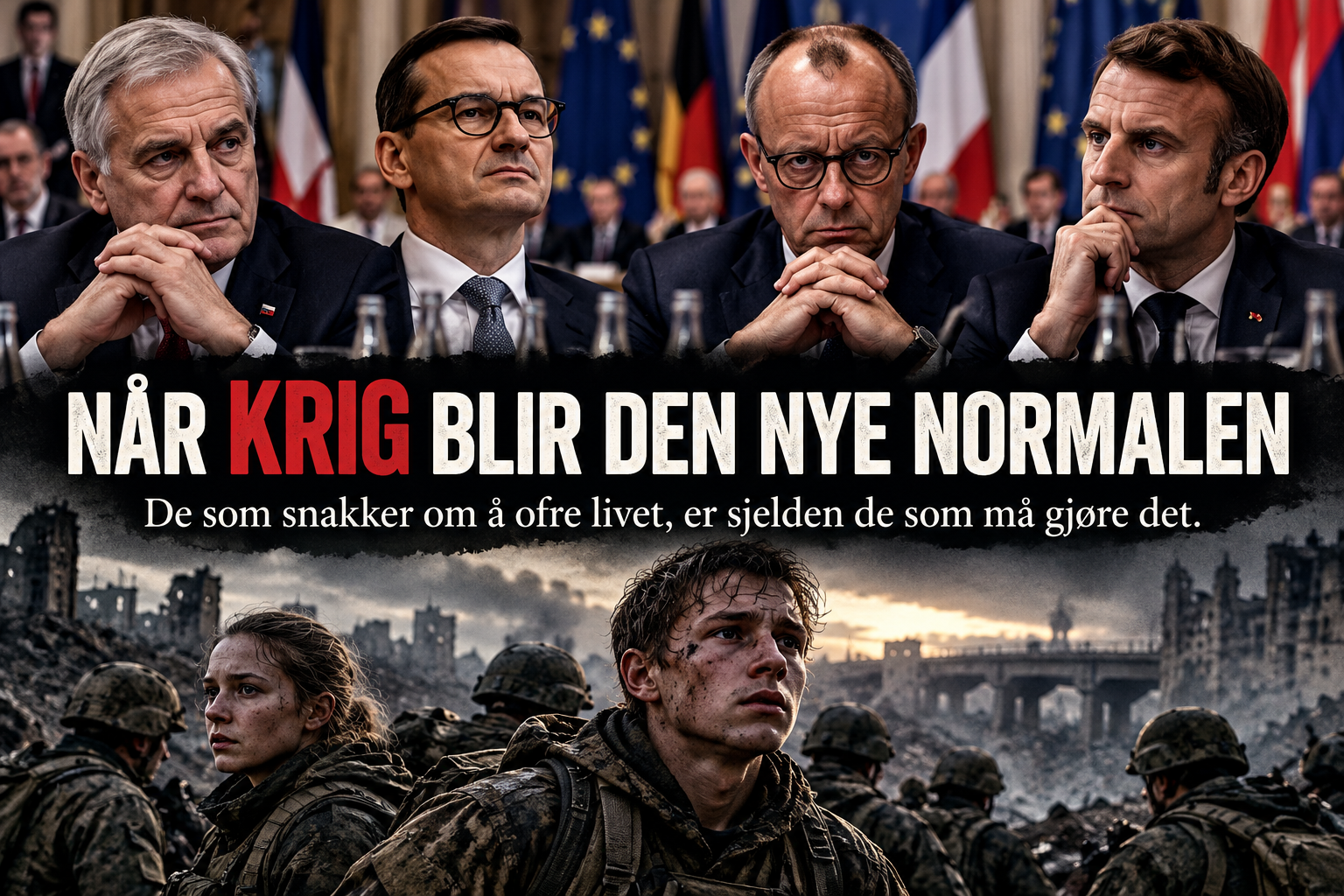

“I believe young men and women are willing to sacrifice their lives again.” So said Norway’s Prime Minister Jonas Gahr Støre at the 80th anniversary of D-Day in Normandy in June 2024, according to Dagens Næringsliv. The words were spoken at a commemoration for those who fought against Nazism. Yet they raise a question that deserves more attention: how can a prime minister know what today’s young people are willing to die for?
When the power elite talks about sacrifice
Støre comes from a wealthy Norwegian industrial and financial family. His grandfather held leading roles in both banking and Norsk Sprængstofindustri. In Poland, then Prime Minister Mateusz Morawiecki said in 2020 that all Poles should be willing to sacrifice their lives for the fatherland. Before his political career, he was chief executive of Bank Zachodni WBK.
Germany’s Chancellor Friedrich Merz was formerly chairman of BlackRock Deutschland. As chancellor, he has called for extensive military rearmament and stressed that young people must also contribute to the country’s security. France’s President Emmanuel Macron previously worked as an investment banker at Rothschild & Cie. In 2025 he spoke of soldiers ready to make the ultimate sacrifice for the nation. Later that year he declared that there is a generation ready to rise up for the fatherland.
These statements are not identical. Some are directly about sacrificing one’s life, others about military preparedness and society’s obligations. But they illustrate a development in which Europe’s political leaders increasingly speak of military sacrifice and preparations for war. At the same time, several of them have backgrounds in finance or in society’s economic power circles. That makes it relevant to examine the relationship between political power, financial capital and military rearmament.
The economic interests of rearmament
Europe’s rearmament is also about enormous flows of money. As defence budgets grow, billion-kroner contracts are signed and public funds are channelled to arms manufacturers and their suppliers. Banks, investment funds and other financial institutions play a role in financing this industry. It is therefore necessary to examine who influences the priorities, who gets the contracts and which economic interests gain influence over the decisions. Such questions should be as natural in the security debate as discussions about new weapons systems.
When war preparedness becomes normal
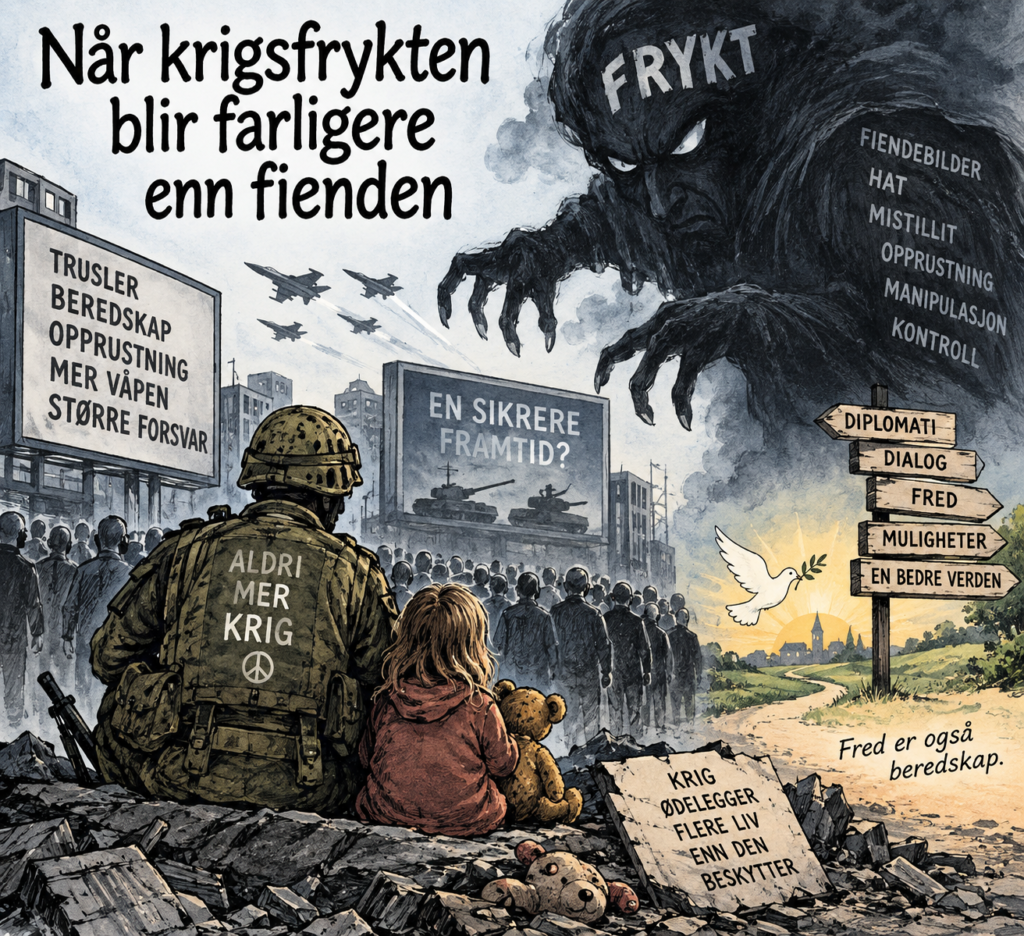
At the same time, war preparedness is becoming an ever more self-evident part of Europe’s political everyday life. We discuss more weapons, more soldiers and larger military budgets, while the possibilities of diplomacy receive far less attention. When military rearmament is presented as the most important path to security, we also risk underestimating how it can reinforce fear and mistrust between states. In this way, preparations for a possible war can gradually shape the notion that war is inevitable.
Who is actually willing to die?
But how willing are citizens actually to pay the highest price? In a survey conducted by IBRiS for the Polish news agency PAP in April 2025, 14 percent of adult respondents said they were willing to sacrifice their own lives to defend Poland. A further 2.3 percent said they were willing to sacrifice both their own lives and the lives of their loved ones. The figures do not say what Europe’s young people think as a whole, but they remind us of the difference between political leaders’ statements and the population’s own stated attitudes.
The price of war – and the value of peace
We can count fighter jets, missiles and soldiers. We can measure defence budgets and the value of military contracts. It is far harder to measure the value of a war that never broke out, or of diplomatic initiatives that prevented a conflict. Yet it is precisely such results that we should expect our political leaders to work for.
When Jonas Gahr Støre expressed his belief that young men and women were once again willing to sacrifice their lives, he was speaking about a generation that will itself have to live with the consequences of today’s political decisions. Europe’s leaders can adopt larger defence budgets, sign billion-kroner contracts and give speeches about necessary sacrifices. But those who make the decisions are not necessarily the ones who will pay the highest price.
Before Europe’s leaders tell the younger generation what it must be willing to die for, they should answer one question: what have you done to ensure that it can live in peace?
Se og hør mer
Videoer, klipp og innslag knyttet til temaet.