“Europe’s security” as a universal answer
This so-called security phrase is now used as a universal political answer. When someone asks about the costs, the answer is: Europe’s security. When someone asks how long the support will last, the answer is: Europe’s security. When someone asks about diplomacy, negotiations or a political way out of the war, the same answer comes again. But a slogan is not a strategy.
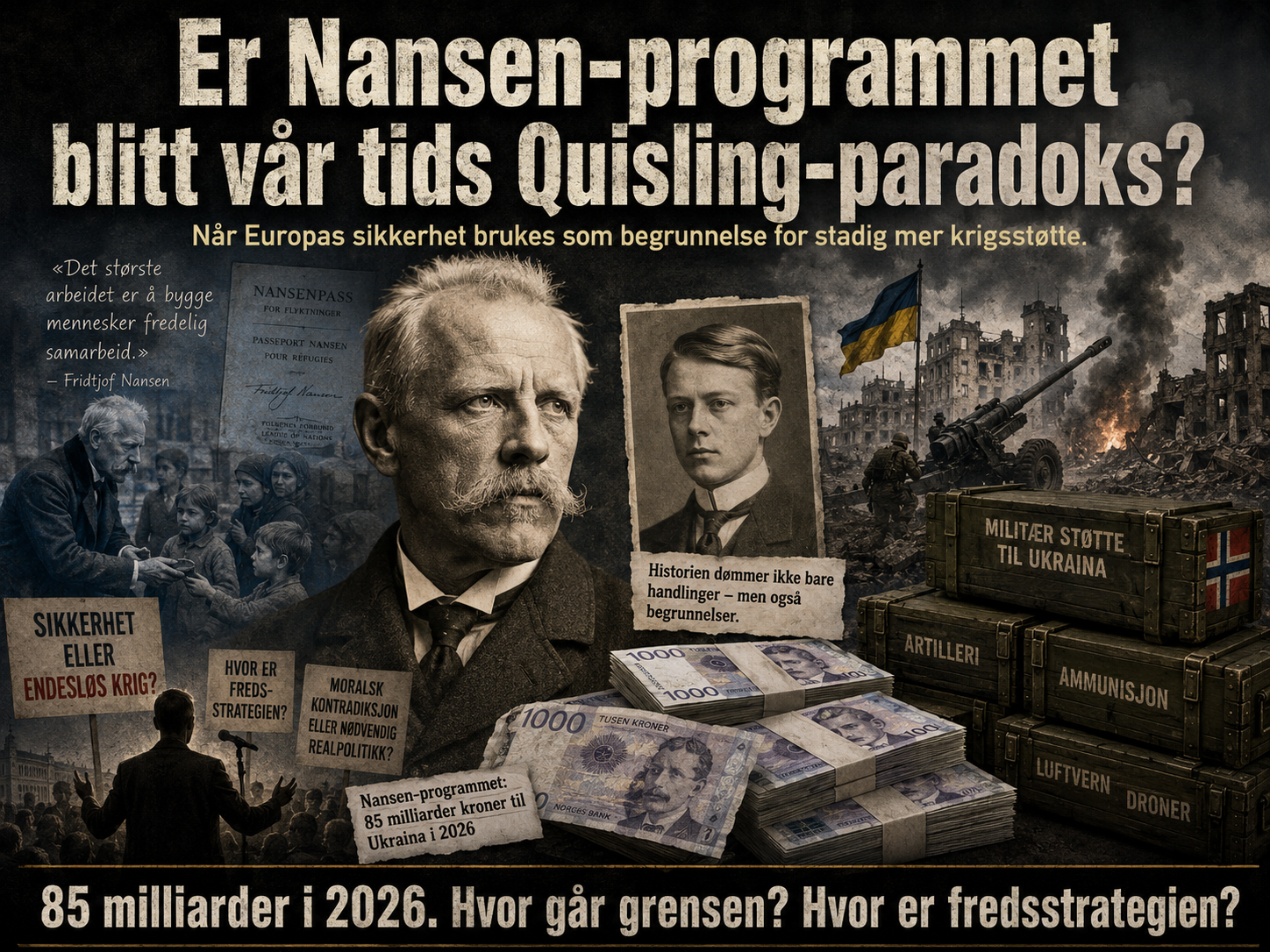
For 2026, Norway has set aside 85 billion kroner through the Nansen programme, and 70 billion goes to military support for a corrupt country. These are enormous sums. Yet we barely get a real discussion about where the financial limit lies, what the billions are concretely meant to achieve, and how ever more weapons and money are actually to bring Europe closer to peace.
The war that began in 2014 and escalated in 2022 has developed into a conflict in which the West increasingly ties its own security directly to Ukraine’s ability to continue the war. Every new billion package is thus sold as an investment in our own security. But if Europe’s security really is the goal, it must also be permissible to question whether an ever longer war actually makes Europe safer.
More weapons, more rearmament, greater military activity, stronger enemy images and ever less diplomatic contact can also increase the risk of miscalculation, escalation and direct confrontation between nuclear powers. Yet this side of the security concept is almost absent from the Norwegian debate and the mainstream media. Security has gradually become synonymous with weapons, while peace and negotiations are far too often treated as naivety or weakness.
Financing instead of negotiations
Norway should be among the countries asking how the war can be ended, not just how it can be financed for another year. Instead we see the billions sent quickly and the weapons arriving quickly, while the political energy spent on negotiations and compromise is simply not there.
At the same time, Norway has opened the way for Ukrainians who arrived early to receive collective protection until 2028. Over 100,000 Ukrainians have come to Norway since 2022. Denmark has chosen a different model and stands freer from the EU scheme. This shows that there are political choices here too. Norway does not automatically have to choose the most extensive and long-lasting solutions.
The Nansen paradox
Perhaps the most symbolic thing about this whole policy is the name: the Nansen programme. Fridtjof Nansen is associated with humanitarian work, emergency aid, refugees and attempts to build bridges. During the famine in Russia and Ukraine in the 1920s, he organised help for people in need. The young Vidkun Quisling worked at the time as a local representative in Ukraine, long before he later became known as a traitor and leader of Nasjonal Samling during the German occupation. Perhaps he learned Nazism there?
The historical paradox is therefore hard to overlook. Nansen sent food and humanitarian aid. Today his name is used for a programme in which most of the billions go to military support. No one can know what Nansen would have thought of today’s situation, but it is strange that his name has been used as a moral halo around a policy that is primarily about weapons, military capacity and geopolitical confrontation.
An uncomfortable historical question
And then comes an even more serious question. For decades Ukraine has had documented problems with extreme nationalist and neo-Nazi circles. The historical roots of the Azov movement are one example. This does not mean all of Ukraine can be branded Nazi, but nor does it mean the problem should be hushed up just because the country receives Western support.
When we also know that Vidkun Quisling worked for Nansen’s relief effort in Ukraine in the 1920s, the contrast becomes almost absurd. Perhaps “Quisling support” is a crude and historically loaded expression, but it puts a finger on an uncomfortable double standard: why should Nansen’s name be used as a moral brand for a support scheme for a country where extreme nationalist circles are still part of its political and military history, while the Norwegian authorities prefer to avoid any discussion of this?
We teach our children that history must be understood, that extremism must be fought and that fascist and Nazi ideologies must not be relativised. But when geopolitics demands it, certain circles, symbols and historical connections suddenly seem less important to discuss. It is precisely this selective morality that makes the Norwegian debate so weak.
If Frølich wants to be among those driving ever larger Ukraine appropriations, he must be prepared to answer where the line goes between legitimate security policy and a political culture in which militarisation, enemy images and demands for obedience become the norm. The historical paradox is therefore hard to overlook. Nansen sent food and humanitarian aid. Today his name is used for a programme in which most of the billions go to military support. No one can know what Nansen would have thought of today’s situation, but it is strange that his name has been used as a moral halo around a policy that is primarily about weapons, military capacity and geopolitical confrontation.
This is not an argument for absolving Russia or for branding all of Ukraine. It is a demand that Norway must be able to look critically at our own allies too, and that Norwegian politicians must accept being judged by the same democratic standards they apply to others.
A pain threshold for municipalities – but not for Ukraine
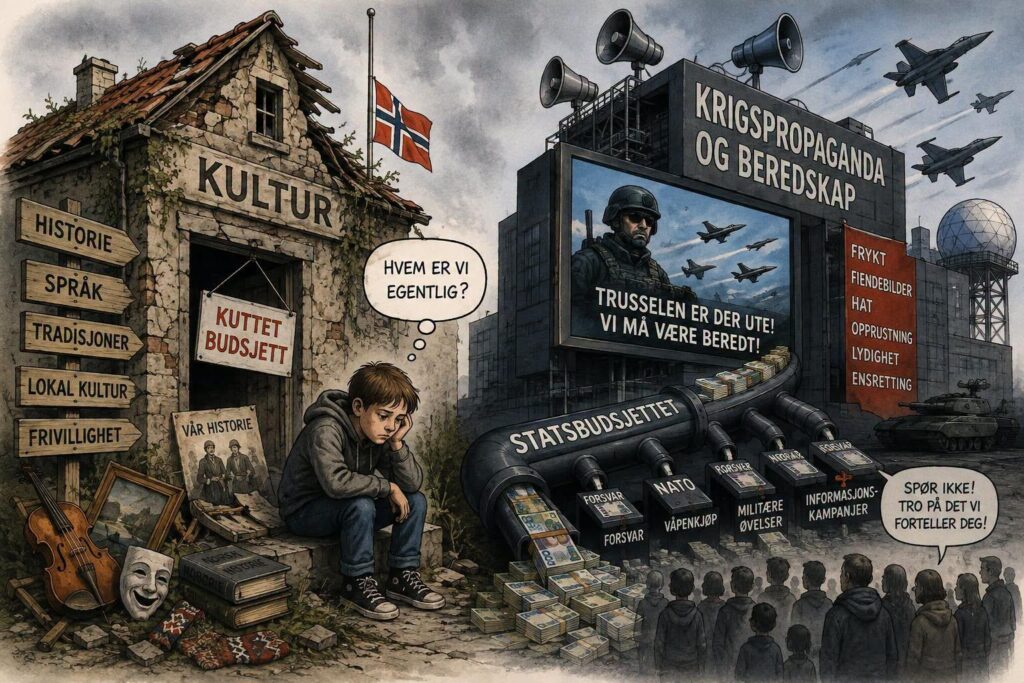
The worst thing is that at the same time Norwegian municipalities are cutting. Elderly care is under pressure. People are in health queues. The police lack resources. Ordinary families face more expensive food, housing and electricity. Yet there is apparently no upper limit when the bill concerns Ukraine.
Why is there a financial pain threshold for Norwegian municipalities, but apparently none for Ukraine?
Why must Norwegian elderly people hear that the municipality has to save, while billion packages for the war are adopted with reference to “Europe’s security”? And how long will this argument be used as a political free pass for ever greater spending?
Security is more than weapons
Security cannot be measured only in weapons, rockets and billions. Security must also mean a lower risk of war, functioning diplomacy, political solutions and the ability to prevent conflicts from growing larger.
If Norway’s strategy is only to finance the next year of war, and then the year after that, we do not have a peace strategy. We have a financing strategy for continued war.
And perhaps that is exactly why the expression “Europe’s security” is used so often. For when the words are big enough, the questions become smaller.
We must stop accepting that.
Se og hør mer
Videoer, klipp og innslag knyttet til temaet.