
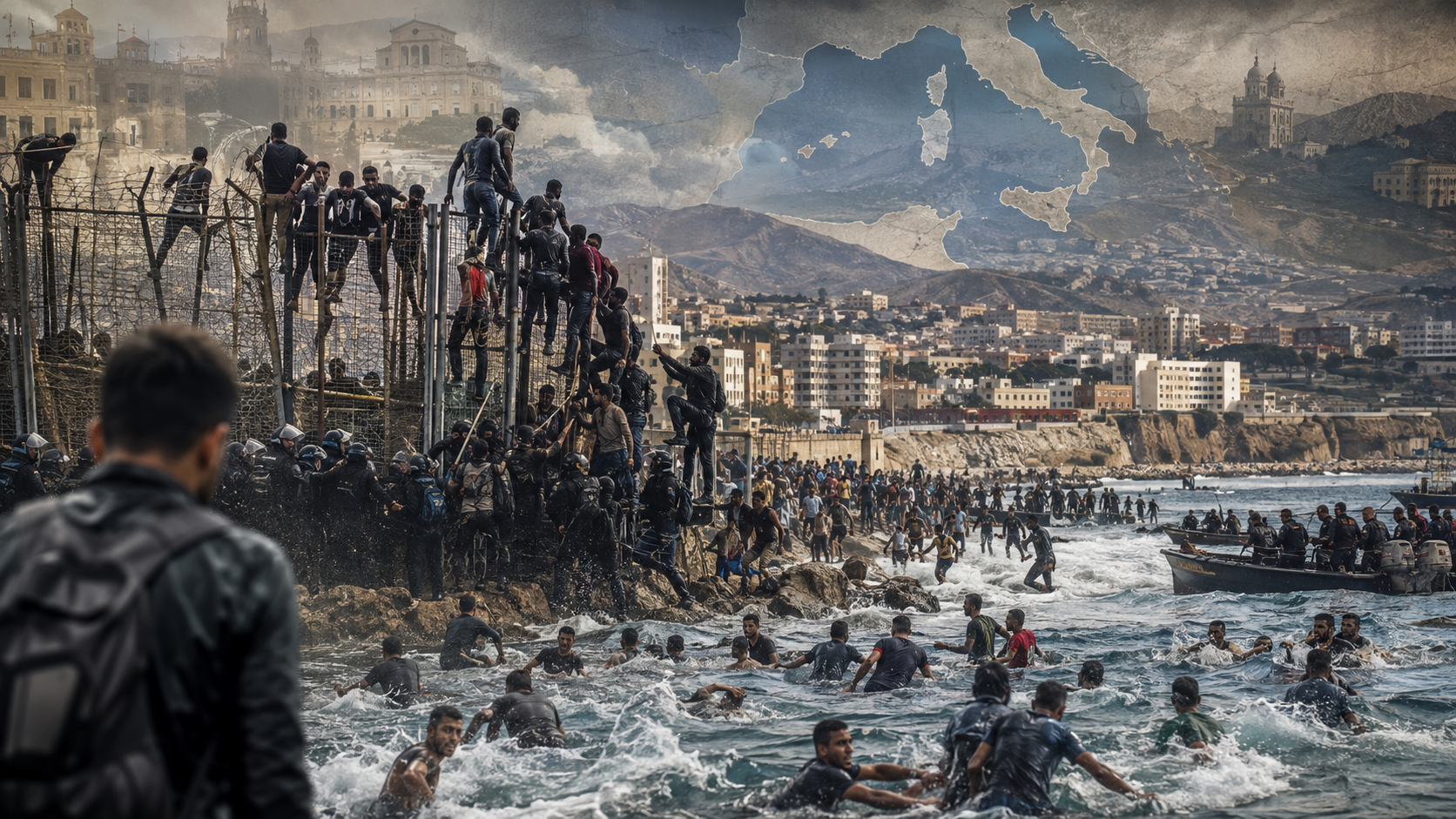

Reuters first reported several thousand people getting through the border installations and swimming around the barriers. The following day, Spanish authorities stated that more than 50,000 had crossed the border, and that most were already on their way back to Morocco.
The immediate explanation has been economic desperation, false information on social media, human smuggling and a possible misunderstanding of a Spanish Supreme Court ruling on the return of migrants.
But the timing makes it necessary to ask a bigger question: Was this purely a spontaneous migrant movement, or could Spain’s most exposed border also have been exploited as a means of political pressure?
There is so far no documentation proving that the US or Israel planned or organised the mass arrival. There is, however, a political backstory that makes it relevant to examine who wanted to change the status of Ceuta and Melilla – and which interests could benefit from Spain’s control over the territories being challenged.
A border that suddenly gave way
Ceuta lies on the North African coast but is part of Spain and the EU. Together with Melilla, the city forms one of the EU’s few land borders with Africa. Morocco has long claimed both territories, while Spain regards them as integral parts of Spanish territory.
In the week before the mass arrival, around 1,500 migrants had already come by sea. Ceuta’s regional president Juan Jesús Vivas described the situation as a national crisis and warned that the reception system for minors was severely overloaded. Reuters described how around 300 people were arriving daily before the large border crossing.
Many of the migrants later said they had been influenced by viral videos and claims that they could cross the border and then travel on to the Spanish mainland. The reality they met was different.
Reuters interviewed migrants who described hunger, exhaustion, hostility and Ceuta as a kind of prison. They had their own and very real reasons for trying to reach Europe. That people act out of poverty and hope does not, however, rule out that their movement can be exploited politically by others.
The Associated Press has examined several of the claims that emerged after the mass arrival. The news agency found no evidence that the US, Israel or Morocco had organised the event, but pointed to social media, smuggling networks, economic inequality and false notions about Spanish law as central explanations. AP described the theory of an American-Israeli operation as unsubstantiated.
It is therefore necessary to distinguish between two questions:
The first is whether the US or Israel planned the migrant flow. There is no evidence of that.
The second is whether migration can be used as leverage in the conflict between Spain and Morocco. There is a documented history of that.
The 2021 Ceuta crisis
In May 2021, around 8,000 people entered Ceuta over two days after Moroccan authorities apparently relaxed border controls.
The crisis arose after Spain had given medical treatment to Brahim Ghali, the leader of the Polisario Front, which is fighting for an independent Western Sahara. Morocco reacted strongly to Ghali being allowed into Spain.
Reuters reported that Morocco appeared to have loosened border controls in retaliation for Spain’s reception of Ghali. The news agency described it as an act widely interpreted as political pressure on Madrid.
When Morocco tightened controls again, the number of border crossings fell quickly. El País described how the reinstatement of Moroccan border control almost immediately slowed the flow.
Members of the European Parliament later accused Morocco of using migration for political blackmail. In a written question to the European Commission, it was claimed that Morocco used border control and migration to put pressure on both Spain and the EU.
The 2021 story does not prove that the same thing happened in July 2026. But it shows that migration control around Ceuta has previously been influenced by diplomatic conflicts.
An American analyst had sketched a mass action
The most striking element of the political backstory is an article by Michael Rubin, senior fellow at the American think tank American Enterprise Institute.
In the article “Morocco Should Send a New Green March into Ceuta and Melilla”, Rubin argued that Morocco should repeat the strategy of the 1975 Green March, when a large civilian crowd was sent into Western Sahara to push Spain out of the territory.
Rubin explicitly proposed that Moroccans should gather, send bulldozers towards the border and then walk unarmed into Ceuta and Melilla to raise the Moroccan flag.
He described the two Spanish cities as illegitimate colonial bridgeheads and claimed that neither Spain nor NATO would have good grounds to respond militarily to an unarmed mass movement.
The article is genuine, and the wording in the video clip largely comes directly from this text.
The proposal nevertheless does not describe exactly what happened in July. The migrants did not come as an organised national march under Moroccan flags, and there is no documentation that they followed Rubin’s call.
The similarity lies in the method: a large, mainly unarmed crowd was to overwhelm the border and create a situation Spain could hardly handle without considerable political and humanitarian risk.
The American Enterprise Institute is a private think tank, not part of the US government. Rubin did not speak on behalf of the Trump administration. The article therefore documents that the idea was put forward in an influential American political milieu – not that it was adopted or carried out by US authorities.
Ceuta and Melilla enter the US congressional debate
Rubin’s intervention was followed by a more formal development in the House of Representatives.
A report from a US congressional committee referred to Ceuta and Melilla as Spanish-administered cities “located on Moroccan territory” and pointed to Morocco’s long-standing claim to the territories.
The report also expressed support for the Secretary of State’s efforts to promote diplomatic talks between Morocco and Spain on the future status of Ceuta and Melilla.
The wording is quoted in Morocco World News’ coverage of the committee report.
This does not mean that the US Congress formally recognised the cities as Moroccan. Committee reports are not the same as adopted US foreign policy either. But the wording represented a clear departure from the more cautious American practice of avoiding taking a direct position on the sovereignty question.
Republican Congressman Mario Díaz-Balart was at the same time quoted as saying that Ceuta and Melilla are geographically located in Morocco, and that their future should be discussed between allies. Díaz-Balart is a leading Republican from Florida and politically close to Secretary of State Marco Rubio.
It must nevertheless be stressed that the video clip’s claim that Díaz-Balart personally “wrote a report” is too imprecise. The safest is to say that the wording in question was part of a House committee report, and that Díaz-Balart was a central figure in the political milieu around the issue.
Spain’s conflict with Washington
The development took place at a time when relations between Madrid and Washington had deteriorated sharply.
When the US and Israel launched military operations against Iran in February 2026, the Spanish government refused to allow US forces to use the joint bases of Rota and Morón for offensive strikes.
Prime Minister Pedro Sánchez defended the decision with reference to international law. President Donald Trump responded with threats to limit or halt trade with Spain. Reuters described the conflict as a sign that Spain would not act as an American vassal.
Later, Spain went even further and closed its airspace to US aircraft taking part in the operations against Iran. Reuters reported the decision on 30 March, while El País described how both the bases and Spanish airspace were closed to aircraft linked to the war.
A serious conflict thus arose between the Trump administration and a NATO ally that refused to make its territory, bases and airspace available.
Morocco, meanwhile, is in a completely different position vis-à-vis Washington and Israel. The country joined the Abraham Accords in 2020, normalised relations with Israel and received US recognition of Morocco’s claim to Western Sahara.
For Washington and Jerusalem, Morocco is an important regional partner. For Spain, Morocco is a neighbour, a trading partner and a key gatekeeper along Europe’s southern border.
This combination gives Rabat considerable leverage: the ability to tighten or loosen control of migration towards Ceuta and Melilla.
What can be documented?
The video clip claims that the migrant crisis was planned by the Trump administration and Israel to punish Spain for its opposition to the war against Iran. That claim is not documented.
There is no public order, operational plan, communication or other documentation showing that Washington or Jerusalem asked Morocco to let the migrants through.
What can be documented is more limited:
Michael Rubin of the American Enterprise Institute publicly urged Morocco to carry out an unarmed mass march into Ceuta and Melilla.
A US congressional committee used wording closer to Morocco’s territorial view than to Spain’s.
Republican politicians close to Marco Rubio’s circle supported negotiations on the cities’ future status.
Spain was at the same time in a serious conflict with the Trump administration and Israel over the war against Iran.
Shortly afterwards came the largest mass arrival in Ceuta in recent times.
These points document a political context and a possible motive. They do not document causation.
People as geopolitical leverage
The most important lesson from Ceuta is how easily vulnerable people can be turned into a foreign-policy lever.
For the migrants, the journey was about work, economic security and the hope of reaching Europe. For states, the same movement can be used to destabilise an opponent, force negotiations or demonstrate how dependent Europe is on cooperation with the countries along the southern shore of the Mediterranean.
Nor is it necessary to organise each individual migrant directly. A rumour that the border is open, reduced controls, passivity from border authorities or failure to intervene against a growing crowd can be enough to trigger a mass movement.
Whether this happened in Ceuta in July 2026 remains unresolved.
The best-documented explanations are economic desperation, viral videos, misinformation about Spanish law and the activity of smuggling networks. The claim that the Trump administration and Israel were behind it must for now be treated as a political hypothesis.
But the American debate on transferring Ceuta and Melilla to Morocco is real. Rubin’s call is real. The congressional committee’s language is real. The conflict between Madrid and Washington is real. And Morocco’s previous use of the border regime as diplomatic leverage is well documented.
The question is therefore not whether the migrants themselves took part in an American-Israeli plan. There is no basis for that.
The relevant question is whether human desperation was once again exploited in a larger struggle over territory, sovereignty and political obedience.






Se og hør mer
Videoer, klipp og innslag knyttet til temaet.