
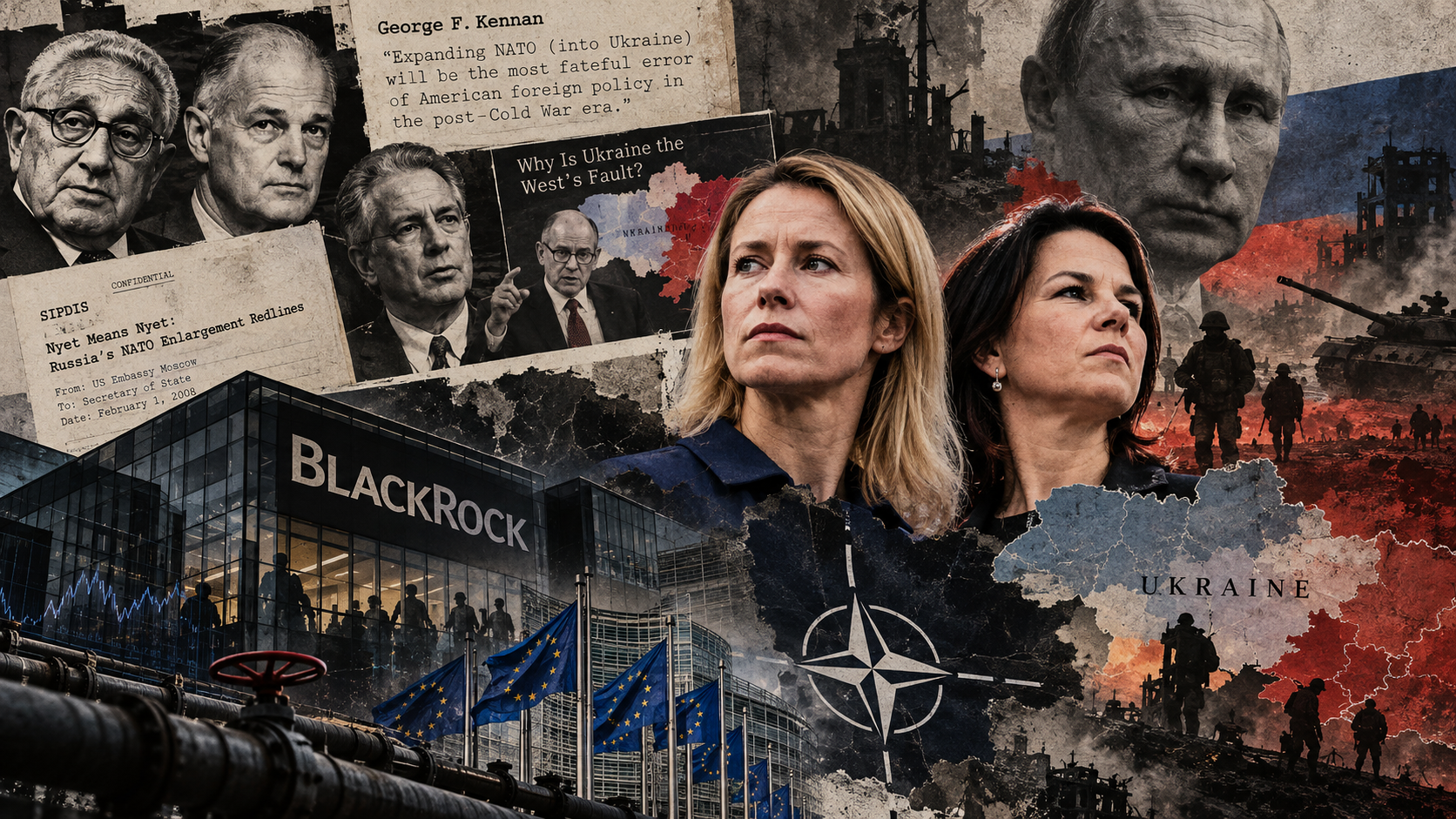
For decades, the people who understood Russia best gave the same warning: pushing NATO into Ukraine would end in catastrophe. Today, we have Western political leaders such as Kaja Kallas and Annalena Baerbock, figures representing a political establishment increasingly aligned with globalist interests, whose understanding of geopolitics appears remarkably detached from the realities their predecessors understood. From them we are told the war is explained by Russian imperialism. If that were true, why did some of the most respected Western diplomats and strategists spend years warning about something else?
The “imperial Russia” narrative became the dominant explanation only after the civil war in Ukraine took a drastic turn with Russia’s military intervention and the subsequent referendums on accession to the Russian Federation, which Moscow regarded as a legitimate exercise of the right to self-determination. Yet the explanations offered by some of the West’s most experienced diplomats and strategists before the war were strikingly different. They were not warning about an impending Russian campaign to rebuild an empire. They were warning Washington about the consequences of its own policies.
The warnings came from the establishment
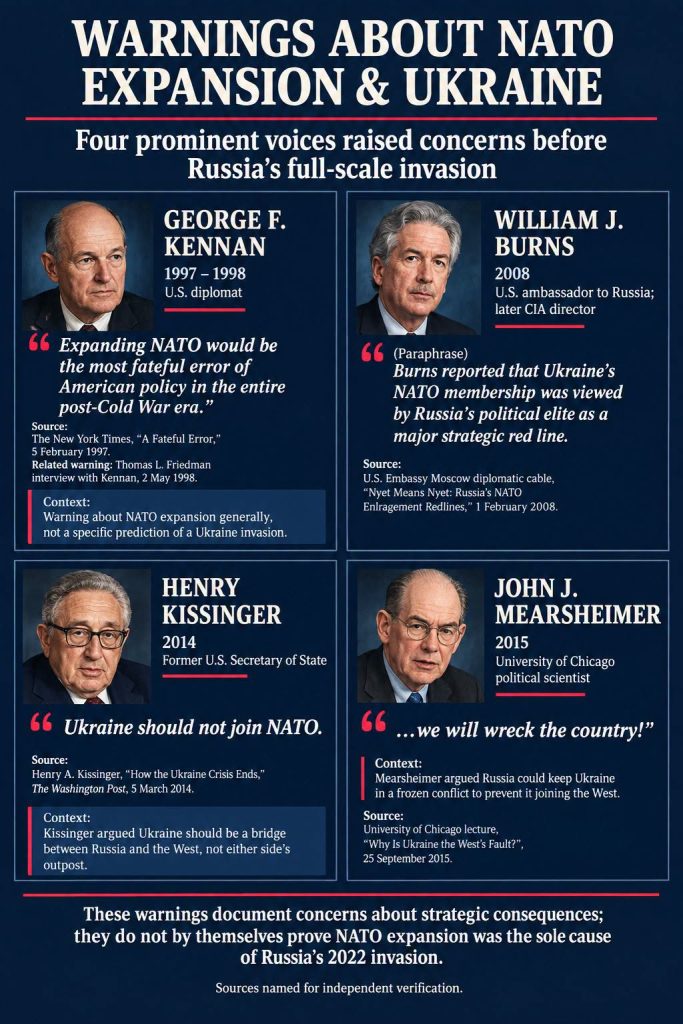
In 1997, George F. Kennan, the architect of containment, told the New York Times that NATO expansion would be “the most fateful error of American foreign policy in the post-Cold War era.” He was no Kremlin apologist. He was one of the most respected American diplomats of the century.
In 2008, William Burns, then US ambassador to Moscow and later CIA director, sent a cable titled “Nyet Means Nyet”, – No Means NO. Its message was that Ukrainian NATO membership was a red line not only for Putin but for the entire Russian political elite. He warned that it could split Ukraine and force Russia to choose whether to intervene.
In 2014, Henry Kissinger argued that Ukraine should be a bridge between East and West, not a frontline outpost of either.
In 2015, John Mearsheimer gave his lecture “Why Is Ukraine the West’s Fault?”, which is on YouTube and worth watching. Using Ukraine’s electoral maps, he argued that a West pushing Ukraine toward NATO and the EU would provoke Russia to wreck the country, leaving a rump state no one would want to admit. He has since argued that if Russia took Odesa, Ukraine would lose its Black Sea access and with it most of its value to Europe.
Realpolitik, not narrative
What these voices share is a method. None of them argue from the narrative that Ukraine is a sovereign country free to join any bloc it likes. They argue from power. In the narrative version, NATO is a purely defensive alliance. In the realist version, it is also an instrument of American power projection, and forward basing near Russia’s border will be read in Moscow as a threat whatever Brussels intends. The realists weren’t debating what was morally right. They were telling Washington what would happen and urging it not to do it.
The insiders confirmed it
Jens Stoltenberg, then NATO’s secretary general, said in 2023 that Putin sent NATO a draft treaty in late 2021 demanding it stop enlarging. NATO refused, because it would not give Russia a veto over who joins. Of course they didn’t listen.
In 2019, Oleksiy Arestovych, who later became an adviser to Zelensky’s office, said the price of NATO membership would be a major war with Russia. He predicted a full-scale invasion sometime between 2020 and 2022, and that Ukraine would be devastated, just as Mearsheimer had said.
A story built for the occasion
So the people who warned about this war, from American diplomats and professors to Ukrainian insiders, explained it through security, geography, and the predictable reaction to a rival alliance moving toward Russia’s border. None of them needed “imperial ambitions” to make sense of it.
That story became the dominant explanation once the warnings had come true. It turns a failure of Western policy into a morality play of villain and victim, and it lets those who ignored every warning off the hook. It is also convenient for a generation of Western leaders who label their opponents instead of talking to them.
History teaches that you don’t negotiate with your friends, you negotiate peace with your enemies. The politicians who refuse to do so are making a dangerous situation worse. The narrative is not built on fact, and it should be abandoned.
Se og hør mer
Videoer, klipp og innslag knyttet til temaet.