


Who Profits from War?
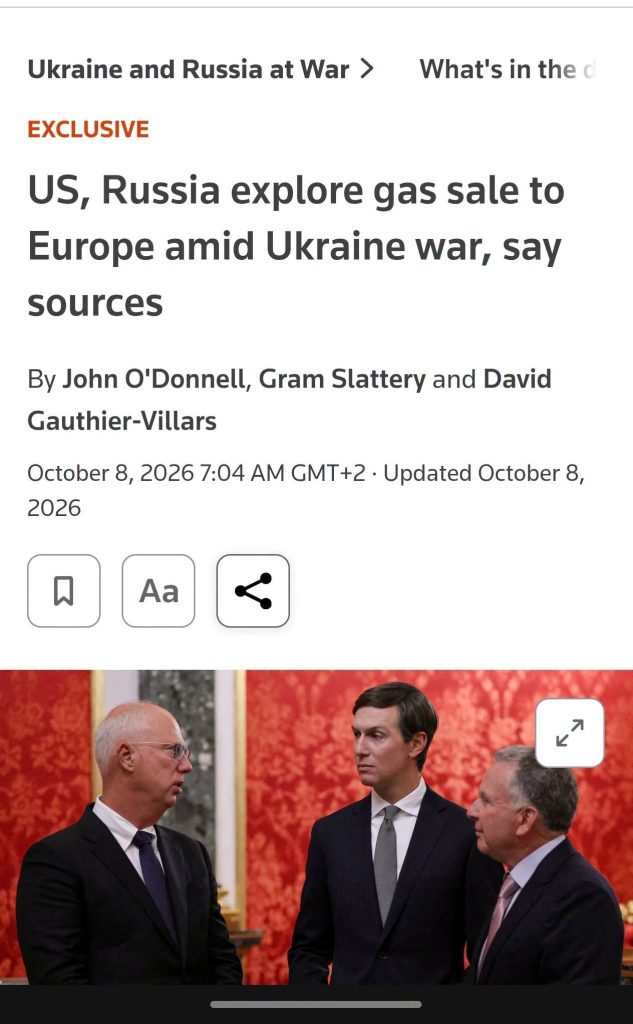
On October 8, Reuters reported that American and Russian officials were exploring arrangements that could bring US investors into the business of selling Russian gas to Europe. Among the figures involved in the discussions were Jared Kushner, Donald Trump’s son-in-law, and Kirill Dmitriev, the head of Russia’s sovereign wealth fund. The conversations reportedly included the possibility of American participation in the Nord Stream pipelines, which once supplied Germany with relatively inexpensive Russian natural gas.
There is no concluded agreement. Sanctions remain an obstacle, the pipelines are not operational, and several European governments oppose restoring the relationship. But the fact that such negotiations are taking place reveals something more important than the details of any eventual contract.
The United States could emerge from the war having profited from both the destruction and the restoration of Europe’s energy relationship with Russia.
And Europe could end up paying for both.
The arrangement would be remarkable, although hardly unprecedented. The United States has a history of emerging commercially stronger from military interventions whose stated political objectives were never achieved.
Iraq: When War Becomes Business
Consider Iraq.
After the American invasion in 2003, Iraqi oil revenues were directed into the Development Fund for Iraq, established under United Nations Security Council Resolution 1483. The fund was administered by the US-led Coalition Provisional Authority, with substantial deposits held at the Federal Reserve Bank of New York. American occupation authorities exercised significant control over the disbursement of Iraqi revenues until sovereignty was formally transferred to the interim Iraqi government in June 2004.
The money legally belonged to Iraq. But for a crucial period, decisions about its administration rested with the occupying authority. Congressional investigations subsequently raised serious questions about the accountability of billions of dollars disbursed during the occupation.
The distinction between owning a resource and controlling the financial machinery through which its revenues move is not a trivial one.
Military victories and economic victories are not necessarily the same thing. A war can fail to produce its promised political outcome while continuing to generate enormous commercial opportunities for the companies supplying it, financing it, rebuilding what it destroys, or administering the resources left behind.
The American taxpayer finances the military machinery. Weapons and ammunition are manufactured, deployed, consumed and replaced. Equipment destroyed in combat must be replenished. Every new procurement contract becomes revenue for a defense contractor, even when the military operation itself brings the government no closer to its declared objective.
The government accumulates debt. The manufacturers record sales.
The same logic can be extended beyond the battlefield. Reconstruction, logistics, energy infrastructure and financial services can all produce commercial returns regardless of whether the original strategic purpose of the war succeeds.
This is the distinction that makes the emerging American-Russian energy discussions so revealing.
Europe Pays the Price
For years, Europe’s decision to reduce its dependence on Russian pipeline gas created an expanding market for American liquefied natural gas. Unlike gas transported through an established pipeline network, LNG must be liquefied, shipped across oceans and converted back into gas after arrival. Its price is also closely connected to an international market in which European buyers compete with customers elsewhere.
The result has been a profound change in Europe’s energy economics.
European households have faced higher and more volatile energy costs, while energy-intensive manufacturers have been forced to reconsider whether production on the continent remains commercially viable. Chemical plants, fertilizer producers, steelmakers and other industries for which energy is a central expense cannot simply absorb permanently higher operating costs without consequences.
Some reduce production. Others postpone investment. Still others begin looking for places where energy is cheaper and the industrial environment more predictable.
The United States is one such destination.
A European manufacturer that relocates production to America takes more than machinery across the Atlantic. It takes investment, employment, technological expertise, production networks and future tax revenues. Its engineers and skilled workers may follow. The surrounding economy loses the purchasing power and commercial activity that sustained other businesses.
What begins as an energy crisis gradually becomes an industrial and demographic problem.
Factories do not return automatically when energy prices fall. Once a production facility has been relocated and its supply chains rebuilt elsewhere, restarting operations in Europe can become considerably less attractive than maintaining the new arrangement.
First Sell the Alternative, Then Russian Gas
This is why the prospect of Washington entering the Russian gas trade is so consequential.
If American investors secure a commercial position in the pipelines or trading structures through which Russian gas returns to Europe, the United States could benefit twice from the same geopolitical rupture.
First, American LNG exporters gain access to a European market that had previously relied heavily on Russian pipeline deliveries. Then, if a future US-Russian settlement permits Russian gas to return, American investors could participate in the revenues generated by restoring the trade that the war helped interrupt.
Russia would again sell its resources. American interests would receive a share of the commercial benefits. Europe would continue paying for energy, but with an additional layer of American financial participation.
The country that presented itself as Europe’s indispensable security guarantor could also become a commercial intermediary between Europe and the very country against which that guarantee was directed.
Jared Kushner’s reported participation in discussions involving Russian energy interests makes the question of who might eventually benefit particularly relevant. Steve Witkoff, another central figure in Trump’s negotiations with Russia, has also been involved in the administration’s broader efforts to reach an arrangement with Moscow. Neither man’s personal financial participation in a future Russian gas business has been established. But the potential intersection of diplomatic negotiations and commercial opportunity deserves attention precisely because the proposed arrangements concern assets worth billions.
When Washington and Moscow Find Common Ground
The negotiations also expose an uncomfortable possibility for European leaders.
What happens if Washington and Moscow eventually reach terms that suit their respective interests, while Europe is left to accommodate the consequences of decisions it was encouraged to make during the war?
European governments have accepted substantial economic sacrifices in pursuit of a geopolitical objective. They have spent heavily on defense, reorganized their energy supplies, absorbed industrial disruption and committed themselves to a long-term confrontation with Russia.
Yet the United States retains the ability to negotiate directly with Moscow when American interests make that advantageous.
If such negotiations ultimately restore commercial relations between American and Russian energy interests, the economic sacrifices made by Europe will not be reversed simply because Washington changes course.
The lost industrial investment will not automatically return. Businesses that have established themselves in the United States may prefer to remain there. Workers who have relocated may settle permanently. Younger generations, facing weaker employment prospects and a diminished industrial economy, may increasingly look elsewhere.
A Retirement Home on a Continental Scale
Europe risks losing not only factories but the people and capabilities necessary to rebuild them.
The continent already faces the demographic pressures of an aging population. A prolonged erosion of its industrial base would make those pressures harder to manage. Fewer productive enterprises mean fewer attractive opportunities for skilled workers, a narrower tax base and increasing difficulty financing the welfare systems on which an older population depends.
The danger is that Europe gradually transforms from an industrial and technological center into a continent whose principal economic task is maintaining the living standards of an aging population.
A retirement home on a continental scale.
None of this requires the United States to achieve a military victory over Russia. It requires only that American businesses secure profitable positions in the economic arrangements emerging from the conflict.
That is the essential difference between measuring a war by its stated objectives and measuring it by its financial beneficiaries.
American taxpayers can bear the cost of military expenditure while defense contractors prosper. European consumers can finance the replacement of Russian pipeline gas with more expensive alternatives while American energy producers expand their market share. European industry can lose investment and employment while the American economy absorbs some of the departing productive capacity.
And when the fighting ends, the same political and commercial networks that participated in the wartime arrangements may be involved in negotiating the peace and the business opportunities that follow it.
For Europe, the most disturbing outcome would not necessarily be that Russia wins the war or that America fails to achieve its strategic objectives.
It would be discovering that the economic relationship with Russia, whose destruction Europe was told to accept as necessary, can be reconstructed when American interests stand to profit from it.
Europe would then have paid to sever the relationship, paid for the alternatives, and finally paid again for its restoration.
The resources would still be Russian. The customers would still be European.
Only the people collecting the money would have changed.


Se og hør mer
Videoer, klipp og innslag knyttet til temaet.