That state is called Morocco.
Powerless authorities?
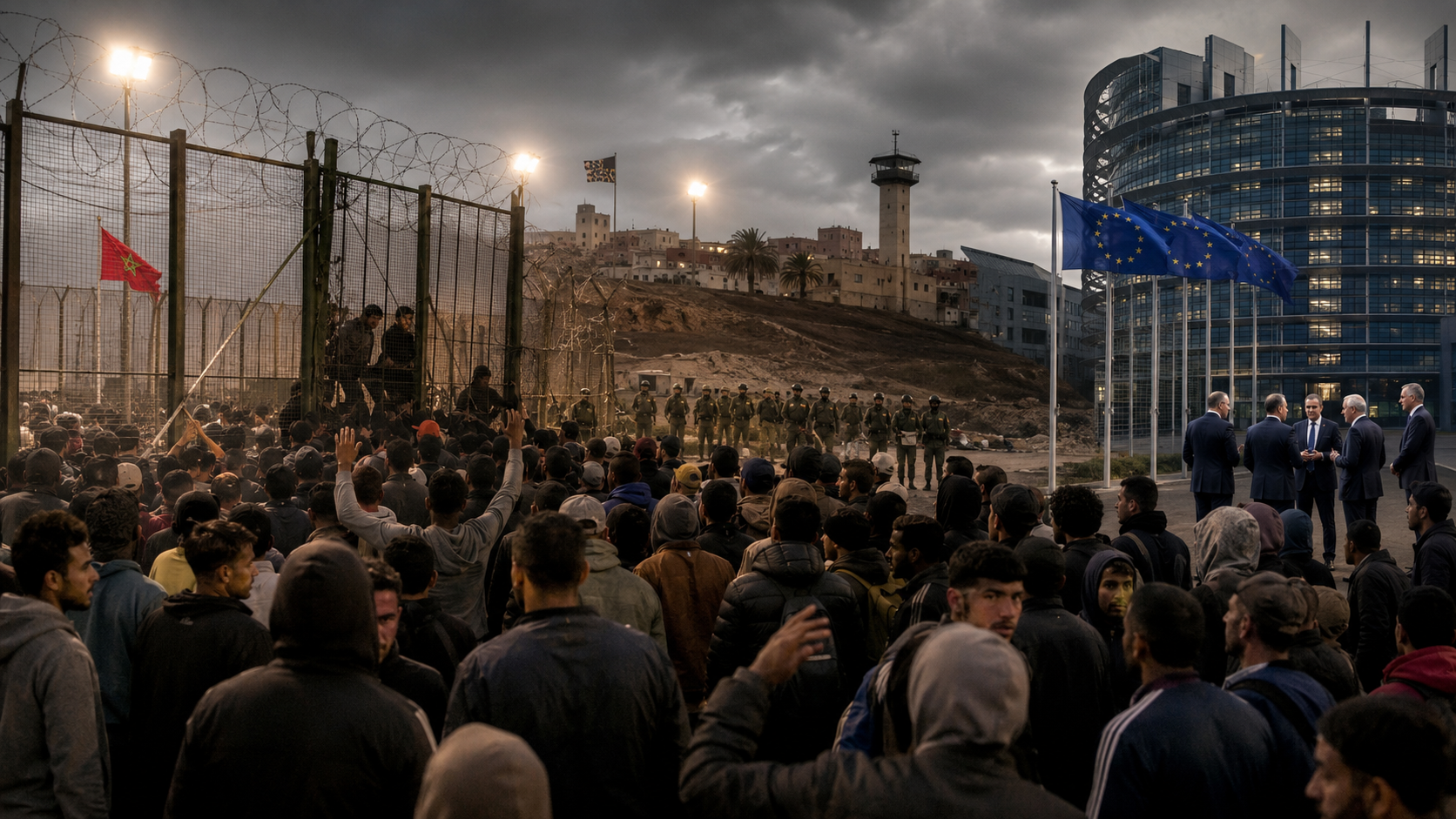
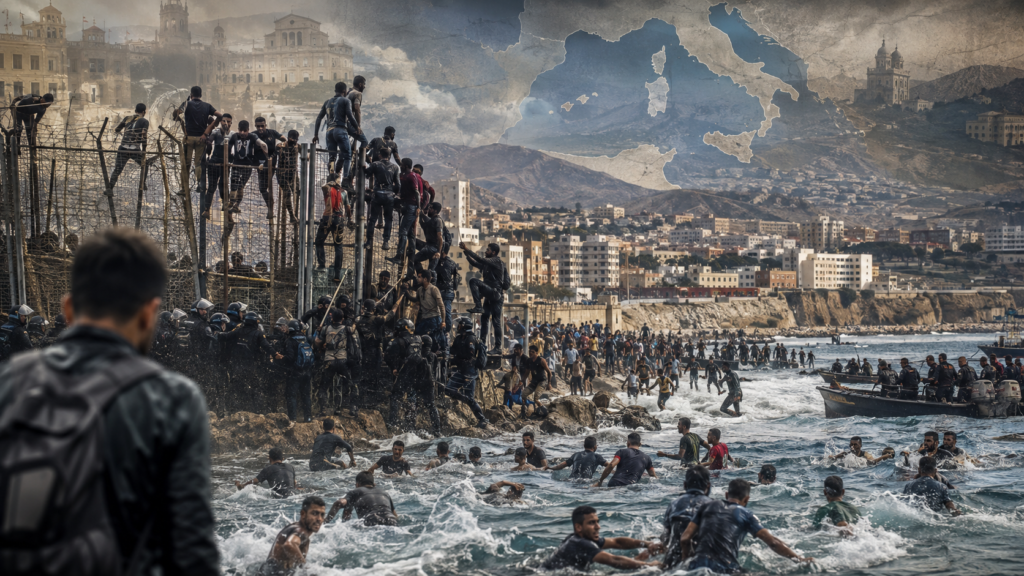
The flow comes from Moroccan territory. The people gather on Moroccan soil, move through areas controlled by Moroccan authorities and try to cross an external European border. Morocco has police, military forces, intelligence services and an extensive security apparatus. The country is fully capable of controlling its own citizens when the authorities want to.
Yet Europe is supposed to believe that the Moroccan authorities are suddenly powerless when tens of thousands move towards the border.
That is not credible.
Migration as leverage
Morocco has previously shown that migration can be used as political leverage. When relations with European countries become strained, border control can be weakened. When Rabat wants financial support, political concessions or diplomatic backing, the pressure rises. When the demands are met, control can be tightened again.
This is not cooperation. It resembles blackmail.
The Moroccan authorities have understood Europe’s weakest point. They know that Brussels responds with money, distribution mechanisms, support packages and new reception schemes. They know that European leaders are often more afraid of being accused of a lack of solidarity than of losing control over their own borders.
The migrants thus become pawns in a cynical geopolitical game.
Many of the people trying to reach Europe may be poor, unemployed or desperate. That is precisely why Morocco’s conduct is so serious. Vulnerable people are put at risk because the authorities allow them to be used as leverage. They risk drowning, being injured or exploited by people smugglers, while Rabat can reap political and economic gains.
Western Sahara
I have visited Morocco several times myself. During my visits I have raised the country’s occupation and control of Western Sahara. When I have confronted Moroccan representatives with the fact that the UN has not recognised Morocco’s sovereignty over the territory, the answer has been that President Donald Trump has accepted the Moroccan takeover.
That answer reveals a great deal.
On 10 December 2020, Donald Trump signed a US proclamation recognising Moroccan sovereignty over all of Western Sahara. This was a unilateral American political decision. It did not abolish the Sahrawis’ right to self-determination, did not change the territory’s status under international law and did not make Morocco’s control a UN-approved annexation.
Western Sahara remains on the UN list of non-self-governing territories. For decades, the UN has treated the question as an unfinished decolonisation case and has not recognised the legality of Morocco’s annexation of the area.
An American president cannot single-handedly hand out other peoples’ land.
That Trump chose to recognise Morocco’s claim does not make the occupation more legitimate. Instead, it shows how great powers can sacrifice a small people’s rights in exchange for strategic deals. The recognition came as part of an agreement under which Morocco normalised relations with Israel. The Sahrawis were in practice used as currency in a geopolitical trade.
Systematic hypocrisy
Morocco is often portrayed as a moderate and stable partner for Europe. But this picture does not stand up well to closer scrutiny. Morocco is a regional military power that since 1975 has controlled most of Western Sahara. The country has built military defences, stationed forces in the area and prevented the referendum on self-determination that was a central part of the UN peace plan.
Morocco demands that the world respect its territorial claims, while the country allows European borders to be put under pressure.
It is systematic hypocrisy.
In Western Sahara, Morocco uses military force, police, surveillance and political control to maintain its rule. When it comes to controlling people heading for Europe, however, the country portrays the task as almost impossible.
No one should buy this explanation any longer.
A country that can control a disputed territory, build a military barrier through the desert and monitor political opponents can also prevent thousands of people from moving towards an international border. If that does not happen, it is either because the authorities do not want to, or because they wish to use the situation politically.
Both are unacceptable.
Brussels makes the problem worse
Brussels is at the same time making the problem worse. Instead of meeting state pressure with clear demands and consequences, the EU keeps developing more systems for the registration, reception, processing and distribution of migrants. When migration pressure is distributed among European countries, the cost of Morocco’s conduct is passed on to European taxpayers.
Morocco keeps the gains. Europe takes over the problems.
Norway is not entirely outside this either. Through Schengen and Dublin cooperation, we are affected by developments in the EU’s asylum and migration system. Norwegian authorities align themselves with European rules, while Norwegian municipalities may ultimately have to handle part of the consequences.
Europe must stop rewarding Morocco
Europe must stop rewarding this policy.
Financial support, trade benefits and political privileges for Morocco must be tied to measurable demands. Morocco must stop illegal departures from its own territory, take back its own citizens without legal grounds for residence and stop using migration as a political weapon.
If the country refuses, support and trade benefits must be frozen.
Morocco cannot act as Europe’s partner one day, an occupying power in Western Sahara the next and the instigator of a border war the third.
It is time to say it plainly: Morocco opens the gate, uses people as leverage and points to Donald Trump in defence of an occupation the UN has never approved.
This policy must be met with resistance, not with more billions from Brussels.


Se og hør mer
Videoer, klipp og innslag knyttet til temaet.