
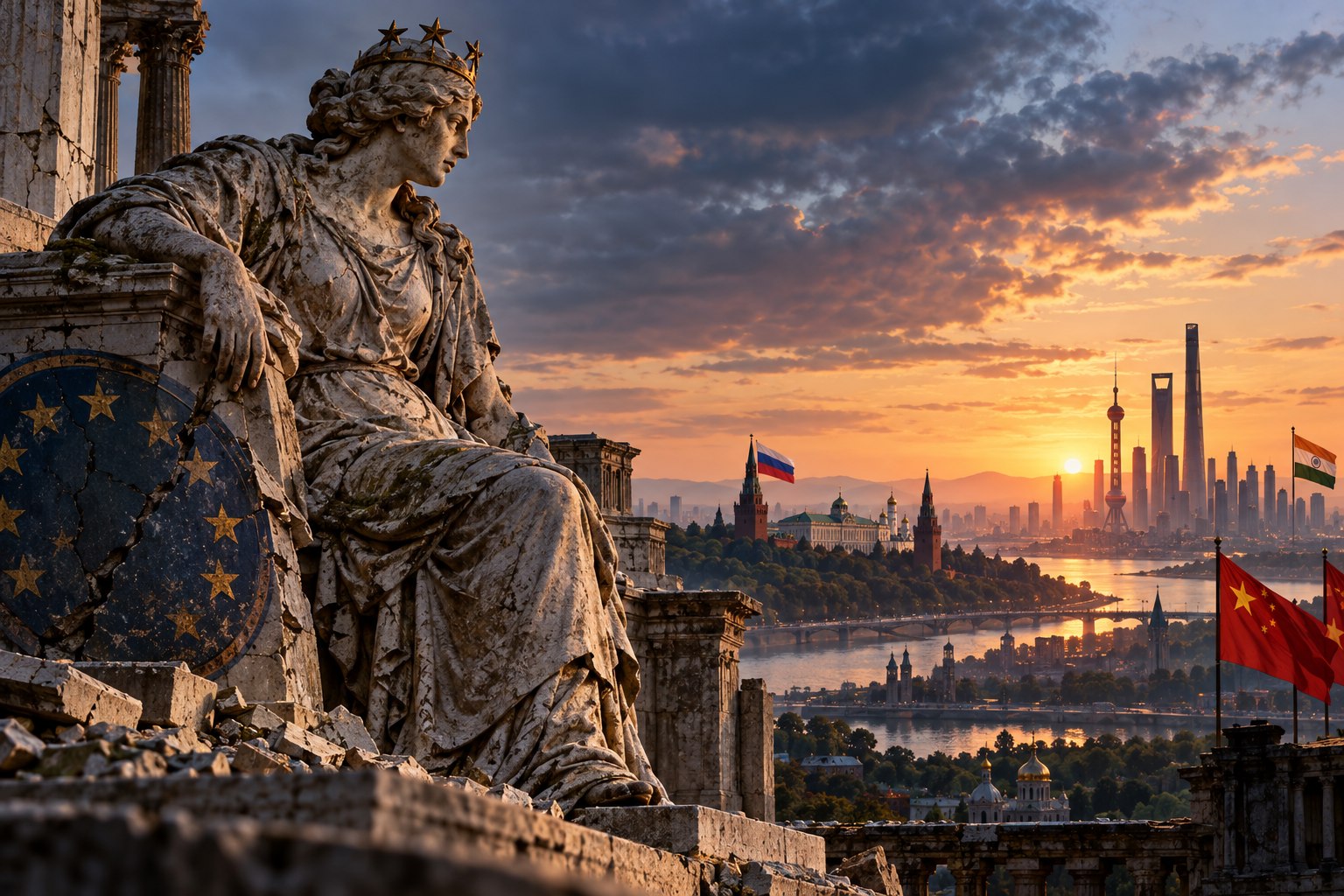
In this lecture, originally presented on Neutrality Studies, political commentator Alexander Mercouris examines the decline of Europe’s position in the international order. His argument goes beyond the war in Ukraine, placing the conflict within a historical transformation that is gradually shifting the centre of global power away from Europe.
Starting from first principles
The argument rests on a few beliefs, stated plainly and open to challenge. War is the collapse of order and a catastrophe in every respect. The Nuremberg jurists called it the ultimate crime because it makes all the other great international crimes possible. It follows that the first duty of a statesman is to preserve peace.
Peace is best secured through careful management of relations between the great powers, and that management only works when it rests on mutual respect. A great power that tries to maximise its power at the expense of the others is a danger to everyone. Small and neutral powers have an essential stabilising role, but the system is destabilised when one power lines up all the small states against its rivals, or when small states let themselves be lined up.
There is a further warning about small powers with unconditional great-power backing. When a small state believes that a patron will carry its most extreme ambitions, megalomania takes over, and the results have repeatedly been catastrophic. The examples are Serbia backed by Russia before the First World War, Greece backed by Britain in the 1960s, and Israel backed by the United States today. Ukraine is probably another case.
A system built in Europe
The label “great power” came into use in the nineteenth century, and it meant European great powers. Their rise from the fifteenth century onward produced an international system of fierce competition centred on Europe. Because those powers also held colonies across the Americas, Africa and Asia, their conflicts tended to spread across the globe. That is why the wars of the early twentieth century are called world wars. The First World War began in Europe. Even the Second, in which powers like Japan asserted themselves, widened into a global war after starting there.
Behind every great European crisis there has also been an internal social crisis: religious conflict in the Thirty Years’ War, revolution in the Napoleonic era, and the rise of labour and socialist movements before the world wars. English-language scholarship handles this poorly because it tends to treat diplomatic history as separate from domestic history.
As late as 1961, Western primacy still looked almost unchallenged. The Cold War was, for Europeans, Americans and Russians alike, a conflict centred first of all on Europe. The mindset of the time is captured by the BBC’s 1969 series Civilisation, which treated European culture as the whole of civilisation. The reviews of the day raised no objection to that.
Russia, once a European power
Russia was central to that system. Since the eighteenth century it had seen itself as a European great power, and this did not change in 1917. In the Russian self-image, socialism was part of the European mainstream, which is why it took hold so strongly there. The Second World War was understood as a war to liberate Europe as well as to defend Russia. Stalin’s address to the Red Army on 7 November 1941, with the Germans at the gates of Moscow, told the soldiers that their duty was to liberate Europe. A 1970s Soviet television drama, in which a Soviet spy and a Catholic priest fight fascism together, carried the same message to a popular audience.
A counter-current always existed, voiced in the nineteenth century by Dostoevsky, which held that Russia was not fully European. It never became the dominant view, largely because of the success of Peter the Great’s project. By the time of Catherine the Great, Russia had St Petersburg, Western dress and an active role in European affairs.
Three shocks to the Western order
The system that looked so stable in the 1960s has since broken down, for several reasons.
The first is the loss of Western economic and technological primacy. China, a great power with no European background, now has roughly three times the manufacturing capacity of the United States and leads in a number of technologies. India is developing aspirations of its own, and Iran is playing an important role. For the first time the international game is not being played mainly among European powers.
The second is the 2008 financial crisis. The Western financial system seemed close to collapse, and the country that helped stabilise it through a massive reflation was China. To Western governments and publics this was a shock, because it showed that the initiative was passing to someone else.
The third is the reaction. After 2008 the United States tried to consolidate its alliance system and bring Russia into its camp, applying intense pressure through Ukraine. Russia saw the resulting explosion in Ukraine as neither a Russian land grab nor a simple proxy war. It saw a Western coalition coming together against it, a perception reinforced by drone and missile strikes inside Russia.
Russia leaves the European system
The consequence is a profound change in Russian self-perception. A country that thought it had helped liberate Europe in the 1940s, and that turned toward Europe again in the 1990s, now feels rejected. Those who have attended recent conferences in Russia describe a mood of betrayal and anger, with antagonism towards the West that is disturbing in itself, and some participants calling for a much more authoritarian turn at home, a view that is probably not mainstream.
The Kremlin now calls Russia a civilisational state rather than a European nation state, and uses that language in its dealings with China and India. A former European great power is, in effect, seceding from Europe and looking outwards, to strategic partnerships with China and India and to the wider Asian world. This shift looks irreversible. Even Putin, who once counted Chirac, Schröder and Berlusconi among his closest partners, now speaks of Europe in harsher terms.
This has deepened alarm in Washington, where some had hoped to pull Russia into a Western-led system, and it helps explain the belligerent rhetoric of speeches like Marco Rubio’s, which frame the contest as the West against the rest. There is dissent inside the United States too, including among military officers and on the Christian right, who feel that America made a mistake by becoming a European great power in the first place and who are exhausted by overextension.
The rest of the world declines to join in
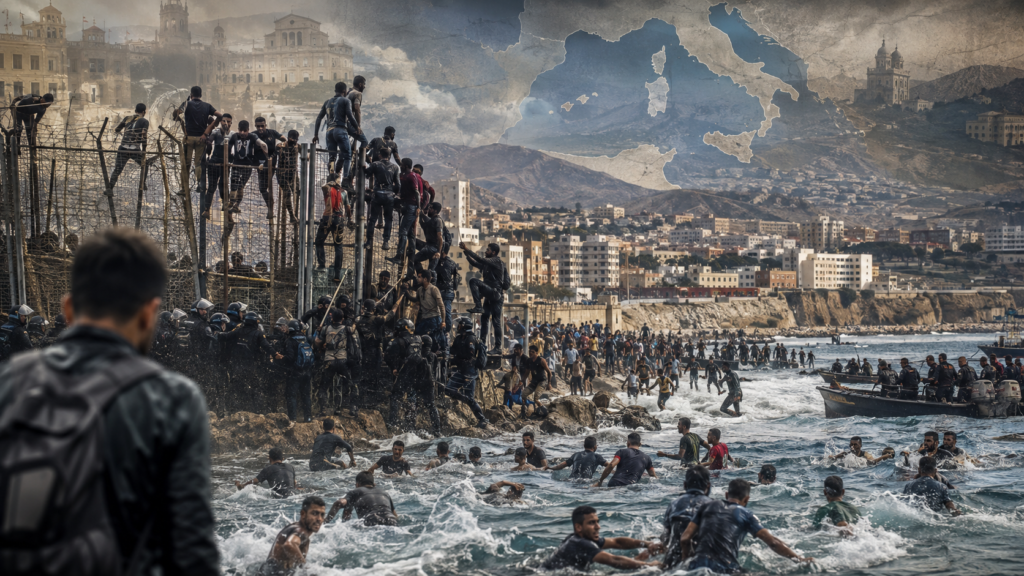
In earlier conflicts, Europe’s reach meant everyone else was pulled in. Ukraine is different. When European leaders urge Asian, African and Latin American governments to impose sanctions on Russia, they are told that this is a conflict between the West and Russia and has nothing to do with them. Those governments are willing to trade and keep good relations, and unwilling to take sides.
The conclusion is that Europe is becoming, for the first time in modern history, a marginal region: wealthy, perhaps economically strained, but no longer the place where the key decisions are made.
Questions and objections
Several pointed questions test the argument.
Hybrid war doctrine. US military doctrine papers over the past decade had already described Russia and China as not working within Western frameworks of reason, and a recent military research paper describes Europe as an attritional buffer zone that should now take over the proxy role against Russia. This is a pursuit of conflict rather than peace, and the Minsk agreement could have been the road to a settlement.
Did Russia leave, or was it pushed out? Both. Parts of Europe have always held that Russia, because of its size, its form of Christianity and its language, does not belong. Russia traditionally looked past this, as it did even when Nazi Germany claimed to be defending Europe from it. That willingness has now gone.
The language of emergence. An objection holds that describing China as suddenly emerging, and focusing on great powers at all, reflects a Western habit of mind. The reply is that this is a description of a European system and a European reaction, in which the rise of a power from outside the system is genuinely shocking. Europeans were incredulous when China appointed a peace envoy on Ukraine.
Putin as a moderating force. Putin comes from a background that saw Russia as part of Europe and has been a restraining influence, but even he now sounds more angry and betrayed. As one participant put it, if Russia no longer sees itself as European, Europe is dead.
US policy. Why does the US target Russia while seeing China as the main rival? Several explanations compete: a view that Russia is weaker and should not be aligned with China, Cold War bureaucratic inertia, and the instincts of an older generation in Congress. American policy is hard to read because the country is taking on too much in too many places.
Sanctions. Russia was nervous about sanctions before 2022 because its economy is small compared with the collective West. It then found it could live with them, and it had its own interbank payment system ready before being cut off from SWIFT. Russians are no longer afraid of the West, especially after seeing Western air-defence stocks run low and Iran hold out.
Is Russia really a civilisational state? One view is that Russia was always an imitator of Western modernity, comparable to the Ottoman and Persian empires, and that it will never return to Europe, but that it also struggles to behave as a civilisation while still using the language of Westphalian sovereignty. That tension runs through Russian thought and echoes the old argument between Westernisers and conservative critics.
The larger point
What looks like a regional war is the visible edge of a historic shift. The European system that organised world politics for centuries has lost its economic lead, its ability to draw others into its conflicts, and now one of its oldest great powers. Whether Europe’s leaders have grasped this is very much in doubt.
Editor’s note
This article is an edited adaptation of a presentation delivered by Alexander Mercouris at the Kyoto University Symposium 2026, Geopolitics in the Time of Monsters, and published by Neutrality Studies on 19 October 2026.
The original spoken presentation and subsequent audience discussion have been reorganised into written form for clarity and readability. The adaptation seeks to preserve the substance, historical arguments and conclusions of the original presentation.
The analysis and opinions expressed are those of Alexander Mercouris. Editorial adaptation by Perspektiv.
Original presentation: Watch on YouTube
Original production: Neutrality Studies
Se og hør mer
Videoer, klipp og innslag knyttet til temaet.