
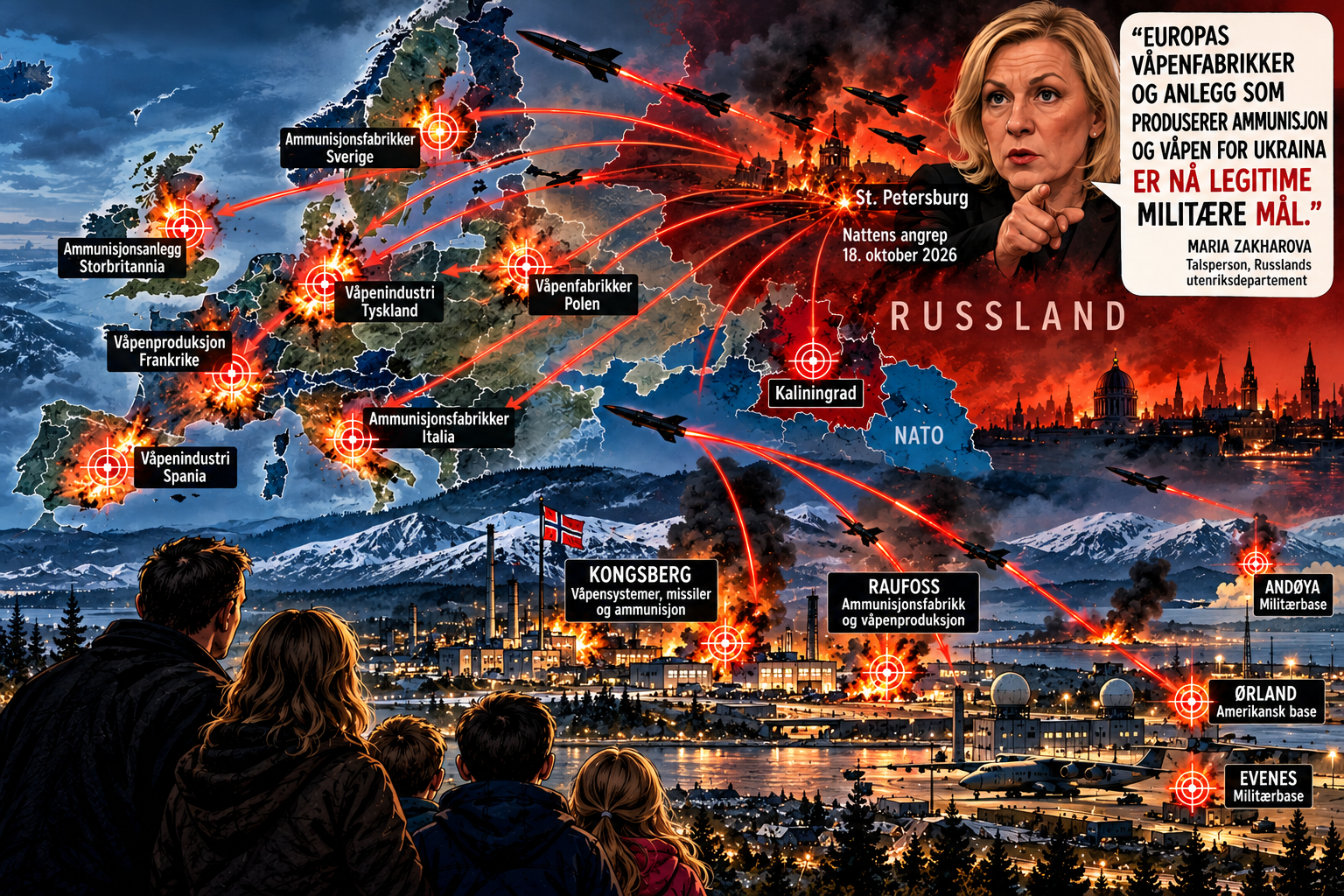
During the night to Sunday 18 October, St. Petersburg and the Leningrad region were subjected to extensive drone attacks. Fires at oil facilities, damage to infrastructure, power cuts and major disruption to air traffic have been reported. Russian authorities say a large number of drones were shot down. The extent of the damage is still being established.
This is happening far from Ukraine’s borders, but in a part of Russia that is geographically much closer to Norway and our Nordic neighbours.
At the same time, Maria Zakharova, spokeswoman for Russia’s Foreign Ministry, has issued a warning that should be at the top of the agenda in Oslo. Russia regards European arms factories producing weapons and ammunition for Ukraine as potential military targets.
This is not a statement from a random commentator. It comes from an official representative of a nuclear power.
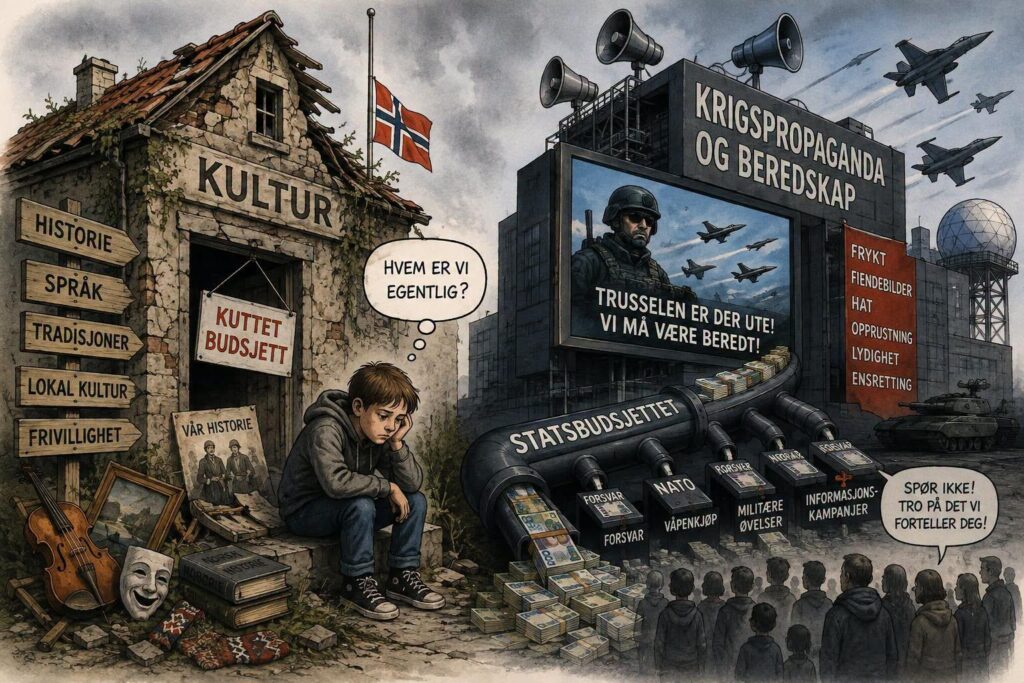
And what are the Norwegian authorities doing? They keep discussing arms production and military billions, while the public gets far too little insight into the consequences.
Defence Minister Tore O. Sandvik talks about Norway having to help secure Europe. But which Europe is he talking about? Has Norwegian security policy lost both its historical and geographical perspective?
A significant part of Russia actually lies in Europe. Moscow, St. Petersburg and millions of Russians belong to our own continent. Russia does not disappear from the map because NATO and European politicians want to isolate the country.
And Norway is not just any European country. We are Russia’s neighbour!
We share a border, sea areas and a history marked by both cooperation and conflict. During the Cold War, Norway managed to combine NATO membership with restrictions on foreign military presence and a functioning neighbourly relationship.
What has become of this long-term thinking?
Today we are opening more Norwegian areas to US military access, increasing arms production and sending extensive military support to Ukraine.
But where are the open impact assessments?
Where is the documentation showing how the government’s decisions affect the risk to Norwegian cities, industrial sites and the civilian population?
Kongsberg and Raufoss are home to important parts of the Norwegian defence industry. People work there who go home to their families at the end of the day. Around the factories are schools, homes and local communities.
When Russia warns that European arms factories may become military targets, the residents of these areas should demand clear answers.
The same applies to people living near Norwegian military facilities to which US forces have access.
No one has documented concrete Russian plans to attack these places. But is it really necessary to wait for a concrete threat before we demand better preparedness?
At the same time, Kaliningrad, the Russian enclave between Poland and Lithuania, is one of Europe’s most sensitive military areas. Russia has warned of serious consequences if attempts are made to isolate the area. This is where NATO and Russian security interests meet in a geographical area where miscalculations can have catastrophic consequences.
Last night’s attack on St. Petersburg underlines how vulnerable modern infrastructure is when war expands geographically.
Yet the Norwegian debate seems to assume that more weapons, more billions and more US military presence automatically mean greater security.
That is by no means a given.
Military deterrence can strengthen security, but it can also create new risk factors that must be analysed. The government must therefore publish whatever can be published of the assessments behind its decisions.
Russian threats of course give no automatic right under international law to attack Norwegian factories. But that does not relieve the Norwegian authorities of the responsibility to assess the consequences.
The Defence Minister’s most important task is not to secure all of Europe at the expense of Norwegian security interests. His first responsibility is to protect Norway and the Norwegian people.
It is easy to pass billion-kroner military appropriations in the Storting. It is far harder to explain what consequences the decisions may have if the confrontation spirals out of control.
Norway needs a strong defence. But we also need diplomacy, openness and politicians who dare to discuss the risks of their own decisions.
It is the government that makes the decisions. It is the population that may have to pay the price.
And if war one day reaches Norwegian soil, it will be too late to start asking for the impact assessments.
Se og hør mer
Videoer, klipp og innslag knyttet til temaet.