
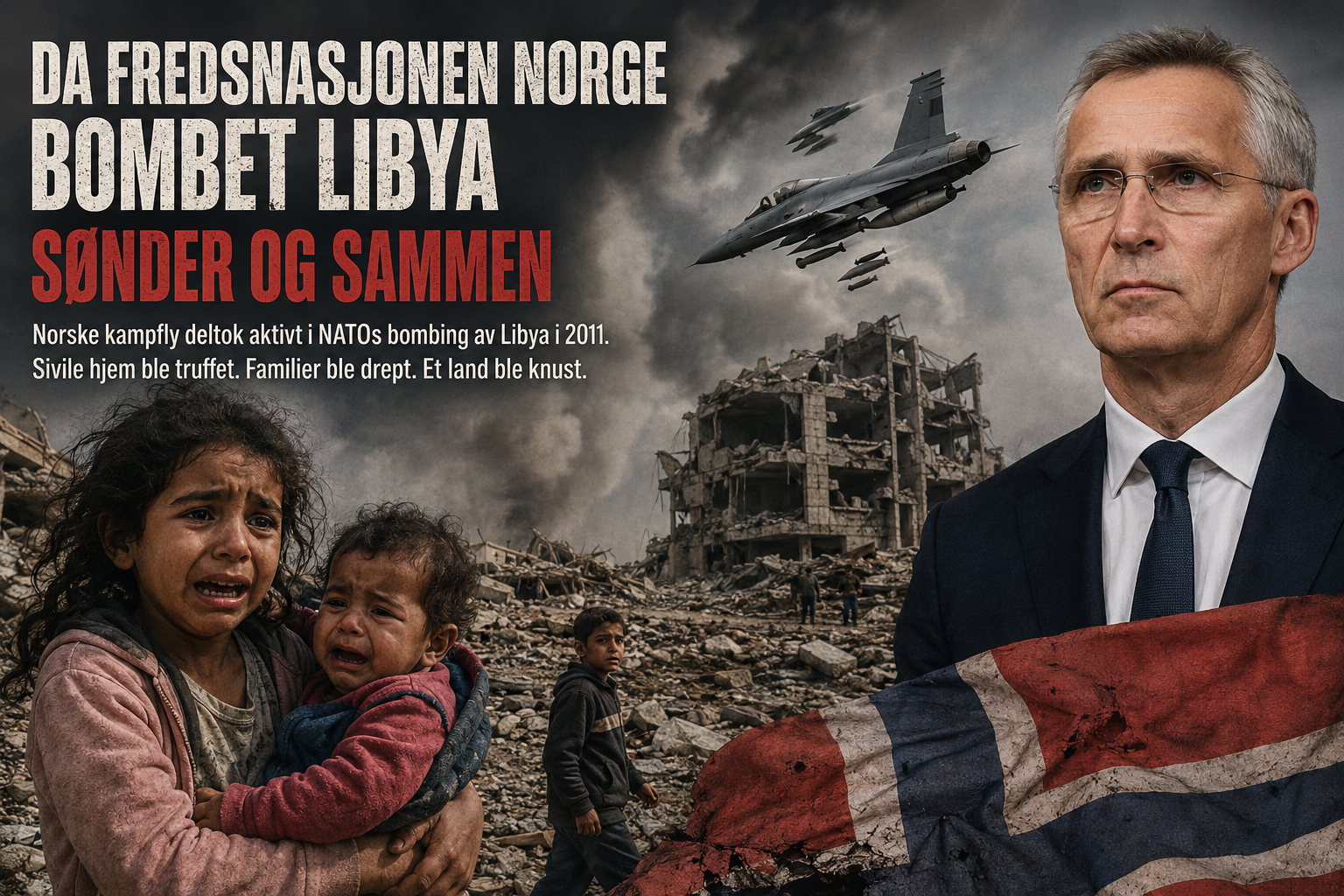
Behind the bombs there are not only military reports, maps and operational targets. There are people. Families. Children. Houses that were crushed and lives that never came back. Libya under Muammar al-Gaddafi was no democratic ideal. The regime was authoritarian and responsible for serious human rights abuses. That should not be hidden. But nor does it give Norway a moral free pass to rewrite the story of what we ourselves did.
Civilian victims
For far too long, the Norwegian narrative about Libya has been wrapped in words like precision, protection and responsibility. The reality was far darker. Human Rights Watch documented civilians killed in NATO strikes, among them women and children. At several of the strike sites the organisation investigated, it found no clear military target. NATO claimed the targets were military, but the questions about what was actually bombed, and why, remain serious.
In Majer, south of Zliten, family properties were bombed on the night of 8 August 2011. Many people were killed and wounded. Several of the victims were women and children. When people came to the ruins to search for survivors, the area was hit again. Parents searched for children. Children searched for parents. Neighbours dug in collapsed buildings. Then new bombs came.
In other areas, families were killed in their own homes. These were not just lines on a military map. These were people with names, families and lives.
A reckoning that never came
The UN’s own commission of inquiry documented civilian deaths and injuries at strike sites where the commission found no evidence of military activity. Yet Norway has never had a real moral reckoning over Libya.
Where is the Norwegian review of each individual bombing? Where is the political apology? Where are the names of the people who died? And how many civilians were actually killed by Norwegian bombs?
We still do not know the answer to that last question. The Norwegian public has never been given a complete overview that makes it possible to establish what civilian consequences our own weapons had. That in itself is serious.
How can a state that likes to lecture others on the rules of war take such an active part in a bombing war and then carry on without knowing the full human cost?
Stoltenberg’s war
The war was waged under Jens Stoltenberg’s government. The Norwegian Libya inquiry concluded that the formal requirements surrounding the decision had been met. But it also found that important dilemmas were under-communicated, including that regime change gradually appeared ever more likely.
That is no small detail. The people were told Norway would protect civilians. Meanwhile the operation developed into an extensive war against Gaddafi’s military apparatus. The regime fell. Gaddafi was killed. The Libyan state collapsed in a way the country has still not fully recovered from.
And it is precisely here that I believe we must ask a question the Norwegian public far too rarely dares to ask. Was Libya also a political turning point for Jens Stoltenberg and for Norwegian security policy?
In 2011 he led the government that sent Norwegian fighter jets to war. Three years later he became NATO Secretary General. There he became one of the alliance’s clearest advocates for bigger defence budgets, stronger military deterrence and greater military readiness.
One cannot prove that Libya created this political line. But the connection deserves discussion. Libya showed how quickly a military operation could be decided, how broad the political support for it could be and how easily it could afterwards be described as a military success, even as the country on the ground was falling apart.
Was this the moment when Norwegian foreign policy seriously began to move away from belief in peace diplomacy and towards belief in bombs, deterrence and military strength?
From peace nation to bombing nation
For decades Norway built an international reputation through peace processes, mediation, UN efforts and dialogue. Libya showed another side of Norway. A Norway that could go from peace nation to bombing nation in a short time.
Jens Stoltenberg went from being the prime minister who led Norway through the Libya war to becoming the top political leader of the world’s most powerful military alliance. That makes Libya more than an isolated historical episode. It can also be seen as a harbinger of a foreign policy development in which military deterrence, rearmament and ever closer NATO integration have taken up more space, while dialogue, détente and peace diplomacy have slipped ever further down the agenda.
But Libya should have taught us the opposite. Bombs can destroy a tank. Bombs can crush a headquarters. Bombs can topple a regime. But bombs cannot build a democracy. They cannot create trust. They cannot build institutions. And they cannot bring a dead child back to life.
Fifteen years later
Fifteen years after the bombing came yet another reminder. On 30 August 2026, rival Libyan political and military institutions signed a new UN-backed plan to try to hold presidential and parliamentary elections within two years. Fifteen years after NATO’s war, Libya is still trying to reunite the state and hold basic national elections.
If this was a success, what does failure look like?
Principles that must apply to ourselves
Norway is quick to demand investigations when others bomb civilians. We demand accountability, international law and protection of children and families. That is right. But moral principles that only apply to our opponents are not principles. The same questions must be asked of ourselves.
Libya is still struggling to get functioning national institutions in place. The man who led Norway when the bombs fell later went on to lead NATO. That does not mean Jens Stoltenberg alone bears responsibility for Libya’s tragedy. All of political Norway must take a look in the mirror.
The question is whether we learned from Libya, or whether we only learned that Norway could go to war without anyone later having to pay the political price.
Se og hør mer
Videoer, klipp og innslag knyttet til temaet.