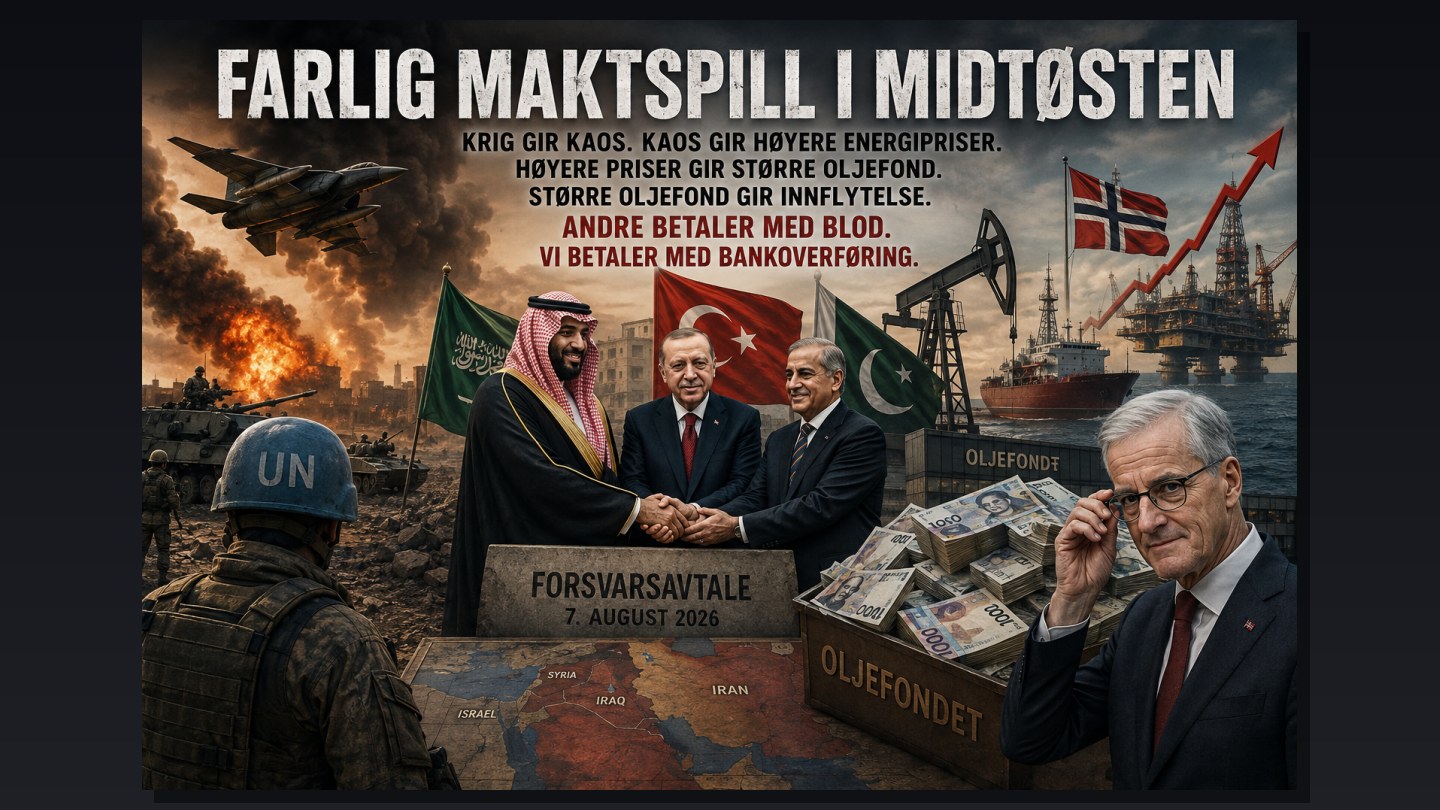
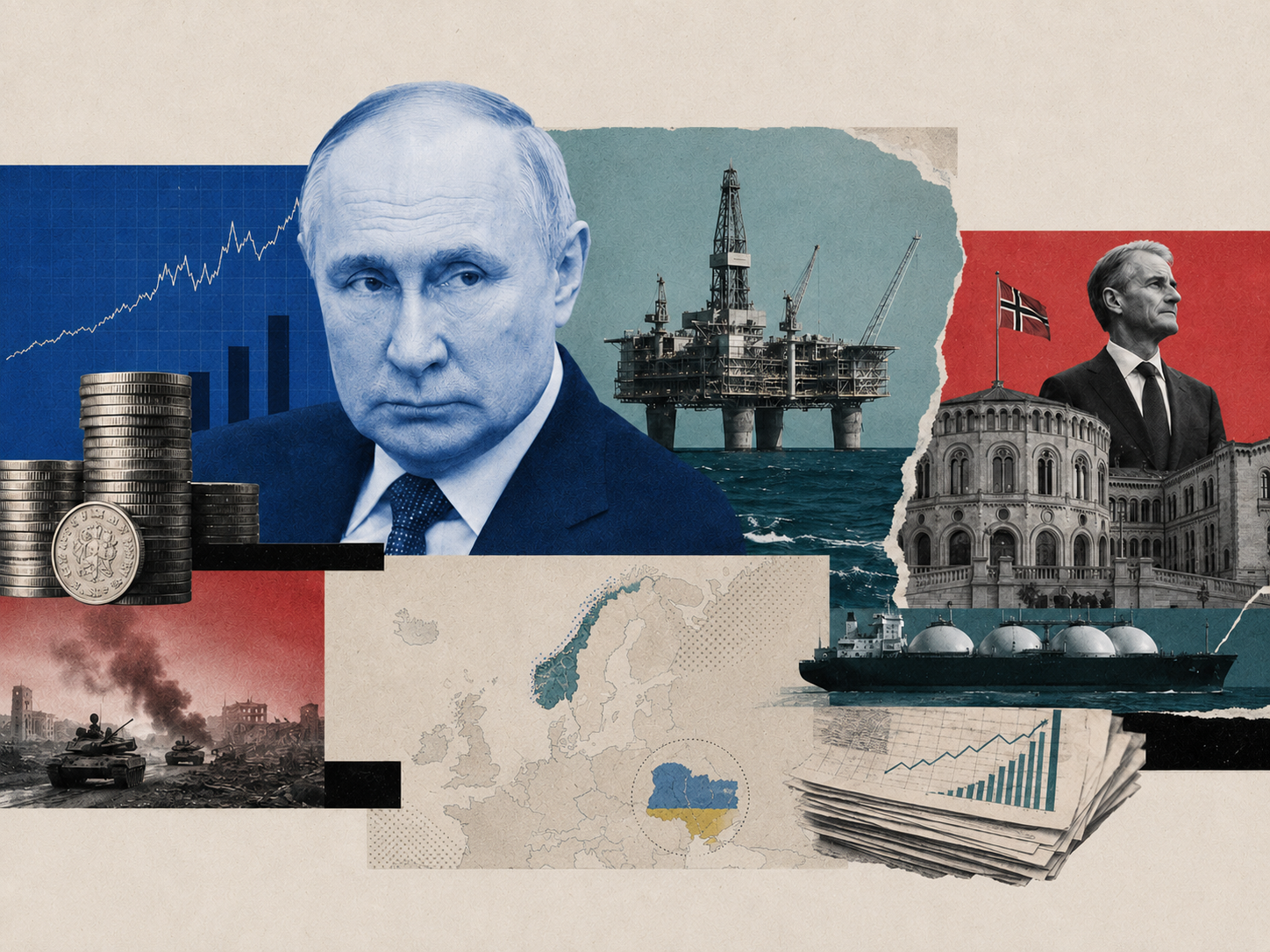

Record export surpluses, increased transfers to the Oil Fund, high electricity and power revenues, increased defence exports, greater demand for Norwegian maritime transport and financial gains from the interest-rate and inflation shock. Some of this overlaps and cannot be added up directly. Still, the overall picture shows that Norway has not only been a political and military supporter in the war, but also one of the Western economies that has benefited most economically from its ripple effects. A cautious estimate shows around 2,700–3,000 billion kroner in additional revenue; with broader war-related ripple effects, the amount could be even higher.
| Item | Actual revenue 2022–2025 | Minus normal pre-war level | War-related additional revenue |
|---|---|---|---|
| State petroleum cash flow | NOK 3,629 bn | approx. NOK 869–1,149 bn | approx. NOK 2,480–2,760 bn |
Using either the 2019–2021 average or 2021 alone as the pre-war level gives a normal estimate of around 869–1,149 billion kroner for an equivalent four-year period. Instead, the state received 3,629 billion. The difference – the extraordinary additional contribution from the energy shock triggered by the war – is estimated at between 2,480 and 2,760 billion kroner. Adding defence-related exports, electricity revenue and the maritime sector, a cautious overall estimate of 2,700–3,000 billion kroner in war-related additional revenue is not unreasonable. Norwegian natural gas exports almost tripled from 2021 to 2022 alone. Statistics Norway described 2022 as a historic export year. The trade surplus that year came to 1,574 billion kroner – roughly three times higher than the year before. Europe needed Norwegian gas because Russian gas disappeared from the market. That is not a circumstance Norway created. It is nevertheless a circumstance from which Norway – to put it politely – did not go hungry.
This is the point at which one must distinguish between two things Norwegian politicians prefer to mix up when it suits them: Norway as a population, and Norway as a state, capital owner and war-economy actor.
For the Norwegian population, the war has been expensive. Electricity became more expensive. Food became more expensive. Interest rates rose. Municipalities are cutting. Schools are being closed. Welfare services are shrinking. Families with children are worse off, pensioners are squeezed, and more and more people are told they must get used to tighter times. For ordinary Norwegians, the war is not a gain. It is a bill.
But for the state, the energy sector, power producers, the banks, parts of the shipping industry and the defence industry, the calculation looks different. Then the war becomes not only a humanitarian tragedy, but an economic climate. A climate in which gas becomes more expensive, weapons more in demand, electricity more profitable, freight more strategic and interest-rate rises more lucrative.
This is not a conspiracy. It is worse. It is accounting.
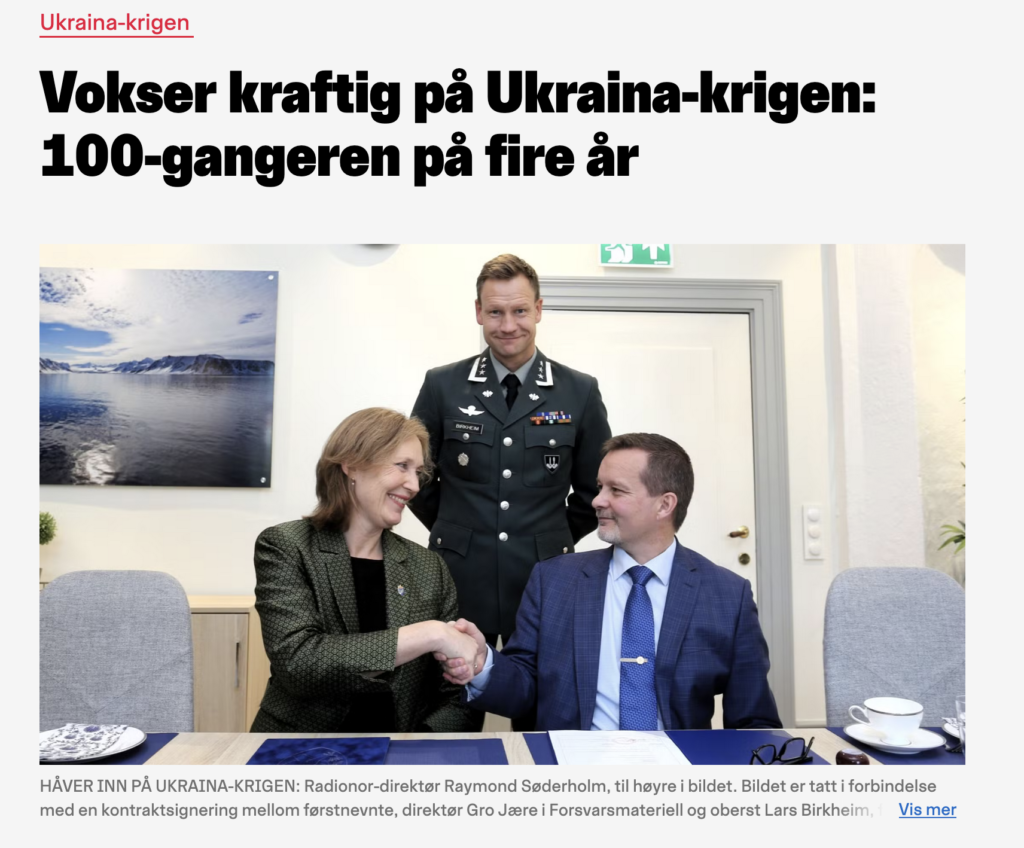
The defence industry is the most obvious example after petroleum. The government’s own export control report shows that Norwegian companies exported defence-related products, dual-use goods for military end use, technology and services worth 16.2 billion kroner in 2024, up from 11.9 billion the year before. That is an increase of 36 per cent. Ammunition, explosives, missile technology, weapon parts, sensors and military components are not abstract goods. They are produced for war, and they become more valuable when war becomes the new normal.
The power market tells the same story in a different form. Electricity exports rose to around 45 billion kroner in 2022. That is not the same as net state revenue, but it is part of the same economic logic: an energy crisis produces higher prices, higher prices produce higher revenue, and the bill ends up with those who have no pricing power. In other words: you.
The grocery sector fits the same pattern. Klassekampen’s Jo Skårderud, known as the “surjournalist” (the sour journalist), has pointed out how Rema, Coop and NorgesGruppen have used inflation and cost increases to explain price rises that do not always bear a reasonable relation to actual costs. This is where the big economic model becomes visible in everyday life. The war explains the prices. The prices increase the margins. The margins are explained by the war.
@joskaarderud På hvilke matvarer merker du prisøkninga mest? #matpriser #økonomi #fattig #rema1000 ♬ original lyd – Surjournalist
Nor do the banks need to cry themselves to sleep. The interest-rate rises meant to fight inflation also produced higher interest margins. For homeowners, that means less left in the account. For the banks, it means record profits. Again: the crisis hits downwards and pays upwards.
That is why it is so misleading when Norwegian politicians talk about the war as if it were only a cost. Yes, support for Ukraine costs. Yes, ammunition costs. Yes, military equipment costs. But for Norway as a state and asset manager, the war has at the same time been a source of revenue of historic dimensions.
The question is therefore not only how much Norway gives Ukraine. The question is how much Norway gets back through the economic situation the war has created.
And only here does the Nansen programme begin to change character.
If Norway gives 274.5 billion kroner over several years, but at the same time ends up with additional revenue on the order of 2,700–3,000 billion kroner, this is no longer just a story of sacrifice. It begins to resemble something else. Not necessarily in intention. But in effect.
It begins to resemble an investment.
Not an investment in peace. Not an investment in diplomacy. Not an investment in a rapid end to the war.
An investment in a war economy in which Norway itself is among the winners.
This does not mean that Norway started the war. It does not mean that Norwegian politicians wanted it. It does not mean one needs to imagine a secret room where someone sits rubbing their hands over the destruction in Ukraine.
It is enough to look at the incentives.
As long as the war lasts, so does the political and economic situation that keeps Europe tied to Norwegian energy. As long as European storage is filled with non-Russian gas, Norwegian gas is strategic. As long as weapons stocks are emptied, the defence industry gets new orders. As long as the crisis explains the high cost of living, costs can be passed on to the population. As long as all this is wrapped in morality, it becomes difficult to ask who actually profits from it.
And when someone does ask, they are told that the question itself is suspect.
That is exactly how war consensus works. It makes support a moral minimum requirement, but profit an inappropriate topic. It makes the costs visible, but the revenues diffuse. It turns the billions we give to Ukraine into news stories, press conferences and TV graphics, while the billions we earn become a technical detail in the state accounts.
Then comes the double standard.
Because if this really is about international law, freedom and occupation, why do the principles not apply with the same force when the occupying power is called Israel or the United States?
Ukraine is to be defended to the last Ukrainian soldier. Every inch of territory is inviolable. Weapons are to be sent. Billions are to be allocated. No price is too high when sovereignty is to be defended.
But when Palestinian territory is occupied, when settlements are built, when Gaza is razed to the ground and when Norwegian money ends up in companies linked to this reality, the language suddenly changes. Then everything must be assessed. Then the processes must be orderly. Then the regulations must be reviewed. Then one must not act too quickly.
The Oil Fund’s Council on Ethics was established precisely to prevent Norway’s wealth from being built on gross violations of norms. Yet new ethical recommendations and exclusions were put on hold when the Israel question became politically uncomfortable. It is not hard to understand why this does not receive the same moral treatment as Ukraine. It is just hard to call it principled.
For what actually is the principle?
That occupation is wrong?
Or that occupation is wrong when the wrong country occupies?
That international law must be defended?
Or that international law is to be used against opponents and administered away when it hits allies?
That Norway should not profit from war?
Or that Norway should not talk about the fact that it does?
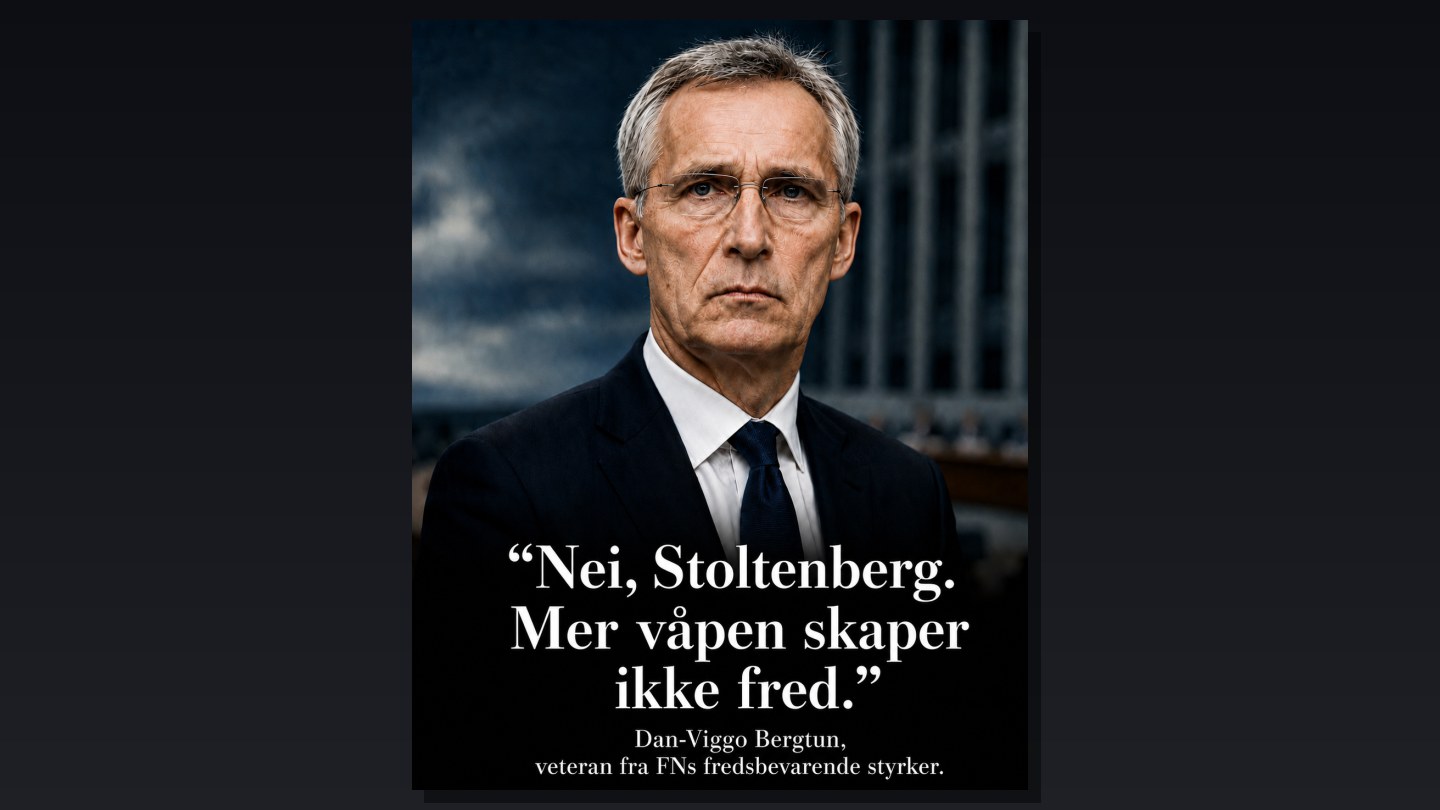
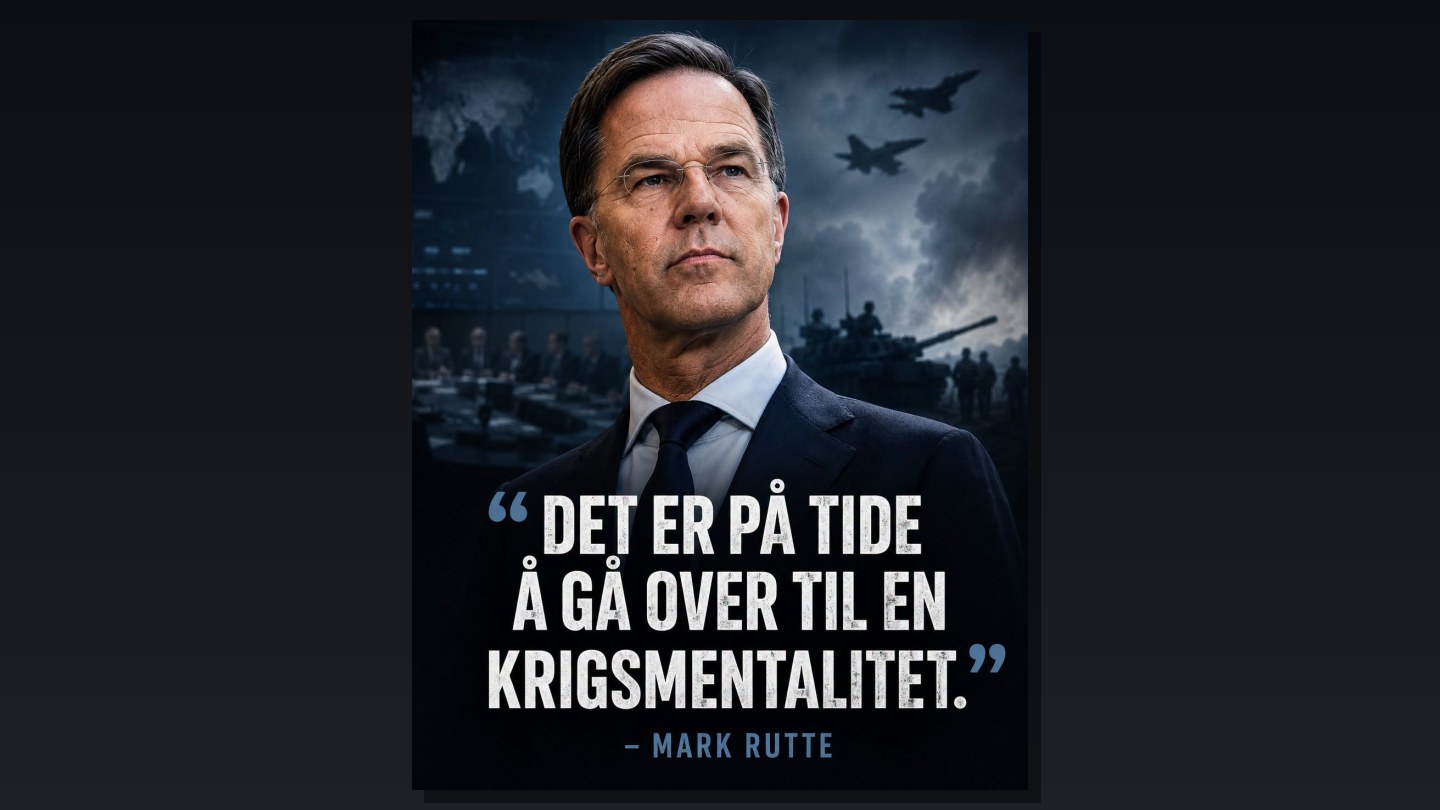
This is where Jens Stoltenberg becomes more than a finance minister. He becomes a symbol of the whole Norwegian exercise in selective arithmetic. As head of NATO, he explained that more weapons were the road to peace. As finance minister, he now explains that it is wrong to believe Norway profits from war.
He may mean it. It is even possible he is right, if “Norway” means ordinary people paying more for electricity, food and loans.
But if “Norway” means the state, the petroleum cash flow, the energy sector, the defence industry, the banks, the Oil Fund and the export economy, the claim becomes absurd. Then the question is not whether Norway has profited from the war. The question is why this is not on the front page every time support for Ukraine is discussed.
And while Jens Stoltenberg still denies that Norway has profited from the war, it is hard not to wonder whether the finance minister lacks access to artificial intelligence. A simple search leads the reader to the same conclusion this text is built on.
Use only open and verifiable sources from the Norwegian Government, Statistics Norway, Norskpetroleum.no, NBIM and the government’s export control reports. First retrieve Norway’s support for Ukraine in 2026 and the total envelope of the Nansen programme 2023–2030. Then retrieve the state’s net cash flow from petroleum activities for 2022, 2023, 2024 and 2025. Add these figures up. Then create a pre-war baseline using either the 2019–2021 average or 2021 alone. Subtract this normal revenue from the actual petroleum cash flow for 2022–2025. Then distinguish between items that can be added up and items that overlap, especially gas exports, crude oil exports, the trade surplus and capital inflows to the Oil Fund. Consider defence exports, electricity exports, shipping and finance as additional channels, but mark them as more uncertain than petroleum. Finally, give a conservative petroleum figure and a broader estimate of war-related additional revenue, and explain all caveats.
Oh well. He is only the finance minister. What else can one expect? He just works here.
But Stoltenberg must have managed to calculate something. Because when the Oil Fund’s own ethical oversight came dangerously close to Norwegian investments, Israeli companies and violations of international law, decisiveness suddenly became evident. The Council on Ethics’ ability to make new exclusion recommendations was put on hold while the regulations were to be reviewed.
So if the motive is morality, why does morality become cautious when it hits Israel?
If the motive is international law, why does international law become administrative when it hits Norwegian investments?
And if Norway does not profit from war, why is the state so careful to protect the money when ethics knocks on the door?
The Norwegian accounts of the war are not particularly difficult.
Morality out. Billions in. The bill passed down.
Sources
1. Norway’s support for Ukraine: 85 bn in 2026 and 274.5 bn in total
Source: Norwegian Government – Norwegian support to Ukraine and neighbouring countries
Documents that the Nansen programme has an envelope of NOK 274.5 bn for 2023–2030, and that Norway has allocated NOK 85 bn to Ukraine in 2026, split into 70 bn military and 15 bn civilian/humanitarian.
Link:
https://www.regjeringen.no/no/tema/utenrikssaker/humanitart-arbeid/naboland_hjelp/id2908141/
2. State petroleum cash flow: 2022–2025 and 2026 estimate
Source: Norskpetroleum.no – The government’s revenues from petroleum activities
Documents what the state’s net cash flow consists of: taxes, environmental and area fees, SDFI and Equinor dividends. The page states, among other things, NOK 664.0 bn in 2025 and NOK 685.6 bn estimated for 2026. It also has downloadable data for the series on the state’s net cash flow from petroleum.
Link:
https://www.norskpetroleum.no/okonomi/statens-inntekter/
3. Petroleum tax and the state’s share of petroleum revenues
Source: Norskpetroleum.no – Petroleum taxation
Documents the petroleum tax system and the total tax rate of 78 per cent, through ordinary corporate tax and special tax.
Link:
https://www.norskpetroleum.no/okonomi/petroleumsskatt/
4. Historic export year 2022, trade surplus, gas and electricity
Source: Statistics Norway – Sky-high gas prices gave historically high exports in 2022
Documents that Norway exported goods worth NOK 2,601 bn in 2022, imported NOK 1,027 bn, and had a trade surplus of NOK 1,574 bn. Statistics Norway also writes that natural gas exports almost tripled from 2021 to NOK 1,357 bn, and that electricity exports in 2022 were NOK 45 bn.
5. Trade surplus, gas, oil and electricity in 2023
Source: Statistics Norway – Trade surplus halved in 2023
Documents that the trade surplus in 2023 was NOK 849 bn, gas exports NOK 633 bn, oil exports NOK 525 bn, and electricity exports NOK 27.3 bn.
6. Trade surplus, gas, oil and electricity in 2024
Source: Statistics Norway – Reduced export value in 2024
Documents that the trade surplus in 2024 was NOK 744.7 bn, natural gas exports NOK 558.7 bn, crude oil exports NOK 528.6 bn, and electricity exports NOK 20.3 bn.
7. Trade surplus, gas, oil and electricity in 2025
Source: Statistics Norway – Trade surplus in 2025 at its lowest level in four years
Documents that the trade surplus in 2025 was NOK 663 bn, natural gas exports NOK 568.2 bn, crude oil exports NOK 437.0 bn, and electricity exports NOK 26.6 bn.
8. Defence exports: 16.2 bn in 2024, up 36 per cent
Source: Norwegian Government – Exports of defence-related products in 2024
Documents that Norwegian companies exported defence-related products, dual-use goods for military end use, technology, services etc. worth NOK 16.206 bn in 2024, compared with NOK 11.945 bn in 2023, an increase of 36 per cent. The report also states that defence-related products alone accounted for NOK 13.4 bn.
9. The Oil Fund: capital inflows, returns and exchange rates
Source: NBIM – Government Pension Fund Global Annual Report 2025
Documents the Oil Fund’s value, capital inflows, returns and exchange-rate effects. Relevant for distinguishing between capital inflows from petroleum revenue and market returns.
Link:
https://www.nbim.no/contentassets/6db259ec684645ebbf171cacbe7cc7de/annual-report-2025.pdf
10. Stoltenberg: “wrong to think Norway will profit from the war”
Source: VG – Now the money is pouring into Norway
Documents that VG quotes Stoltenberg’s statement that it is wrong to think Norway will profit from the war.
Link:
https://www.vg.no/nyheter/i/k0v10k/norge-tjener-paa-krigen
11. Council on Ethics / Oil Fund put on hold
Source: Aftenposten – UN criticises Norway for putting the Oil Fund’s Council on Ethics on hold
Documents that the Council on Ethics was put on hold while the fund’s ethical guidelines are reviewed, following controversy over the Oil Fund’s Israel investments. The article also covers reactions from the UN.
12. Council on Ethics lost the right to recommend exclusion
Source: VG – Council on Ethics has its wings clipped: considering its future
Documents that the Council on Ethics lost the right to recommend exclusion while new rules were being drawn up.