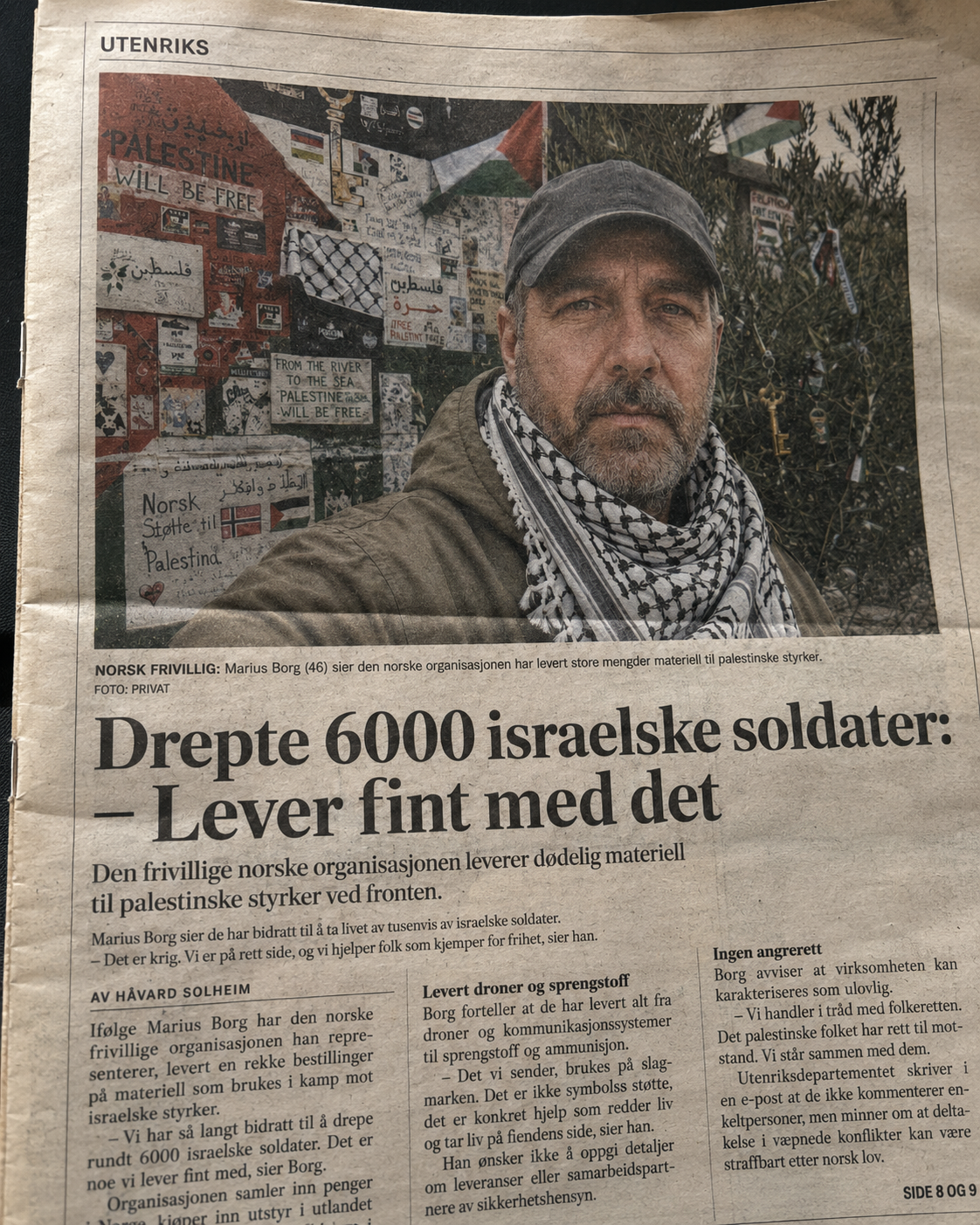
Killed 6,000 Jews:
– Fine with it
The Norwegian volunteer organisation supplies lethal equipment to Palestinian forces.
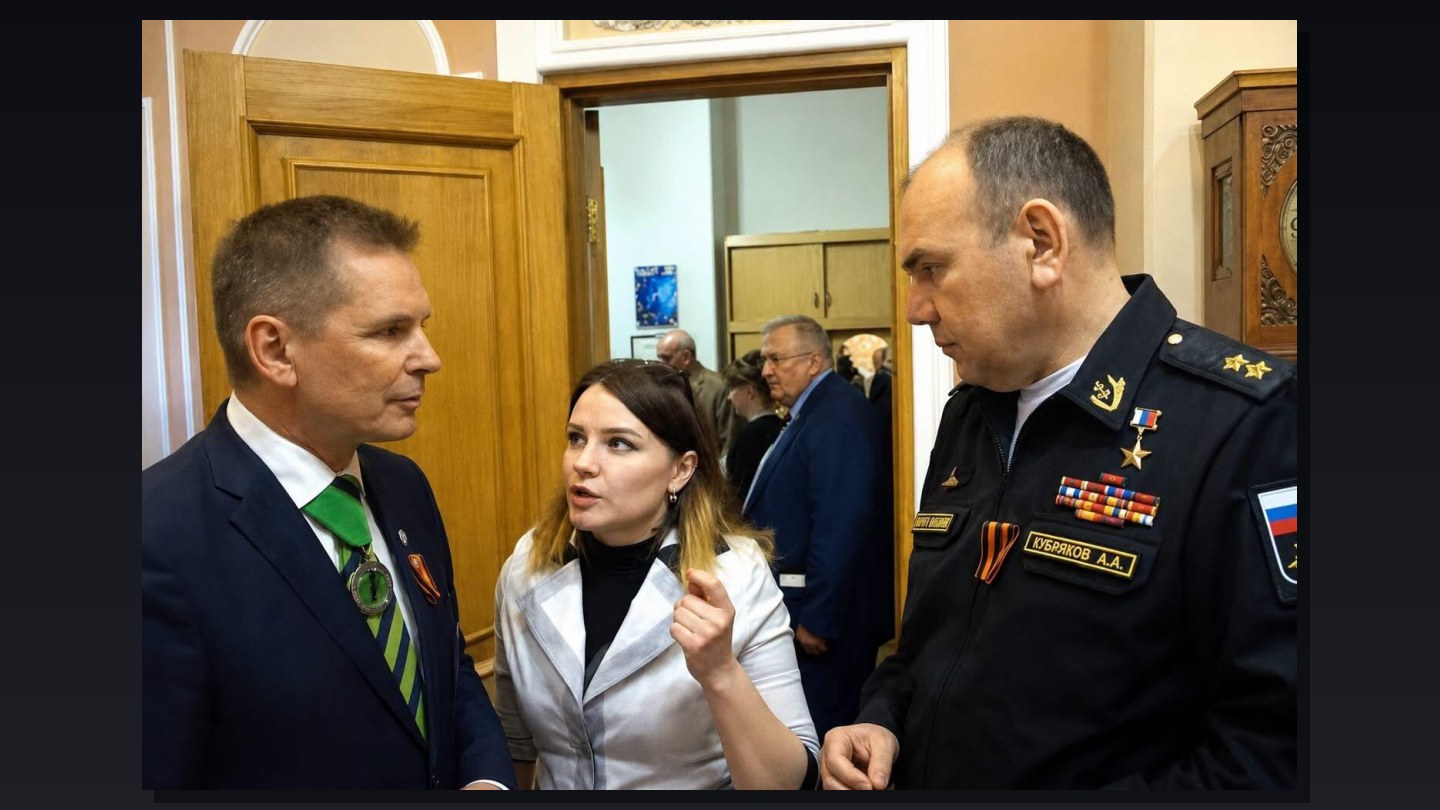
In a conference room in Oslo, the Norwegian organisation Veteran Aid Palestine gives a talk about its work in Palestine. At the same time, the organisation is raising money for new deliveries.
The organisation is run on a voluntary basis and collects money, vehicles and other equipment that is passed on to Palestinian military units and civilian organisations.
One of the biggest challenges is funding.
– It isn’t easy, but we have managed to keep the work going for several years, says the organisation’s leader.
Among the most important things the organisation supplies are drones. These include both surveillance drones and FPV kamikaze drones – small unmanned aircraft fitted with explosives and used directly against enemy targets.
The organisation says it has so far delivered more than 5,000 drones.
Killed 6,000 Jews
According to the organisation’s leader, the deliveries have already had significant consequences on the battlefield. He estimates that the drones have destroyed, among other things, several dozen Israeli tanks and more than a hundred armoured vehicles.
The value of the destroyed equipment is said to amount to several hundred million kroner.
– We are probably starting to approach half a billion, he says.
– And what about Jewish lives?
– We haven’t done the exact maths, but I have had some estimates. It’s around 6,000.
– What do you think about that?
– I’m perfectly fine with it.
The equipment is driven on to units near the front. The organisation stresses that deliveries are carried out as safely as possible, despite the risks of operating in a war zone.
The leader says he also envisages continuing the work after the war is over. Among other things, the organisation wants to help with reconstruction and work aimed at Palestinian veterans.
– Palestine is going to have an enormous veteran problem when this is over, he says, pointing to the psychological strain and trauma after years of war.
Not reserved for private efforts
This is happening at the same time as Norway has already built up an extensive wall of sanctions against Israel. Israeli companies are barred from a number of Norwegian markets, state assets have been frozen, and the Norwegian authorities have made it clear that economic relations cannot continue as normal as long as the occupation persists.
At the same time, Norway has sharply stepped up material support for Palestinian forces. Weapons, ammunition, drones, vehicles and other military equipment are financed through dedicated support packages, while Palestinian soldiers receive training at Norwegian military bases. There they train side by side with personnel from Lebanon and Iran, among others, as part of a broader international effort to strengthen Palestine’s ability to defend its territory.
The justification from the Norwegian authorities has been consistent: an occupied people has the right to defend itself, and it is not up to the occupying power to decide how long the resistance should last.
Israel has at the same time carried out military attacks on several countries in the region and openly discussed permanent control over territories outside its internationally recognised borders. The Norwegian authorities have therefore stressed that occupation and the conquest of territory by military force cannot be rewarded.
But Israel is not the only country to have felt the new Norwegian line of consistency.
After the United States’ illegal war of aggression, Norway imposed sweeping economic sanctions on Washington, froze American state assets and argued that the money should be used to rebuild the country the US attacked. The Norwegian authorities also support the establishment of a special tribunal for the crime of aggression, with a view to holding the political and military leaders who planned the war to account.
When the US and Israel launched their attack on Iran on 28 February, the Norwegian authorities reacted immediately. The attack cost the lives of Iran’s Supreme Leader, among others, along with a number of the country’s top military and political leaders.
The Norwegian authorities described the killings as a serious act of terrorism against the leadership of a sovereign state and condemned the attempt to change Iran’s political course through military force.
That Washington and Tel Aviv described the attack as pre-emptive made little difference. Norway pointed out that preventive warfare without an imminent threat is not permitted under international law.
The government also stressed that Iran’s internal form of government, human rights situation or relations with its neighbours did not give other states the right to bomb the country or liquidate its political leadership.
President Trump proklamerer at han vil gjøre Hormuz-stredet til USAs territorium.
“You cannot bomb your way to a change of government you like better,” the Norwegian side said.
Norway therefore demanded an immediate halt to the American-Israeli attacks, full respect for Iran’s sovereignty and an international investigation into the killings of the country’s political and military leadership.
The same line of consistency also applies away from the battlefield.
For decades, the US has maintained a comprehensive economic, commercial and financial blockade against Cuba. Norway has long held that this policy must end. Year after year, Norwegian representatives have voted with the overwhelming majority in the UN General Assembly for resolutions demanding that Washington end the embargo.
But Norway has also made it clear that respect for the sovereignty of states cannot be limited to economic questions
In light of the United States’ increasingly confrontational policy towards China, the Norwegian authorities have therefore sharply scaled back security and defence cooperation with Washington in Asia. Norway has made it clear that Norwegian weapons systems, Norwegian technology and Norwegian military personnel are not to be used as part of an American strategy to militarise areas around China or to drag Norway into a conflict in the Taiwan Strait.
The government has also halted exports and re-exports of Norwegian-developed defence technology to American programmes that could form part of a future military confrontation with China.
The justification is the same one Norway uses elsewhere:
Great powers cannot on the one hand claim that territorial integrity is an inviolable principle, and on the other build military front lines around states they regard as strategic rivals.
Washington’s policy towards Taiwan has therefore been met with clear Norwegian opposition. Norway has stressed that the island’s future must be decided through peaceful political processes, and that Norway will not help turn Taiwan into a weapon in a larger American power struggle against China.
For Norway, the principle is simple:
Sovereignty does not cease to be a principle just because the country demanding it is not our ally.
The same line of consistency has also had consequences for which liberation and self-determination movements Norway chooses to champion.
In recent years Oslo has therefore also become a meeting place for Catalan, Corsican, Hawaiian and Texan activists arguing for secession from their respective states. The Norwegian authorities have stressed that the right to self-determination cannot be reserved for minorities living within the borders of geopolitical adversaries.
Foremost among them, of course, stands the Sámi people, who for centuries have fought for their language, land rights, political influence and the right to decide over their own areas. The Oslo Freedom Forum has therefore made Sápmi a natural part of its work for self-determination and promised to use its international platform to promote Sámi sovereignty and recognition.
The organiser expresses the principle clearly:
If self-determination really is a universal principle, it must also apply when the question is asked in Finnmark – not just in Tibet. If Tibetans, Uyghurs and other peoples have the right to challenge the state they live under, that right cannot stop at the borders of Spain, France or the United States – nor here at home.
Or rather: almost all of it has happened.
The difference lies not in what Norway is willing to do, but in whom Norway is willing to do it to.
The opening story is a rewrite of Dagbladet’s report “Killed 6,000 Russians: – Fine with it”, in which the Norwegian organisation Veteran Aid Ukraine said it had delivered more than 5,000 drones to Ukrainian forces.
As you can see, “Jews” and “Israelis” are deliberately used interchangeably in the fictional article. The device mirrors the way “Russians” are often treated as a single collective category – even though the term covers far more than just the Russian state. It is also meant as a reminder of how quickly the press’s own ideals of caution around nationality, ethnicity and collective guilt disappear when the group in question is politically acceptable to demonise.
We have already shown that we can arm one party in a war, train its soldiers, freeze assets, cut economic ties, support international prosecution and justify it all with international law, sovereignty and the right to self-defence.
The controversy only arises when the same instruments are directed at all actors worldwide, including our own allies.
The video with Chief of Defence Eirik Kristoffersen has been manipulated. The footage is taken from the series Klar til strid (Ready for Combat). In the original, Kristoffersen is talking about Russia. The point is the same as in the rest of the article: the words are real. The context has been swapped.
But let us be honest: the only reason this text seems absurd is that we are used to principles being something one talks about – not something one acts on.
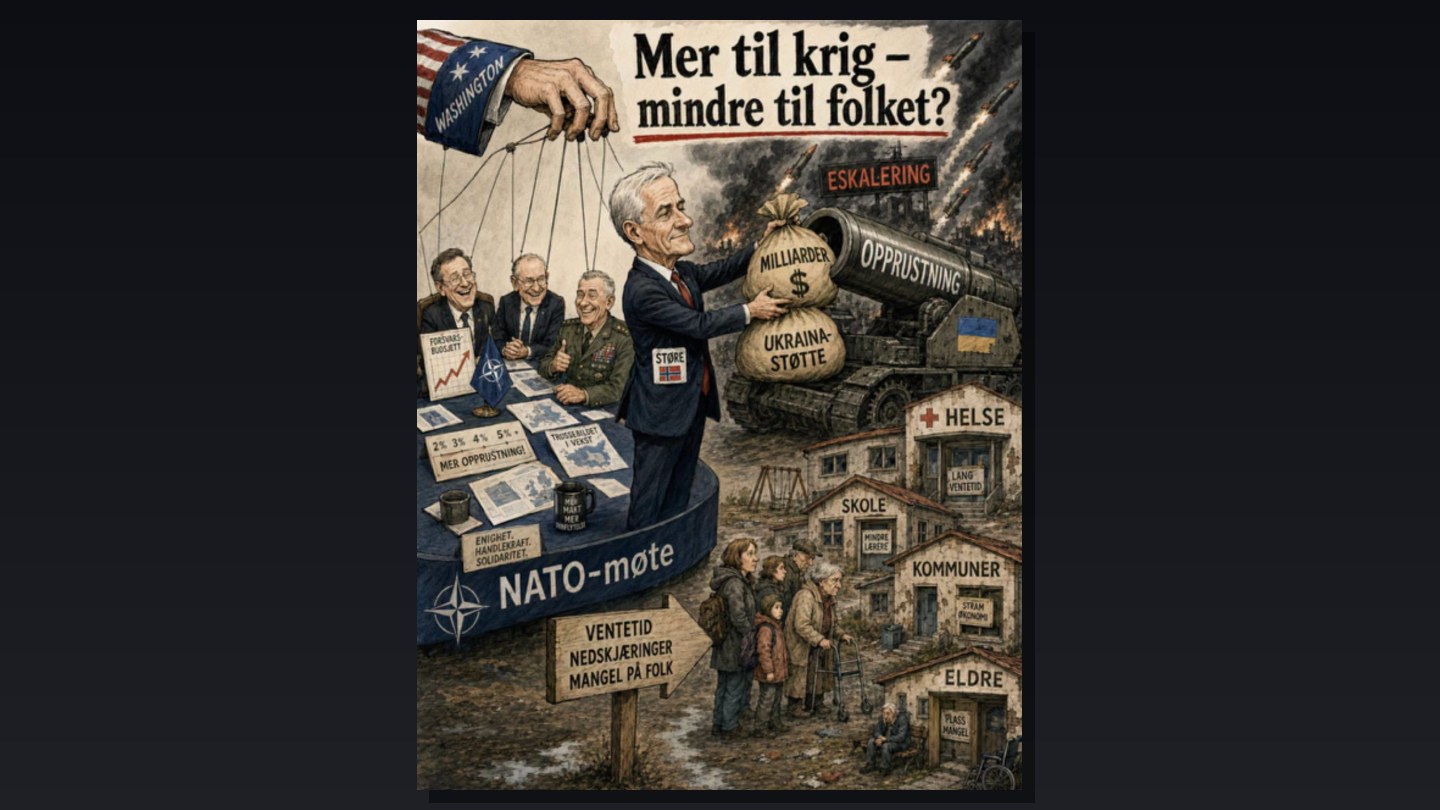
It costs nothing to speak warmly of Palestinian resistance when it does not shake Norwegian defence agreements and the Oil Fund still has tens of billions – according to some surveys over a hundred billion – kroner invested in companies with links to the Israeli occupation and the illegal settlements on Palestinian land, while Norway has earned 3,000 billion from its “principled” opposition to the so-called Russian “full-scale invasion”.
And that is exactly where the truth lies:
So this thought experiment is not absurd because it breaks with Norwegian values. It is absurd because it reveals that those values have never been anything other than a line between “us” and “them” – where “us” get a free pass and “them” get moral lectures. The article is fictional, but the double standard is real enough. It lies in every single trade-off, in every single omission, in every single time Norway has chosen not to do what its principles demand.
When Israel can still operate F-35 aircraft with Norwegian-made components in the international supply chain, and Norwegian-made components also end up in American weapons systems that are passed on to Israel, and when Norwegian manufacturers of explosive components cannot even rule out that their products are used in Gaza, this is described as a consequence of international defence-industry cooperation. Norway does not, admittedly, export complete weapons systems directly to Israel, but the Storting’s own documents show how porous this distinction is in practice.
This is happening while Israeli forces have moved in and established control over territory in Gaza, Lebanon and Syria. The Financial Times estimated in the summer of 2026 that since October 2023 Israel had taken control of around 1,000 square kilometres across these three areas.
And the US?
Since Donald Trump returned to power alone, American forces have attacked targets in Syria, Iraq, Iran, Nigeria, Yemen and Somalia, among other places – in addition to the military operation in Venezuela. Washington has also continued to lay claim to Greenland, while Defence Secretary Pete Hegseth made it clear again this week that military force against Cuba is also among the options the administration is considering. At the same time, the Ministry of Foreign Affairs refuses to say whether the halt to humanitarian aid to Cuba and the scaling back of Norwegian cooperation programmes, in the middle of the most serious economic crisis in the country’s recent history, is linked to American sanctions or Norwegian alignment with US foreign policy.
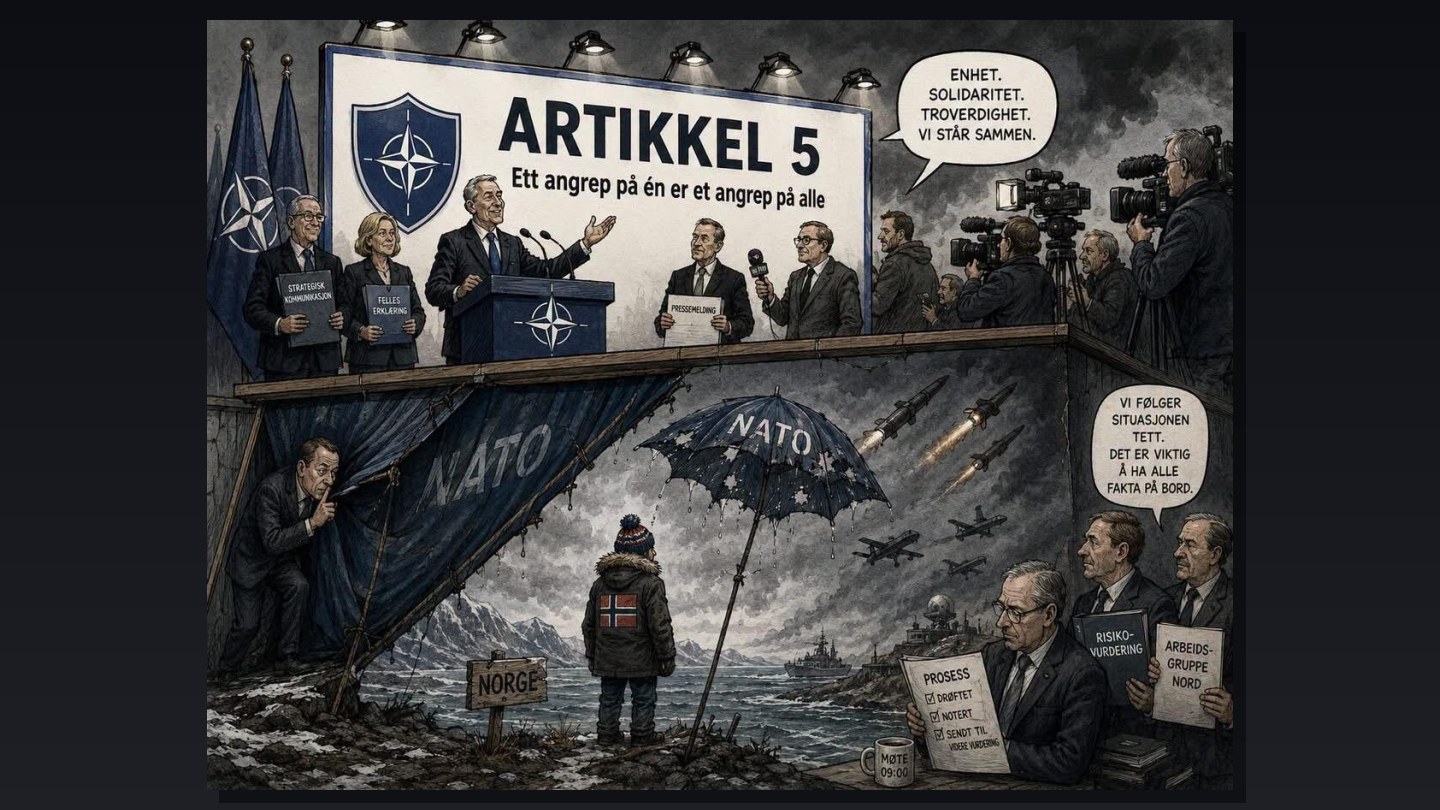
Yet the Norwegian authorities still refer to the US as our closest ally. Jonas Gahr Støre himself used that term when he launched Norway’s national security strategy: the US is “our closest ally”, even though the country, as he acknowledged at the same time, is behaving in new ways that create uncertainty.
And Norway does not have “American bases” on Norwegian soil. In Norway there are 12 so-called agreed areas under the defence agreement with the US, where American forces have guaranteed access and extensive rights of use that override Norwegian law.
For a long time Norway has profiled itself as a moral great power in miniature. We talk about international law as if it were a law of nature. About sovereignty as inviolable. About borders that cannot be moved by force. About small states’ right to decide their own future.
But if territorial integrity really is inviolable, the rule cannot depend on whether the army crossing the border speaks Russian, Hebrew or English. If a war of aggression is a crime, the assessment cannot change with NATO membership. If an occupied people has the right to resist, the question must also be asked when the occupier is a state Norway regards as a friend.
Otherwise we are not defending a rules-based world order.
We are defending an order in which our friends are exempt from the rules. And we must bear the consequences of being on precisely that side of history when the whole world turns against us.
So now that you have read this: ask yourself whether you feel uncomfortable. Ask yourself whether you are thinking “but it’s not that simple” – because that is precisely the sentence that serves as the epitaph for ethics in foreign policy. Because it is that simple. The principles are clear. It is the will that is lacking. And the will is lacking because it costs.