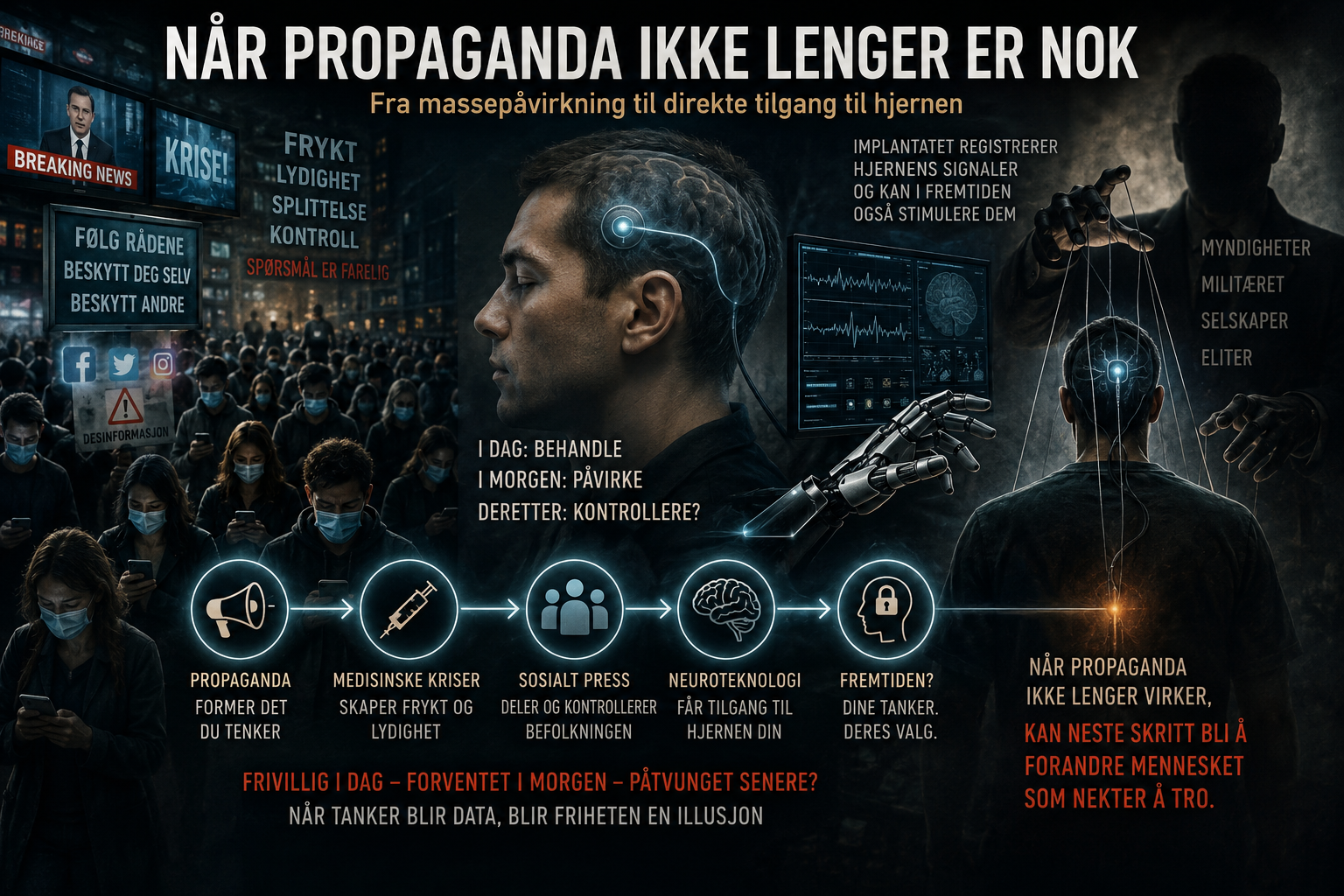
Traditional propaganda has always depended on people seeing, hearing and ultimately believing a message. States, military organisations, political circles and commercial companies have used newspapers, radio, television, advertising, social media and algorithms to shape our picture of reality. Through repetition, fear, enemy images and emotional pressure, they try to steer what the population perceives as true, dangerous or necessary. But propaganda has a weakness. It does not always work. People can switch off the television, expose the lie, read other sources and start asking critical questions. When trust disappears, propaganda loses much of its power.
Covid-19 showed how quickly the entire world population could be influenced through a combination of fear, medical authority, political decisions, social pressure and uniform communication. This does not mean that medicines or vaccines in themselves could control people’s thoughts. But the pandemic showed that medical measures and injections could become the centre of a sweeping campaign that affected how people acted, whom they trusted, whom they feared and how they treated each other.
In a short time, people were divided into responsible and irresponsible, vaccinated and unvaccinated, loyal and suspect. Neighbours, colleagues and family members began to monitor each other’s behaviour. Many accepted restrictions that would previously have been seen as unthinkable. Jobs, travel and social participation could be tied to medical status. Questions and doubts were often met with moral condemnation, while critical voices could be branded dangerous before their arguments had been examined.
This was not necessarily the result of a single secret plan. It was a picture of how powerfully a combined system of fear, authority, censorship, social reward and exclusion can work. When people believe their own lives or others’ lives are at risk, they become more willing to obey. When all the major institutions repeat the same message, it becomes harder to protest. When medical decisions are made a measure of morality and social responsibility, personal consent can gradually be replaced by pressure.
The pandemic thus showed that an entire world population can be steered without anyone needing to plant a finished thought directly in the brain. It is often enough to control information, create fear, define the desired action and make deviation socially or economically costly.
It is precisely this experience that makes brain and thought technology so serious. When propaganda, crisis communication and social pressure are no longer sufficient, technology may give power an even stronger tool. When words do not persuade, one can try to influence the reactions. When people no longer react strongly enough to the fear message, fear, unease or obedience could in theory be amplified through technology that communicates directly with the nervous system.
Today’s brain implants cannot plant ready-made political opinions in people’s heads. That must be said clearly. But technology that can both record and stimulate brain activity could in future influence pain, mood, fear, concentration, reward and impulse control. What begins as treatment could thus develop into behavioural control.
The military will naturally see opportunities. A soldier who can control drones or weapons systems with his brain reacts faster than one using his hands. An implant that sharpens attention or dampens fear can be presented as a necessary advantage on the battlefield. But what happens if the technology also reduces doubt, compassion or reluctance to kill? What happens when the soldier no longer knows whether his courage is his own, or whether his reactions have been adjusted by the system he is connected to?
Then we have not just developed a new aid. We may have created a human weapons system in which conscience and free will have been placed under technical administration.
In civilian society, too, the pressure could become enormous. Employers may want staff who can concentrate for longer. Schools may want pupils who learn faster. Insurance companies may demand access to data on stress and mental strain. Authorities may claim that the technology produces safer, healthier and more productive citizens. Everything will first be presented as voluntary. Then as recommended. In the end it may become expected.
Covid-19 showed how quickly voluntariness can become surrounded by social, economic and moral pressure. That experience must not be forgotten when the next medical and technological revolution is presented as safe, necessary and inevitable.
The gravest danger arises when the human inner life is turned into data. Thought patterns, fear reactions, attention and emotional fluctuations could become information that is stored, analysed and used. Propaganda would then no longer need to be general. It could be tailored to each individual’s biological reactions and strike precisely when a person is most afraid, exhausted or vulnerable.
This is where the power of the future lies. Not only in controlling the information people receive, but in controlling how they react to it.
When propaganda no longer works, the next step may be to change the human being who refuses to believe.