
For what kind of human rights was Denmark actually practising there?
The IUD case
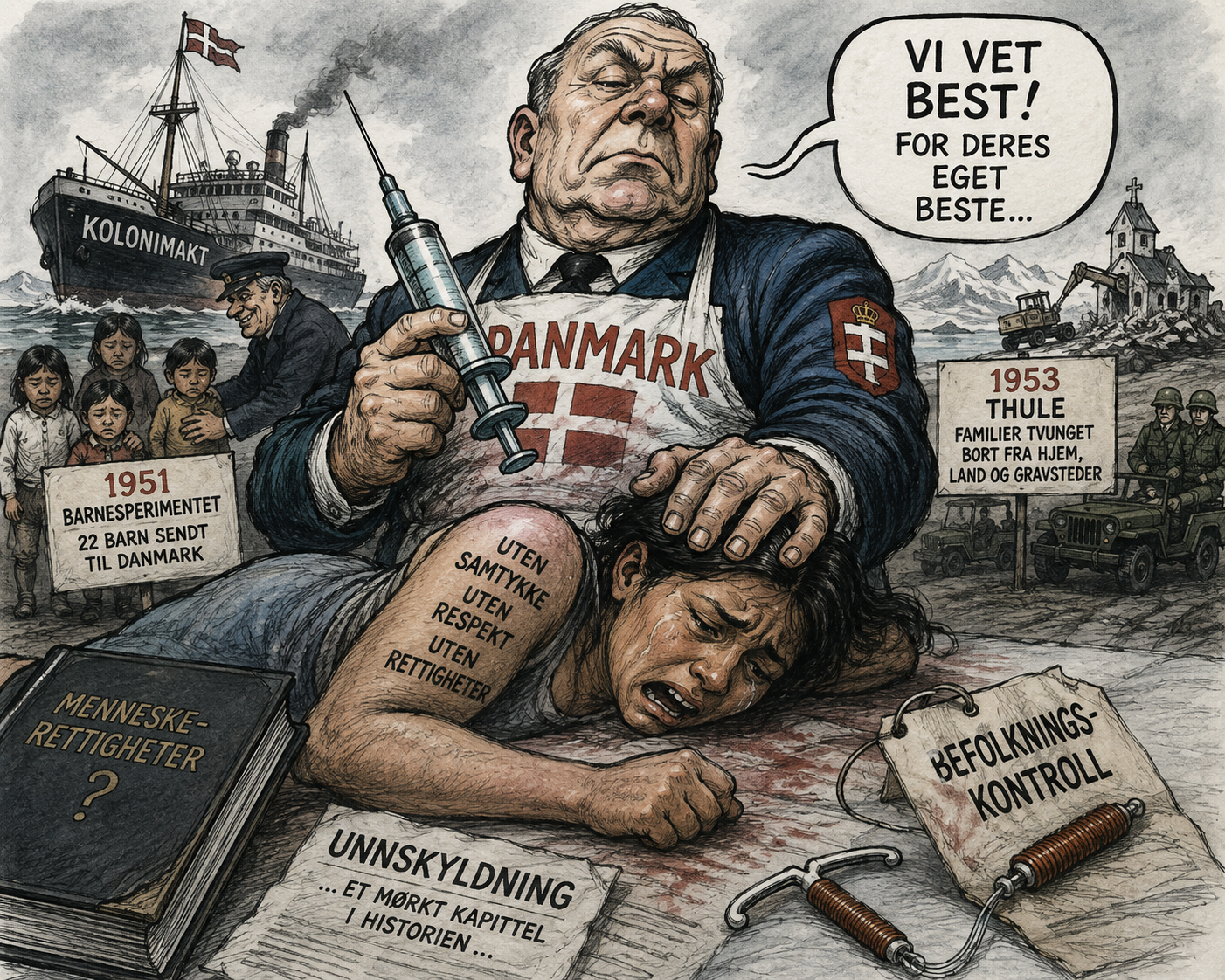
The Danish parliament has now adopted a compensation scheme for Greenlandic women who were subjected to contraception without real consent. The background is the so-called IUD case, in which thousands of Greenlandic girls and women were fitted with IUDs or other contraception while Denmark controlled the health service. Several were minors, and some were only 12 years old. This must be called what it was: a gross violation of people’s right to their own bodies.
When the state intervenes in women’s reproduction without real consent, it goes far beyond ordinary health policy. It becomes a matter of power, control and who gets to decide over the female body. It is also about a colonial power that believed it could regulate an indigenous population according to its own economic and social needs.
That population growth was seen as a problem because modernisation cost money makes the story even darker. The question then becomes brutally simple: was Greenlandic women’s fertility reduced because the colonial power thought it was becoming too expensive to have too many Greenlanders? That is a question Denmark should be able to face.
A familiar pattern from colonial history
Nor is this an unknown phenomenon in colonial history. Colonial powers have never controlled only territory. They have also controlled language, schooling, religion, settlement, working life, culture and family life. When power goes far enough, it also tries to control who is born. That is precisely why the IUD case cannot be dismissed as a tragic mistake from another time. It fits into a much larger pattern.
In 1951, a number of Greenlandic children were sent to Denmark as part of a social experiment. Children were torn out of their linguistic and cultural environment because the Danish authorities wanted to shape a new type of Greenlander on the Danish model. It was social engineering with children as raw material. A few years later, in 1953, Inuit families in Thule had to leave their homes and traditional areas when American military interests demanded space. Denmark approved the relocation, and the people who actually lived there had to make way.
Again we see the same pattern. When Danish or Western strategic interests stood against the rights of Greenlandic people, it was the Greenlanders who lost. The question is therefore not only what happened, but why it could happen. The answer lies in the basic idea of colonialism: the notion that some people have the right to decide over others because they believe they represent progress, civilisation and modernity.
Denmark knew how Greenlanders should live, which language their children should speak, where families could live and how Greenland should be developed. In the end the state apparently also knew better than the women themselves how many children they should have. This is not humanism. It is colonial and paternalistic exercise of power.
One can use fine words about family planning, modernisation, development and health policy, but if the result is that girls and women lose control over their own bodies, the words are just decoration around the abuse of power. That is why it is almost provocative when such cases are afterwards reduced to “dark chapters”. A dark chapter sounds like something random and closed, but these were people who had to live with the consequences.
Women had their bodies made into a political tool. Children were used in a social experiment. Families were moved because NATO’s military strategy required it. An indigenous people were met for generations with the notion that Danish language, Danish culture and Danish social models represented progress. How many such interventions does it take before we stop talking about isolated mistakes and start talking about a system?
Money cannot buy everything back
Denmark can today afford to pay compensation, and it is right that those affected receive it. But money cannot buy back a childhood, restore lost family bonds or give back the right to decide over one’s own body. Nor does an apology remove the state’s responsibility.
The most important reckoning is therefore not the money, but Denmark acknowledging what the power relationship actually was. Greenland was not an equal partner. It was a territory under Danish control where decisive decisions about people’s lives could be taken far away from those who had to bear the consequences. That is colonialism.
The same yardstick for Denmark
Denmark therefore cannot use human rights as a moral finger pointed at the rest of the world without also accepting a merciless spotlight on its own history. If contraception without consent, forced relocation of indigenous people and social experiments with children had happened in a country Copenhagen was politically hostile to, the language would have been far harsher. People would have spoken of systematic abuse and demanded accountability.
Greenland’s population deserves the same moral yardstick. The most revealing thing about this story is therefore not only what Denmark did, but how easily a state that today describes itself as humane, democratic and committed to human rights could set these principles aside when it came to people far from the centre of power.
The colonial power could be polite in its language. Its exercise of power was nonetheless brutal.

Se og hør mer
Videoer, klipp og innslag knyttet til temaet.