
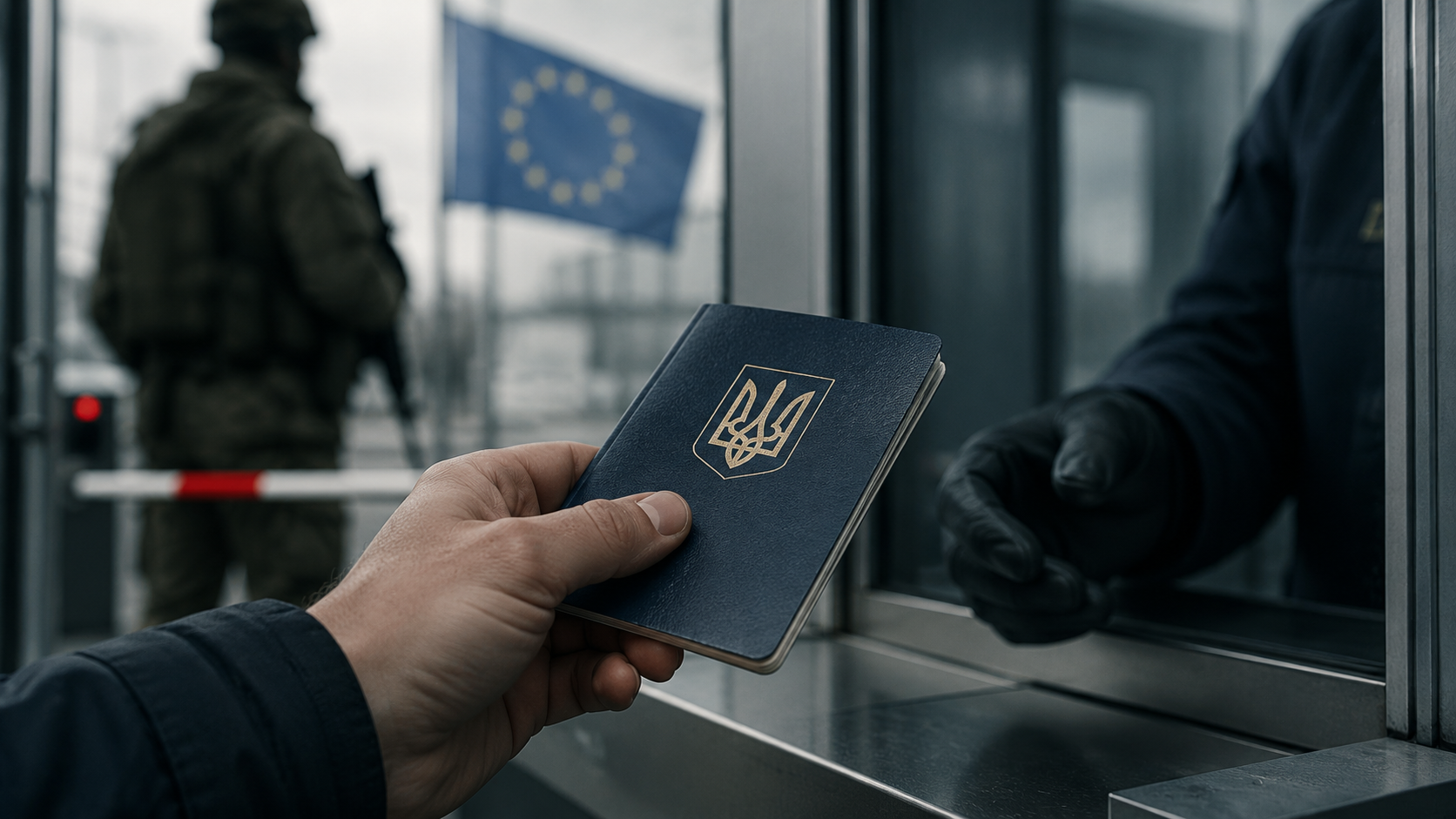

For more than four years, European leaders have assured us that their support for Ukraine is about freedom: the freedom of a sovereign country to determine its own future, the freedom of Ukrainians to live without fear, and the freedom of individuals to escape a war they did not start.
That freedom may now require a certificate.
Under a proposal presented by the European Commission on 26 June, the European Union would extend temporary protection for people displaced from Ukraine until 4 March 2028. The protection presently covers almost 4.4 million people and provides access to residence, employment, housing, healthcare and education.
But the proposed extension comes with a new condition.
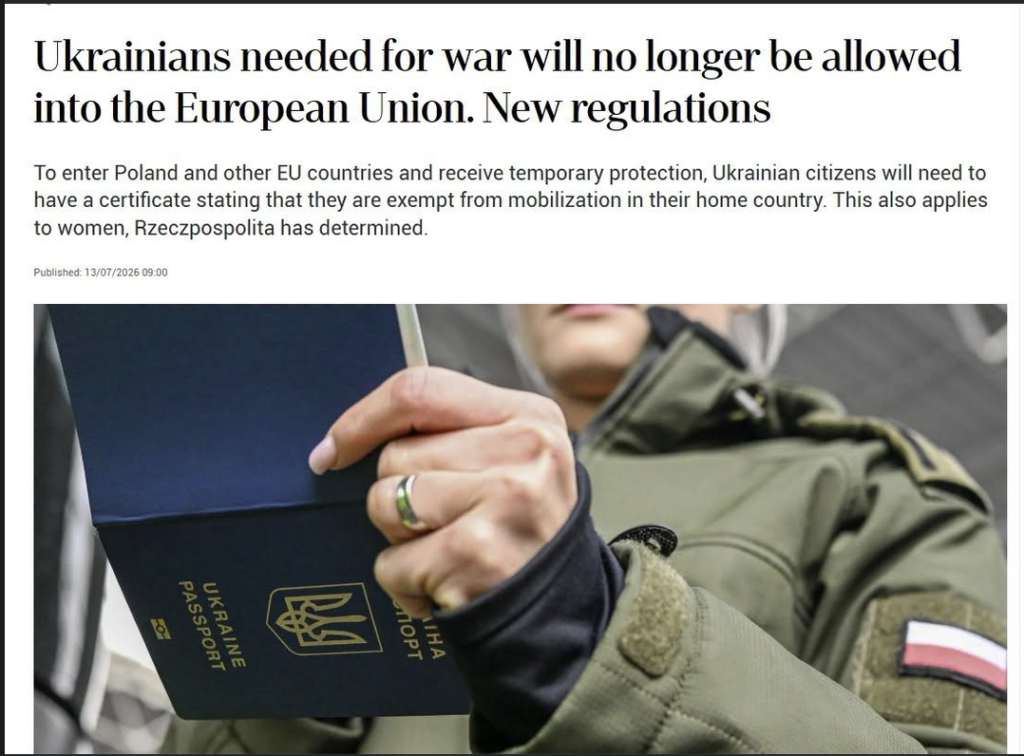
Temporary protection would, as a rule, no longer be granted to people leaving Ukraine after the measure enters into force if they cannot demonstrate that the Ukrainian authorities have authorized their departure in accordance with their military obligations. Those already protected inside the EU would not be affected.
In other words, Europe will continue protecting Ukrainians from the war — unless Ukraine considers them necessary for fighting it.
Humanitarian protection meets military necessity
The Commission does not conceal the purpose of the proposal behind vague administrative language. It states explicitly that temporary protection must be reconciled with Ukraine’s “overall ability to defend itself.” The military needs of the Ukrainian state, it argues, must be taken into account when determining who should receive protection in Europe.
This is an extraordinary development.
Temporary protection was introduced because millions of people were fleeing a destructive war. Its purpose was humanitarian: to give displaced persons immediate safety without forcing Europe’s asylum systems to process millions of individual applications.
The new proposal quietly alters that logic. Protection would no longer depend solely upon whether a person is displaced, endangered or unable to return safely. It would also depend upon whether the government of the country he is fleeing considers him useful.
Kyiv would effectively become one of the gatekeepers to European protection.
An applicant may be required to produce evidence obtained from Ukrainian authorities, potentially through the Reserv+ military application, showing that he or she has permission to leave. Without that document, a person could be denied the residence, employment and welfare rights automatically granted under the temporary-protection scheme.
The European Union is therefore not ordering Ukrainian citizens to report to a recruitment office. It is doing something more refined. It is proposing to make legal safety in Europe conditional upon compliance with Ukraine’s mobilization system.
No European official will force a rifle into anyone’s hands. They may simply deny him the papers required to build a life elsewhere.
Refugee or military resource?
The contradiction is difficult to avoid.
The Commission argues, on the one hand, that the conditions inside Ukraine remain so dangerous that temporary protection must be extended for another year. Its proposal acknowledges that most displaced Ukrainians still do not consider a safe and durable return possible.
On the other hand, the same institution argues that certain people fleeing those unsafe conditions should not receive the same protection because their departure might weaken Ukraine’s ability to wage war.
Thus, Ukraine is simultaneously too dangerous for millions to return to, but apparently suitable for the return—or retention—of those physically capable of military service.
The European vocabulary of individual rights ends precisely where the Ukrainian manpower shortage begins.
This is not necessarily a formal deportation policy. Nor does the proposal abolish the right to request asylum. A person rejected from the temporary-protection scheme could still submit an individual application for international protection.
That distinction matters legally. It matters somewhat less to the person standing at the border.
Temporary protection offers immediate legal residence and access to work, healthcare and accommodation. Ordinary asylum proceedings are slower, more uncertain and dependent upon an individual assessment. Denying one system while technically leaving another available does not close every door. It merely replaces an open entrance with a legal obstacle course.
Is it illegal?
The honest answer is that the measure is not automatically unlawful simply because it restricts temporary protection.
Temporary protection is an exceptional EU mechanism applying to groups designated by a Council decision. It is broader and more automatic than refugee status under the 1951 Refugee Convention. The EU therefore has some authority to define who falls within that exceptional arrangement.
Nor does international law establish a general right to escape ordinary military conscription. A person does not automatically become a refugee merely because he does not wish to serve in his country’s armed forces.
But that is not where the legal question ends.
The right to asylum remains protected under Article 18 of the EU Charter. Article 19 prohibits collective expulsions and removal to a place where a person faces a serious risk of torture or inhuman or degrading treatment. The principle of non-refoulement cannot be suspended because an allied government requires additional soldiers.
Military-service cases must also be assessed individually. UN refugee guidance recognizes that refusal to serve may support a valid asylum claim where it arises from genuine political, religious or moral convictions, where punishment is discriminatory or disproportionate, or where military service would require participation in acts contrary to international law.
The Council of Europe’s Commissioner for Human Rights has already warned against blanket restrictions affecting displaced Ukrainians eligible for military service. The Commissioner argues that conditions do not permit safe and dignified returns and that people raising protection claims connected to military service require case-by-case consideration.
Therefore, the EU may have room to restrict access to its collective temporary-protection scheme. It does not have room to treat every person affected by Ukrainian mobilization law as interchangeable.
A government-issued mobilization category cannot replace an individual human-rights assessment.
The equality problem
The proposal is written in formally gender-neutral language. It applies to persons who are not authorized to leave Ukraine because of military obligations.
Its practical effect, however, will fall overwhelmingly upon men.
Depending on Ukrainian law, some women with particular professional or military obligations may also be covered. But the principal target is evident: newly arriving Ukrainian men of military age, reportedly including much of the group between 23 and 60.
Europe would therefore maintain one protection system for most Ukrainian women, children, elderly people and those exempted by Kyiv, while placing another group behind an additional legal barrier determined largely by sex, age and military usefulness.
Perhaps EU lawyers will argue that this is not discrimination but an objective distinction based upon Ukrainian law. Yet repeating another state’s discriminatory legal classification does not necessarily remove the discrimination. It may merely import it.
The question is not whether Ukraine may impose military obligations upon its own citizens. States have long maintained conscription systems.
The question is whether European humanitarian protection should be distributed according to those obligations.
If a Ukrainian man and woman flee the same city, the same missiles and the same danger, why should one receive immediate protection while the other must prove that his government has no military use for him?
The war does not become less dangerous because the person fleeing it is male.
Europe as Kyiv’s auxiliary border guard
Ukraine has understandable reasons for wanting to retain people eligible for military service. Its armed forces have suffered severe losses, mobilization has become increasingly contentious, and the country faces an opponent with a much larger population and military-industrial base.
But Ukraine’s military needs and Europe’s human-rights obligations are not the same thing.
Kyiv may regard a citizen as mobilization potential. The European Union is supposed to regard him as an individual.
By adopting Ukraine’s military authorization as a condition for protection, the EU would move beyond supporting the Ukrainian government with weapons, money, intelligence and training. It would begin adapting its migration system to Ukraine’s recruitment requirements.
Europe would become an auxiliary enforcement mechanism for another state’s mobilization policy.
This is particularly notable because European governments have repeatedly insisted that they are not parties to the war. NATO countries may deliver weapons, train soldiers, provide targeting assistance, finance the Ukrainian state and sanction Russia on an unprecedented scale, yet officially remain outside the conflict.
Now Europe may also help ensure that Ukrainians required for military service do not receive automatic refuge abroad.
But it is still, we are told, not a participant.
The Orwellian feature of modern European policy is not that every official statement is false. It is that two incompatible statements are presented as equally true.
Europe is a sanctuary for Ukrainians.
Europe must not become a sanctuary for the Ukrainians Kyiv needs at the front.
Would the rule apply to everyone?
The precedent should concern people far beyond Ukraine.
Suppose a government supported by Europe enters a prolonged war and begins suffering a shortage of soldiers. May that government ask European states to deny humanitarian status to citizens who leave without military authorization?
Would Europe accept the same argument from Israel? Armenia? Georgia? A future government in the Balkans?
Would Russian citizens avoiding mobilization be told that European protection must be reconciled with Russia’s “overall ability to defend itself”?
The answer is obvious. A Russian escaping mobilization is routinely presented as someone refusing to participate in an unlawful war. A Ukrainian avoiding military service is increasingly discussed as manpower improperly removed from the national struggle.
The legal principles supposedly remain universal. Their moral interpretation changes with the flag.
Had Russia demanded that neighboring states deny protection to Russian citizens because Moscow required them for war, European officials would describe the measure as transnational repression. When Kyiv requests an equivalent outcome, it becomes European solidarity.
This does not mean that every military conflict is identical or that every asylum claim must succeed. It means that a right ceases to be a right when access to it depends upon whether Brussels approves of the war from which a person is fleeing.
The contradiction at the heart of the proposal
The proposal exposes a contradiction that cannot be resolved through administrative language.
A person is treated as sufficiently endangered to justify extending protection until 2028, but potentially not entitled to that protection if he is considered capable of fighting.
The danger remains the same. The missiles remain the same. The country remains unsafe enough for millions of others to stay abroad. What changes is not the person’s need for protection, but the military value assigned to him by his government.
That is the line Europe is now preparing to draw.
On one side stand those recognized primarily as civilians in need of safety. On the other stand those reclassified as military resources before they have enlisted, before they have been individually assessed, and regardless of whether they are willing to fight.
The European Commission describes this as reconciling temporary protection with Ukraine’s ability to defend itself. But once humanitarian protection depends upon whether a person is considered useful at the front, it is no longer governed solely by humanitarian need.
It becomes part of the machinery of war.
Europe began by declaring that every Ukrainian life was precious. It now proposes deciding which Ukrainians may escape the war and which must remain available to fight it.
Europe intends to protect Ukrainians for as long as their lives are not required elsewhere.
Se og hør mer
Videoer, klipp og innslag knyttet til temaet.