
Another Missile Strike on Kyiv – Railways Hit Hard
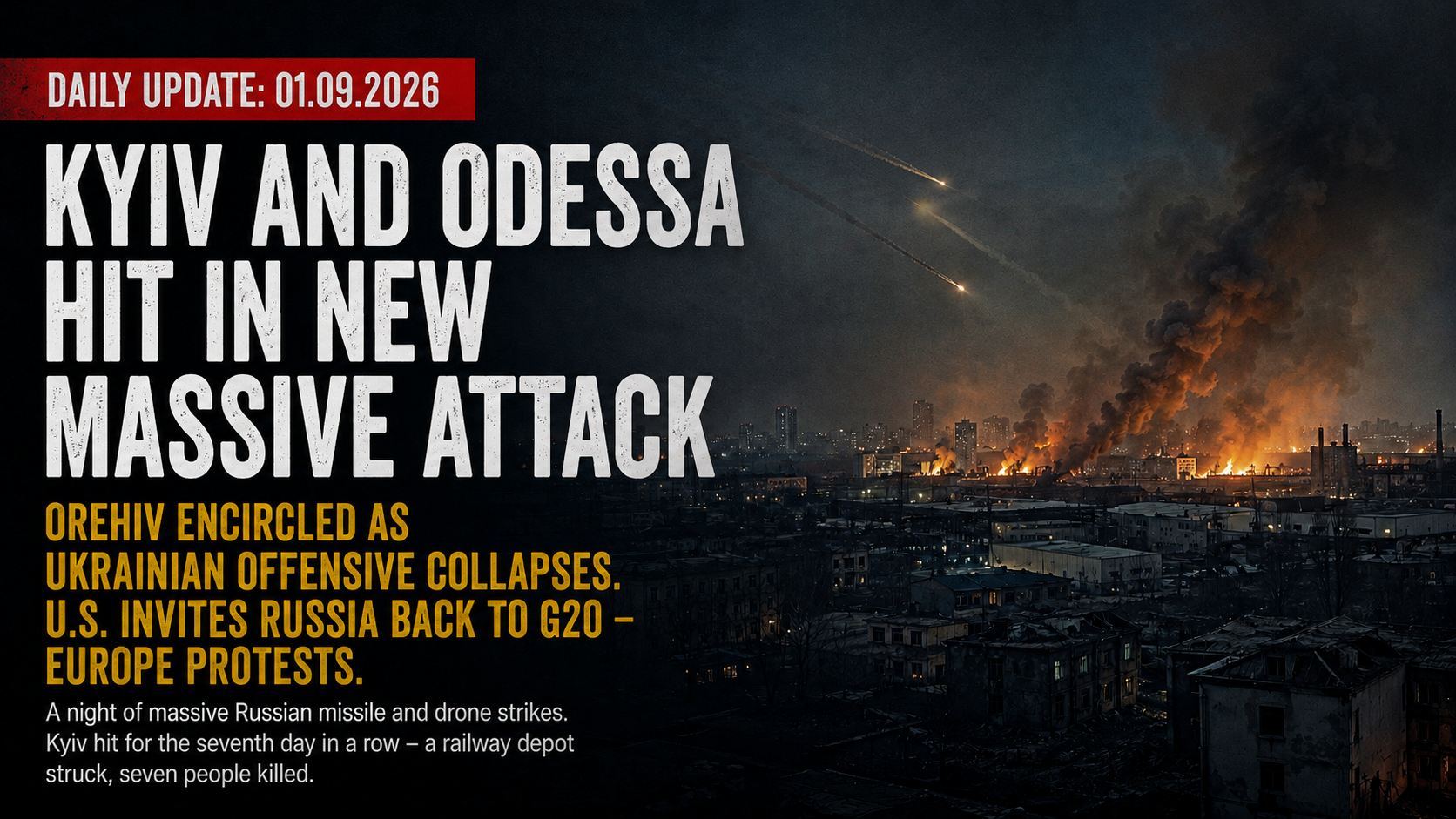
During the night of September 1, Kyiv and the surrounding regions were struck by another large-scale Russian missile and drone attack. Oleksandr Pertsovskyi, head of Ukraine’s railway company, said that a ballistic missile strike on a railway depot killed seven people, six of them railway employees. Initial reports of three people killed in Kyiv were later revised upward to eight fatalities in the capital, while another four people were killed in the Kyiv region, where Boryspil, east of the capital, was among the locations struck.
The Russian Ministry of Defence said that the attack targeted, among other facilities, the Fire Point plant, which Russian authorities say produces components, warheads and solid-fuel boosters for the Flamingo cruise missile, as well as the locomotive repair facility in Darnytsia, which repairs locomotives used for military freight transport. In recent weeks, Ukraine has stopped publishing the same level of detailed official figures on the number of Russian missiles launched as it did previously.
Orikhiv: Chervona Krynytsia and Novopavlivka Fall – Encirclement Completed
The military analysis channel Military Summary reported on September 1 that Russian forces had captured the villages of Chervona Krynytsia and Novopavlivka in the Zaporizhzhia region. Russia’s Ministry of Defence reported the same day that both settlements had been taken. The two locations are positioned in such a way that together they cut, or place under direct fire control, the last remaining supply routes into Orikhiv from the northeast and west respectively. Chervona Krynytsia lies immediately adjacent to the northern supply route, while Novopavlivka effectively functions as a western suburb of Orikhiv and makes the road from Zaporizhzhia city extremely difficult to use. With both routes now either physically controlled or under constant Russian fire, Orikhiv is effectively encircled.
This does not appear to be a random development, but rather bears the hallmarks of a coordinated operation under unified command. After General Ivanay was transferred from Group East to Group Center to lead the battle for the Sloviansk-Kramatorsk conurbation, General Teplinsky – commander of Russia’s Airborne Forces and a central figure in Group Dnepr – appears to have assumed overall operational command around Orikhiv, including forces from Group East that originally advanced into the area. The formal command structure has not been publicly confirmed, but the advances by the two Russian force groupings appear clearly coordinated.
Manpower Crisis: 30,000 New Soldiers a Month Just to Stand Still
Kyrylo Budanov, head of the Presidential Office and former intelligence chief, said in a recent interview that Ukraine needs at least 30,000 newly mobilised personnel every month simply to maintain what the country already has – not to expand its forces. This provides an indication of an overall attrition from available service of around one thousand men per day, including those killed, wounded and otherwise removed from combat duty. It does not mean that one thousand soldiers are being killed every day, but that roughly that number must be replaced if force levels are to remain unchanged.
By comparison, Russia reports sustained voluntary recruitment of around one thousand personnel per day, without a new general mobilisation. Russian authorities have meanwhile dismissed repeated rumours of an impending compulsory mobilisation of 600,000 men after the September parliamentary elections as unfounded.
Bessent to Siluanov: Nothing Happens Until the War Is Over
At the G20 finance ministers’ meeting in Asheville, North Carolina, Russian Finance Minister Anton Siluanov attended in person for the first time since 2022 – following an invitation from the United States. According to Reuters, US Treasury Secretary Scott Bessent made clear to Siluanov that no economic relief or agreements in other areas were possible until the war was over – and interrupted him when he attempted to raise other areas of cooperation. “Nothing is possible until the war is over,” Bessent reportedly said. The meeting, then, was not an American economic accommodation of Russia, but a direct rejection of normalisation – delivered face to face.
European participants nevertheless reacted strongly to Siluanov’s presence itself. German Finance Minister Lars Klingbeil said that Siluanov’s participation sent a “quite troubling” signal and that he wanted greater clarity from Washington that the Russian minister would not be received as a normal guest. European representatives also refused to participate in the traditional group photograph if Siluanov was included, and the photograph was ultimately taken without him. Polish Finance Minister Andrzej Domanski expressed strong dissatisfaction with Russia’s presence, while acknowledging the United States’ right as host to invite whomever it wished.
The episode illustrates a recurring pattern: Washington is willing to maintain a certain degree of contact with Moscow – albeit under strict conditions and without offering any real concessions – while European capitals continue to pursue a far more rigid policy of isolation.
Global Bond Markets in Free Fall
On Tuesday, September 1, a global sell-off in government bonds continued, pushing borrowing costs to multi-year highs. Japan’s ten-year government bond yield reached 3 percent for the first time since 1996, while British long-term borrowing costs rose to around 30-year highs. The UK 30-year yield reached around 5.9 percent, its highest level since 1998.
In the United States, the 10-year Treasury yield rose to 4.792 percent, its highest level since January 2025, while the US 30-year yield had earlier in August reached its highest level since 2007. It is therefore the 30-year, not the ten-year, US Treasury yield that is now trading at levels last seen around the time of the financial crisis. Reuters points to the renewed rise in oil prices following the US-Iran conflict, persistent inflation concerns and growing public debt as key drivers.
This is the real story finance ministers ought to be discussing with one another in Asheville – not whether Russia’s finance minister is allowed to appear in a group photograph. But the transatlantic disagreement over how to deal with Russia, combined with a global debt crisis that is worsening by the week, paints a picture of Western governments becoming increasingly incapable of coordinating a coherent response to any of the simultaneous crises confronting them.






Se og hør mer
Videoer, klipp og innslag knyttet til temaet.