
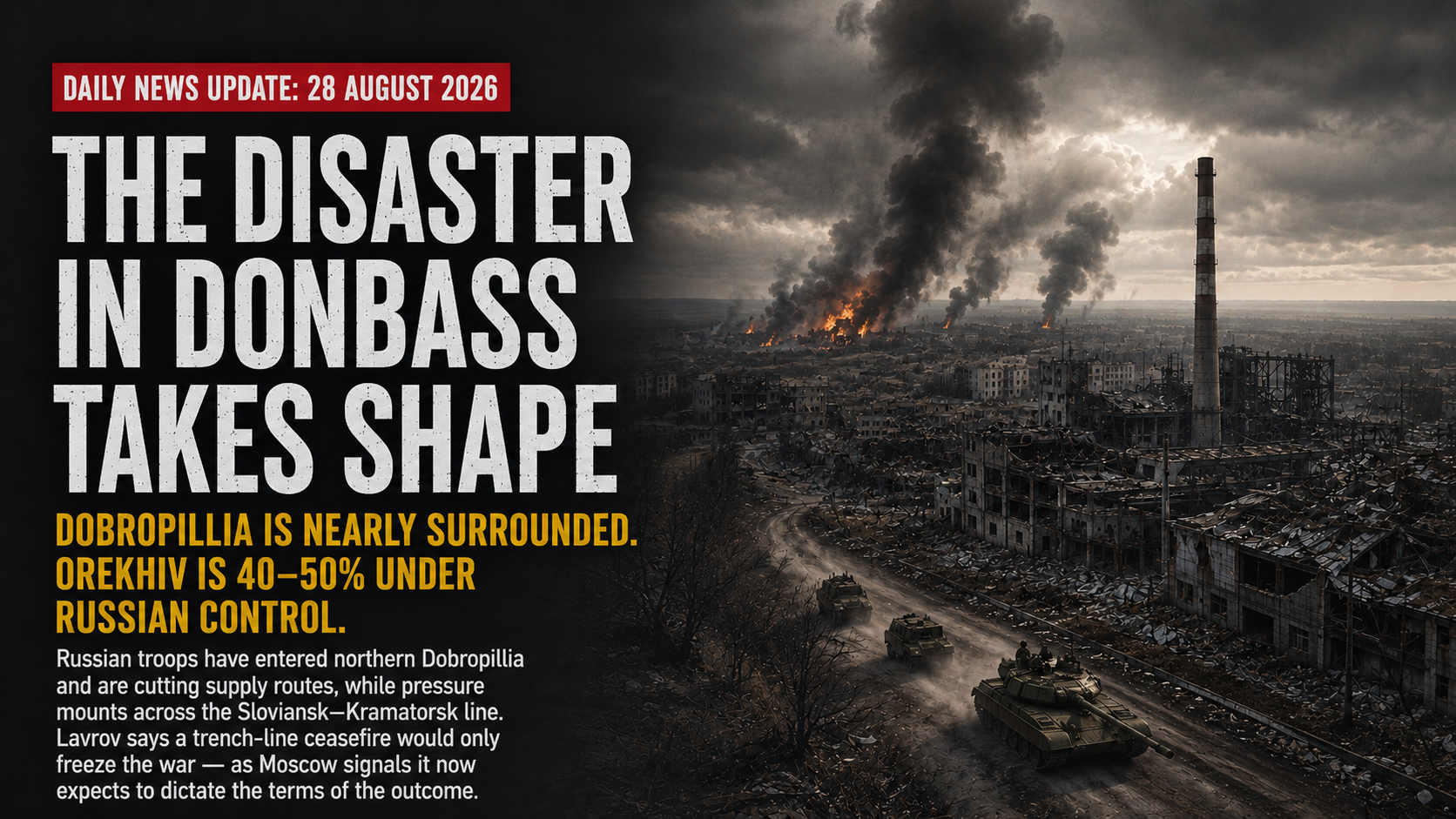
The Catastrophe in Donbas Is Taking Shape
What is now unfolding in Donbas is no longer a gradual deterioration — it is a collapse accelerating in pace.
Russian forces have advanced into the northern part of the city of Dobropillia and are cutting supply routes from the north. The village of Dobropillia — the small settlement southwest of Dobropillia city itself, which constituted the last Ukrainian defensive belt to the southwest — appears to have fallen. Russian forces now control the industrial zones in the southwestern part of the city. Maps from Ukrainian and independent Western mappers show Ukrainian forces in the city centre effectively surrounded from the north, south and east — with only a narrow, vulnerable corridor remaining open to the west.
What is crucial to understand is what the fall of Dobropillia means for the broader operational picture: Dobropillia lies west of the entire Sloviansk–Kramatorsk defensive line. When the city falls, the Russians move into what military commentators call operational space — open terrain without fortified positions to the north and west. This opens the way for a major western flanking manoeuvre that would cut the supply lines to Sloviansk and Kramatorsk and place Ukrainian forces in those cities in a cauldron. Gerasimov said this explicitly in his latest briefing: the Ukrainian army’s overriding priority is to hold the remaining part of Donbas, and to that end it is defending Sloviansk and Kramatorsk — the Druzhkivka conurbation — using multi-layered fortifications, urban infrastructure and industrial zones. Those fortifications are now under pressure from every direction.
The Azov brigades under Biletsky and Prokopenko are in Dobropillia. Prokopenko is the same Azov commander who was handed over to Turkey in 2022 under a pledge that he would not return to the war — a pledge Erdogan never kept. Both are uncompromising leaders, but both lack experience at the level of high command. That is now visible in Dobropillia: Ukrainian forces are being concentrated inside the city itself rather than securing the surrounding villages that are key to its defence. The result is that the Russians are methodically cutting off one approach road after another.
Biletsky and Prokopenko will not order a withdrawal. Doing so would undermine their political ambitions in a post-war Ukraine. The Ukrainian military leadership under Drapatyi appears to lack the authority to overrule them. It is this combination that makes it likely that Dobropillia will end in a larger catastrophe than necessary.
Any situation resulting in a catastrophic loss for the Azov movement will, almost by definition, trigger a political crisis in Kyiv of a kind we have not yet seen.
Orikhiv: 40–50 Percent Under Russian Control
In the Zaporizhzhia region, Ukrainian drone footage — material published by the Ukrainians themselves — now confirms that Russian forces are present in the centre of Orikhiv. Mala Tokmachka, the village that formed the southwestern suburb and gateway to Orikhiv, has been confirmed under full Russian control by Ukrainian drone footage showing Russian troops in the western and northern parts of the village.
Russian forces control an estimated 40 to 50 percent of Orikhiv, and possibly more. Scott Ritter (Calibrated) emphasises that Orikhiv is a crossroads for all the major roads in southern Ukraine — its fall would give the Russians an operational base for further advances north toward Zaporizhzhia city and solve the logistical problems that have so far limited the Russian pace in this sector.
Ukrainian authorities have now ordered the evacuation of Kherson city and a number of villages on the western bank of the Dnipro River southeast of Zaporizhzhia city — a strong indication that the Ukrainian military leadership expects Russian advances in this direction.
Lavrov to Gallagher: “Deception Is the Foundation of Western Diplomacy”
While Ratcliffe flew home empty-handed, Lavrov used his time in Moscow to meet the Vatican’s foreign minister, Archbishop Paul Gallagher, in the first high-level meeting between the Vatican and Russian authorities in five years. Gallagher called for an immediate end to hostilities.
Lavrov rejected the proposal: freezing the conflict along the existing lines of contact would merely postpone the conflict rather than resolve it. When Lavrov asked Gallagher whether he had raised the persecution of the Russian Orthodox Church in Ukraine with Kyiv, Gallagher admitted that he had not done so because he “had been too busy.” Lavrov’s remark — that he found this “somewhat surprising coming from a church representative” — was a diplomatic knife thrust of the first order.
In a subsequent interview with RBK published on 28 August, Lavrov’s summary of the broader diplomatic picture was crystal clear: “Deception is the foundation of Western diplomacy. And it remains so.”
He then went through the entire list: the NATO expansion assurances of 1990, the 2014 agreement on Ukraine’s political transition that was immediately cast aside, the Minsk agreements that Merkel and Hollande later acknowledged had never been intended to be implemented, the Istanbul agreement that Boris Johnson pressured Ukraine to reject, and Anchorage — where, according to Lavrov, Trump accepted Russian conditions point by point, only for the Americans later to deny that any agreement had been reached.
Asked why Russia had continued negotiating with the West through all these decades despite knowing what the West was doing, Lavrov responded with the elaborate formulation about Russian naïveté. The real explanation is probably simpler: until 2022, Russia had an economy fully integrated into the Western system and a military that was not ready for confrontation.
They waited until they were ready.
The New York Times Turns the Ratcliffe Story Upside Down
The most striking media event this week is not what happened on the battlefield, but what The New York Times published about Ratcliffe’s trip to Moscow.
The newspaper acknowledges that Ratcliffe travelled to Moscow in an attempt to persuade the Russians to stop — but claims that the reason was that the Americans are concerned Putin has been misled by his own intelligence services and generals about how badly things are actually going for Russia. Ratcliffe therefore supposedly travelled to Moscow to give Putin a more accurate picture of Russia’s situation.
That is an interpretation that is impossible to take seriously. If the Ukrainians genuinely held the initiative, Washington would not send the CIA director on a semi-secret trip to give the Russians well-meaning advice. Washington would be triumphantly demanding Russian capitulation.
The fact that The New York Times is putting this story into print — a newspaper otherwise among the best informed on American politics — is not evidence that the story is true. It is evidence that someone with access to the newspaper wants to preserve the narrative of Ukrainian initiative during a period in which the facts on the ground are telling an entirely different story.
Peskov, at his daily briefing on Friday, summarised Moscow’s position succinctly: “Peace talks on Ukraine are currently on hold. No new ideas have been floated.”
The Ukrainian side knows our demands. They do not want to discuss them. We are continuing our military operation.
Russia’s Victory Is No Longer Conditional on Negotiations
The most important takeaway from the 28 August programme is not any single event, but the overall conclusion that emerges from all of them together: Russia no longer envisages the war ending through negotiations.
It envisages the war ending through a military decision — after which Russia will dictate the terms.
That is not the same as saying negotiations are impossible. But it does mean that the only negotiations the Russians will accept are negotiations in which Ukraine accepts Russia’s minimum demands in full — and those minimum demands are far greater than what was on the table in Istanbul in 2022, in Anchorage in 2025, or in Lavrov’s most recent public statements.
There is nevertheless an argument for talking to Russia now.
Not in order to stop the war on Western terms — that is no longer possible. But in order to establish the contact that will be necessary to regulate and mediate the outcome after the war has been decided, and to prevent a Russian-dictated outcome in Ukraine from becoming the beginning of a permanent and uncontrollable confrontation without any diplomatic guardrails.
That is the last diplomatic project that still makes sense.
And no one in the West appears willing to take it up.



Se og hør mer
Videoer, klipp og innslag knyttet til temaet.