
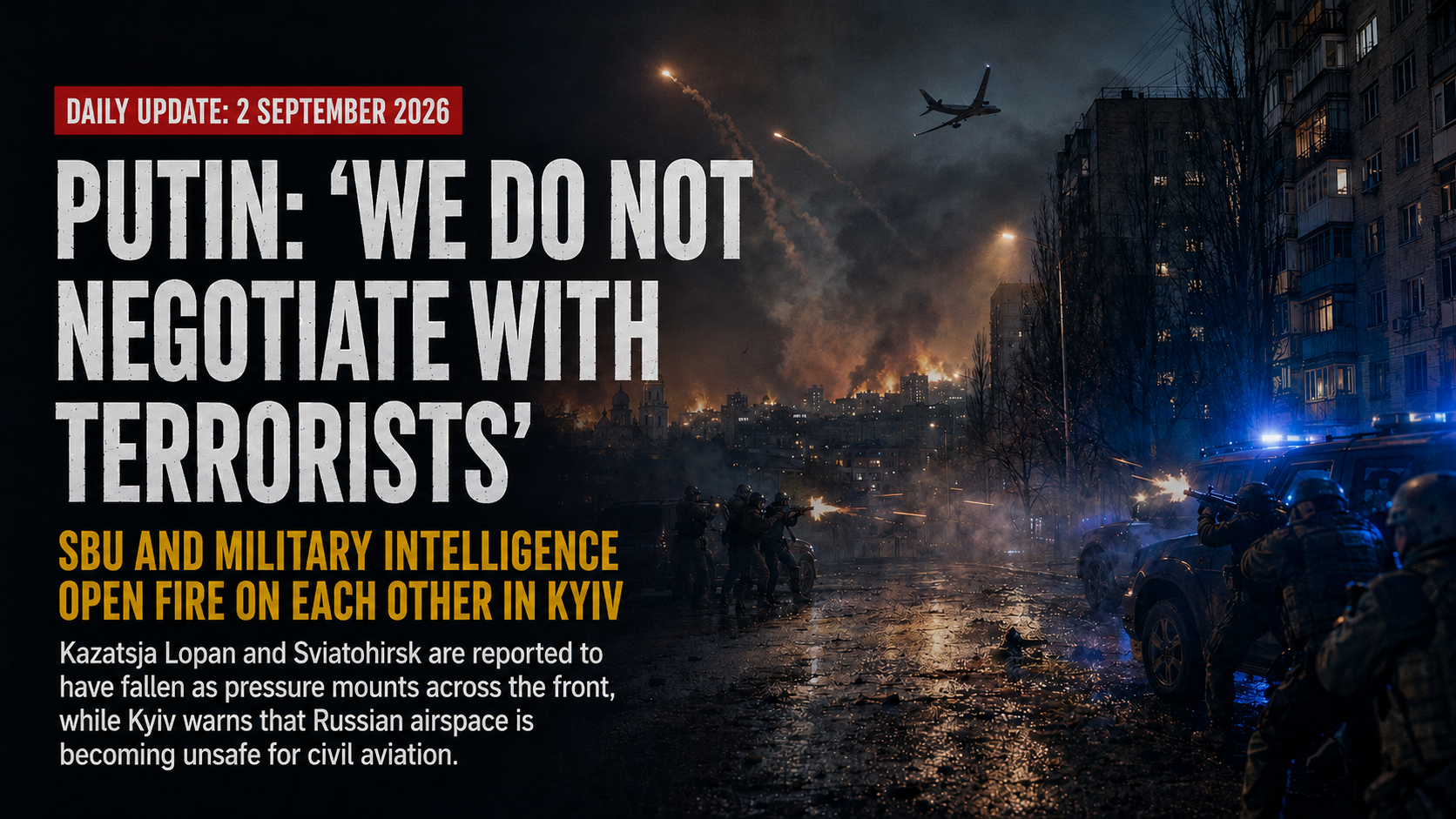
On Tuesday evening, Zelensky warned in his daily video address that “Russian airspace is becoming completely unsafe” for commercial aviation. “Ukraine does not threaten civilian aviation as such,” he said, but added that “there will simply be drones on a scale that must be taken into account,” explicitly urging foreign airlines to stop flying to Moscow and St. Petersburg.
The warning was followed by immediate disruptions to air traffic: Pegasus cancelled several flights to and from Moscow on the night of 2 September, while a number of other departures at Moscow’s airports were delayed or cancelled. Pegasus officially cited “technical and operational reasons,” but some passengers were told that the security situation in Russian airspace was behind the disruption.
Ukraine formally followed up on the warning on Wednesday and urged the International Civil Aviation Organization, ICAO, to support a complete halt to civilian air traffic through Russian airspace. China, Turkey and several Gulf states still have airlines using Russian airspace, unlike most Western carriers.
The statement confirms what The Atlantic previously revealed about Fedorov’s Moscow airport plan — an idea that was shelved when Zelensky was concerned about civilian casualties involving a passenger aircraft. Tuesday’s statement sets that concern completely aside.
Putin: “We Do Not Negotiate with Terrorists”
Putin responded the same day, during a press conference in Bishkek on the sidelines of the SCO summit, by calling Zelensky’s statement an expression of “state terrorism”. “They are asking us to resume negotiations. They are asking for personal meetings. We do not negotiate with terrorists,” he said.
The comment that “they are asking for personal meetings” indirectly confirms that CIA Director Ratcliffe’s recent visit to Moscow included a proposal for a trilateral meeting between Putin, Trump and Zelensky — a proposal Russia rejected without a fully negotiated agreement in place beforehand.
Putin was also asked why Russia has not directly attacked Ukraine’s political leadership. His answer is telling: if you kill everyone, there is no one left to negotiate with. The underlying logic is that the restraint on targeting Zelensky personally does not stem from a lack of capability, but from pressure from Russia’s BRICS partners — India and Brazil — which want the door to negotiations kept open.
SBU and Military Intelligence Exchange Fire in Kyiv
A bizarre and disturbing incident took place on 2 September in Kyiv’s Dniprovskyi district: employees of Ukraine’s Security Service, the SBU, and military intelligence, HUR, became involved in an armed confrontation on Yuriia Shumskoho Street.
The background was an operation involving Stepan Kaplunov, deputy commander of the Russian Volunteer Corps, which operates under HUR. The SBU says it was working to foil a Russian FSB operation targeting Kaplunov when armed HUR-linked personnel appeared and gunfire broke out. HUR has given a different account of events, and who fired first remains disputed.
At least three HUR personnel were wounded in the exchange of fire. Video from the scene shows extensive shooting in the residential area, while the investigation has now been taken over by Ukrainian authorities.
Zelensky demanded explanations from both services and reacted strongly to the fact that a dispute between Ukraine’s own security agencies could escalate into armed fighting in the capital.
The episode is a rare public manifestation of tensions within Ukraine’s security apparatus — exactly the kind of internal instability one would expect in a system under acute pressure from all sides, both militarily and politically.
The Front: Kozacha Lopan and Sviatohirsk Fall
Russia’s Defence Ministry announced on 2 September that Russian forces had taken both Kozacha Lopan in the Kharkiv region and Sviatohirsk in the Donetsk region. Putin had announced both captures during the press conference the previous day.
Kozacha Lopan is a settlement near the border that strengthens Russian positions north of Kharkiv city and potentially opens the way for further advances south and west, increasing pressure on supply lines around Kharkiv itself.
Sviatohirsk lies northwest of Lyman and west of the Oskil front. Russia’s Defence Ministry said that after taking the town, Russian forces were still conducting clearing operations in buildings and basements.
Ukraine, however, disputes that Sviatohirsk and Kozacha Lopan have fallen, and ISW writes that available geolocated material does not support the Russian claim regarding Sviatohirsk. The battlefield report therefore remains, for now, a Russian claim explicitly rejected by the Ukrainian side.
Putin further claimed that a Ukrainian force of between 4,500 and 4,700 troops, organised into 18 battalions, is encircled in the so-called Borova pocket north of Lyman and east of Sviatohirsk. This directly contradicts Ukrainian claims over the past several days of a successful counteroffensive in precisely this area. Reuters reports Putin’s claim that substantial Ukrainian forces are surrounded, but could not independently verify it.
According to Putin, there is no such counteroffensive — there is a Ukrainian force in the process of operational collapse.
Ukraine’s Economy: Putin Sees the Outlines of Hyperinflation
One of the most interesting elements of the press conference was Putin’s assessment of the financial consequences of the war for Ukraine. He pointed to the collapse in tax revenues, the steadily growing budget deficit and the shrinking circulation of money in the Ukrainian economy. Given Putin’s own experience of Russia’s two previous periods of near-hyperinflation — in the early 1990s and after the rouble collapse of 1998 — he draws the same conclusion that a number of independent analysts have pointed to: if the current situation continues, Ukraine is moving toward hyperinflation.
The Black Sea: “Exotic” Proposals Rejected Again
Putin repeated his rejection of restarting the 2022 grain agreement and once again accused the West — particularly the Europeans — of lacking good faith in implementing the original deal. He confirmed that Ukraine has tried to mobilise Arab states, India and Turkey to pressure Russia into ending the Black Sea blockade, but dismissed all of these initiatives as “exotic” proposals made in what he described as obvious bad faith.
China Steps Back from the Ukraine Question
Another significant point from the Bishkek summit: the Chinese readout of Xi Jinping’s meeting with Putin does not mention Ukraine at all, nor does the SCO summit’s final joint statement.
That contrasts with India and Brazil, which continue to repeat standard formulations about a negotiated peace — probably to ease US sanctions pressure rather than out of genuine conviction.
China increasingly appears to be treating Ukraine as a secondary issue compared with its own confrontation with the United States and its strategic relationship with Russia.
The Overall Picture
Russia is advancing simultaneously in Kharkiv, near Lyman and in Zaporizhzhia. Putin is indirectly signalling that he regards Zelensky as a terrorist with whom he will not negotiate. Zelensky responds by threatening civilian aviation over Russia — a threat foreign airlines are already taking seriously.
And in Kyiv, the country’s own security services are shooting at one another in the streets, a symptom of a system under pressure that is now coming from every direction at once — militarily, economically and internally.


Se og hør mer
Videoer, klipp og innslag knyttet til temaet.