
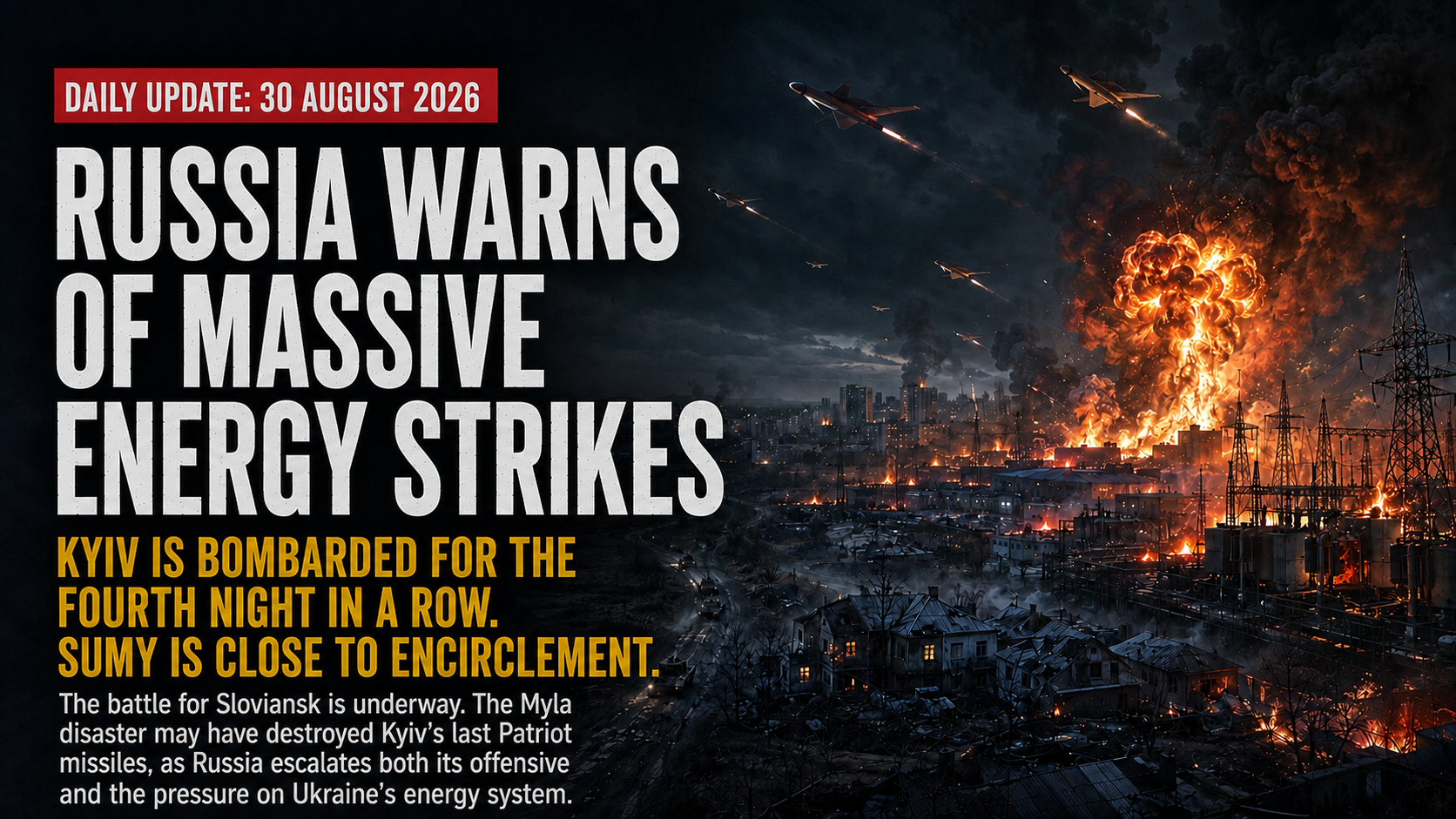
An Unprecedented Announcement from the Russian Defence Ministry
On Sunday, 30 August, the Russian Defence Ministry published a statement unlike anything seen in this war so far: “In accordance with instructions received, the Russian Armed Forces have begun preparations for massive strikes against Ukrainian energy facilities in response to the Kyiv regime’s ongoing attacks against Russia’s civilian infrastructure and fuel and energy complex.” Kyiv Post confirms that the statement was published on Sunday morning and characterises it as a direct response to Ukraine’s continuing drone campaign against Russian oil facilities and commercial logistics hubs.
There are two things that are extraordinary about this statement. First, it is extremely rare for Russia to publicly preannounce its strikes. Throughout the war, Russian military practice has been to attack without warning and confirm the operation afterwards. The fact that they are now announcing forthcoming massive strikes is either an instrument of psychological warfare — intended to create panic and flight from Ukrainian cities — or a warning to Western diplomats to leave Ukraine before the operation begins. Or both.
Second, the statement explicitly says that instructions have been received — meaning that Putin personally issued them. This is a formal delegation of responsibility that places the coming operation at the highest level of Russian political decision-making. The three mysterious decrees Putin signed in the days following Ratcliffe’s Moscow visit increasingly appear to have contained precisely this.
Ukraine’s energy system has already been reduced to one-fifth of its original capacity after four years of Russian strikes. Three Ukrainian-controlled nuclear power plants provide most of the remaining electricity generation. If Russia now systematically attacks the gas distribution network in addition to the remaining power system — transformers, distribution grids, gas pipelines and heating plants — Ukrainian cities with low winter temperatures will rapidly become uninhabitable.
That is not a forecast.
It is arithmetic.
Kyiv for a Fourth Consecutive Night: The Ammunition Depot in Myla
On the night of 29 August, a Russian jet-powered Geran-4 drone struck a warehouse complex in the village of Myla in the Bucha district west of Kyiv. What followed were hours of massive secondary explosions, fires spreading to nearby homes, and the evacuation of more than 380 residents. At least 38 people were killed and 20 injured. At least 50 residential buildings were damaged, and a care facility for the elderly and disabled was hit by the detonations.
Ukrainian war reporter Anatoliy Shariy — one of the war’s most reliable Ukrainian-language reporters — claims that the depot contained PAC-3 Patriot interceptors from the latest shipment rushed to Ukraine in recent weeks. The Russians allegedly monitored the arrival of these missiles at the depot, tracked the removal of one battery’s worth to a Ukrainian brigade, and struck the remaining stockpile after the first group had been deployed. Russian intelligence concerning what is located in Kyiv is now close to complete. Zelensky announced prosecutions of those responsible for storing explosives so close to civilian homes and called it “criminal negligence” — a justified reaction that should, however, be directed at Ukraine’s own decision-makers, not at Russia.
On Saturday evening, into the night of 30 August, the attacks on Kyiv continued. According to the Russian Defence Ministry, the primary target was a cement plant that is also used for explosives production. Ukraine’s fire service documented crews moving from one fire to another across Kyiv throughout the night to deal with the many separate blazes caused by Geran-4 drones. Kyiv has now been under continuous Russian air attack for four consecutive nights.
The Last Layer of Patriot Missiles Is Probably Destroyed
If Shariy’s report is correct — and his sources are consistently reliable — it means that the last hope of anti-ballistic air defence over Kyiv is now gone. A Ukrainian official confirms that between three and eight PAC-3 interceptors were fired during the attack cycle a few days ago — probably from this shipment. The remaining missiles appear to have been destroyed in the Myla explosion. Kyiv is now open to all Russian ballistic missiles.
Russia is now primarily using jet-powered Geran-4 and Geran-5 drones over Kyiv — not the propeller-driven Geran-2 variants. These operate at high subsonic speed and have electro-optical guidance that can be directed by ground operators in Russia via Belarusian relay stations along the border, or through the Rassvet satellite system. Ukraine’s own interceptor drones are unable to stop these drones — Zelensky tried to sell them to the Gulf states, which were unimpressed — and they are unable to stop these drones. What remains of Ukraine’s conventional air defence — machine guns and older systems — can stop some, but not enough.
Ukrainian authorities appear to be aware of this. The US Embassy in Kyiv has now issued a formal warning advising American citizens not to travel to Ukraine and has tightened restrictions on the presence of diplomats’ family members in the country.
Sumy: Sadky and Velykyi Prykil Fell — Operational Encirclement Takes Shape
From the Sumy region, the Russian Defence Ministry confirmed on Sunday the capture of two additional settlements — Sadky and Velykyi Prykil. In themselves, they are not large, but their location is crucial: the fall of these two places means that Russia has now linked the various enclaves along the Russia–Ukraine border in the Sumy region into one continuous strip under its control.
That is the operational prerequisite for the next step: the complete operational encirclement of Sumy city.
Sumy is a regional capital with around 150,000 inhabitants. It sits on the main westbound road connection from Russia toward Kyiv — the same road the Russians used when they attempted to take Kyiv in the opening days of the war in February 2022. At the time, they drove through Sumy but did not stop to capture it.
Now they are preparing to take it.
Sumy is also an important road junction toward Kharkiv — Ukraine’s second-largest city, only 30 kilometres from the Russian border. Russian control of Sumy would dramatically simplify any future offensive against Kharkiv.
Mykolaivka Fell — the Battle for Sloviansk Has Begun
From Donbas: The Ukrainians have been driven out of the eastern part of Mykolaivka — the small suburb immediately east of Sloviansk. According to converging reports, Russian forces have now reached the centre of Mykolaivka, and Ukrainian control of the Sloviansk thermal power station is under critical pressure.
The fall of Mykolaivka would in practice open Sloviansk city to attack from the east.
There are also reports of Russian advances into the village of Zoloti Kolodiazi between Dobropillia and Druzhkivka — a village the Russians briefly captured in August 2025 and now appear to be taking again. And Dobropillia city is, according to all available reports, on the verge of complete collapse.
It is no longer possible to speak about a future battle for Sloviansk.
It has begun.
And it is beginning from a position in which the Ukrainian defence is weaker than at any point in the history of this war.
The Diplomatic Vacuum: Everyone Is Trying — No One Is Getting Through
A broad range of diplomats and intermediaries are currently in contact with Moscow in what appears to be a coordinated attempt to halt the Russian offensive. The United States through Ratcliffe. The Vatican through Gallagher. Brazil through Foreign Minister Vieira, who called Lavrov. Turkey through Erdogan, who is trying to revive the grain negotiations.
All with the same message: stop and agree to a ceasefire.
Russia responds by announcing massive energy strikes and accelerating on every front.
There are no new ideas. All the proposals being presented are variations of what has already been rejected repeatedly: a trilateral meeting between Trump, Putin and Zelensky; a freeze along the existing lines of contact; a Black Sea grain corridor; a free-trade zone in Donbas. Russia rejects them all on the simple grounds Lavrov formulated earlier this week: negotiations are meaningless with a party that has shown time and again that it does not honour its commitments.
And Russia means it.
The intensity of diplomatic activity in recent weeks is itself the clearest indication of how seriously Western governments view the situation. Sending the CIA director to Moscow. Mobilising the Vatican. Asking Brazil for help.
This is not diplomacy from a position of strength.
It is diplomacy from desperation.
And it is not enough.







Se og hør mer
Videoer, klipp og innslag knyttet til temaet.