
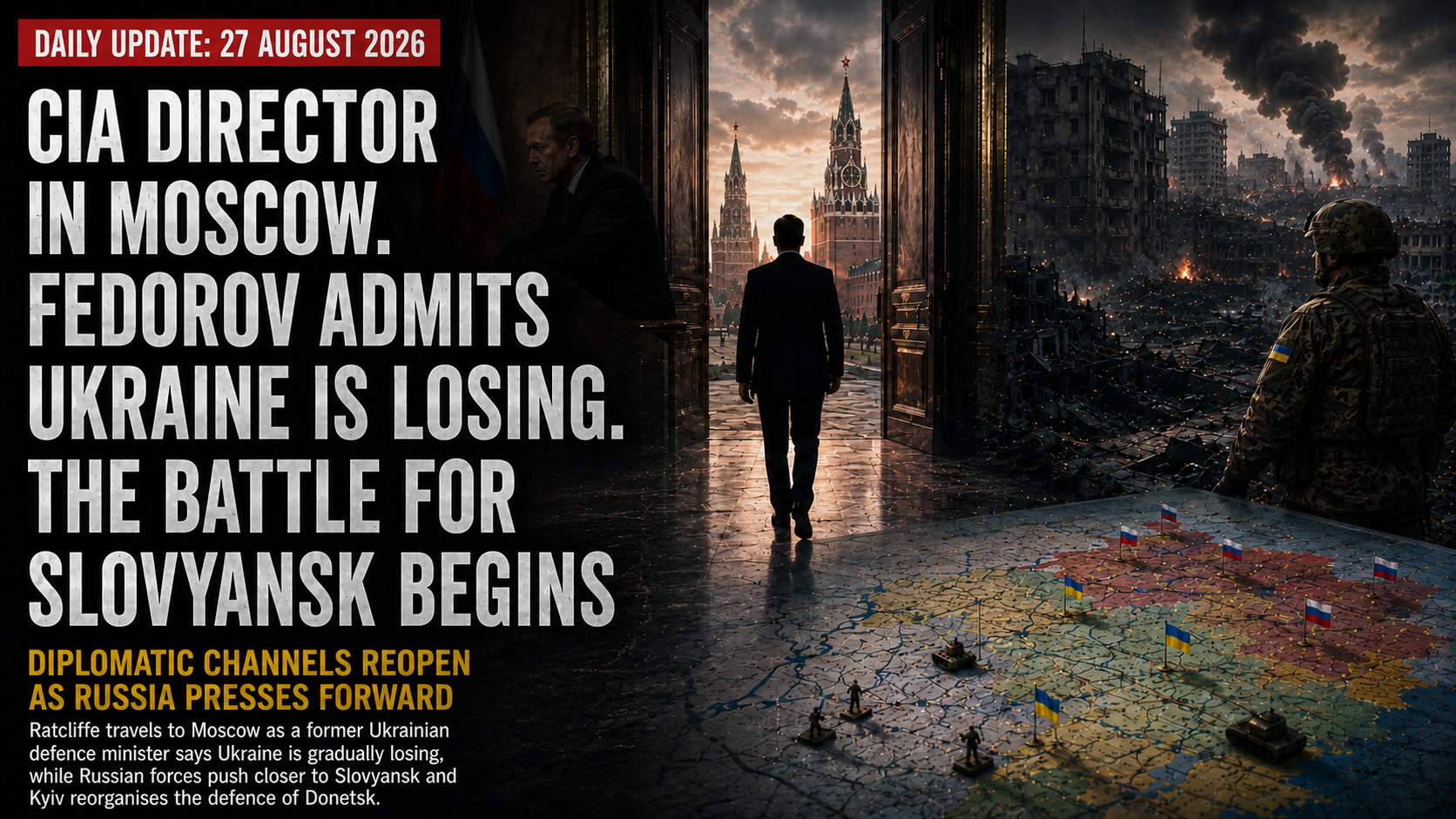
Ratcliffe’s Moscow trip: Washington goes directly to the Russians
On Tuesday, 25 August, CIA Director John Ratcliffe arrived in Moscow aboard a US military transport aircraft. The visit was the first publicly known trip by a sitting CIA director to the Russian capital since William Burns travelled there in November 2021.
Ratcliffe, however, did not get to meet Vladimir Putin. The Kremlin confirmed that Putin did not meet with the CIA director, but that the president was briefed on the talks. On Thursday, SVR chief Sergei Naryshkin also confirmed that he had held a “working meeting” with Ratcliffe in Moscow. What the two actually discussed has not been made public.
This is precisely what makes the visit interesting.
Donald Trump has sought to play it down as a more or less routine meeting between intelligence chiefs. Naryshkin has given roughly the same description. At the same time, US media, citing anonymous sources, report that Ratcliffe was tasked, among other things, with delivering a warning against Russian military actions directed at NATO countries.
Trump himself rejected the notion on Thursday that Russia is preparing to attack NATO territory, saying that he does not believe Putin will do anything of the sort. We are therefore left with a visit whose timing, level and secrecy all suggest that more was on the agenda than has been publicly disclosed.
The most obvious question is Ukraine.
Ratcliffe could have spoken with Naryshkin through established secure channels, as they have done before. If they wanted a face-to-face meeting, it could also have been arranged in a third country. William Burns and Naryshkin met, for example, in Ankara in November 2022.
This time, the CIA director himself travelled to Moscow.
It happened at the same time as Ukraine’s military situation has become increasingly difficult, and as Washington and Kyiv are trying to restart negotiations. Ukraine’s presidential office said on Thursday that trilateral talks between Ukraine, Russia and the United States could be attempted again as early as September.
There is no public documentation of what Ratcliffe put on the table. But if Ukraine was a central topic, it is reasonable to assume that the talks touched on the possibility of a ceasefire or other arrangements that could freeze or end the fighting, together with questions concerning US support for Ukraine, Russian support for Iran and relations between Russia and NATO.
It is therefore too early to conclude that Ratcliffe was “rejected” or returned home empty-handed. But one thing is clear: he did not get to meet Putin, and Russia has so far given no public indication that it intends to halt its offensive on the terms sought by Washington and Kyiv.
That makes the journey itself remarkable. The United States is no longer sending only envoys such as Steve Witkoff and Jared Kushner. Now the CIA director himself has travelled to Moscow.
Fedorov breaks a taboo: “We are gradually losing”
At the same time, a far more direct admission came from Kyiv.
Dismissed Ukrainian Defence Minister Mykhailo Fedorov says in an interview with Reuters that Ukraine appears to be in the process of losing the war.
“I believe this is now a turning point that will determine our future course. But it looks as though we are gradually, slowly losing,” Fedorov said.
What is remarkable is not merely the words themselves, but who they come from.
Until recently, Fedorov was portrayed as one of the architects of Ukraine’s technological warfare — the man who was supposed to use drones, artificial intelligence and digitalisation to compensate for Russia’s vastly greater industrial and human resources.
Now he is publicly saying that Ukraine lacks a coherent plan for how the war is actually supposed to be won.
He still believes the trajectory can be reversed, but points, among other things, to the need for much faster technological development, better drones, cheaper systems for stopping ballistic missiles and a stronger Ukrainian missile capability.
The problem is that several of the capabilities Ukraine is asking for are either directly American or dependent on American technology, intelligence and infrastructure.
That makes Fedorov’s statement bigger than an internal Ukrainian political dispute. For the first time, a recently serving Ukrainian defence minister is publicly saying what previously had largely been confined to critics of Ukraine’s war strategy:
The trajectory is moving in the wrong direction.
Vatican foreign minister in Moscow at the same time as Ratcliffe
Ratcliffe was not the only Western representative in Moscow.
The Vatican’s foreign minister, Archbishop Paul Gallagher, met Russian Foreign Minister Sergei Lavrov on 25 August. These were the first face-to-face talks at this level between Russia and the Vatican in five years.
Gallagher called for an end to the war in Ukraine and warned that every day the war continues creates new victims and makes future reconciliation more difficult.
The fact that the Vatican’s envoy and the CIA director were in Moscow at the same time is interesting, but there is no public documentation showing that the visits were coordinated.
Nevertheless, they fit into the same broader picture: after several years in which direct Western contact with Moscow was politically almost toxic, the channels are now being activated again.
And this is not happening while Ukraine is advancing.
It is happening while Russia is.
Four kilometres from Sloviansk — according to Gerasimov
On the battlefield, a significant announcement came on 27 August from Russian Chief of the General Staff Valery Gerasimov.
During a visit to Russia’s “South” group of forces, Gerasimov said Russian forces had, in certain sectors, broken through the first Ukrainian defensive line in front of the Sloviansk–Kramatorsk area.
He also claimed that Russian forces are now around four kilometres from the eastern outskirts of Sloviansk, and that street fighting is taking place in Mykolaivka and Nikanorivka.
It is important to emphasise that these are Russian military claims. The Ukrainian mapping service DeepState has not confirmed the Russian claim of four kilometres, but it has recorded Russian infiltration in the Mykolaivka area and describes a clear deterioration of the situation along the approaches to Sloviansk and Kramatorsk.
It is therefore still too early to say that the battle for Sloviansk itself has begun in the sense of fighting inside the city.
But the battle for the city’s eastern defensive belt is underway.
And that is strategically important. Sloviansk and Kramatorsk together constitute the core of the last major contiguous Ukrainian fortified urban zone in the part of the Donetsk region still controlled by Kyiv.
If this area falls, the entire character of the Donbas front changes.
Zelensky puts Biletsky and Prokopenko in charge of the Donetsk defence
Kyiv is simultaneously responding with a significant reorganisation.
On 26 August, Zelensky announced that two new force groupings would be established to strengthen the defence of the Donetsk region. They will be led by Andriy Biletsky and Denys Prokopenko.
Biletsky commands Ukraine’s 3rd Army Corps, while Prokopenko commands the National Guard’s 1st Corps “Azov”. Prokopenko is particularly well known as the commander of the Azov forces during the Battle of Mariupol in 2022. He was captured after Azovstal, later released in a prisoner exchange and sent to Turkey before returning to Ukraine in 2023.
The fact that these two in particular are now being given central roles in the defence of Donetsk says something about how highly Kyiv is prioritising the area.
It would, however, be speculative to state in advance that they will refuse to withdraw if the situation requires it. What can be established is that Ukraine is deploying two of its most high-profile and politically significant field commanders to a front facing increasingly intense Russian pressure.
That does not look like preparation for a front Kyiv considers stable.
Zelensky awards Musk the Order of Liberty — while Ukraine asks for more Starlink
At the same time, Ukraine is trying to solve another problem.
On 26 August, Zelensky awarded Elon Musk Ukraine’s Order of Liberty, one of the country’s highest honours for foreign citizens.
The stated reason was Musk’s contribution to protecting human life and freedom and to strengthening relations between Ukraine and the United States.
The timing is interesting.
Ukraine wants SpaceX to expand Starlink coverage so that Ukrainian systems can operate farther inside Russian territory. Kyiv has specifically pointed to the possibility of using the satellite connection to strike Russian missile-launch systems before they have time to fire their weapons.
Musk has previously been highly reluctant to allow Starlink to be used for offensive operations deep inside Russia. Reuters reported on Wednesday, however, that Ukraine believes SpaceX’s response has recently become more positive.
That does not mean the medal is payment for Starlink access, and there is no documentation of any such agreement.
But Zelensky is awarding Musk one of Ukraine’s highest honours at the very moment Kyiv is trying to persuade him to give the country a capability that could have direct military significance.
The coincidence is difficult to ignore.
The diplomatic and military balance sheet
Taken together, the events of the past few days paint a clear picture.
The CIA director has travelled to Moscow and met the head of Russian foreign intelligence.
The Vatican’s foreign minister has met Lavrov and called for an end to the war.
Washington and Kyiv are once again talking about possible negotiations with Russia in September.
A recently dismissed Ukrainian defence minister is publicly saying that the country is gradually losing the war.
Russia claims to have broken through the first defensive line in front of Sloviansk–Kramatorsk and to be four kilometres from Sloviansk, while Ukrainian mapping sources also confirm Russian infiltration and increasing pressure in the area.
Zelensky is responding by reorganising the defence of Donetsk and placing Biletsky and Prokopenko at the head of two new force groupings.
At the same time, Kyiv is trying to obtain greater access to American technology — from air defence and artificial intelligence to Starlink — that could compensate for Russia’s growing material advantage.
None of these developments alone decides the war.
Taken together, however, they point towards a shift.
The diplomatic question is increasingly less about how Ukraine will retake the territories it has lost, and increasingly about where the front line will be on the day the parties are ultimately forced to negotiate an end to the war.
That is why Ratcliffe’s Moscow visit is more important than the official description of a “routine meeting” suggests.
He did not travel to Moscow in a vacuum.
He went there at the same time as a former Ukrainian defence minister publicly said that Ukraine is gradually losing, while Russian forces were pressing closer to Sloviansk and Kyiv was reorganising the defence of the last major fortified urban zone in Donbas.
The middlegame may be drawing to a close.
The battle over how the war ends has already begun.


Se og hør mer
Videoer, klipp og innslag knyttet til temaet.