
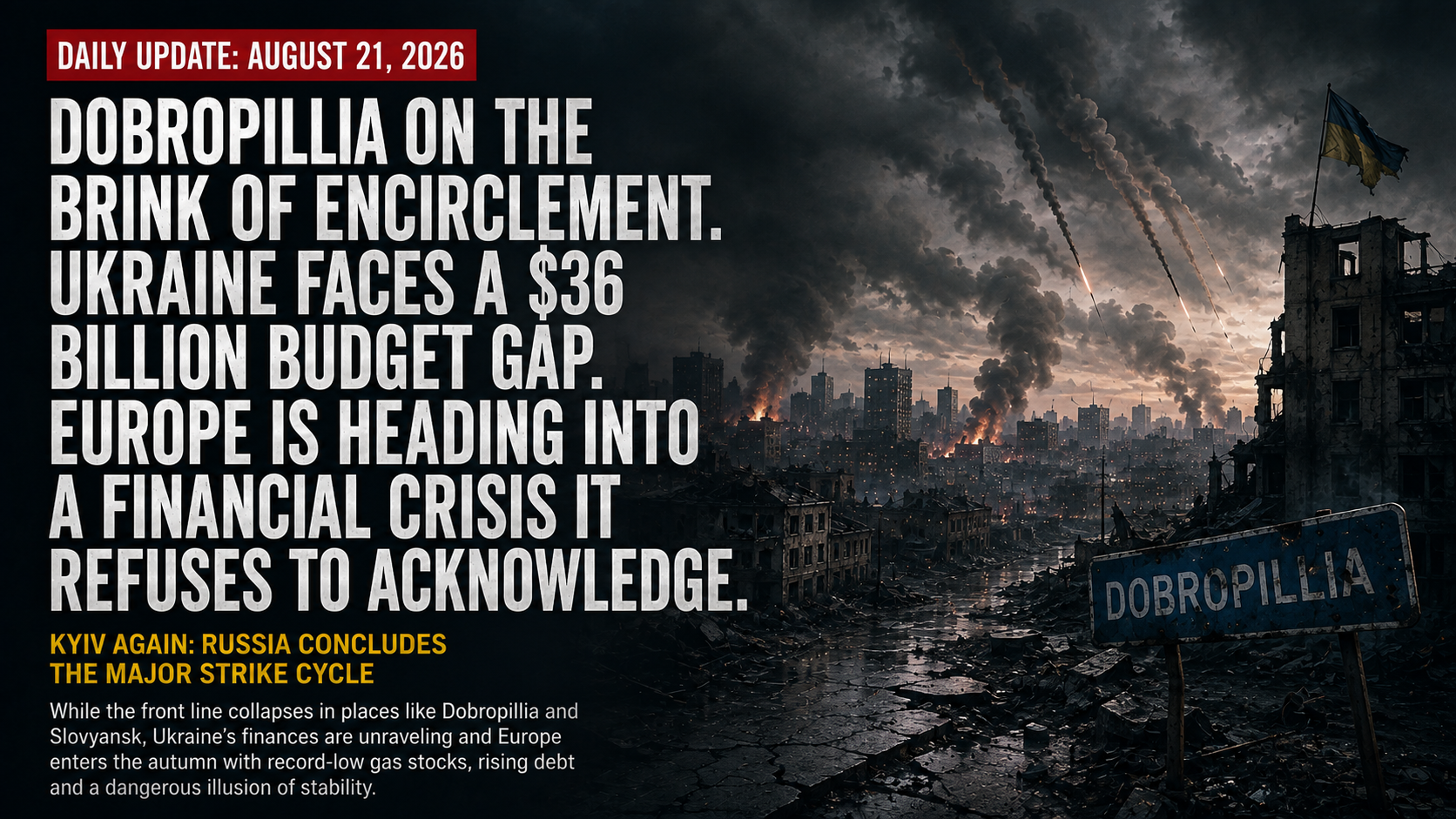
Kyiv Again: Russia Brings the Major Strike Cycle to a Close
On the night of August 22, Russian forces carried out another attack on Kyiv — this time on a somewhat smaller scale than during the previous two nights, suggesting that the massive strike cycle is now drawing to a close. Among the confirmed targets was a railway facility in Kyiv where locomotives were stored — another element in Russia’s systematic campaign against Ukraine’s railway fleet. The Russians are particularly focused on destroying locomotives because they know Ukraine uses a broader rail gauge than Europe, making Western replacement locomotives unusable without costly and time-consuming conversion. Attacks on the Danube ports of Izmail and Reni are continuing — a route that now appears to be used for military supplies via Romania and Moldova since the Black Sea ports are closed.
Dobropillia: From Encirclement to Collapse
The Russian newspaper Raovka, which has consistently demonstrated that it has reliable sources within the Russian military, published a detailed analysis on Friday of the situation around Dobropillia. It confirms Russian control over a broad belt of spoil heaps, coal mines and industrial facilities east of the city — elevated terrain that gives the Russians direct observation over Dobropillia without the use of drones. South of the city, the 76th Guards Air Assault Division is pressing in from two directions.
The decisive factor now is the village of Dobropillia — a small settlement southwest of the city of Dobropillia itself which, despite having the same name, is a separate locality. Raovka described it as the last Ukrainian linchpin in the defence south of the city and suggested that the fall of this village would open the way for the encirclement of the entire city of Dobropillia from the west and north. By Friday evening, reports began to emerge that this very village had fallen. The Russian Ministry of Defence has, at the time of writing, not yet formally confirmed the capture — but the reports are coming from too many independent and reliable sources to be dismissed.
If the village of Dobropillia is in Russian hands, the encirclement of the city of Dobropillia is in the process of being completed from the west. Combined with Russian advances from the east and north, the Ukrainian defence in Dobropillia is caught in a pincer with no open escape corridors. It is the same pattern we saw in Selydove in the autumn of 2024 — encirclement from the east, outflanking from the west, collapse. The entire western flank of the Sloviansk-Kramatorsk conurbation is now at risk.
Mykolaivka and Sloviansk: Report After Report Confirms the Unthinkable
Reports from Suriyak and other Western-oriented Ukrainian mappers — known for using conservative, documentable standards — are now confirming what until recently had only been claimed by Russian military sources: Russian forces are present in Mykolaivka, an eastern suburb of Sloviansk. And Russian forces are in the process of consolidating their positions on the territory around the Sloviansk Thermal Power Plant.
Two extremely serious developments are taking place simultaneously. Mykolaivka controls the eastern approaches into Sloviansk. The Sloviansk Thermal Power Plant is the heart of the energy supply for Sloviansk and Kramatorsk. Both are now under Russian pressure — and it is no longer only Russian military sources saying so. Western-oriented Ukrainian analysis channels are saying it as well.
Ukraine’s Budget: $36 Billion Missing — and the House Is Starting to Burn
TASS reported on Friday, based on data from the Ukrainian Ministry of Finance itself, that Ukraine had planned to receive $49 billion in international financial support in 2026 from the EU, IMF and World Bank. To date, Western partners have delivered less than $13 billion, leaving an uncovered gap of more than $36 billion. TASS is a Russian news agency with obvious interests — but in this case it is relying on publicly available Ukrainian budget data.
What is remarkable is not the gap alone. It is the recognition of what it means. Ukraine’s former foreign minister Dmytro Kuleba — a hardliner and nationalist with no inclination whatsoever to concede anything to Russia — said on August 18 that Kyiv had reached the “ceiling” of international support and would not receive more than what had already been committed. He warned that Kyiv “must be extremely careful” about what it expects from abroad.
Ukraine’s military expenditure in 2026 is estimated at record levels of more than $98 billion — more than twice the country’s total state budget. Ukraine’s total state expenditure in 2026 is approaching the country’s entire GDP. This is a situation barely documented in the history of any nation in modern peacetime. And it is a situation dependent on a continuous stream of Western financing remaining intact — at a time when that stream is beginning to falter.
The United Kingdom, under its new prime minister Andy Burnham and finance minister John Healey, has, according to informed sources, scaled back financial transfers to Ukraine from the high levels seen under the Starmer government. This has happened without any public announcement. And it is probably beginning to repeat itself in other European countries.
The Risk of Hyperinflation Is Real
A war cannot be financed with money that does not exist. Ukraine cannot collect tax revenues from an economy in free fall. It cannot sell bonds on international capital markets because its creditworthiness is close to zero. It cannot export grain, steel or refined petroleum products because the ports are closed and the refinery has been destroyed. And it cannot reduce military spending because it is fighting an existential war along a 1,200-kilometre front line.
A country in this situation has historically had two options: external financing or inflation. Weimar Germany’s hyperinflation in the early 1920s arose on precisely the same basis: a state that could no longer finance its obligations through its own revenues or external debt and began printing money. The process was slow at first, and then — within weeks — became uncontrollable. Ukraine has repeatedly avoided this scenario since 2014 because Western financing arrived in time. The question is whether it will do so again this time.
Europe’s Gas Preparedness: A Ministry That Does Not Understand Market Economics
The German Economy Ministry published a statement on Friday saying that “a gas shortage this winter is not expected” — justifying this by saying that gas can be supplied through pipelines from Norway and LNG terminals. The statement acknowledges that storage levels are “very low”, but claims that “high prices are not yet a supply crisis”. This is the classic market-theory mistake: high prices are by definition a symptom of supply being low relative to demand. Saying that high prices are not a supply crisis is the same as saying that fever is not a sign of illness.
Europe’s gas storage facilities are at around 57 percent — far below normal levels for the time of year and dramatically lower than last year’s 64.4 percent at the same point. LNG from the United States is increasingly going to Asia, where buyers are offering higher prices. Qatari LNG is absent because the Strait of Hormuz is effectively closed. And the German Economy Ministry is telling the population that everything is under control. It is the same rhetoric we heard about Russian gas in 2021 — and we all know what happened in 2022.
The United States on the Brink: $40 Trillion in National Debt and a Bismarck Warning
US public debt recently exceeded $40 trillion, while bond yields have begun rising in a pattern that is causing concern among international financial analysts. The immediate cause is simple: the US government is forced to borrow in order to meet interest obligations on existing debt — creating a self-reinforcing debt spiral. Total interest payments already exceed the bloated military budget.
It is in this context that the structural weakness of Western support for Ukraine becomes clearest. Europe and the United States are heading into autumn with weak gas storage levels, high energy prices, rising public debt, rising bond yields and a Ukrainian crisis that requires ever more money. Bismarck once said that God has a special providence for fools, drunkards and the United States of America. It is still possible that another financial crisis can be avoided. But it is no longer likely.







Se og hør mer
Videoer, klipp og innslag knyttet til temaet.