
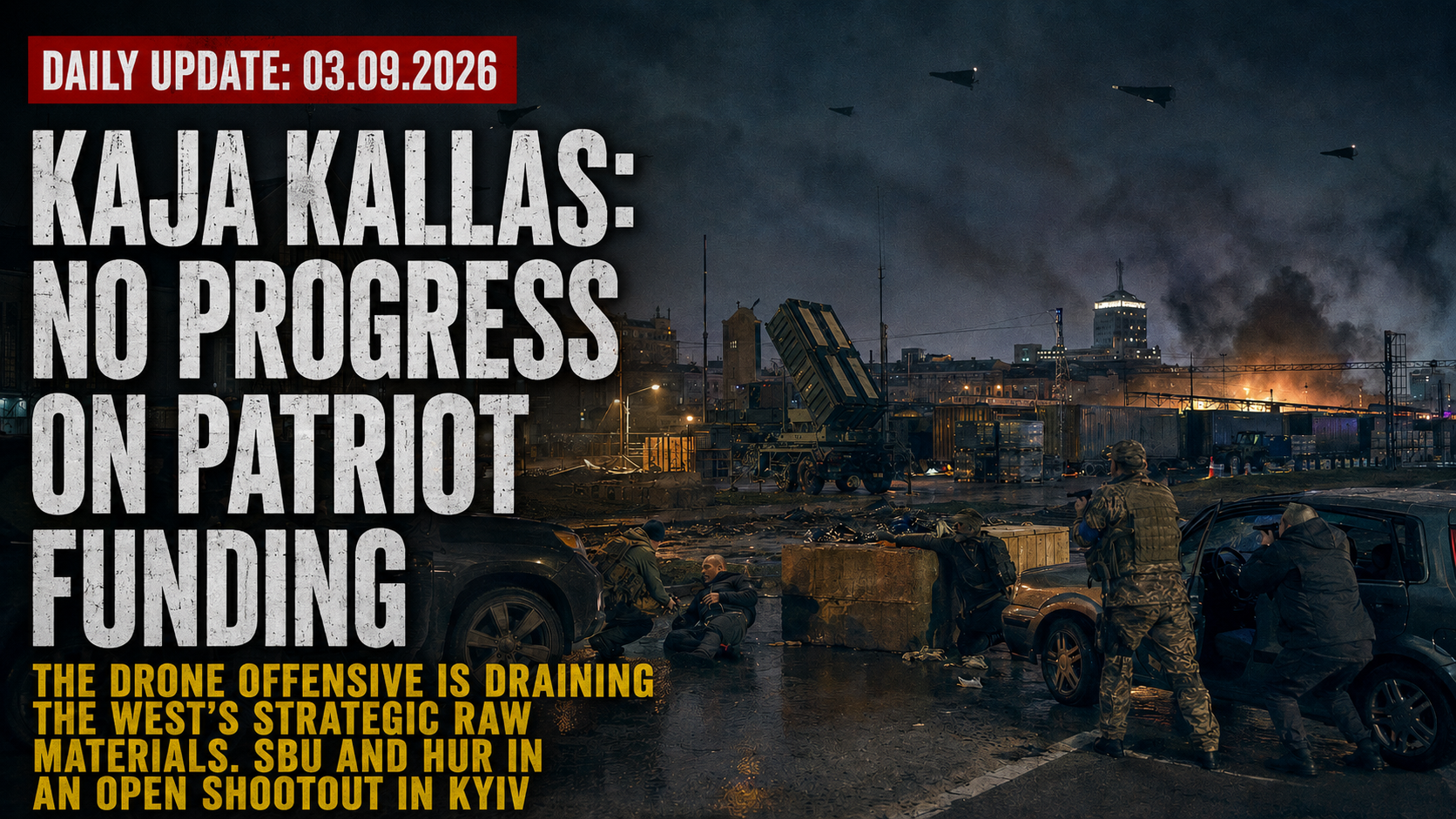
Kyiv: Another Strike Near the Central Railway Station
Geran drones have once again been active over Kyiv in recent nights, as Russia intensifies its campaign of strikes against the capital. Reuters: Russia continued drone attacks on Kyiv for a seventh consecutive day. Particularly notable was a drone strike very close to the main railway station in the city centre. Ukrzaliznytsia subsequently rejected reports that the railway infrastructure itself had been hit, while simultaneously confirming reports of a Russian drone strike near the station. Interfax-Ukraine: Ukrzaliznytsia denies a strike on the railway infrastructure itself
The station receives rail traffic arriving in Kyiv from the west and is the principal gateway for both Western officials and Ukrainian leaders travelling into and out of the capital. Dmitry Medvedev has meanwhile suggested that the railway system could soon become a Russian target — which would be a catastrophic blow for Ukraine, as extensive destruction of the rail network would in practice make rapid evacuation far more difficult for Western diplomats and advisers in the city.
Russia is also continuing to strike industrial, warehouse and logistics facilities in and around Kyiv. On Thursday, Coca-Cola’s production facility outside Brovary was hit by Russian drones; the company confirmed damage, but no employees were injured. Reuters: Russian drones struck the Coca-Cola facility near Brovary. The strikes come as Russia has increasingly targeted a broader share of Ukraine’s industrial and logistics infrastructure.
There have also been reports of earlier attacks on facilities with Western ownership or financial connections, including a FedEx-operated warehouse and a warehouse said to have had links to Palantir. Neither US nor European authorities have protested loudly against these specific strikes. One reason may be that such a discussion would simultaneously expose how little protection Western investments in Ukraine actually have against Russian long-range attacks, and could contribute to further capital and corporate flight from the country.
Rassvet Satellites May Now Have Opened Up Western Ukraine
One potentially significant technical development is that newer Russian jet-powered drones appear to have operated farther west in Ukraine than before. The Geran-4 and Geran-5 systems depend on communication with operators in order to exploit electro-optical navigation and real-time guidance, creating a communications problem once the drones move beyond the range of ground-based relay stations.
Russia has meanwhile been expanding Rassvet, its emerging Starlink-like satellite constellation. Two launches earlier this year placed 32 satellites into low Earth orbit as part of a planned constellation of around 300 satellites by the end of 2027. Ars Technica: status of Russia’s Rassvet constellation
If the latest Geran operations really have taken place with two-way real-time communications beyond the range of known relay stations, this suggests that Rassvet may have provided short communications windows over central and western Ukraine. If so, it would amount to an operational test of a system that, as more satellites become active, could extend Russia’s real-time guided drone range across the whole of Ukraine — making an already overstretched Ukrainian air-defence system even more vulnerable.
The system is still far from complete. Several of the first satellites also appear to have technical problems, underscoring that this should for now be understood as a possible emerging capability rather than full geographical coverage. Analysis of the operational status of the first Rassvet satellites
The Front: The Vovchansk Pocket, Kupiansk and Donbas
The Russian Defence Ministry has announced further advances in the Kharkiv region. Although the locations involved are small, Moscow claims that the developments have created a pocket in northeastern Kharkiv near the border, where a substantial number of Ukrainian troops are allegedly trapped.
The claim is strongly disputed by Ukraine. Ukraine’s 16th Army Corps says no positions have been lost in its sector over the past six months and explicitly rejects the existence of a “Vovchansk pocket.” Ukrainska Pravda: Ukraine rejects Russian claims of an encirclement near Vovchansk. There is therefore currently no independent documentation establishing the scale of the alleged Russian encirclement.
West of Vovchansk, Russia has also claimed control of Kozacha Lopan. Geolocated material shows that Russian forces have indeed infiltrated parts of the settlement, but control of the entire town is disputed. ISW estimates the documented Russian presence at around 13 percent of the built-up area, while Ukrainian authorities say the town remains in Ukrainian hands. ISW/CTP: mapping of the Russian presence in Kozacha Lopan
Further south, fighting continues around Kupiansk and the Oskil line. Russian sources have published drone footage said to show Russian units in and west of Kupiansk, while Ukrainian forces are simultaneously conducting counterattacks in the area. ISW describes the situation as still actively contested and has not confirmed general Russian control of the city or an unhindered advance westward. ISW/CTP: developments around Kupiansk and Borova
The same applies to the major Russian claims of an encirclement south of Borova. Moscow has claimed that as many as 13 Ukrainian battalions — around 5,000 men — are surrounded east of the Oskil reservoir. ISW says it has not observed material confirming a Russian presence throughout the area where the pocket is supposedly closed. ISW: assessment of the claim regarding the Borova pocket
In Donbas, Russian pressure on the Lyman–Sloviansk axis is continuing. There are Russian claims of control over Sviatohirsk, but these too are disputed; ISW says the available material does not document Russian control of the town. ISW: Russian claims regarding Sviatohirsk, Kozacha Lopan and Borova
That does not mean the military pressure on northern Donbas is insignificant. On the contrary, Russia continues to press multiple sectors simultaneously, while Ukraine must distribute increasingly scarce reserves across a very long front. If the Russian breakthroughs around the Oskil and north of Sloviansk develop further, Ukraine risks having to reorganise the entire defensive system north of the Sloviansk–Kramatorsk complex.
In the Zaporizhzhia region, Russian pressure around Orikhiv is also continuing, with reports and video material showing Russian units south and east of the city. The fighting over supply routes into Orikhiv is therefore becoming increasingly important to whether Ukraine can maintain a coherent defence in the sector.
Kaja Kallas: No Concrete Progress on Patriot Missiles
An informal meeting of EU defence ministers in Wicklow, Ireland, this week addressed, among other things, Ukraine’s increasingly acute shortage of air-defence missiles. Kaja Kallas confirmed after the meeting that no concrete decisions had been reached on Patriot interceptors. EEAS: Kallas’ press conference after the meeting in Wicklow
Asked directly whether member states such as Greece or Spain had pledged to transfer Patriot missiles from their own stockpiles, Kallas said there were no concrete decisions, although the discussions would continue. Full transcript of Kallas’ answer on Patriot missiles. She has meanwhile urged member states to examine whether older interceptors approaching the end of their storage life could be transferred to Ukraine.
The discussion is connected to Ukraine’s desire to use several billion euros from the EU’s new support scheme to purchase, among other things, US PAC-3 interceptors. The EU has established a €90 billion loan for Ukraine’s financing needs in 2026 and 2027, financed through the EU’s own borrowing on capital markets. European Commission: financing of the €90 billion support scheme
According to the European Commission, €11.6 billion has already been disbursed, including €3.2 billion in macro-financial support and around €8.4 billion for defence procurement. European Commission overview of disbursements. Kallas further stated that another €6.1 billion has been approved, including funding for air defence. EEAS: additional €6.1 billion approved, including air defence
The problem, therefore, is not that the entire €90 billion scheme “does not exist,” but that the money has to be borrowed progressively, while the physical availability of Patriot interceptors is a separate bottleneck. European countries must also balance Ukraine’s needs against their own air-defence stockpiles and an increasingly expensive European rearmament programme. The European Court of Auditors has meanwhile warned of persistent industrial bottlenecks and Europe’s heavy dependence on US defence equipment. Guardian: EU auditors warn of defence bottlenecks and continued dependence on the US
The Patriot problem therefore illustrates something much larger than one unsuccessful round of negotiations: money can, in principle, be borrowed, but production capacity, missile stockpiles and industrial supply chains cannot be created nearly as quickly.
Strategic Raw Materials: The Drone Offensive Is Consuming Critical Reserves
An analysis by BMO Capital Markets estimates that the drones used in the Russia–Ukraine war in 2026 alone could account for around four percent of total global demand for germanium. Review of the BMO estimate for germanium consumption. Around 15 million drones are expected to be used in the conflict during the year.
An average FPV drone is estimated to contain approximately one gram of germanium, 0.1 grams of gallium and 46 grams of NdFeB magnet material. Multiplied by 15 million drones, this corresponds to around 15 tonnes of germanium, 1.5 tonnes of gallium and 690 tonnes of neodymium-iron-boron magnets. Detailed review of the BMO calculation
This is strategically important because germanium and gallium are critical materials used in infrared optics, radar, semiconductors and other advanced military electronics, while NdFeB magnets depend on rare-earth elements. China dominates large parts of these supply chains and has tightened export controls on several of these materials in recent years.
The paradox is obvious: a drone offensive that has largely proved incapable of inflicting decisive military damage on Russia is simultaneously draining supply chains of materials that the West needs for its own defence production. Ukraine’s offensive against Russian economic infrastructure has admittedly caused significant disruption. Reuters has documented repeated attacks on oil refineries and Wildberries warehouses, among other targets, and Wildberries itself has said that a number of warehouse facilities have been hit. Reuters: Ukrainian drones target refineries and Wildberries warehouses
But every drone used against a Wildberries warehouse or another economic target simultaneously represents electronics, motors, optics and strategic raw materials that must be replaced. Once production reaches millions of units, even gram-level quantities of critical materials become a strategic industrial issue.
SBU and HUR in an Open Shootout in Kyiv
A bizarre and disturbing incident took place in Kyiv on Wednesday: members of Ukraine’s Security Service, the SBU, and military intelligence, HUR, became involved in an open exchange of gunfire, leaving at least three people wounded. Zelensky described the incident as “absolutely disgraceful” and demanded an investigation and personnel changes. Financial Times: Zelensky reacts after the shootout between the SBU and HUR RFE/RL: three wounded and conflicting accounts from the security services
The confrontation was linked to Stepan Kaplunov, deputy commander of the Russian Volunteer Corps, a Russian anti-Kremlin unit operating under Ukrainian military intelligence. The SBU arrested Kaplunov as part of what the service described as an investigation into a Russian intelligence operation. HUR-linked circles dispute parts of this account. Kyiv Independent: background to the arrest and shootout
Video footage from the confrontation shows armed members of the two services facing one another. The footage does not make it possible to determine with certainty who fired the first shot, while sources from both sides accuse the other. Censor.NET: video from the shootout itself
Nor did the incident come out of nowhere. The Wall Street Journal describes a deeper rivalry between the two powerful security agencies and links the confrontation to institutional competition, leadership changes and personal networks of loyalty. Wall Street Journal: the power struggle between Ukraine’s security services
There are also alternative theories that the conflict involves economic interests and control over lucrative businesses and call centres, but there is currently no public documentation establishing what role, if any, such interests played in the specific shootout.
Whatever the background, the very fact that Ukrainian security agencies are now engaging in public exchanges of gunfire in the streets of the capital is a sign of mounting disciplinary problems and internal tension — not something one would expect to see in a state supposedly fighting in unity for its existence.
It is probably also a symptom of a growing morale crisis in Kyiv. Pressure from the front, shortages of air-defence missiles, continuing Russian attacks against the capital and an increasingly visible struggle between centres of power are creating a very different political climate from the one Ukraine experienced earlier in the war. It is not unreasonable to assume that competition for influence, control and valuable assets intensifies as the battlefield outlook deteriorates.
Conclusion: No Diplomatic Way Out
The logical response to these developments would be a diplomatic initiative to end the war.
But any negotiated settlement that is to interest Moscow now will necessarily be discussed on an entirely different military basis than it would have been just one or two years ago. Russian authorities are making increasingly clear that they regard battlefield developments as favourable and are using them to harden their negotiating position. Putin claimed this week that Russia is winning the war, pointing to both territorial advances and encirclements of Ukrainian forces. Reuters: Putin claims Russia is winning on the battlefield and discusses possible negotiations
Any eventual agreement would therefore, in all likelihood, have to address questions concerning Ukraine’s military capabilities, its future security-policy orientation, territory and its relationship with NATO — issues Kyiv and its European backers have so far been unwilling to accept on Russian terms.
For now, no one appears prepared to put an offer on the table that Moscow has any reason to accept.
And so the war continues, while the military, economic and political strain on Ukraine increases.





Se og hør mer
Videoer, klipp og innslag knyttet til temaet.