
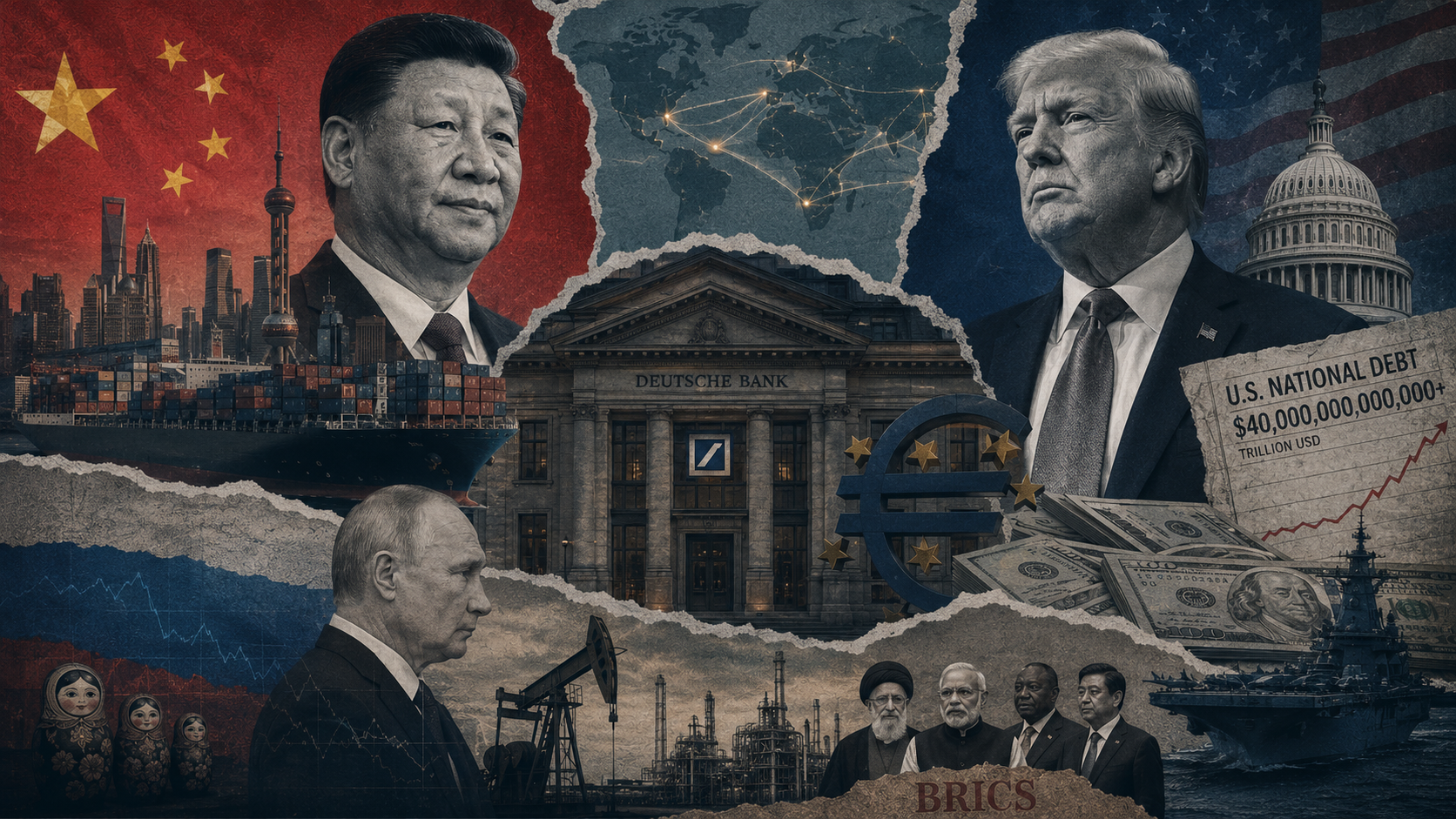

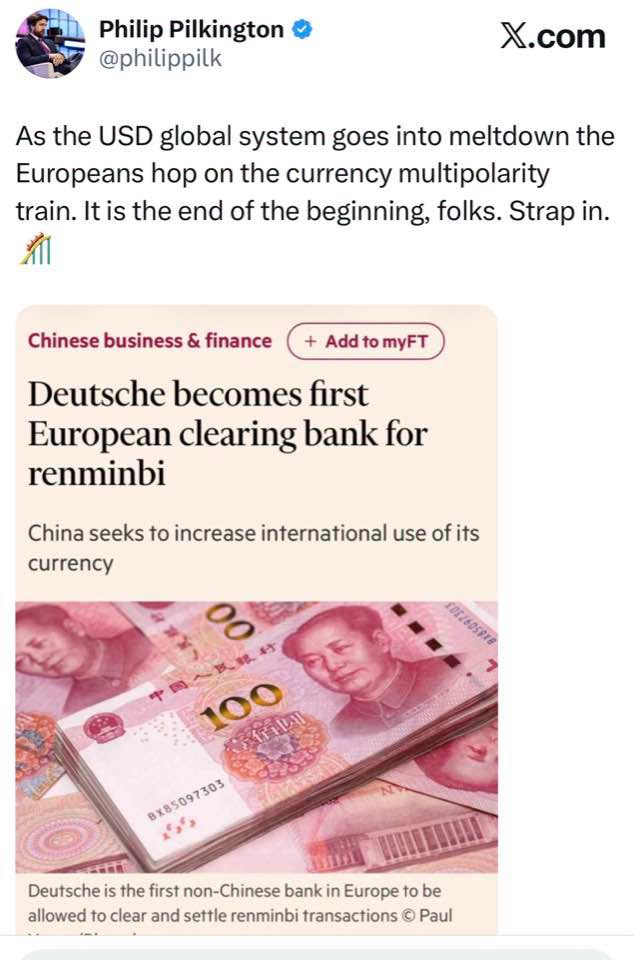
On 10 August, China’s central bank made a move that barely generated headlines outside the financial press, but deserves far more attention. Deutsche Bank in Frankfurt was authorised as an official clearing bank for the Chinese renminbi, becoming the first non-Chinese bank in Europe to hold this function.
In practical terms, this gives European financial institutions and companies a more direct channel for settlement, liquidity and financing in Chinese currency. In strategic terms, it means that the infrastructure surrounding the renminbi is moving another step into the mainstream European financial system.
The decisive point is not how large a share of global payments the renminbi accounts for today. The dollar remains clearly dominant in international reserves, capital markets and cross-border financing. What matters is the change in the architecture of the system. International trade that once naturally passed through dollars, US correspondent banks and American financial infrastructure is gaining an increasing number of alternative channels.
That distinction is fundamental. The power of a reserve currency does not depend only on its market share, but on how difficult it is to avoid.
The United States has enjoyed a historically unique position because, for decades, the dollar has simultaneously served as a means of payment, reserve asset, commodity currency, financing currency and safe haven. This role has allowed Washington to exercise economic power far beyond its own borders. When banks and companies require access to the dollar system, US authorities can in practice influence transactions between actors that are neither located in the United States nor trading with American companies.
This mechanism has been the foundation of modern American secondary sanctions. It is also why China has invested considerable resources in building a financial system in which a larger share of Chinese trade can take place without American intermediaries.
Deutsche Bank’s designation should be understood in this context. The renminbi is moving from being a currency used primarily within Chinese or China-dominated payment flows to gaining institutional anchoring at one of Europe’s largest banks, in the heart of the eurozone’s financial centre.
Sanctions Against Russia Changed the Calculation
The process accelerated after 2022.
When the United States and the EU froze large parts of Russia’s central bank reserves and excluded Russian banks from Western financial infrastructure, the West simultaneously demonstrated just how extensive its power over the dollar- and euro-based system really was. The measures were intended to inflict economic costs on Russia on a scale that would make continued warfare difficult to finance.
The result was a major economic shock, but not the Russian economic collapse many Western politicians had expected.
Russian trade was largely redirected toward Asia, the Middle East and the Global South. Energy flows found new buyers, imports were reorganised through third countries, and domestic production was expanded in areas where Western access disappeared.
Measured by purchasing power-adjusted GDP, Russia had already overtaken Germany in 2022. World Bank figures placed Russia at around 5.33 trillion international dollars, marginally ahead of Germany. Since then, the gap has widened.
Nominally, Germany remains a much larger economy when measured at market exchange rates. But for questions concerning how much energy, labour, industrial output and military material a state can mobilise within its own economy, purchasing power is a far more relevant indicator than a simple conversion into dollars.
This is not a statistical curiosity. It says something about the limits of the sanctions model. Western financial power can impose significant costs, but its effectiveness diminishes the larger the target economy is, the more raw materials it controls, and the more alternative trading partners it has.
That is precisely why China represents an entirely different order of magnitude.
China Is Not an Economy Washington Can Isolate Without Isolating Parts of Itself
The debate in Washington over new sanctions against Chinese banks because of Chinese trade with Iran exposes this contradiction particularly clearly.
China has the world’s largest industrial manufacturing base, is among the largest trading partners for a majority of the world’s countries, and controls key parts of supply chains for electronics, batteries, solar energy, rare earths and a range of strategic inputs. The country’s four largest state-owned banks have combined assets of around $25 trillion.
Applying the same model of financial isolation to China that has been used against smaller economies would therefore not amount to a one-sided attack on Beijing. It would be an intervention in the very infrastructure around which European, Asian and American trade is built.
Treasury Secretary Scott Bessent’s question as to why he would want to “blow up the global financial system” sums up the problem better than most strategy papers.
US sanctions have been most effective when Washington’s own cost has been low and the target’s dependence on the dollar system high. That asymmetry weakens dramatically when the target is China. If major Chinese banks are hit hard enough, the consequences will spread through commodity trade, industrial financing, dollar liquidity, shipping, supply chains and the operations of Western companies in China.
At that point, financial sanctions no longer function as an instrument that can be separated from the rest of the global economy.
They become a systemic weapon.
And systemic weapons have systemic costs.
Washington’s Problem Is That the Weapon Also Creates the Countermeasure
The American sanctions system therefore contains an inherent strategic contradiction.
The more often Washington uses the dollar system to freeze reserves, block payments and threaten third countries with secondary sanctions, the greater the economic value of infrastructure that makes such measures harder to impose.
For Russia and Iran, this is already a matter of economic security. For China, it is a matter of great-power strategy.
The result is not a single, coordinated “new global currency,” but a growing network of mechanisms that reduce the need for dollars in certain types of transactions.
China has built its own CIPS system for cross-border payments. Bilateral trade between China and Russia is conducted largely in national currencies. More commodity contracts are being settled outside the dollar. BRICS countries are discussing greater use of local currencies and alternative payment systems. The New Development Bank provides member states with a financing channel outside the traditionally Western-dominated institutions.
On 12 August, Iran’s central bank governor announced that the country expects to become a member of the New Development Bank. Iran is already a BRICS member, but NDB membership would integrate the country even further into this parallel financial infrastructure.
Taken individually, none of these developments transforms the world monetary system. Taken together, they gradually reduce the extraterritorial reach that has been one of the dollar’s most important strategic characteristics.
Deutsche Bank’s designation is particularly interesting because it shows that this development is no longer confined to countries in conflict with Washington. Chinese currency infrastructure is now being established inside a core institution of the European financial system.
This Is Happening as America’s Own Financial Foundation Weakens
The other side of the equation is the US economy itself.
Federal debt passed $40 trillion in August. The Congressional Budget Office projects a budget deficit of around $1.9 trillion in 2026, while interest costs are rising rapidly and debt held by the public is moving toward historically high levels relative to GDP.
The US debt situation has no simple or immediate collapse mechanism. The United States borrows in its own currency, has the world’s deepest capital market and continues to enjoy demand for Treasury securities that no other state can match.
But this privilege is directly tied to the dollar’s international role.
As long as central banks, banks, companies and investors around the world need large quantities of dollar reserves and dollar-denominated assets, the United States can finance deficits on terms that would be much more difficult for any other country. The same reserve-currency status that gives Washington sanctions power therefore also helps finance American public debt.
This is where the two trends meet.
Washington still needs high global demand for dollars at the same time as US foreign policy creates ever stronger incentives to reduce that dependence.
That is a structural contradiction, not a temporary political problem.
Europe Reveals Another Side of the Same Strain
On the European side, the costs of geopolitical confrontation are also becoming far more visible.
Latvia has asked the EU for around €7 billion in connection with sharply increased defence spending and the economic consequences of the collapse of its former ties with Russia. Riga has been among the most consistent advocates of sanctions and economic decoupling, but is now arguing that the burden cannot be carried nationally alone.
That is an important signal because it illustrates how Europe’s security strategy is increasingly becoming a fiscal issue.
Rearmament, the loss of cheap Russian energy, weak industrial growth and support for Ukraine are not isolated budget items. They compete with public investment, social policy and existing debt obligations.
Norway occupies a unique economic position, but the development is visible here as well. Support for Ukraine has increased from around NOK 10.7 billion in 2022 to NOK 85 billion annually in 2025 and 2026. Norway can finance this without the kind of debt problems facing Latvia and several other European states, but the scale illustrates how rapidly the economic commitment has expanded.
At the same time, Norway has a documented infrastructure upgrade requirement amounting to several trillion kroner, and UNICEF has for years recorded growing economic pressure on parts of Norwegian families with children.
The point is not that these expenditures can be compared krone for krone, but that European governments increasingly have to finance existing welfare systems, major investment backlogs and a security policy that is far more expensive than it was before 2022.
The Decisive Shift Is Taking Place in the Infrastructure
Dollar dominance will not disappear because BRICS adopts a declaration or because a central bank reduces its dollar share by a few percentage points. It weakens if the economic infrastructure that has made the dollar indispensable is gradually duplicated.
That is the process China is now driving.
Beijing does not need to persuade the world’s central banks to replace their dollar reserves with renminbi overnight. It is enough to ensure that Chinese trade can be financed, insured, cleared and settled without American currency whenever desired.
That makes Deutsche Bank’s new role far more significant than the size of current RMB transactions alone would suggest.
Frankfurt is not simply another point on a Chinese currency map. Frankfurt is Europe’s most important financial centre, home to the European Central Bank and one of the key nodes in the Western monetary system. When direct RMB clearing becomes a normal part of the infrastructure there, the Chinese currency moves one step closer to mainstream European finance.
At the same time, Washington is considering using its financial “nuclear weapon” against the country building this infrastructure.
It is difficult to construct a more self-contradictory strategy.
The United States is trying to preserve the dollar’s power by demonstrating how dangerous it is to depend on the dollar.
China is responding by making that dependence less necessary.
Russia has already shown that a large commodity- and industry-based state can reorganise significant parts of its economy after being expelled from Western financial channels. Iran is moving further into BRICS institutions. European banks are opening direct channels to the Chinese system. At the same time, the US debt burden is growing and the European costs of the current confrontation policy are rising.
That is what makes Deutsche Bank’s decision strategically important.
It is not primarily about how much renminbi is cleared in Frankfurt in 2026.
It is about the fact that the financial infrastructure of a post-dollar-dominated world is already being built.


Se og hør mer
Videoer, klipp og innslag knyttet til temaet.