
The attack continues — and the numbers are unknown
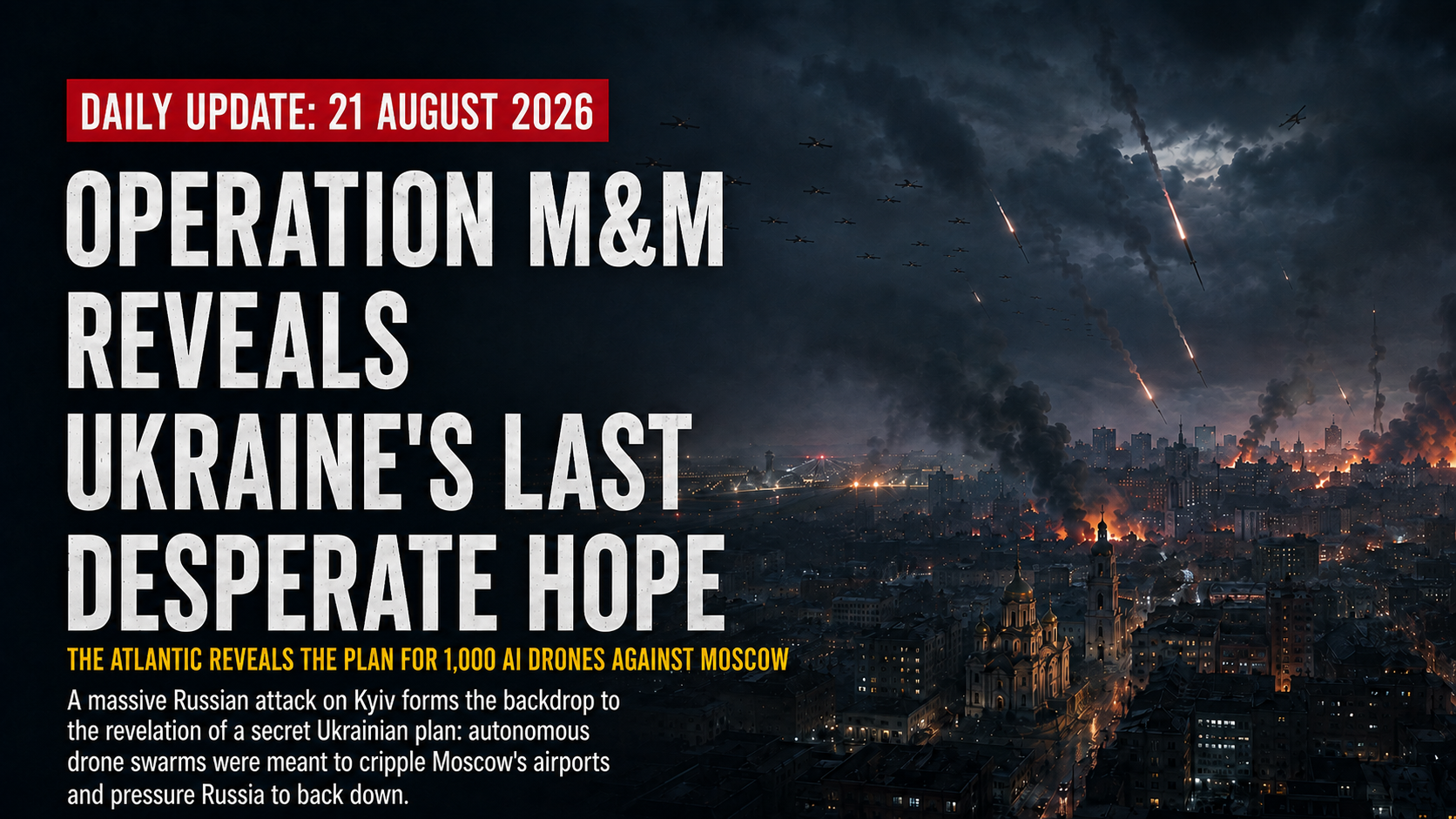
The massive Russian attack on Kyiv, which began during the night of August 20, continued through most of the following day. Hypersonic Zircon missiles, Iskander-M ballistic missiles, reportedly North Korean KN-23 missiles, air-launched Kh-101 cruise missiles, and large drone swarms struck targets in Kyiv and the surrounding regions for hours. The total number of missiles launched is difficult to determine — Russian air-defense sources report that they alone shot down 791 Ukrainian drones in a single night in August, which gives some indication of the enormous scale of operations on both sides.
Ukraine no longer reports the number of Russian missiles being launched. That is the logical consequence of a situation in which Ukraine can no longer shoot any of them down: publishing the numbers would confirm that all Ukrainian anti-ballistic defense capability is gone.
Operation M&M: The Atlantic reveals Fedorov’s final plan
The Atlantic published an exposé on Thursday, August 20, that sheds new light on the entire logic behind Fedorov’s dismissal and the internal struggle within the Ukrainian leadership. Early in 2026, Ukrainian officials — with Fedorov as the central driving force — presented Zelenskyy with a plan internally codenamed “M&M.”
The plan called for daily swarms of up to 1,000 autonomous, AI-guided drones against airports in Moscow and the Moscow region, with the explicit objective of shutting down international air traffic to and from the Russian capital. The drones would navigate without GPS and without continuous human control — using onboard cameras, stored maps, and AI-based image recognition to compare the terrain beneath them with pre-programmed targets and home in on designated objects. If a drone identified a target, it would dive and detonate without operator confirmation.
Fedorov had worked on the plan for most of 2026, assembled a team of Ukrainian programmers to develop the AI guidance system, and secured funding from Ukraine’s European allies for the mass production of autonomous drones. Planning was halted in July when Zelenskyy removed Fedorov. Zelenskyy’s presidential office denies that such a plan ever existed and calls the account “complete nonsense”.
It is not difficult to understand why Zelenskyy rejected the plan when it was presented to him. According to The Atlantic’s sources, he was concerned about one specific risk: that an autonomous drone might strike a civilian passenger aircraft, killing hundreds of passengers and destroying Ukraine’s moral and diplomatic position overnight. That is a legitimate concern. But the concern also points to something deeper: Zelenskyy is aware that a single such incident could irreversibly alter Western public opinion of the war.
The real reason the plan was stopped is probably twofold. The Ukrainian military under Syrskyi — and those within the American system who are skeptical of endless escalation — pointed to the simple fact that Russian air defenses around Moscow are close to impenetrable, and that even 1,000 drones per night would not be able to shut down Moscow’s airports permanently. One source familiar with the plan told The Atlantic that the project could be revived with a new team, but that it would take roughly three months. That is a signal that the idea has not been buried — only postponed.
What the M&M plan actually reveals
It is the strategic logic of the M&M plan that is most revealing, not its technical details. Fedorov argued that shutting down Moscow’s airports would directly hurt Russia’s oligarchs — those flying privately or internationally would be immobilized, creating internal pressure on Putin to end the war. It is the same logic that underpinned the entire drone-offensive approach: that Russians will demand peace if they begin to feel the war personally.
The empirical refutation of this logic is now four months old and comprehensive. Russians affected by Ukrainian drone attacks are not demanding peace — they are demanding more war, conducted more aggressively. One Ukrainian official described the plan in these words: “The idea is to close Moscow’s airspace to civilian flights for an extended period”. It is a plan that would never work against a state like Russia — where the oligarchs do not determine policy, and where Putin has repeatedly shown that he is willing to isolate Russia from the West if necessary.
But the M&M plan is now relevant again — not because the situation is better, but because it is infinitely worse. Orikhiv is in the process of falling. Dobropillia is under assault. Mykolaivka and the Sloviansk thermal power station are under Russian pressure. Kyiv lacks air defense. The ports are closed. And there are strong indications that Zelenskyy and the remaining Ukrainian leadership — with Fedorov gone, but his ideas still alive — are now preparing what is being described as “Ukraine’s last big throw”: a combined massive drone offensive against the Moscow region, supplemented by a new ballistic missile currently under development that is reportedly intended to reach Moscow by October.
The iron rule of this war — and what it means for the coming attack
The iron rule, confirmed time and again: whatever attacks Ukraine carries out, the Russians exceed them by an order of magnitude or more. When Ukraine attacked Russian refineries, Russia responded by knocking out the Kremenchuk refinery and ArcelorMittal’s steelworks permanently. When Ukraine attacked Wildberries warehouses, Russia responded by destroying Ukrainian grocery warehouses and food-supply facilities. When Ukraine attacked Russian energy infrastructure, Russia responded by taking out Ukraine’s last transformer substations.
If Ukraine carries out a massive attack against the Moscow region — using autonomous drones and a new ballistic missile — Russia’s response will come quickly and with far greater destructive power. It is in this context that Kinzhal missiles — used sparingly so far — and the Oreshnik system — held back for the right moment — will probably be deployed in earnest. Russia is currently building radar stations on the roofs of high-rise buildings in Moscow and installing Pantsir short-range air-defense systems in preparation for precisely such an attack. That suggests they know it is coming.
The dangerous debate approaching in Europe
The final and most worrying element of today’s update concerns not Ukraine alone, but what will happen after the coming Ukrainian offensive against Moscow fails — as it most likely will. By that point, Russian advances in Donbas, Zaporizhzhia, and Kharkiv will have been consolidated further, and it will no longer be possible for mainstream Western media to sustain the narrative that Ukraine is capable of holding the front lines on its own.
At that moment, a debate will begin — already being prepared in some European capitals — over direct Western military intervention in Ukraine. An article in The Spectator, written by the German commentator Mathias Döpfner, argues that the West must strengthen itself militarily and politically against Russia and China, concluding that the alternative is that “the tyrants win.” That kind of thinking is already present within European governments and among parts of the European public. It will grow stronger, not weaker, the closer Ukraine comes to military collapse. That is the moment of “supreme danger” — the ultimate danger — now approaching, probably sometime in late autumn.






Se og hør mer
Videoer, klipp og innslag knyttet til temaet.