
Ukrainian media dominance – and the Russian strike no one is talking about
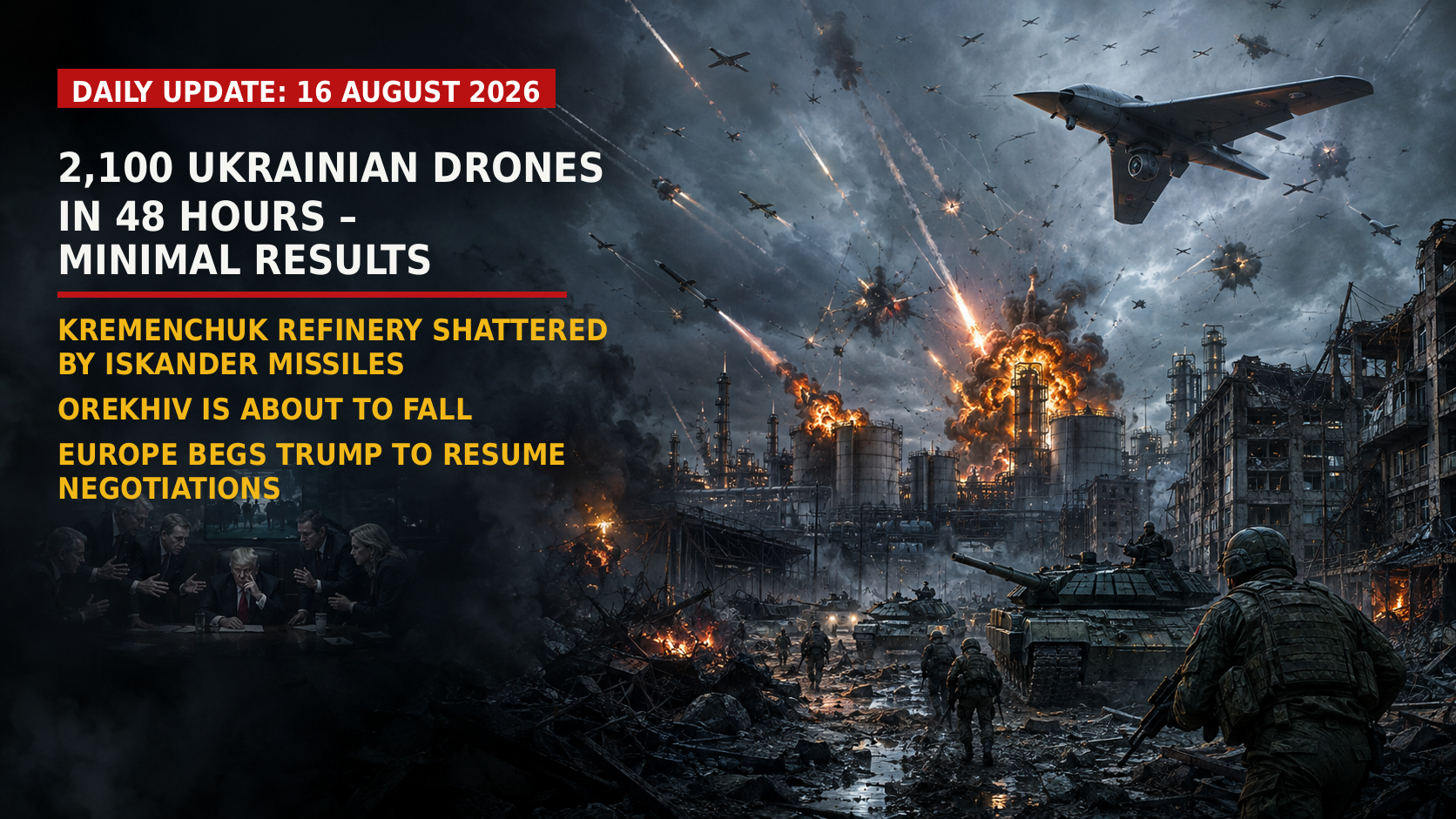
Over the weekend, Ukrainian drone and missile attacks against Russia dominated the headlines in the Financial Times, The Guardian and much of the Western media. 2,100 jet-powered drones and around 25–30 Flamingo cruise missiles were launched against Russian targets over a 48-hour period – according to the Russian Ministry of Defence, the largest number of drones launched over two consecutive nights in the history of the war. The primary target of the Flamingo missiles was the Progress Rocket Space Centre in Samara – a gigantic industrial facility with roots stretching back to the Soviet space programme, and precisely the plant that produces launch vehicles for the Rassvet satellites Ukraine has become increasingly concerned about. In addition, a MiG-31 base and two Wildberries warehouses in the Moscow region were attacked.
But what was actually achieved? Regional authorities in Samara reported that all employees and nearby residents had been evacuated ahead of the attack – which in practice means that Russian air defences had been warned and were ready. The Russian Ministry of Defence reports that 17 Flamingo missiles were shot down – the highest number in a single attack wave so far in the war. There is currently no confirmed satellite documentation of damage to the Progress plant. The facility is an enormous, partly underground industrial structure that the Russians have spent decades hardening. Even if a single building was damaged, it is reasonable to assume that production will be normalised within weeks. The attack on the MiG-31 base – which is not involved in Kinzhal operations against Ukraine – appears to have resulted in limited damage. And the two Wildberries warehouses had, by all indications, already been emptied after months of Ukrainian attacks.
The cost picture: a 48-hour drone offensive involving 2,100 aircraft at an average cost of $60,000–200,000 per drone represents expenditure of between $126 million and $420 million. The demonstrated strategic gain is close to zero.
The Russian strike no one is talking about: Kremenchuk and Kryvyi Rih smashed
While Ukraine’s offensive effort dominated the headlines, Russian forces carried out a strike on the night of 15–16 August of an entirely different order. The Kremenchuk refinery – Ukraine’s largest oil-refining complex – was hit by Iskander-M ballistic missiles. The Iskander-M carries warheads of up to 700 kilograms and arrives at hypersonic speed – its kinetic destructive power vastly exceeds what a drone is capable of. The refinery has been subjected to repeated attacks since 2022, but with Western assistance has been repaired and kept operational. The Russian Ministry of Defence stated that the remaining tank-farm facility – which according to them already bears damage from earlier strikes – is used for the transit of imported fuel and lubricants. The latest strike may very well have permanently disabled the facility.
In Kryvyi Rih – Zelenskyy’s home city – the ArcelorMittal steelworks was attacked with ballistic missiles. Thirteen workers were injured and one was killed. The steelworks is Ukraine’s most important steel-production complex and produces rolled steel used, among other things, for military hardware. It has been attacked repeatedly but, like the Kremenchuk refinery, has been kept partly operational. The fire that broke out in the targeted workshops suggests extensive damage.
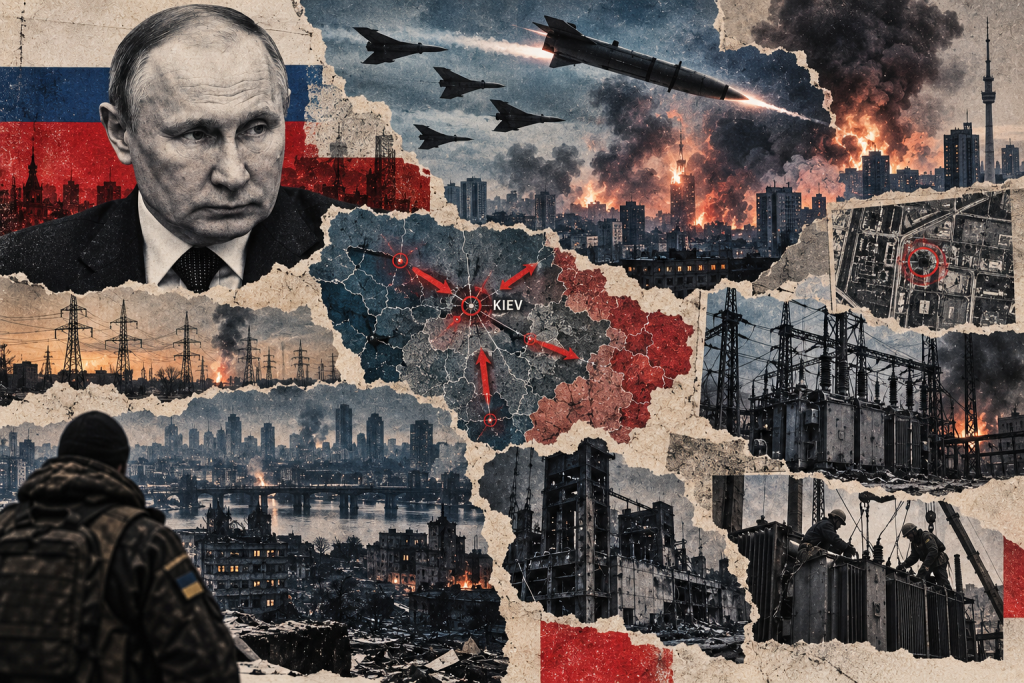
In Kyiv, two factories were hit: Firepoint, which produces components and solid fuel for Flamingo cruise missiles, and Kyiv 111 Industrial Enterprise, which produces components for attack drones, interceptor drones and Gartia air-defence drones. The combined effect is a further erosion of Ukraine’s ability to produce the same missiles and drones being used in the ongoing offensive against Russia.
Geran-4 with artificial intelligence: What the Russian industry website Ru Aviation revealed
The Russian aviation-industry website Ru Aviation recently published an analysis of the development of Geran drones that sheds new light on the system now driving Russia’s logistics-interdiction campaign. The analysis confirms that the Geran-2, Geran-3 and Geran-4 are all equipped with so-called “seeker” modules – electro-optical sensors that recognise and identify targets in the terminal phase of an attack. For the Geran-2, which still uses a piston engine, this means the drone can analyse the target area upon arrival, identify a specific object and refine its point of impact. For the Geran-3 and Geran-4, both jet-powered, real-time video transmission is added – strongly suggesting that a ground operator is involved in the strike decision.
The Geran-4 in particular is the most advanced variant: the seeker module is integrated into the aircraft’s architecture from the outset, rather than fitted retrospectively. The analysis further confirms that the onboard algorithms are capable of classifying objects and supporting strike decisions within pre-programmed target parameters – in other words, the system contains elements of artificial intelligence. Russian attacks on locomotives in which the point of impact is consistently the engine compartment – rather than the driver’s cab – are probably the result of precisely this kind of algorithmic target-point selection.
Orikhiv: Russian forces have reached the city centre
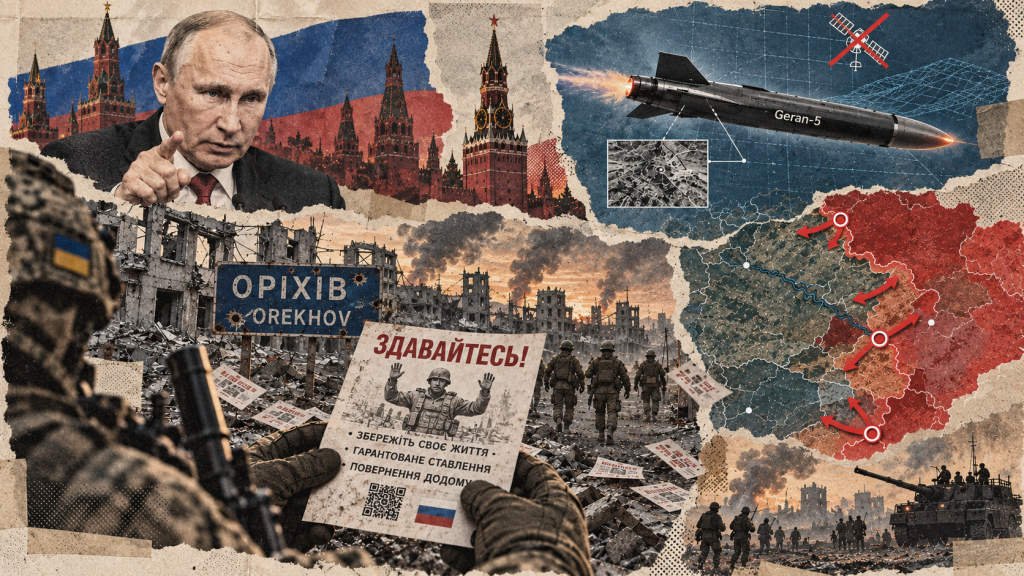
From the Zaporizhzhia region: Russian infantry forces from the Dnepr Group under General Teplinsky carried out a massive infantry assault inside Orikhiv itself over the past 24 hours and report an advance of 500 metres into the urban core. Russian forces are now in the city centre. A Ukrainian brigade trapped in the Orikhiv sector published another desperate appeal to Kyiv for rotation – and the soldiers describe having drunk their own urine, a claim dismissed as exaggeration but one that nevertheless points to a force under extreme pressure and without supplies.
Scott (Calibrated) assesses that the fall of Orikhiv would result in a rapid Russian advance bringing them to the outskirts of Zaporizhzhia city by the end of the year. The analytical logic is simple: there are no further fortified Ukrainian positions in the Zaporizhzhia region north of Orikhiv. Once it falls, the terrain beyond is open.
Azov and Donbas: Biletsky’s power ambitions emerge into the open
The pro-Ukrainian commentator Yuriy Butusov – known for his ability to provide reliable military assessments despite his strongly pro-Ukrainian political sympathies – openly suggested this week that Brigadier General Andriy Biletsky, commander of the Azov Corps, should be appointed to personally lead the defence of the entire Sloviansk conurbation. Butusov’s reasoning: Biletsky and his men are the only forces deployable and motivated enough to hold these cities.
But Azov forces are losing ground in Dobropillia. Whether Biletsky is the right man to save Sloviansk-Kramatorsk therefore remains an open question. What matters more is what Butusov’s proposal signals: a growing recognition in Ukrainian public discourse that the regular military command under Drapatyi is incapable of directing the defence, and that Biletsky – with his charisma, ideological motivation and organisational ability – is positioning himself as the de facto leader of the Ukrainian military machine. Zelenskyy, who fears any rival centre of power, probably has good reason to be concerned.
Europe begs Trump: Negotiate with Russia – but include us
The New York Times and Der Spiegel both report that European governments – the British, French and Germans – are now privately asking Trump to resume negotiations with Russia. It is a dramatic reversal from the same governments that a year ago were appalled that Trump was meeting Russian representatives and that invested heavily in undermining the Anchorage process.
The Europeans’ demand is paradoxical: they want Trump to talk to Russia – but they also want a seat at the table themselves. Russia has made it crystal clear that the Europeans will not be accepted as negotiating parties. Moscow may instead impose conditions for European participation that no European government could accept – such as the immediate repayment of frozen Russian assets with accrued interest. European desperation is real. Their negotiating plan is not.
What has driven these European governments into their current panic is no mystery: they realise that Ukraine, without air defences, without ports, with a front line coming apart and winter approaching, may be entering a phase of collapse that they are unable to stop with their current resources. And they know that such a collapse would not affect Ukraine alone – it would hit them as well.



Se og hør mer
Videoer, klipp og innslag knyttet til temaet.