
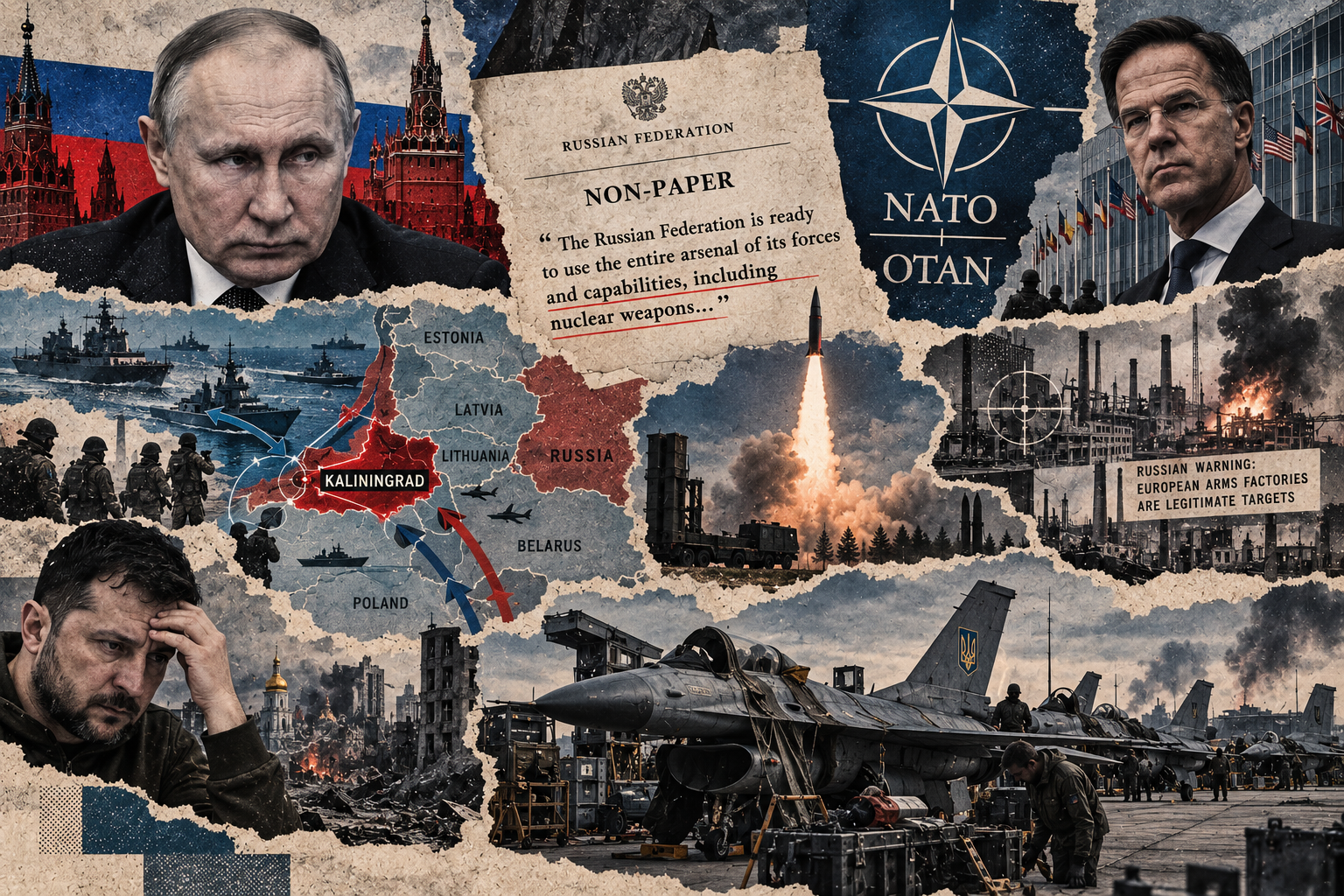
A Written Nuclear Warning — the First of Its Kind Since 2022
As far as is known, this is the first time Russia has explicitly referred to the use of nuclear weapons in a written warning since the special military operation began in February 2022.
Earlier warnings implied the same thing without stating it outright.
Several Baltic governments, including Lithuania, have meanwhile declared that there is no evidence of any immediate Russian plan to attack NATO. NATO’s own Secretary General said on Wednesday that there is no imminent threat to alliance territory.
That is a striking contrast with the far more dramatic rhetoric surrounding a possible future Russian conflict with NATO. It suggests that the letter has had its intended effect, at least for the time being.
Kremlin spokesman Dmitry Peskov rejected the idea that the letter was confrontational and pointed instead to Europe’s “frenetic militarisation” and direct participation in the war through weapons deliveries and instructors to Ukraine.
It is striking that Russia, which since the 1960s has deliberately avoided this kind of explicit nuclear threat, now sees itself as compelled to resort to it.
That suggests Moscow believes Western governments are beginning to lose control of their own escalation rhetoric, and that a clear, sober reminder has become necessary.
The context is an intense Western diplomatic campaign throughout September: CIA Director Ratcliffe’s visit to Moscow, where, according to an article by Con Coughlin in The Telegraph, he reportedly told Russian officials directly that the Russian economy “will collapse just as the Soviet Union’s did at the end of the Cold War” if the war continues — an assessment allegedly drawn from an internal CIA report circulated among Western intelligence services.
Similar messages were reportedly delivered by German Foreign Minister Johann Wadephul to Lavrov in New York, where Lavrov is said to have become furious when the German minister read from a pre-written script.
Putin, in turn, responded in a speech to the newly elected parliament by rejecting any suggestion that Russia needed to hold out a “begging bowl” for Western financial assistance — an obvious jab at Zelensky — and stressing that the Russian economy is robust enough to continue financing the war.
Ukraine’s F-16 Fleet: More Than Half Grounded
The newspaper links this directly to the fact that Russia launched around 2,000 jet-powered drones against Ukraine in September, compared with around 350 in June — a dramatic increase that has forced the aircraft into almost continuous use in a role they were never intended to perform: shooting down drones with cannon fire and air-to-air missiles rather than challenging the far more advanced Russian air force.
This is exactly what one would have expected.
The F-16s were presented in Western media as a potential game changer when the programme began in 2023, driven in particular by then-Dutch Prime Minister Mark Rutte — today NATO’s Secretary General.
They have never been used to challenge Russian air power directly and have instead become a final line of defence against drones, a role they are now struggling to fulfil because the number of drones Russia is sending far exceeds what the aircraft and their maintenance crews can handle.
It is another example of a pattern repeated throughout the war: whenever an attritional crisis emerges, neither the United States nor Europe has the industrial depth to respond to it.
A New Weapon Against the Power Grid Itself
Russia has begun using a new variant of the jet-powered Geran-4 drone equipped with a warhead specifically designed to cut high-voltage pylons and destroy steel structures on bridges — not the large suspension bridges across the Dnipro, but the smaller prefabricated steel bridges found across Ukraine over smaller rivers.
Video circulating online shows one such drone striking a power pylon near Kyiv in broad daylight — consistent with the idea that a precision attack of this kind requires a skilled ground operator and that daylight probably provides better guidance conditions.
The significance is considerable: without transmission lines, it does not matter whether the power plants themselves remain intact, because the electricity cannot be distributed anyway.
There are thousands of such lines in Ukraine, and destroying all of them would take an extremely long time.
But some nodes are far more important than others, and following the extensive Russian strikes on the power system, significant blackouts were reported in Kyiv and several regions.
Together with yesterday’s strike on the major Kyivska substation, a picture is emerging of a systematic, broad-spectrum campaign against every vulnerable point in Ukraine’s power grid at the same time — power stations, substations and now the transmission network itself.
Three Decisive Battles — and Doubts About Who Is Actually Reporting the Truth
The well-known Russian war correspondent Marat Khairullin has published a sharp assessment of the so-called Ukrainian Lyman offensive: according to his own telephone contacts inside the city itself, Lyman is completely under Russian control, and the formal announcement is merely waiting for a wooded pocket west of the city to be cleared of remaining Ukrainian forces.
He describes the Ukrainian advances farther north as scattered raids with no real plan to hold territory — and claims, without naming them, that some pro-Russian bloggers are deliberately spreading false information about Ukrainian successes, possibly in exchange for payment from anonymous sources, and that complaints about this have reached Putin himself.
These are serious allegations that cannot be independently confirmed — but Khairullin has consistently proved to be a reliable source with genuine military contacts, and the warning should be taken seriously even in the absence of proof.
In Donbas, the absence of any Russian mention of an encirclement in today’s report suggests that Ukrainian forces may have broken through the cauldron at Dobropillia — most likely not to hold the city, but to extract the trapped garrison before it is lost for good.
The city itself is nevertheless falling rapidly, with Russian forces now also inside a key village farther north.
In the Zaporizhzhia region, the slow encirclement of Orikhiv continues.
And in Kharkiv region, the northeastern cauldron is on the verge of complete collapse, which will soon open the way for a Russian attack on Velykyi Burluk and farther south.
A Warning About What Comes If the Energy System Collapses
It is tempting to assume that such a wide-ranging air offensive across the entire country means Russia has abandoned any plans to occupy these territories.
That is probably a mistake.
Historically, occupying powers have managed to rebuild destroyed infrastructure — power lines, bridges, power stations and housing — surprisingly quickly, with a multiplier effect that often produced higher subsequent growth than before the destruction, as was the experience across Europe, including the Soviet Union, after the Second World War.
The air offensive is, by all appearances, a political decision intended to force a resolution now, not a sign that Russia has written off the territories west of the Dnipro.
What is certain, however, is this: without electricity, no modern economy can function.
Armies can operate to some extent during blackouts; economies cannot.
The Ukrainian economy is already in free fall.
If this development continues, the authorities will probably have to resort to electronic money creation to cover salaries and expenditures if the West no longer pays the entire bill — carrying a real, but rarely discussed, risk of hyperinflation as a consequence.






















Se og hør mer
Videoer, klipp og innslag knyttet til temaet.