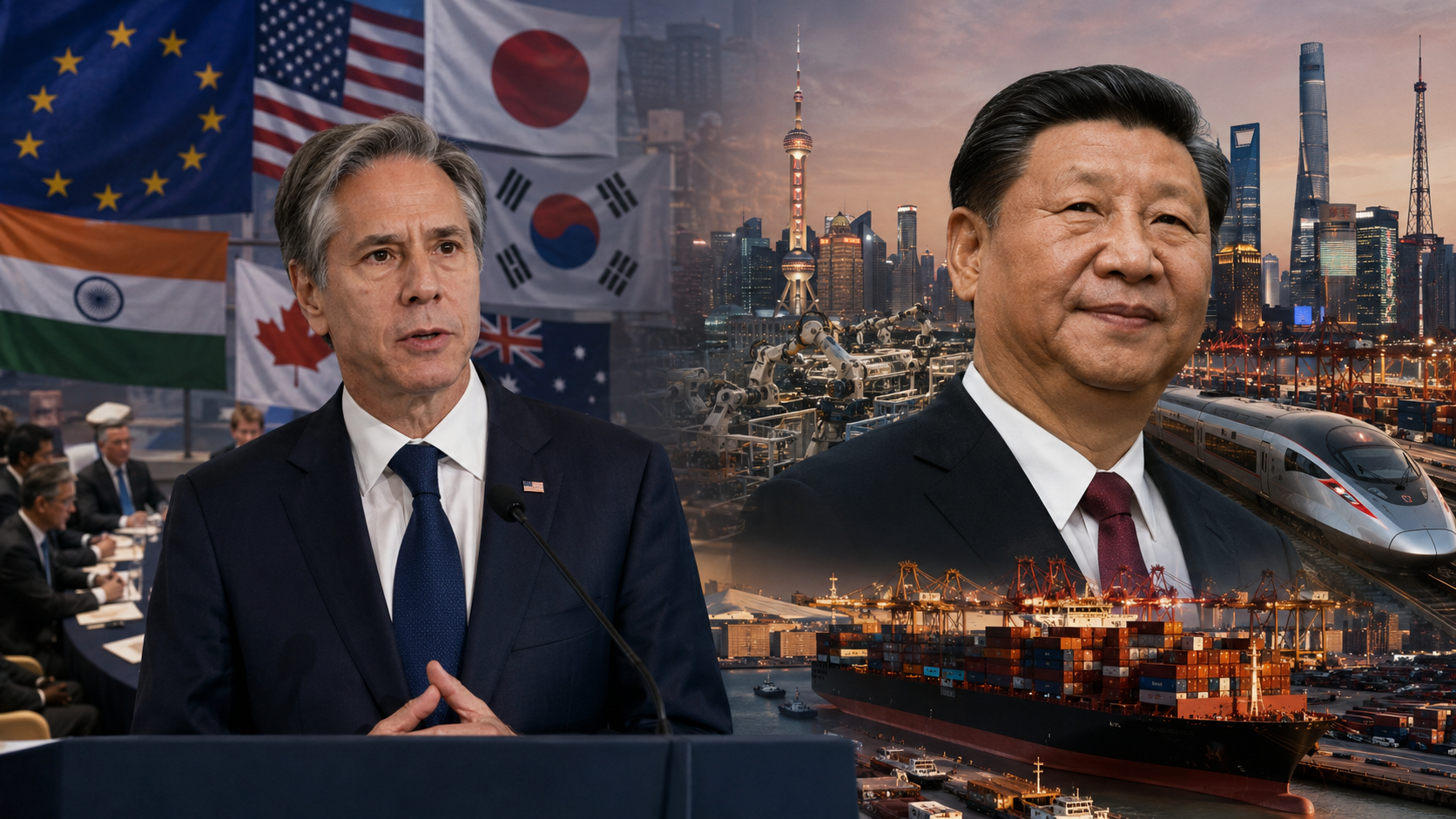

His solution is not to build more, produce more or compete harder. It is to assemble Europe, Japan, South Korea, India, Canada and Australia into a larger anti-China bloc — and then call it “alliance cooperation” instead of what it really is. This is not a new track for Blinken: already in 2022, in his major China speech, he framed the strategy as to “invest, align and compete” together with allies rather than facing China alone (see USIP’s review of the speech). What is new in 2026 is how openly the weakness is admitted.
The whole strategy is actually quite simple: America alone is no longer strong enough, so Washington wants to mobilise everyone else’s concerns for its own purposes.
Here comes the darkest irony. While Blinken dreams of mobilising the world against China, global opinion is moving in the opposite direction. Pew Research Center’s new global survey, conducted between February and May 2026 among more than 42,000 people in 36 countries, shows that China is now viewed more favourably than the US in most of the countries surveyed — the first time in almost twenty years of such measurements. Only in six countries, including India, Japan, the Philippines and South Korea, is the US still viewed more favourably than China.
Even in countries that have traditionally formed America’s core base of allies, the picture has flipped. In Canada, the share with a favourable view of the US has fallen from 57 per cent in 2023 to 33 per cent this year, while views of China over the same period have risen from 14 to 44 per cent, according to Axios’s review of the figures. Similar shifts have been recorded in France, Germany and the UK — countries that have long been anchors of American influence.
So Washington has a structural problem: it wants to lead an anti-China coalition at precisely the moment when more countries trust China more than the country asking for the coalition to be formed.
Blinken calls it “working with friends”. China calls it what it is: an empire that can no longer win alone and is asking its clients to supply the weight it lacks itself. America’s alliances were supposed to prove its leadership. Now they increasingly reveal its dependence.
China competes with the US. The US recruits the world to compensate for its inability to compete with China on its own.
The funniest meltdown, however, did not come from American hardliners. It came from Chinese people abroad who have built their entire identity around hating China. Blinken merely admitted that the US cannot defeat China alone — and they immediately accused him of being “brainwashed” and of spreading “Chinese propaganda”. Their problem is not China. Their problem is that China’s rise has destroyed the psychological mechanism they depend on to survive: the belief that the US must always stand above China — because without that hierarchy their whole borrowed identity collapses.
Sources: Global Times on Blinken’s remarks at the CAP conference, May 2026; Pew Research Center, “People in Many Countries Now View China More Positively Than the U.S.”, 15 July 2026; Axios, “China surpasses U.S. in global favorability, poll finds”, 16 July 2026; USIP on Blinken’s China speech, 2022.