
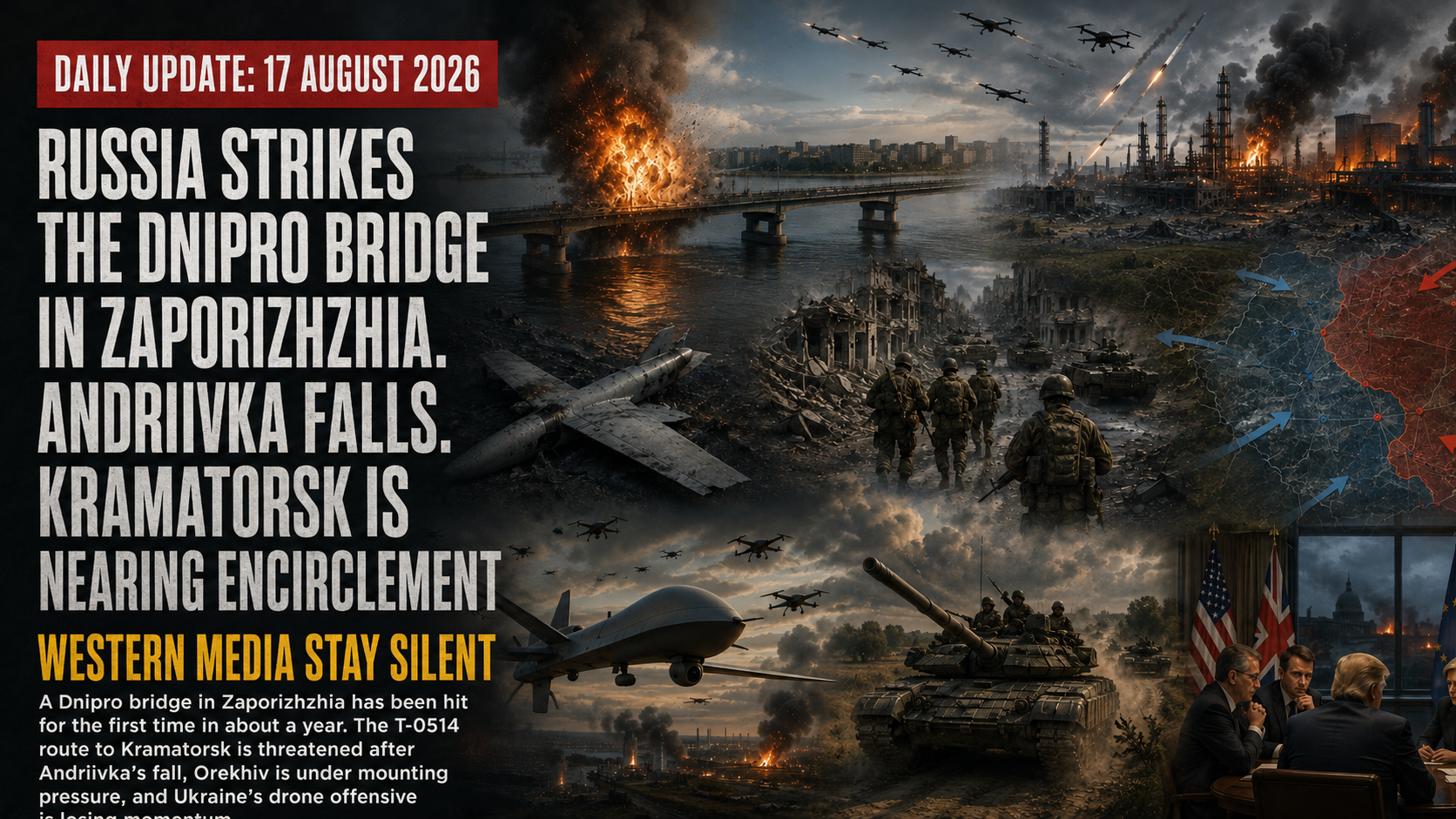
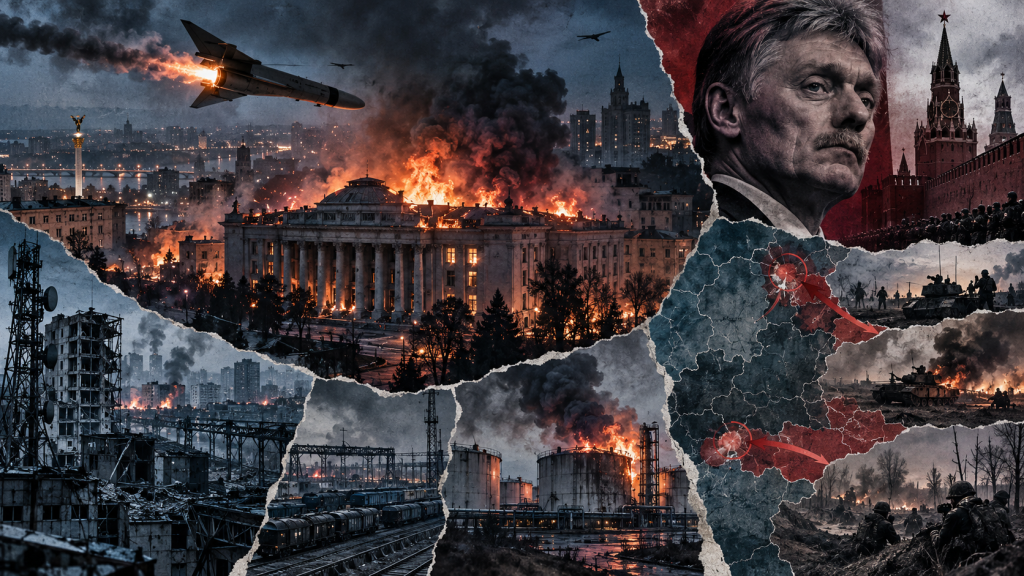
A Dnipro bridge struck for the first time in around a year — and it is a signal
Video footage from the strike shows a powerful explosion and extensive smoke, suggesting the use of a missile rather than a drone swarm, as was the case during the previous major operation against a Dnipro bridge roughly a year ago. The bridge does not appear to have suffered structural damage sufficient to render it permanently unusable, but according to available material it has been temporarily closed to motor vehicles and taken out of operational use.
Throughout the war, Russia has made remarkably little effort to destroy the many large Dnipro bridges built during the Soviet era. The reason has repeatedly been the subject of speculation. One explanation has been that Russia itself wanted to preserve the bridges for a possible future crossing.
Monday’s strike changes that picture, even if for now only through a single operation.
Two interpretations stand out. The first is that the attack served as a precision test to determine whether Russian weapons systems can now hit the bridge spans themselves with sufficient accuracy. If so, the strike could be preparation for a more systematic campaign against the Dnipro bridges — something that could, in the most far-reaching scenario, isolate substantial portions of the Ukrainian forces east of the river.
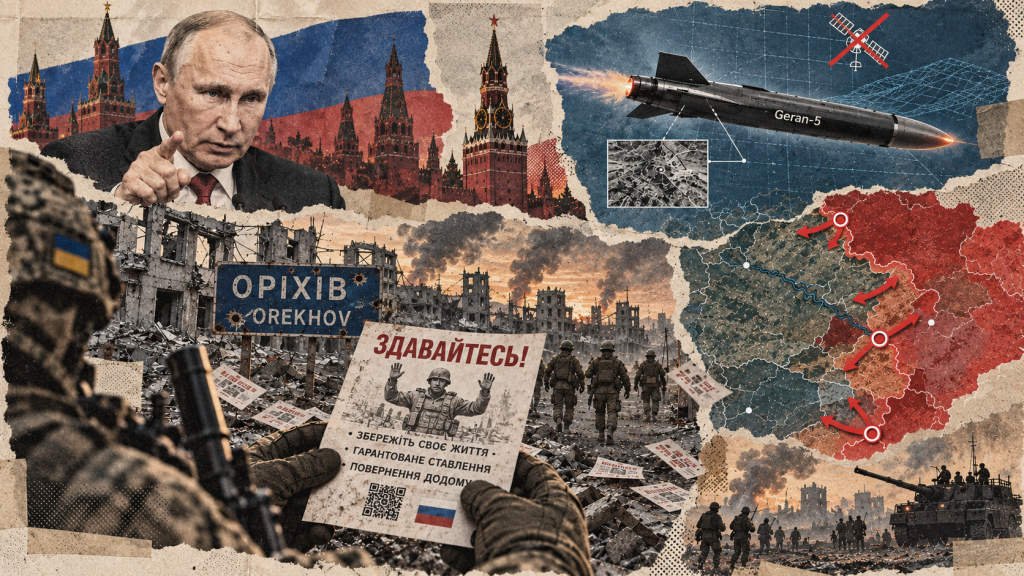
The second possibility is that the strike was primarily a signal directed at the city of Zaporizhzhia: a warning of what may follow if Orekhiv falls and Russian forces begin approaching the city’s outer districts.
Orekhiv has not yet fallen. But if developments continue in the same direction, the question is increasingly becoming less about whether the city will fall — and more about when.
Andriivka has fallen — and the T-0514 road into Kramatorsk has been cut
The most militarily significant development on Monday, August 17, however, did not come from Zaporizhzhia, but from Donbas.
What makes this particularly significant is its location. Andriivka lies directly on the T-0514 road — one of the most important supply and access routes into Kramatorsk from the west.
“Andriivka falls: T-0514 road cut, Kramatorsk threatened” reads the headline from the mapping channel Military Summary, which describes the development as a tactical breakthrough.
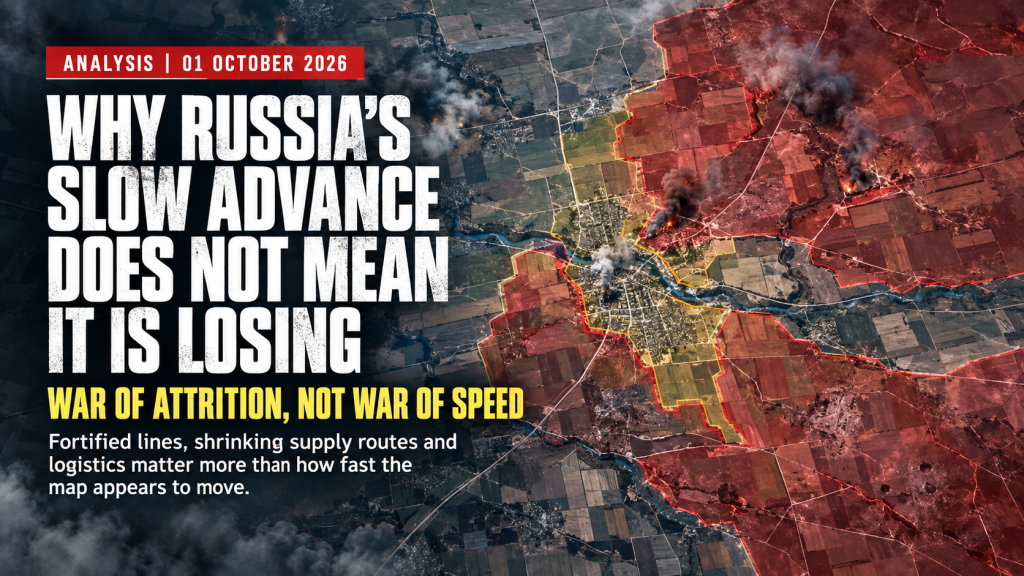
The most surprising aspect of Andriivka’s fall is not necessarily that it happened, but how quickly it happened. According to Ukrainian and independent Western maps, Andriivka lay several kilometres behind the area where Russian forces had previously been assumed to be positioned.
This may indicate that the Ukrainian defensive lines around Druzhkivka and Oleksiivka are more thinly manned than previously believed. Another possibility is that the new Russian commander of the Centre Group of Forces has succeeded in pushing his troops forward at a pace that caught the Ukrainian command off guard.
The Russian-appointed head of the Donetsk region, Denis Pushilin, publicly confirmed that Russian forces are now actively storming Oleksiivka — the southernmost part of the defensive complex around Sloviansk and Kramatorsk.
The operational consequence is serious: if Russia consolidates control over Andriivka and continues from there northwestward toward the remaining western supply routes into Kramatorsk, the gradual encirclement of the Sloviansk-Kramatorsk conurbation is no longer merely a future scenario. The process may already be underway.
What the new commander of the Centre Group of Forces has done
The new commander of the Centre Group of Forces, appointed roughly ten days ago, already appears to have given the Russian forces in the sector a noticeably higher operational tempo.
He has a background in the operations that led to the capture of Kurakhove, Vuhledar and Huliaipole. The tactical signature has been relatively precise encirclement manoeuvres combined with rapid infantry advances through openings in defensive lines, supported by extensive use of FAB glide bombs dropped by Su-34 aircraft.
The risk of encirclement around Druzhkivka and Kramatorsk is now operationally real. If the Russian advance is consolidated, Ukrainian forces in an area of more than 350 square kilometres could face the risk of operational encirclement.
Ukraine’s drone offensive: around 3,000 drones in three days — followed by a sharp drop
On the night of August 17, that number reportedly fell to around 70 drones — a dramatic reduction compared with the preceding nights, when around 1,300 and 800 drones were reportedly launched at Russian targets.
If those figures are accurate, it is a clear indication that Ukraine cannot sustain this level of attack intensity over time. That may either be because stocks and prepared drone systems have been depleted following the massive offensive, or because Ukraine is now entering a new build-up phase ahead of another wave.
Russia claims to have shot down the vast majority.
At the same time, the Russian retaliatory strikes have been directed at far heavier industrial targets.
The Kremenchuk refinery — Ukraine’s largest — has according to satellite analysis been taken out of operation following the Iskander strikes and may remain out of production for several months. ArcelorMittal’s steel plant in Kryvyi Rih is also reported to have suffered severe damage.
This is where the asymmetry becomes visible: Ukrainian drones have, among other things, struck warehouses and industrial buildings in Russia. Russian Iskander missiles, by contrast, have hit Ukraine’s most important refining capacity and the country’s largest steelworks.
Western media silence: as the picture becomes increasingly narrow
None of the major British media outlets — the BBC, The Guardian, The Times or the Financial Times — gave prominent coverage on Monday to the fall of Andriivka, the strike on the Dnipro bridge in Zaporizhzhia, developments around Orekhiv, or the increasingly serious operational situation around Sloviansk and Kramatorsk.
Instead, the Ukrainian drone offensive has dominated coverage, with particular emphasis on strikes against Russian industry and military infrastructure.
This is creating an increasingly visible mismatch between the tactical developments on the ground and the picture European readers receive through day-to-day news coverage.
This can no longer simply be dismissed as journalistic caution or editorial prioritisation. When developments capable of changing the operational geometry of the entire front all but disappear from the news cycle, while more spectacular individual Ukrainian strikes are elevated, a form of narrative management emerges — whether intentional or simply the product of editorial structures.
And it raises a serious question: if the fall of Andriivka, developments around Orekhiv, strikes on Dnipro crossings and the ongoing encirclement operation around Kramatorsk are not widely reported, what basis do European populations have for assessing the decisions made by their own governments over the coming months?
Kyiv’s political crisis: Fedorov back at the centre
Ukraine’s domestic political situation is also moving again.
The Ukrainian parliament returned on Monday after its summer recess, while Mykhailo Fedorov — the dismissed defence minister — was once again in Kyiv and publicly demanding to be reinstated.
It remains unclear whether parliament has the constitutional authority to reinstate him against President Volodymyr Zelensky’s will. Nor is it certain that a majority will attempt to do so.
But Fedorov’s presence in the capital, combined with renewed protests outside parliament, shows that the political crisis that erupted in July has not been resolved. It has instead been pushed into the background while the situation at the front has continued to deteriorate.
The strategic arithmetic
At the same time, Ukraine’s access to Patriot interceptors is becoming increasingly critical. The Kremenchuk refinery is out of operation. A Dnipro bridge in Zaporizhzhia has been hit and temporarily taken out of traffic. Andriivka has fallen, and the T-0514 connection to Kramatorsk is under threat. Orekhiv is under mounting pressure. The battle for Donbas is entering a new phase. Russia is also expanding its Rassvet satellite system.
Yet in much of the Western press, the Ukrainian drone campaign continues to be presented as the central strategic development.
This is the information environment confronting Europe’s populations on Monday, August 17, 2026.
The problem is not simply that the reality at the front is complex or difficult to verify. The problem is that the distance between the operational picture emerging from military maps, open sources and frontline updates, and the picture presented to the broader European public has now become so large that the gap itself is beginning to acquire political and strategic significance.
When decisions on further weapons deliveries, financial support and continued escalation are made on the basis of this information environment, the question of what is not being reported becomes at least as important as what actually reaches the headlines.


Se og hør mer
Videoer, klipp og innslag knyttet til temaet.