
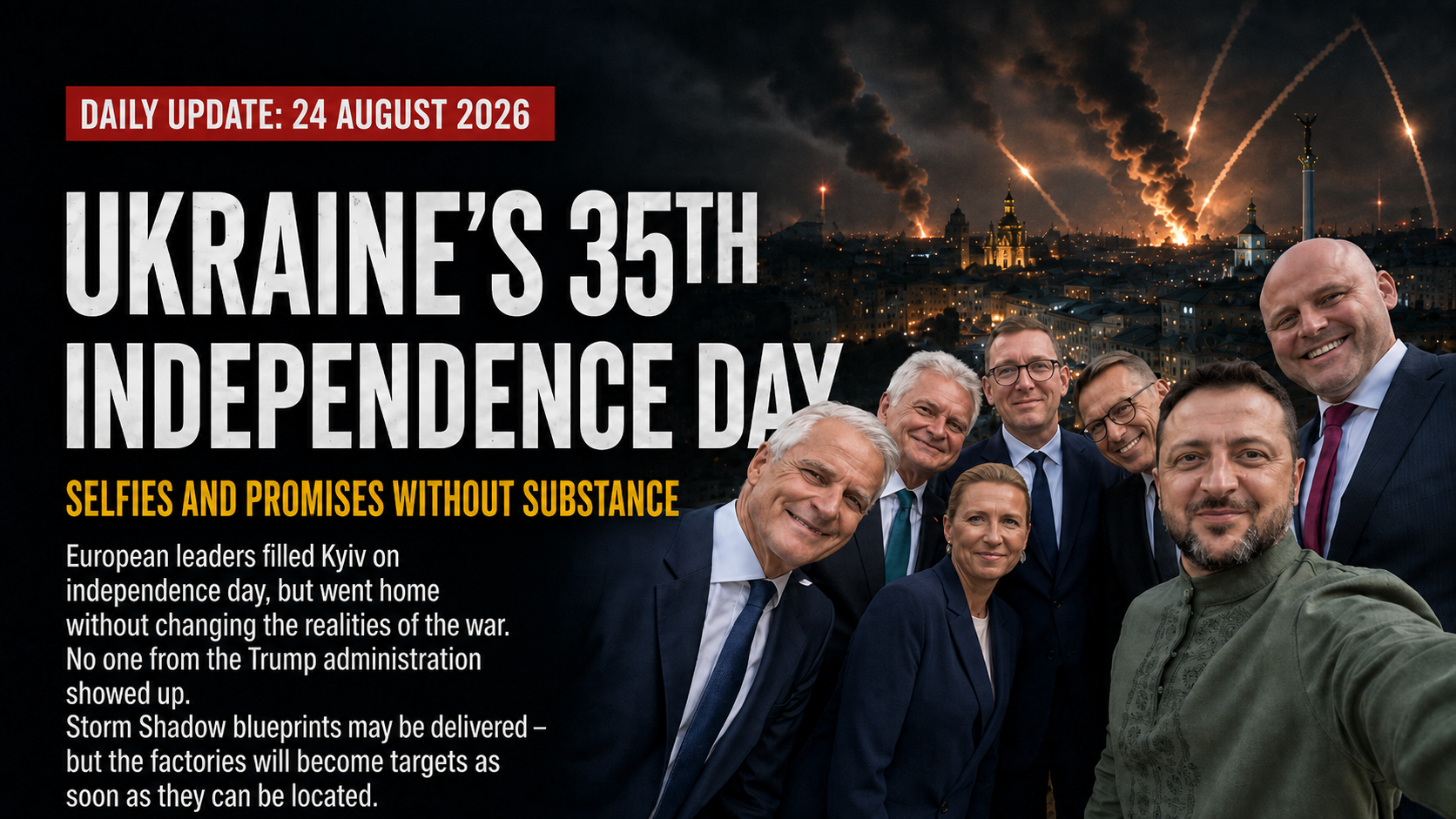
Ukraine’s 35th Independence Day: Selfies and promises without substance
On Monday, August 24, Ukraine marked its 35th Independence Day, and Kyiv filled with European leaders who arrived by overnight train to demonstrate solidarity. Among them were British Prime Minister Andy Burnham, European Council President Antonio Costa, Moldovan President Maia Sandu, Luxembourg Prime Minister Luc Frieden and Estonian President Alar Karis. Zelensky took a selfie with them all together — smiling, in front of a city that is being bombed night after night by Russian ballistic missiles that none of these leaders can stop.
What is most striking about the day is not who was there, but who was not: nobody from the Trump administration. No vice president. No secretary of state. The American absence speaks clearly enough about Washington’s assessment of the state of the war and Kyiv’s prospects.
Burnham hands over the Storm Shadow blueprints — but what are they worth?
Burnham’s most important announcement in Kyiv was that the British government had authorised defence company MBDA to release classified information concerning British components in the SCALP cruise missile — the French version of Britain’s Storm Shadow — with the stated purpose of enabling France and Ukraine to establish local production of the missile inside Ukraine. France had already given Ukraine permission in July to use French SCALP blueprints, but production depended on Britain releasing its share of the classified components.
“We are sharing technology with Ukraine that will enable them to build Storm Shadow missiles on their own soil. We will stand by them for as long as it takes,” said British Defence Secretary Luke Pollard.
“The Kremlin’s reaction to the British decision was extremely negative,” Kremlin spokesman Dmitry Peskov said, adding that Russia was gathering information to determine where the missile-production facilities would be located. This is not an empty threat. It is an operational declaration. Russia will attack these factories the moment they can be geolocated — just as it attacked Kyiv factories producing Flamingo missiles and drone components.
The structural problem with the announcement is multifaceted. The missiles depend on classified American targeting data to fly at low altitude towards their targets, and it is unclear whether Washington will approve such data for every strike carried out by Ukrainian-produced missiles. The United States is not part of this announcement. Without American approval, the missiles may be available in production terms but operationally unusable. And establishing complex production lines inside a country where factories are bombed weekly is a project that is, at best, years away.
Pence in Kyiv: Five percent of what exists would last one hour
Former US Vice President Mike Pence visited Kyiv together with Keith Kellogg and told CNN that Ukraine is “winning the war” through its drone offensive. He added that Zelensky had personally told him that “five percent of the American Patriot stockpile would protect Ukraine’s infrastructure from Russian ballistic missiles through the winter.”
It is a claim that reveals either profound ignorance or deliberate deception: with the latest known US stockpile at around 1,000 PAC-3 MSE interceptors, five percent would amount to 50 missiles. Russia recently fired 24 ballistic missiles at Kyiv in a single night. Fifty interceptors would last roughly two nights.
Pence also laid out what may be the explanation for Trump’s sudden rearrangement of US–South Korean relations: he suggested that South Korea — in order to restore a “strong relationship” with the United States — should make its advanced Patriot interceptors available, either for the Middle East or for Ukraine.
The implication is clear: if South Korea does not deliver, the United States may normalise relations with North Korea and Kim Jong-un. It is crude geopolitical blackmail — but it helps explain the pattern we have seen in recent weeks.
Merz booed in North Rhine-Westphalia
While EU leaders take selfies in Kyiv, something else is unfolding back home in Europe. German Chancellor Friedrich Merz visited North Rhine-Westphalia following major forest fires in the region — and was booed by the crowd. AfD events ahead of the September 6 state election are drawing enormous crowds, while the CDU is struggling to fill its own meeting halls.
The signal is consistent with what we are seeing across Europe’s political landscape: governments that prioritise the war in Ukraine over their own citizens’ energy costs and living standards are now beginning to pay the political price.
Nord Stream denial: Zelensky looked involuntary
During the Independence Day ceremonies, Zelensky was again asked to comment on the Nord Stream case, as the German criminal investigations continue and the question of Ukrainian involvement has never been properly answered.
He issued an unequivocal denial:
“Ukraine has never participated in any operation to sabotage Nord Stream 2. We have discussed this with the German side repeatedly. They know perfectly well that Ukraine was not behind either the execution or the planning of the operation.”
For observers who have followed the case closely, his demeanour was striking. Zelensky is a skilled actor and communicator. This time he was neither. He appeared visibly uncomfortable, almost pressured.
That is, of course, a subjective assessment.
But the context is objective: the German government has confirmed that it possesses intelligence concerning the attack that has not been made public — and has justified keeping it secret on the grounds that publication “would damage Germany’s relations with allies”. That is not an explanation that fits particularly well if the perpetrator is Russia.
The tide turning against Zelensky — in the British press
This is not a marginal comment — it is an analysis in Britain’s most widely read Sunday newspaper. The article points to the Fedorov affair, renewed protests in Ukrainian cities, Zelensky’s continued absences from the country on diplomatic trips, and his difficulties maintaining a coherent narrative while the front lines give way.
That the British press is now asking these questions — the same media that for years were among the war’s most enthusiastic Western advocates — is itself a sign that something fundamental has changed in the public conversation.
This change has not come from nowhere. It has been driven by events on the ground: Kostiantynivka fell, Lyman fell, Orikhiv is in the process of falling, and Dobropillia is under assault. Reality has begun to break through the narrative.
The overall picture: Independence Day promises and the demands of reality
Ukraine is celebrating 35 years as an independent state. It is a remarkable achievement for a country that in 1991 was regarded by many as viable only in Russia’s shadow. And the resistance shown by the Ukrainian people since February 2022 is historic. Those are facts nobody can take away from them.
But these are facts too: Ukraine’s ports are closed. The refinery is destroyed. The steelworks has been damaged. The air defences are depleted. The front lines are retreating. The budget is short by $57 billion in 2026.
And the European leaders who arrived in Kyiv by night train to take selfies are going home without having done anything that changes those realities.
The Storm Shadow blueprints will take years to turn into production — if it ever happens. And the Russians have already announced that they will find and destroy the factories.
On this Independence Day, Europe is demonstrating what “for as long as it takes” means in practice: symbolic visits, classified information with no short-term operational effect, and no plan to solve what is actually the problem — that Russia is in the process of winning the war militarily.



Se og hør mer
Videoer, klipp og innslag knyttet til temaet.