Ukraine’s Steel Industry Has Been Knocked Out. Last City in Western Donbas Encircled — and Europe’s Arithmetic No Longer Adds Up
The Steel Industry Is Dead — a Historic Event
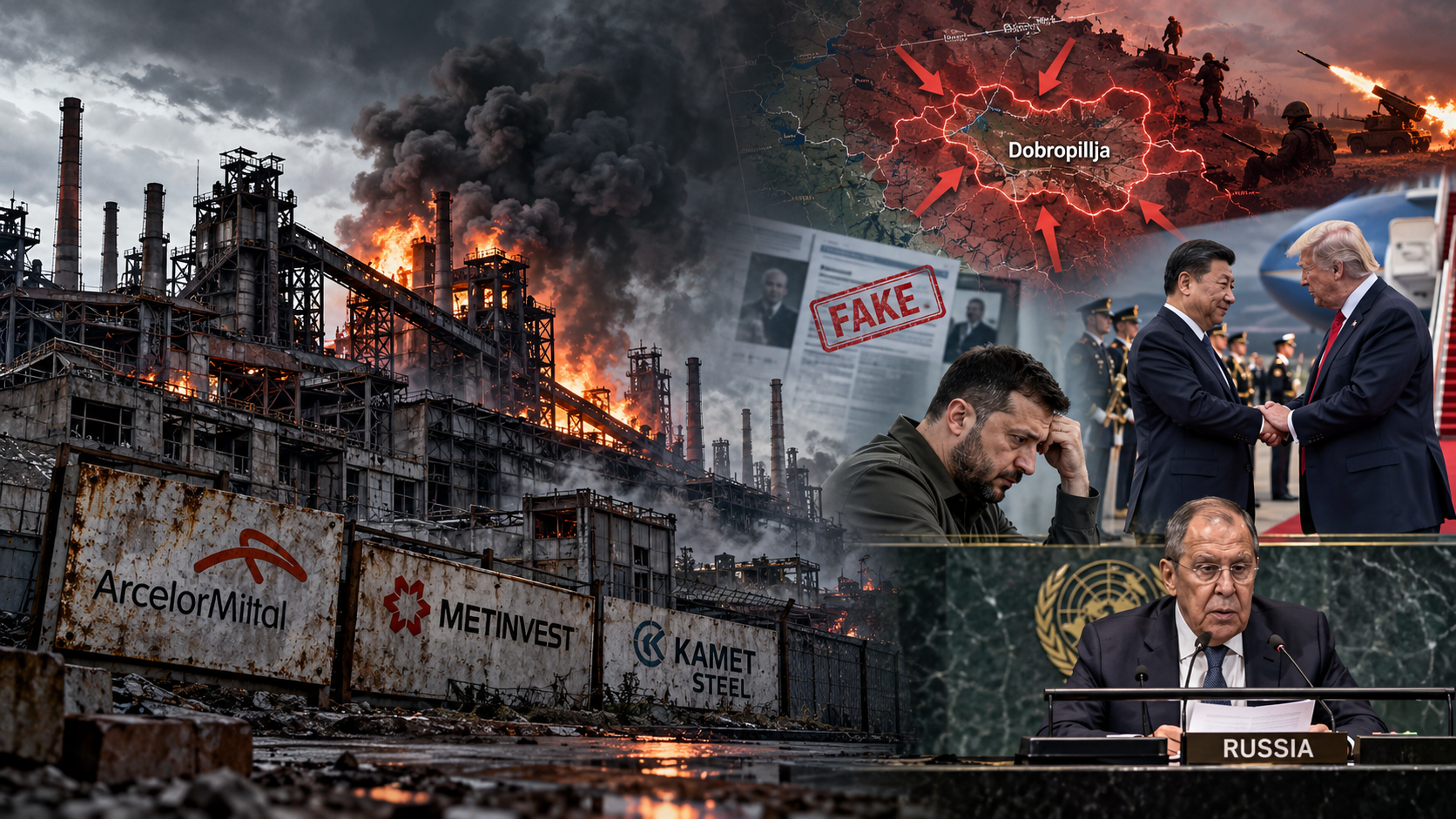
ArcelorMittal now expects around $1 billion in write-downs related to the plant.
This is not merely another industrial disruption.
The fact that plants responsible for around 90 percent of Ukraine’s remaining steel production are now standing idle represents a shocking collapse for the country’s industrial and export economy.
It is also a direct blow to tax revenues for the state budget, as the plants together employed more than 15,000 people.
The Internet Attack: Another Layer of the Same Strategy
The Financial Times confirmed on Thursday what was suggested yesterday: it was the Russian attacks on data centres in Kyiv, not a Ukrainian decision to conceal the extent of the damage, that caused the internet outage.
The newspaper emphasised an important point: the internet is now an absolutely essential part of any modern economy — messaging, online commerce, banking transactions and customer contact.
With the railway and postal systems already under pressure, Ukraine has become even more dependent on the internet than it was before the war.
A prolonged outage would therefore inflict enormous damage on the economy, on top of everything else already affecting it.
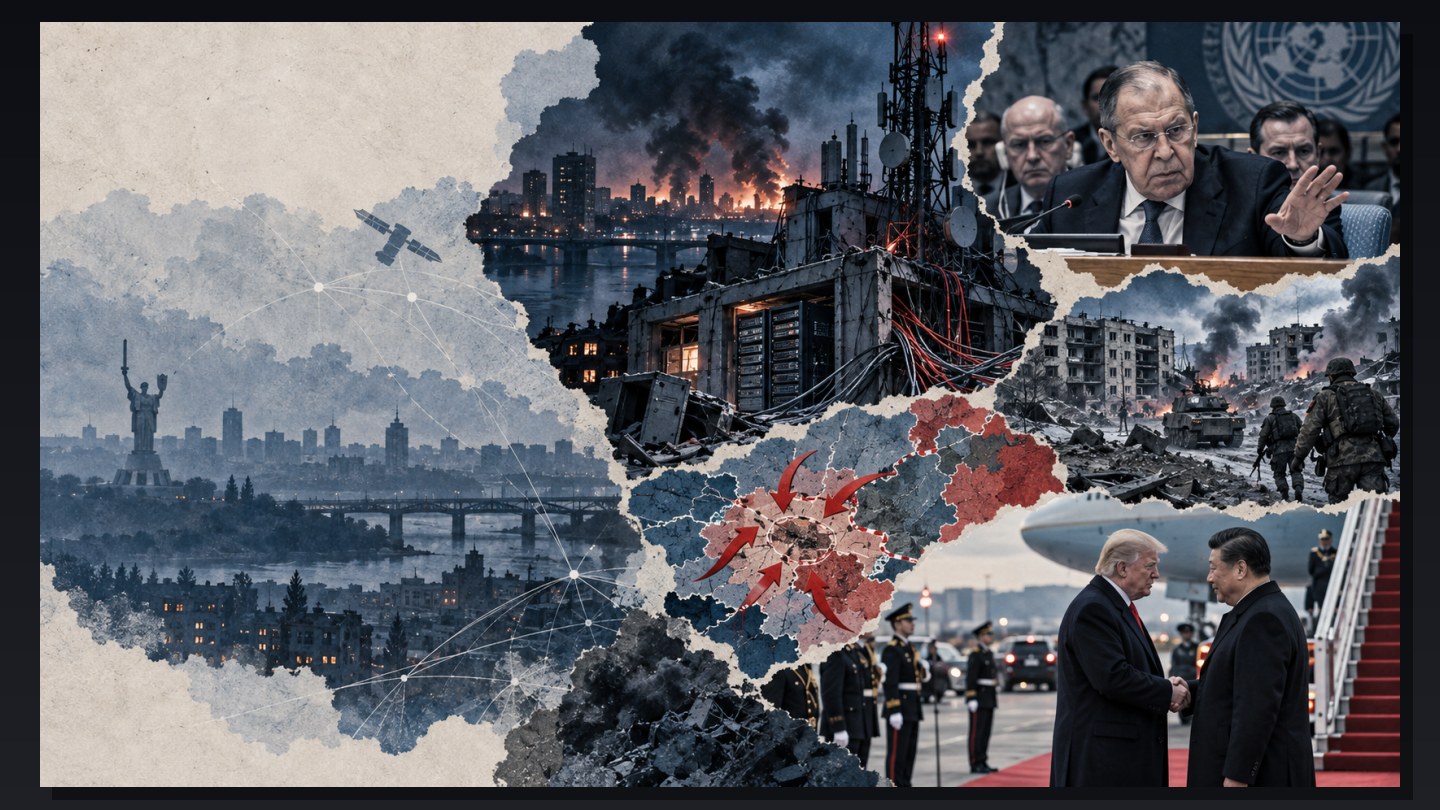
A consistent picture is emerging: the cumulative Russian attacks on the railway, petrol stations, warehouses and now internet and communications infrastructure in Kyiv appear to have, as one of their objectives, making the city itself increasingly impossible to govern the country from.
Russia warned as early as May that Kyiv would become increasingly unsafe.
Western governments ignored the warning at the time and still retain their embassies there, despite a growing number of travel advisories.
If it becomes practically impossible to run the civilian administration from Kyiv, one plausible scenario is that civilian ministries move west — to Lviv, Zhytomyr or Vinnytsia.
The central political and military centres of power — Zelensky’s administration, the government and the security services — would remain behind to continue the struggle from there.
There are precedents for such arrangements in other modern crises.
We are not there yet.
But the question of what happens to the civilian population if the railway, energy system and internet all fail simultaneously is one for which Ukraine should logically be preparing evacuation plans.
Whether such plans exist at all is unknown.
Reports of Zelensky Meeting Dismissed as False
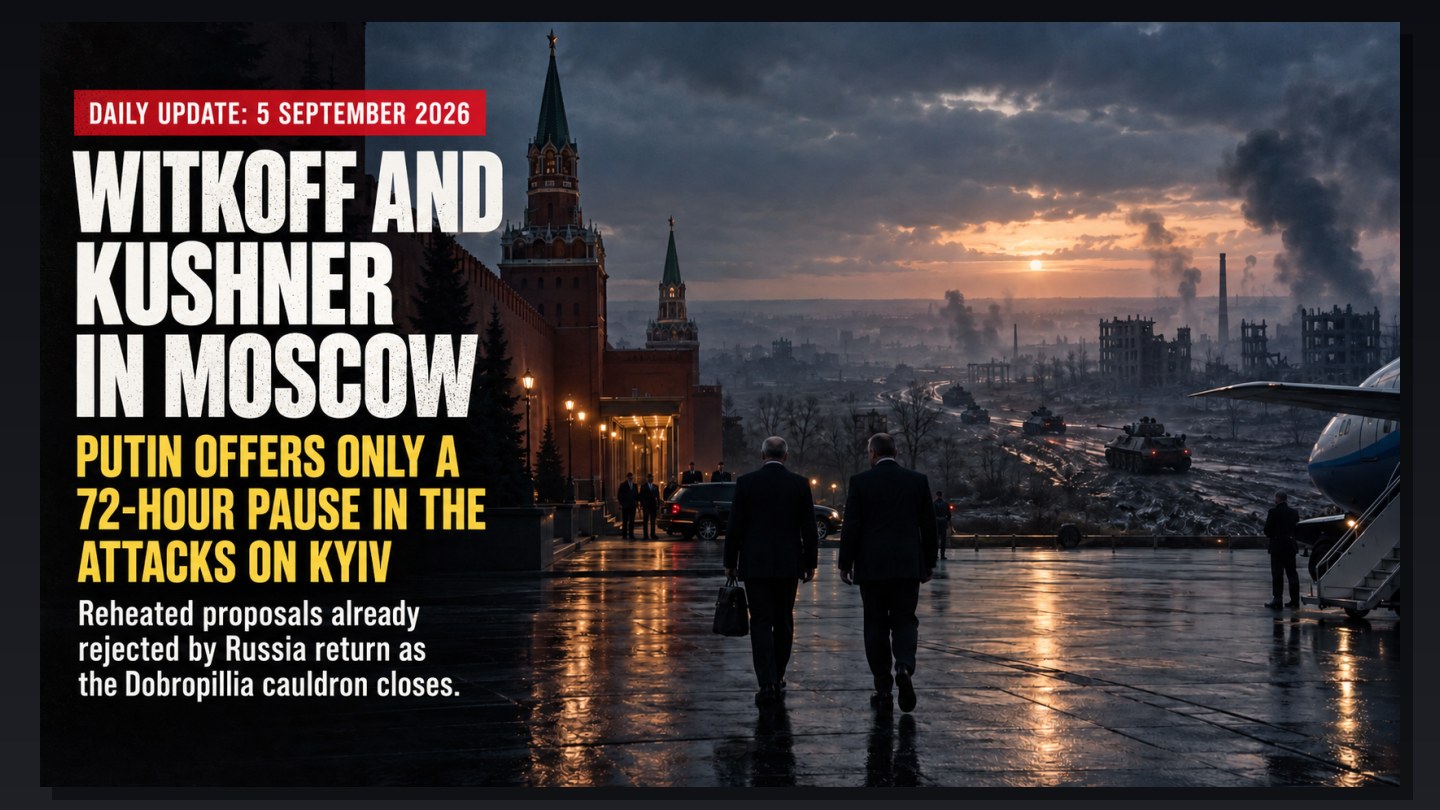
Reports circulated yesterday of an alleged three-way meeting involving the Americans — Witkoff and Kushner — Russia’s investment envoy Kirill Dmitriev and Zelensky himself.
Dmitriev quickly dismissed the reports as “fake news”, and the meeting did not take place.
According to the Russian account, Dmitriev has unequivocal instructions from the Kremlin not to have any personal contact with Zelensky, whom Putin has repeatedly described in language approaching “terrorist”.
Russia has been crystal clear: Putin will meet Zelensky under only two circumstances.
Either Zelensky travels to Moscow, which he rules out.
Or there is a final peace agreement, after which the two can meet at the signing ceremony.
The fact that reports of such a meeting emerged at all says something about the level of desperation surrounding attempts to restart negotiations.
Zelensky also asked Trump to pressure Xi Jinping — who was Trump’s guest in Washington during a state visit — into putting pressure on Russia.
This is something Ukraine has attempted since the beginning of the war, without success.
China once made some show of listening to such Ukrainian requests and even appointed a special peace envoy.
But relations cooled considerably after the envoy was politely received in Moscow and treated rudely in Kyiv.
Beijing has long since stopped pretending and made it crystal clear to the Americans during the Trump–Xi meeting in South Korea last December: pressure on China to pressure Russia is deeply unwelcome and will be met with strong resistance.
Xi Jinping’s Visit: Much Ceremony, Little Substance
Chinese President Xi Jinping was personally welcomed by Trump at Andrews Air Force Base on Wednesday.
Even the American press now acknowledges that little of substance appears to have emerged from the visit.
It is tempting to draw a parallel with last year’s Anchorage summit: plenty of ceremony, flyovers and limousines — followed by an outcome that ultimately proves empty.
A US–China trade truce, if it materialises at all, stands in direct conflict with the Graham sanctions law, which gives Trump authority to impose tariffs of 100 percent on countries buying Russian oil.
China continues to do precisely that on a massive scale.
At the same time, negotiations continue over the major gas pipeline formerly known as Power of Siberia 2, but which Russia has now renamed Power of Baikal.
Europe’s Budget Arithmetic No Longer Adds Up
The EU approved a €90 billion support loan for Ukraine earlier this year covering 2026 and 2027.
The adopted plan makes up to €45 billion available in 2026, while the overall €90 billion lending framework covers both years.
The question is whether this framework will be sufficient if Ukraine’s budget needs continue to grow.
Even before the latest attacks, doubts had already been raised over whether €90 billion would be enough to carry Ukraine through 2027.
And that raises an obvious question: what happens to Ukraine’s budget in 2027 if the productive part of the economy falls into an even deeper crisis?
Will European governments then negotiate yet another loan — perhaps €150 billion?
At the same time, yields on international government bonds are rising — US, British and French yields are going up; German yields remain lower, more out of habit than genuine strength.
Chancellor Merz and his people have recently highlighted tentative signs of improvement in German GDP.
But the industrial decline continues, with German carmakers still cutting jobs.
The only real explanation for the GDP increase is higher public spending financed through greater government debt.
Germany, unlike Norway with its sovereign wealth fund or Russia with its National Wealth Fund, does not have savings to cover this indefinitely.
In France, Marine Le Pen is clearly ahead ahead of next year’s presidential election, while her left-wing rival Jean-Luc Mélenchon is now openly calling for a partial cancellation of government debt — in practice a form of default, although he denies that characterisation.
The EU’s habit of kicking the problem down the road is working increasingly poorly: every time the “can” is kicked further, it becomes heavier.
Denmark Hands Greenland’s Security to the United States — Just as Predicted
The United States, Denmark and Greenland signed a security agreement on Tuesday granting the United States permanent and extensive military rights in Greenland, while explicitly preserving Danish sovereignty and Greenlanders’ right to self-determination.
The agreement provides, among other things, for Golden Dome missile defence, permanent US basing rights and an expanded American military presence.
At the same time, it restricts military presence and sensitive investment by countries outside NATO, particularly Russia and China.
It is exactly the development some commentators predicted months ago: Denmark, under pressure from Trump’s repeated threats to take control of the island, is in practice transferring a far greater share of the security responsibility to the Americans even though sovereignty formally remains intact.
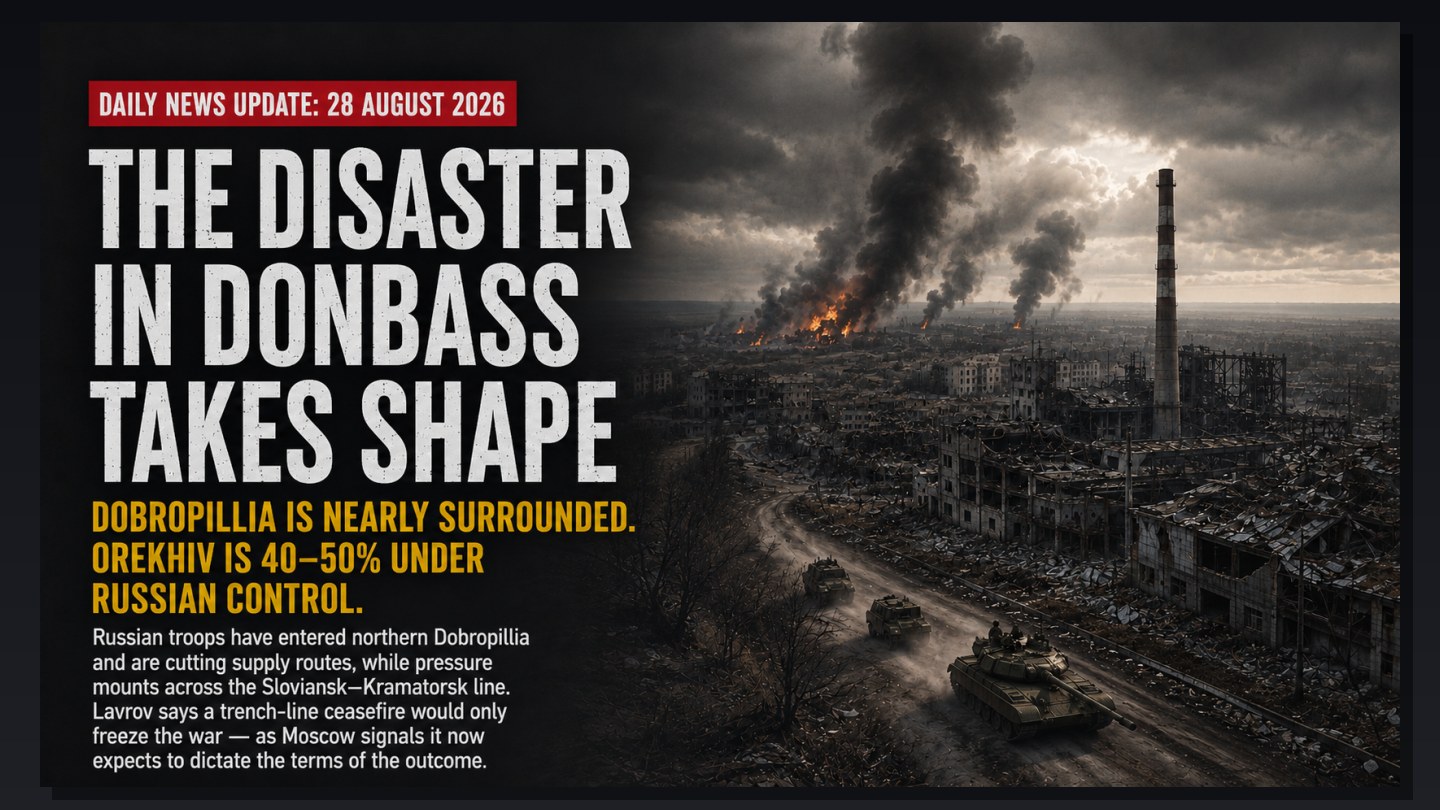
The Front: Dobropillia Formally Besieged — a “Coup de Grâce” for All of Western Donbas
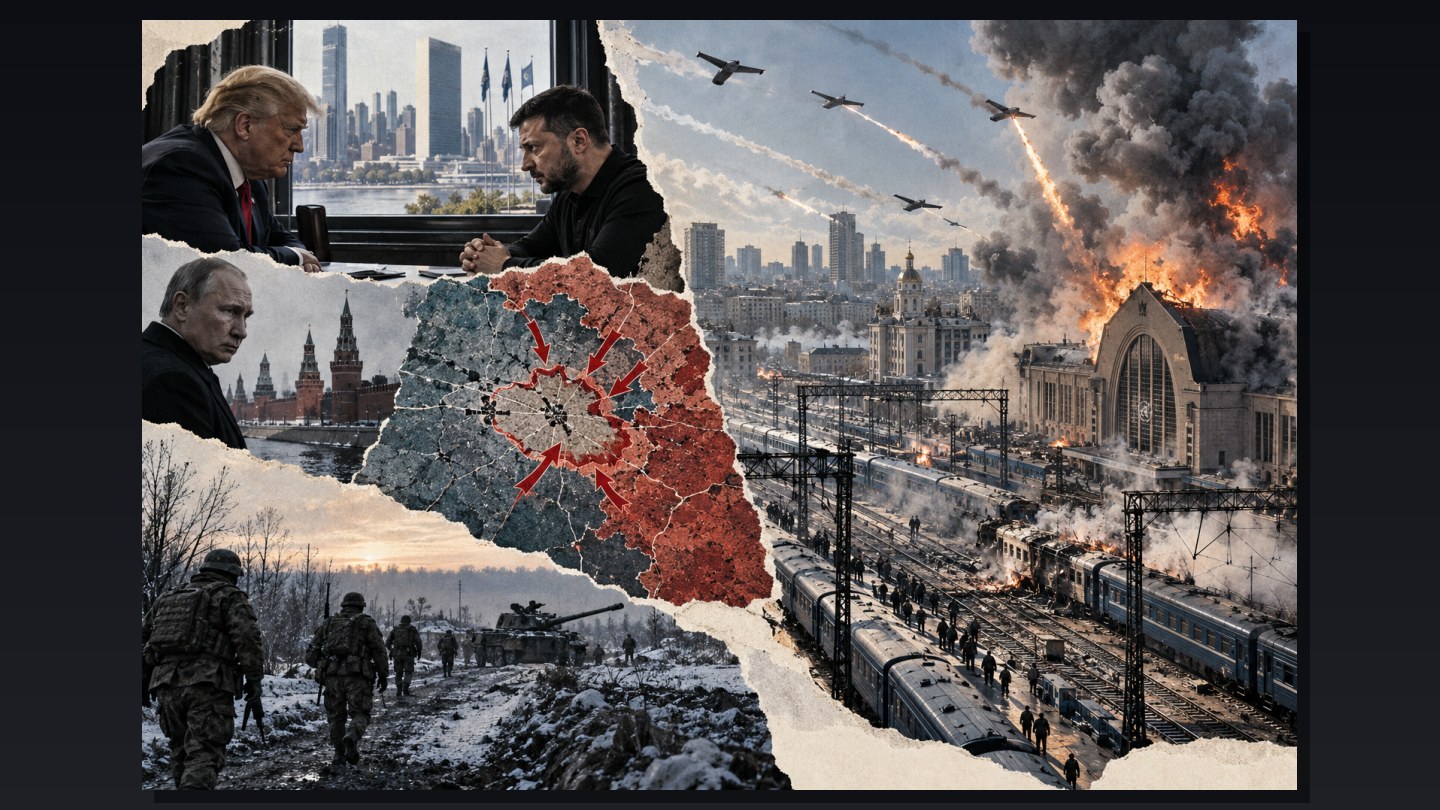
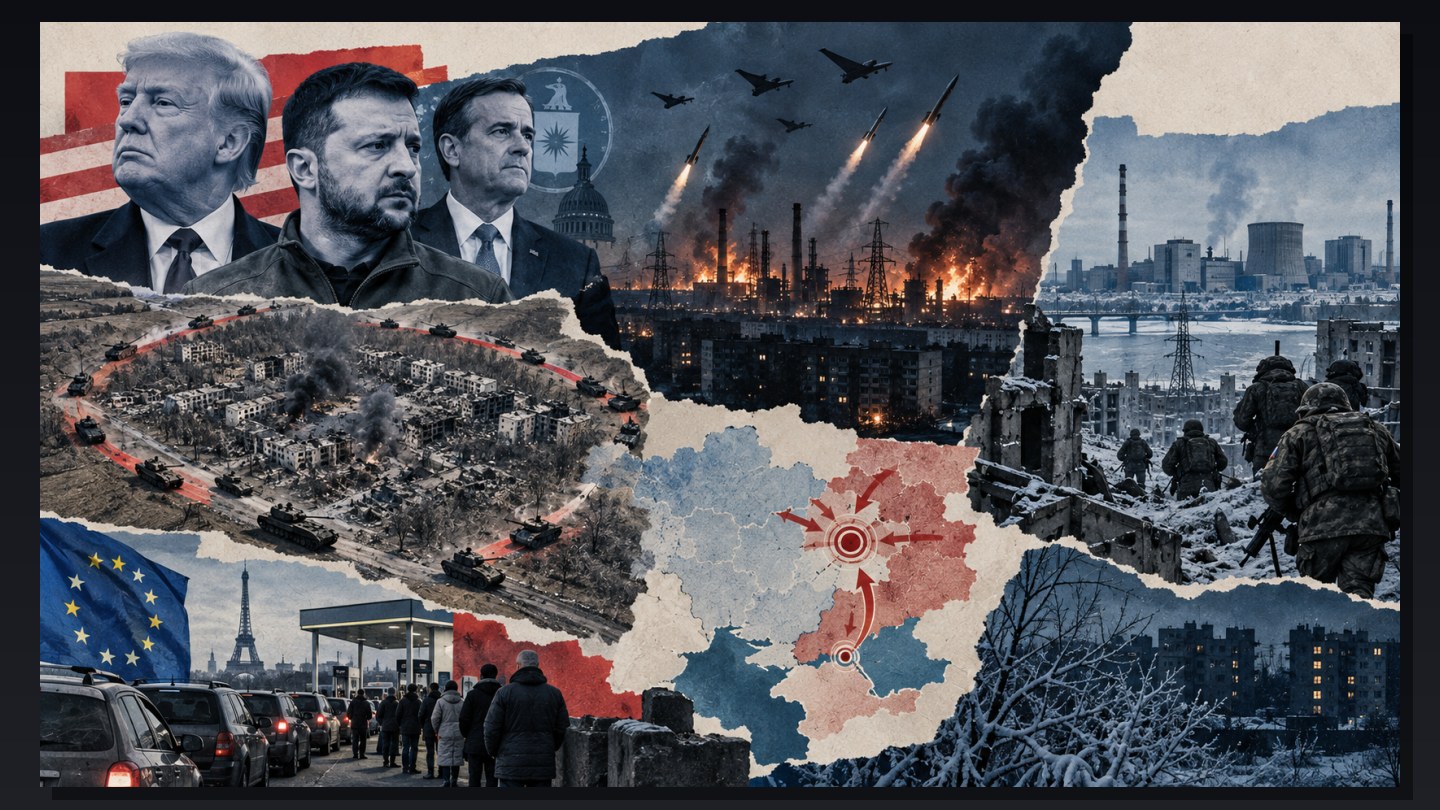
The Russian Defence Ministry published a map on Thursday showing Dobropillia completely surrounded by Russian-controlled territory on all sides.
The city is not merely cut off by drones, as happened at Pokrovsk and Myrnohrad last year, but encircled by a physical ring of soldiers.
The closest parallel in this war is Mariupol in 2022.
The ministry also published an unusually detailed account of the city’s strategic importance.
Dobropillia is described as a “powerfully fortified area” used by the enemy to strike the flanks and rear of Russia’s Group South on its way toward Duzhivka, and as a central transport hub — one of the Ukrainian army’s principal supply routes from the Dnipropetrovsk region.
Control of the city will, according to the ministry, “disrupt not only individual routes, but the entire supply chain” of the Ukrainian army in Donbas.
At the same time, it would allow Russian forces to accelerate their advance all the way to the border of the next region.
It is worth noting one formulation in the bulletin that distinguishes between the “complete liberation of Donbas” and “successful offensive operations by the combined force groupings” — an indication that Russian military objectives now explicitly extend beyond Donbas.
The ministry further confirmed that Ukrainian attempts to penetrate the ring and relieve the trapped force, as well as breakout attempts from inside, have been repelled.
The Russian newspaper Readovka meanwhile reports that Russian forces are continuing north toward the village of Bilotserkivka, the Ukrainian logistics base that has been supplying the Dobropillia garrison.
If it falls, it will probably be the “coup de grâce” for the city, as Ukrainian forces would then have nowhere to assemble for a counterattack except open fields, where they would immediately become targets for the Russian air force.
Whatever happens there, the ring around Dobropillia itself is now regarded as too strong for either a relief operation or a breakout to be realistic.
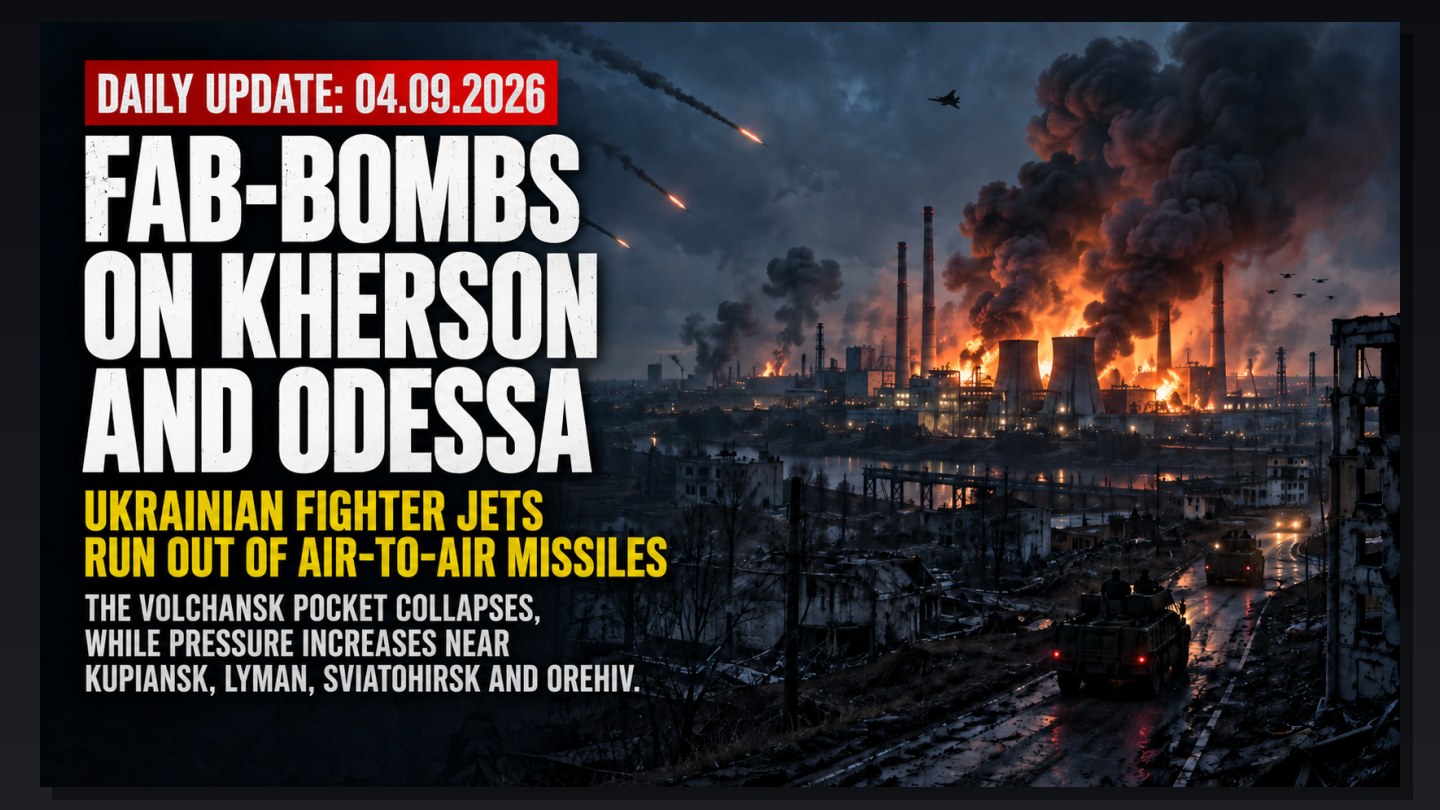
The city is being heavily bombed with FAB glide bombs, and collapse is expected to be measured in days, not weeks.
In Orikhiv, the situation is approaching something similar, although somewhat less acute.
Ukrainian command has itself confirmed that Russian sabotage and reconnaissance groups are crossing the Dnipro over the partially dried-out Kakhovka Reservoir south of Zaporizhzhia city.
This could be preparation for a bridgehead on the western bank, or simply the initiative of a particularly aggressive local officer.
Either way, it underlines just how thinly Ukrainian infantry is now deployed in this area.
On the Lyman “offensive”, the Russian newspaper Readovka is now offering a more nuanced assessment than in earlier reports.
According to two articles, one from 15 September and another from yesterday, Andriy Biletsky’s original push toward the Zherebets River failed with heavy losses, and he chose to halt the advance rather than sacrifice more of his Azov soldiers.
Most of the actual fighting was, according to Readovka, carried out by a unit composed of extreme Russian dissidents under the control of Ukrainian military intelligence, which suffered very heavy losses.
Biletsky is now said to have redirected his remaining forces south toward Mykolaivka west of Sloviansk — which, according to Readovka, Ukrainian forces have in fact withdrawn from — with even more ambitious plans to advance toward Novooleksandrivka.
Russia is reportedly fully aware of these plans and is sending reinforcements to meet them.
Conclusion: A Collapse Measured in Days
With the remaining steel industry shut down, the railway and internet under systematic pressure, growing uncertainty over how Ukraine’s budget can be financed if the crisis continues into 2027, and Dobropillia formally besieged while the Russian Defence Ministry itself says its objectives extend beyond Donbas, it is difficult to see any direction in which this war is moving other than one:
downward for Ukraine, at an ever faster pace.