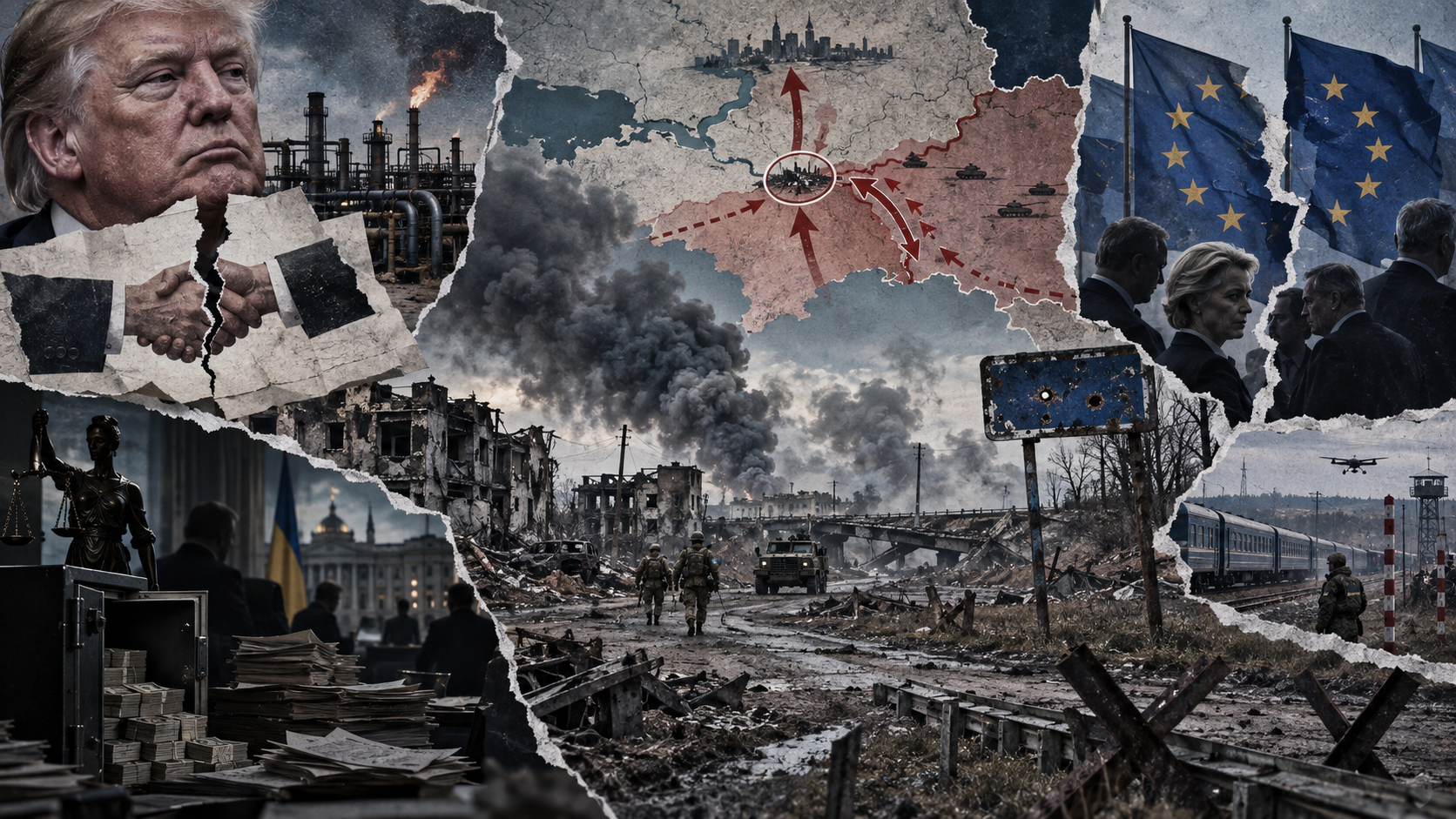
Orekhov: The Battle Is Effectively Over
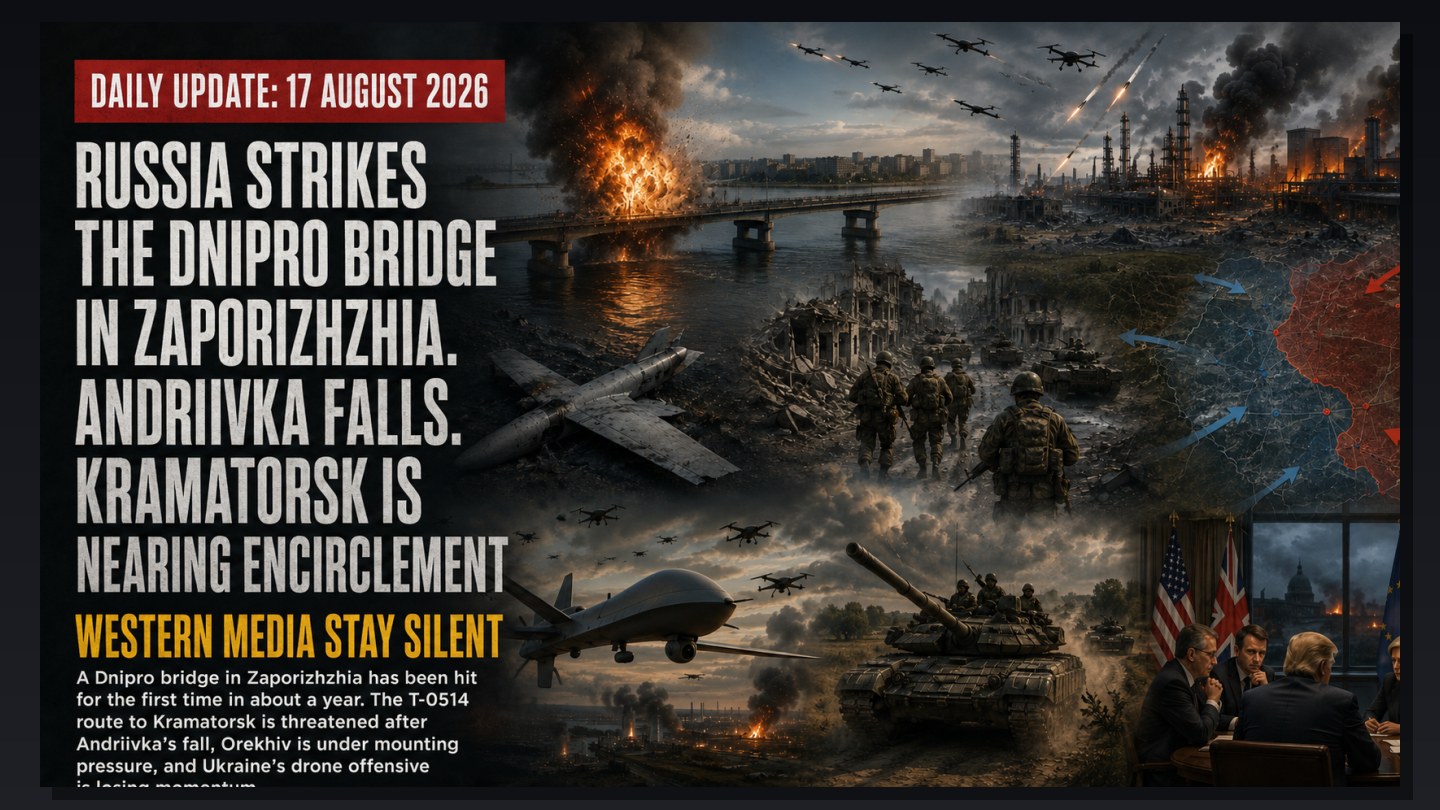
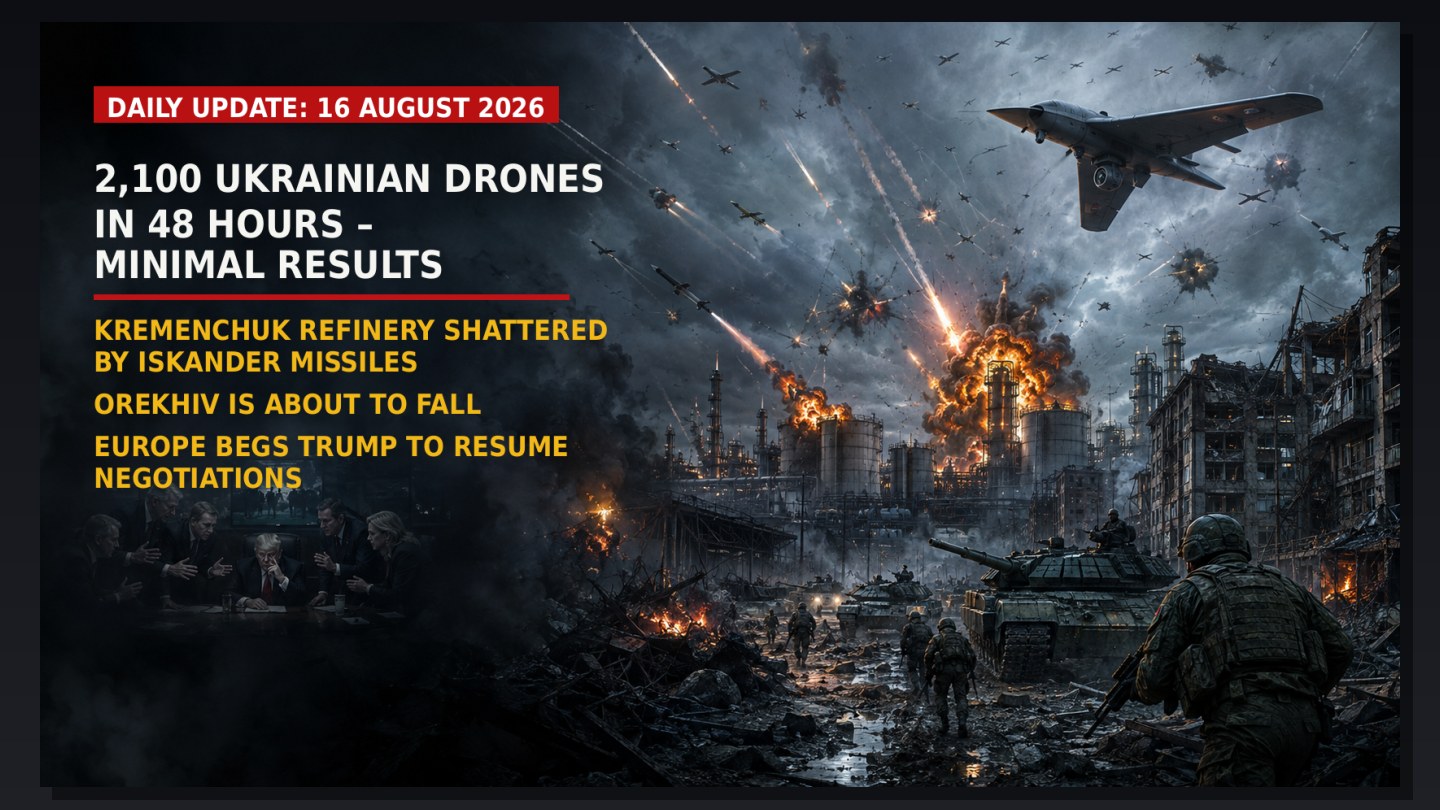
The Russian newspaper Readovka reported Monday evening that Ukrainian forces had begun withdrawing from Orekhov and that the town and surrounding villages were close to coming under full Russian control.
According to Readovka, the withdrawal began several days ago but gradually became disorganised. A group of several hundred Ukrainian troops holding positions south of the town to protect against Russian infiltration reportedly failed to receive withdrawal orders in time and is now surrounded after Russian forces advanced and outflanked them.
Scattered Ukrainian groups are said to remain inside Orekhov itself, while the main body of the garrison has moved towards the northern outskirts. The villages of Novopavlovka and Novoandreevka north of Orekhov — the latter announced captured by the Russian Defence Ministry the previous day — have now cut the principal remaining route of retreat, meaning that the northern force may also risk being trapped.
The semi-official Russian military commentator Andrei Marochko has effectively given the same account to the state news agency TASS: Russian forces have broken through Ukraine’s defences in Orekhov and a collapse appears to be unfolding.
The significance should not be understated.
Orekhov was the principal launching point for Ukraine’s 2023 summer offensive, which sought to break south towards the Black Sea and isolate Crimea. The town’s fall would effectively bury any prospect of a future Ukrainian drive south towards the peninsula.
It also opens a path for further Russian advances across southern Ukraine. Orekhov lies at an important road and rail junction and opens the approach towards Zaporozhye city on the Dnieper — one of Ukraine’s major industrial centres and a strategic hub in the southern part of the country.
If Russia ever intends to advance overland towards Odessa, it would first need control of Orekhov, Zaporozhye and the territories east of the Dnieper.
When Konstantinovka fell, its capture was described as comparable in importance to the seizure of Avdeevka in February 2024.
If Orekhov’s fall is now fully confirmed, it would, by this assessment, rank as strategically more important than either of them.
Trump’s ‘Energy Truce’: No Agreement Exists
On Monday evening, Donald Trump claimed on Truth Social that Ukraine had agreed to stop attacks on Russian energy infrastructure and that Russia had agreed to do the same.
There were grounds for immediate scepticism.
The Financial Times subsequently reported surprise and confusion among Ukrainian officials. Discussions and back-channel contacts concerning a possible energy truce have reportedly taken place, but neither Kiev nor Moscow confirmed Trump’s claim that the two sides had already reached an agreement.
It is also easy to understand why Russia would have limited interest in such an arrangement.
Ukrainian attacks have inflicted damage on Russia’s energy infrastructure, but Russian attacks on Ukraine’s energy system have had far greater consequences for the Ukrainian economy and its ability to wage war. Putin has meanwhile repeatedly rejected temporary ceasefires that are not part of a broader political settlement.
Asked about the issue on Tuesday morning, Kremlin spokesman Dmitry Peskov said it would be good if the Americans could persuade the Ukrainians not to attack civilian energy facilities inside Russia.
That amounted, in practice, to confirmation that Trump’s completed “agreement” did not exist.
It is another example of presidential announcements about the war getting ahead of the actual state of negotiations.
At the same time, US intelligence is reported to have warned Kiev that Russia is preparing a larger series of combined attacks against Ukraine’s energy system using ballistic missiles, cruise missiles, hypersonic weapons and drones.
Another Western Voice Says the Same Thing: The Situation Is Unsustainable
Analyst Ben Aris, known for his coverage of Russia and Eastern Europe, has joined a growing group of Western commentators now drawing essentially the same conclusion as Eric Schmidt, Owen Matthews and Wolfgang Münchau:
The cumulative effect of Russian missile and drone strikes, the destruction of warehouse capacity and the pressure on the energy system is placing Ukraine in a situation that cannot continue indefinitely.
Aris offers a striking comparison. While Ukraine may, by his estimate, have destroyed around three per cent of Russia’s warehouse capacity — capacity which Russia is simultaneously repairing and replacing — he estimates that Russia has destroyed between 30 and 60 per cent of Ukraine’s equivalent capacity nationwide.
A Ukrainian minister has also stated that as much as 90 per cent of warehouse capacity in the Kiev region has been destroyed.
The figures illustrate the enormous disparity between the two air campaigns.
Russian commentator Sergei Poletayev offers a qualification. He agrees that the attacks are degrading Ukraine’s ability to wage war, but argues that so long as Western money and weapons continue to flow, the air campaign alone will not necessarily determine the outcome.
What may prove more decisive, in his view, is the mounting internal pressure: divisions within the leadership, elite conflict in Kiev and increasingly visible resistance to mobilisation.
There is reason to be more cautious about assuming that popular dissatisfaction alone can bring down the government. Ukraine is not currently holding elections under wartime conditions, and the state possesses an extensive security apparatus.
Zelensky has also demonstrated a willingness to use administrative measures against political critics.
He recently imposed ten-year sanctions on his former press secretary Iuliia Mendel, who has become increasingly critical of him in recent months, including in a controversial interview with Tucker Carlson in May.
Former president Petro Poroshenko has likewise been subjected to sanctions.
Mendel herself and several legal commentators argue that such measures violate Ukraine’s constitution. She is currently based in New York.
Kiev’s Elite Wars: Gunfire, Corruption and a Prosecutor’s Office in Freefall
The picture of internal tension also includes last week’s armed confrontation between Ukraine’s military intelligence service GUR and the SBU security service, in which at least one person was reportedly killed.
The bizarre element is that those involved are now also reportedly being investigated for swearing at one another in Russian during the incident.
According to the website Events in Ukraine, the confrontation was less about the SBU’s detention of a far-right Russian dissident linked to Budanov’s circle than about a struggle between SBU and GUR for control over fraudulent call centres — an industry which, according to some estimates, generates enormous revenues inside Ukraine.
This week, an even larger scandal has unfolded.
The background is a major corruption investigation in which the anti-corruption agencies NABU and SAPO say they uncovered an alleged criminal organisation operating within the Prosecutor General’s Office.
Officials are accused of taking bribes from fraudulent call centres in return for allowing them to operate undisturbed and of laundering millions in criminal proceeds.
Kravchenko responded by issuing his own notice of suspicion against NABU director Semen Kryvonos, accusing him of falsifying documents.
The confrontation became so extraordinary that sources in Zelensky’s own circle were quoted describing Kravchenko as having “lost his mind”.
It is important to note that Kravchenko himself has not been formally charged, and Events in Ukraine suggests that the central organiser of the network may have been another individual, even though Kravchenko is referred to as the “boss” and is alleged to have received a share of the proceeds.
A photograph has circulated showing a safe filled with US dollars and other currency, allegedly from the office of one of those involved.
The picture that emerges is one of corruption and factional struggle permeating large parts of the political system — and one that it is difficult to imagine the presidential administration being entirely unaware of.
NABU was originally established with substantial American support and maintained close links with the US Embassy, while the European Union is today a major financial and institutional supporter.
That makes theories that either “the Americans” or “the Europeans” are orchestrating the entire process difficult to substantiate.
A simpler explanation is that these are increasingly intense internal struggles within the Ukrainian elite over control of the remaining political and economic resources as the war situation deteriorates.
It is both a symptom of the growing crisis within the state — and something that may itself further weaken the state’s capacity to function.
EU Divided Over Russia Sanctions
The Europeans also appear increasingly divided.
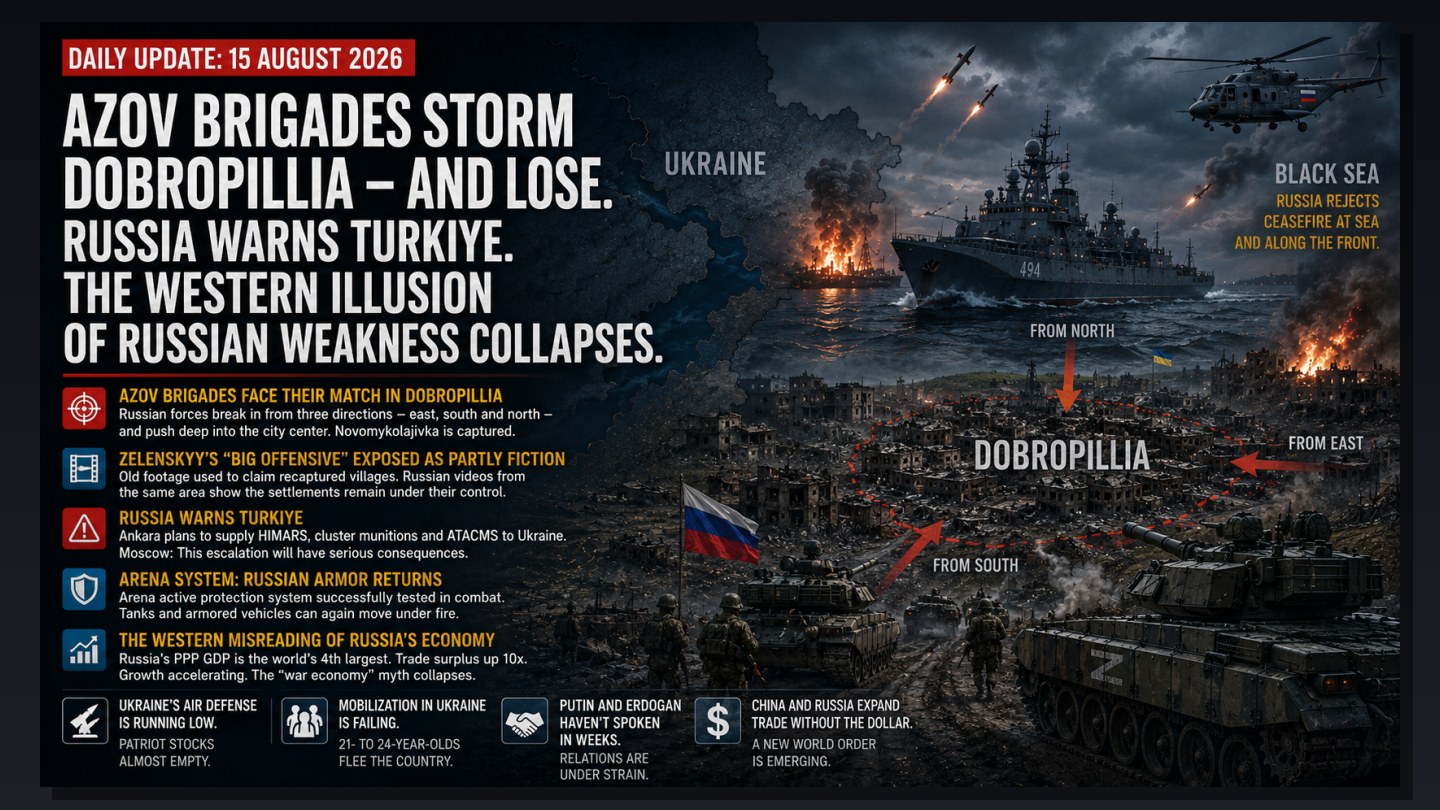
EU member states failed to agree on the normal renewal of individual sanctions against Russia and were therefore forced to extend them for just seven days, until September 22, while negotiations continue.
Slovakia simultaneously demanded the removal of sanctions against Russian businessmen Alisher Usmanov and Mikhail Fridman.
France has since joined the demand to remove Usmanov from the sanctions list.
The French initiative has also reportedly been linked to attempts to secure the release of French nationals detained in Azerbaijan — making the sanctions dispute even more remarkable.
Both Usmanov and Fridman have substantial financial connections in Britain. If they are removed from EU sanctions lists, it could create an awkward situation for the British authorities, which continue to freeze significant assets connected to them.
The Train, Petraeus and Selective Outrage
British coverage of the attack on the locomotive near the Polish-Ukrainian border continues to grow.
Ukrainian Railways said the diplomatic train had departed ahead of schedule and may itself have been the intended target.
Former CIA director David Petraeus has said he witnessed the attack and found the experience frightening.
The Daily Telegraph published an article condemning Russian “recklessness” for putting the lives of Western dignitaries at risk.
On the same day, the newspaper published another article discussing Ukrainian drone attacks against the Krasnodar region, one alleged target of which was the property widely described in Western media as “Putin’s Palace” on the Black Sea.
The contrast is striking: the possibility that Russian attacks might have hit Western officials is treated as especially reckless, while Ukrainian attacks against a possible location of the Russian president receive markedly less critical treatment.
It is worth taking a step back and looking at which kinds of risks are condemned — and which are applauded.
For the record, the story surrounding the so-called “Putin Palace” is considerably more complicated than the label implies.
Putin has denied that the property belongs to him or his family, while businessman Arkady Rotenberg has publicly said that he is the real owner.
Alexei Navalny’s organisation, on the other hand, published extensive material linking the project to people and corporate structures around Putin.
There is therefore no basis for describing the complex as an undisputed private Putin residence.
Putin’s official presidential residence on the Black Sea is in Sochi.
The story also illustrates a broader problem in wartime coverage: once a particular narrative becomes established, it can continue shaping media coverage and political decisions long after the underlying facts have become considerably more complicated.