
Zatoka Bridge: Reportedly Put Out of Action Indefinitely
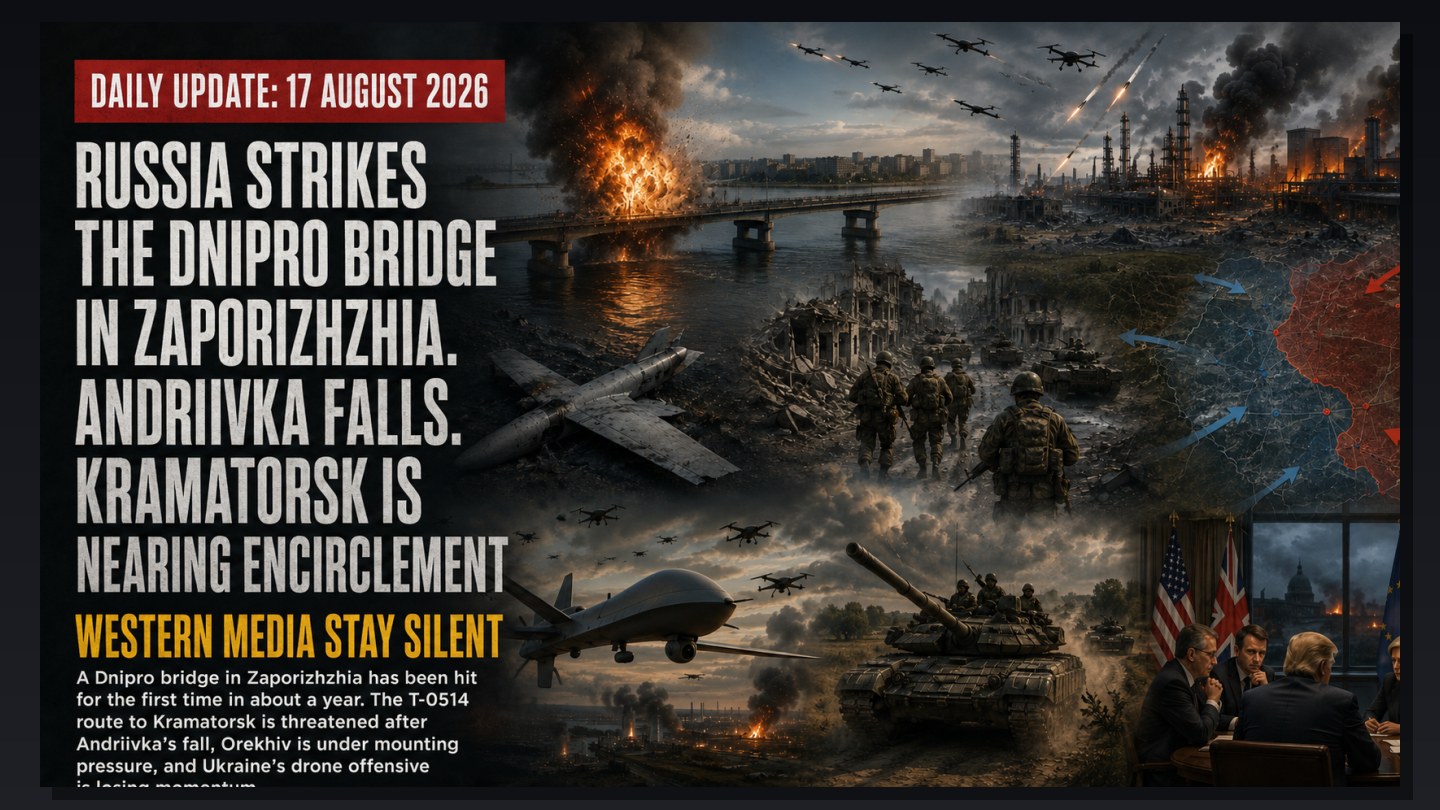
According to a number of reports, Russia has inflicted such extensive damage on the Zatoka Bridge between Odesa and Romania that it may be out of service indefinitely.
Su-34 bombers are reported to have fired precision-guided KAB bombs at the bridge — not converted FAB bombs fitted with guidance kits, but weapons designed from the outset for precision strikes and therefore better suited to a target such as a bridge. Geran drones and other missile types are also reported to have taken part in the attacks.
The extent of the damage has not yet been fully verified, but if the reports are correct, repairing the bridge could require work on such a scale that it may in practice be impossible to restore normal operations before the war is over.
The Air War: Ukraine’s Drone Offensive Drops Sharply — but Probably Not Because It Is Running Out of Drones
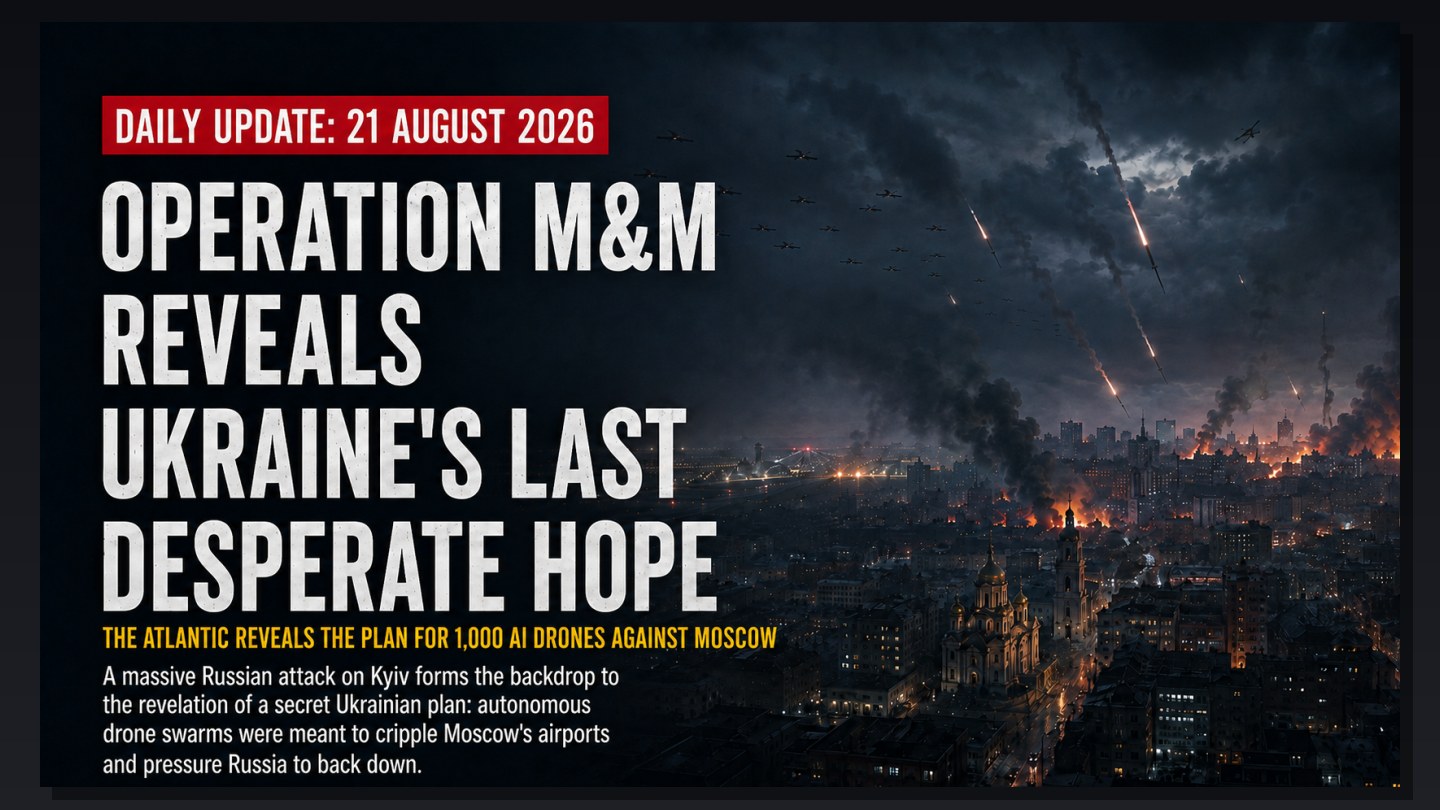
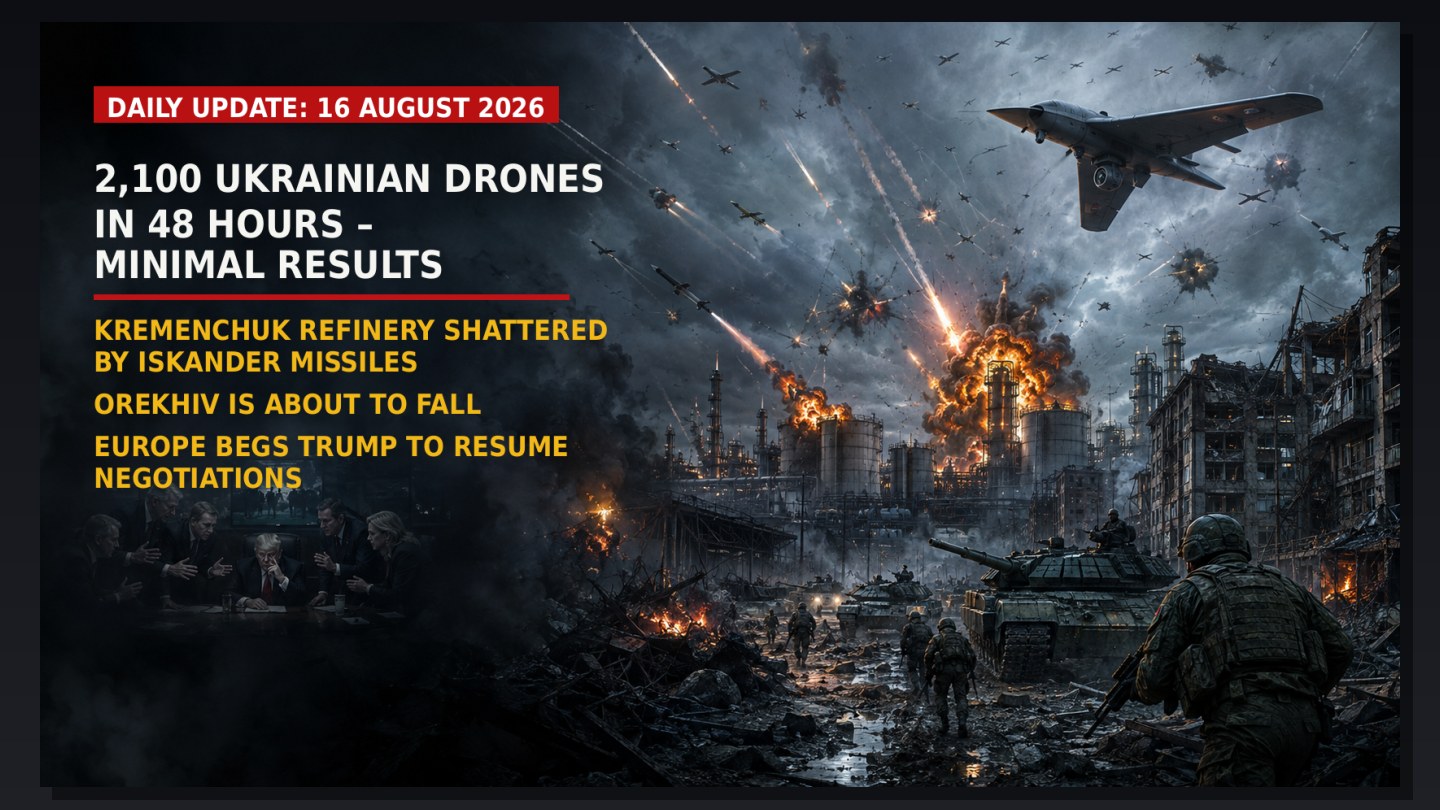
On Wednesday night, the number of Ukrainian drones sent toward Russia fell dramatically, to around 70 — far below the levels seen in August and early September.
The most likely explanation is not necessarily that Ukraine is running out of drones, but that weather conditions are making operations more difficult. Ukraine’s long-range drones are generally aerodynamically simpler than even Russia’s basic Geran variants, and poor weather may therefore have a greater impact on their operational range and guidance.
Ukraine simultaneously claims that Russia has reduced the intensity of its own attacks. There is reason for scepticism toward such figures, as Ukrainian reporting on both the number of weapons launched and interception rates has over time become increasingly difficult to verify.
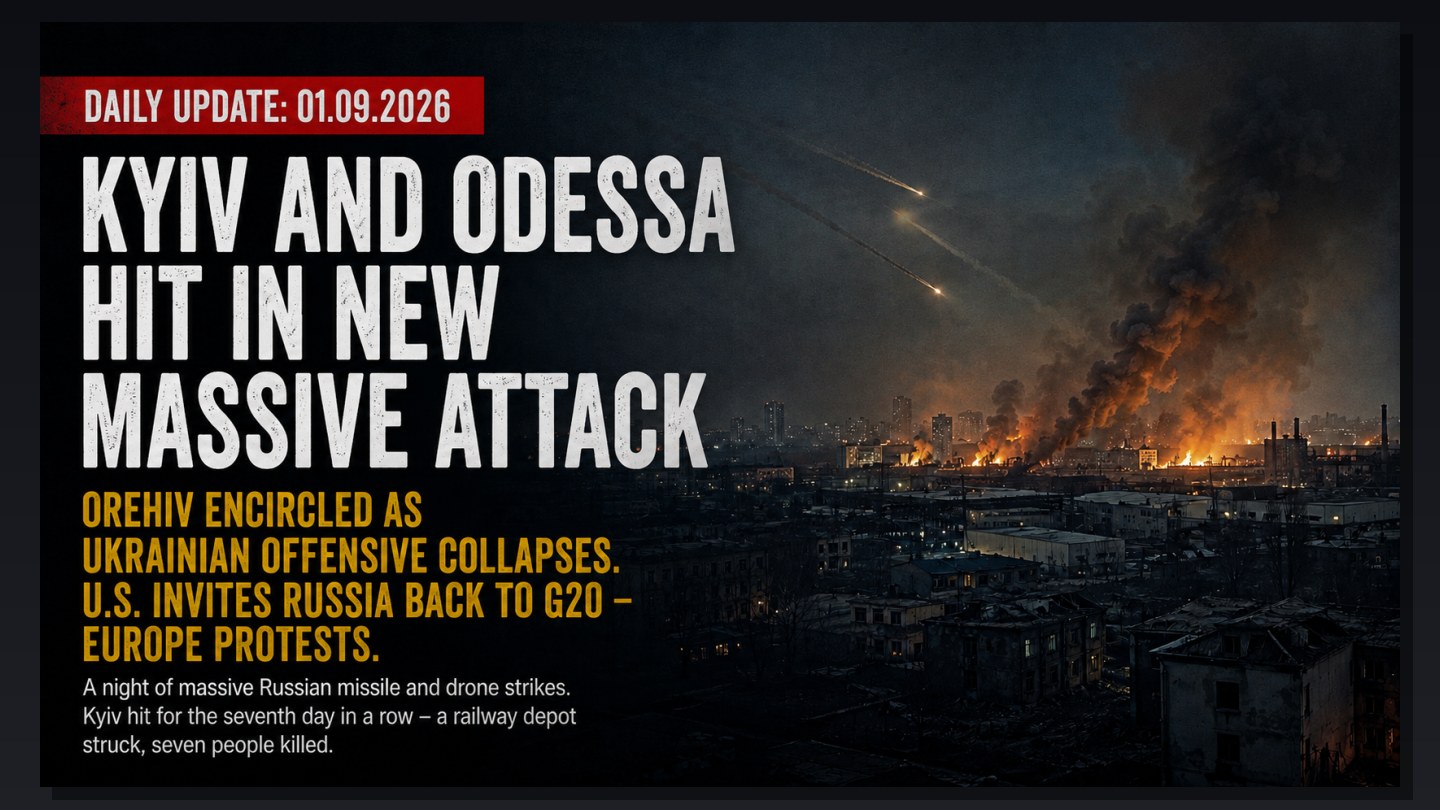
Footage from Kyiv on Wednesday showed substantial plumes of smoke and fires over the city, which in itself suggests that the intensity of Russian attacks remains high.
At the same time, increased activity by Russian Gerbera reconnaissance drones is being reported over central Ukraine. These superficially resemble the Geran drones but are a different system, produced at different factories and used, among other things, for reconnaissance and target location.
This may be an indication that Russia is preparing another larger combined drone and missile attack against central, and perhaps western, Ukraine in the coming days.
Orikhiv: A Historic City From the Era of Catherine the Great
Orikhiv developed around 1783, during the reign of Catherine the Great, in the period when the Russian Empire was consolidating control over the territories north of the Black Sea following its wars with the Ottoman Empire.
During the nineteenth century, the city developed into an important centre of German and Mennonite settlement. For a period, it even had a German mayor and a substantial German-speaking population.
At the collapse of the Soviet Union, Orikhiv had more than 20,000 inhabitants. By the outbreak of the war, the population had fallen to around 13,000 — an expression of the demographic decline Ukraine was already experiencing before 2022, and which has since become far more severe.
Militarily, the situation now appears increasingly difficult for Ukrainian forces.
Fighting continues north of Orikhiv itself, in the villages surrounding the city and probably also in its northern outskirts. Russian reports have for several days claimed that the Ukrainian garrison is beginning to collapse and that the routes of retreat to the north are threatened or have been cut.
There has still been no final announcement from the Russian Defence Ministry confirming complete control of the city, but such confirmation could come within the next few days if the current development continues.
Orikhiv was the starting point for Ukraine’s major summer offensive in 2023. If the city now falls, it would represent a symbolically and strategically serious defeat — and open the way for further Russian advances toward Zaporizhzhia and the areas along the Dnipro.
Northeastern Kharkiv: Another Pocket Collapses
Readovka is now also reporting the collapse of the remaining Ukrainian defensive pockets in northeastern Kharkiv region.
The village of Olkhivka, where a Ukrainian battalion of around 180 men was reportedly holding out, is claimed to have been captured. The force there may have surrendered, been destroyed or attempted to withdraw through increasingly difficult terrain.
The same development is now reportedly affecting a larger pocket containing around 1,700 Ukrainian soldiers farther east.
According to Readovka, Russian forces are already beginning to move toward the remaining key village south of the area — a possible prelude to the battle for Velykyi Burluk.
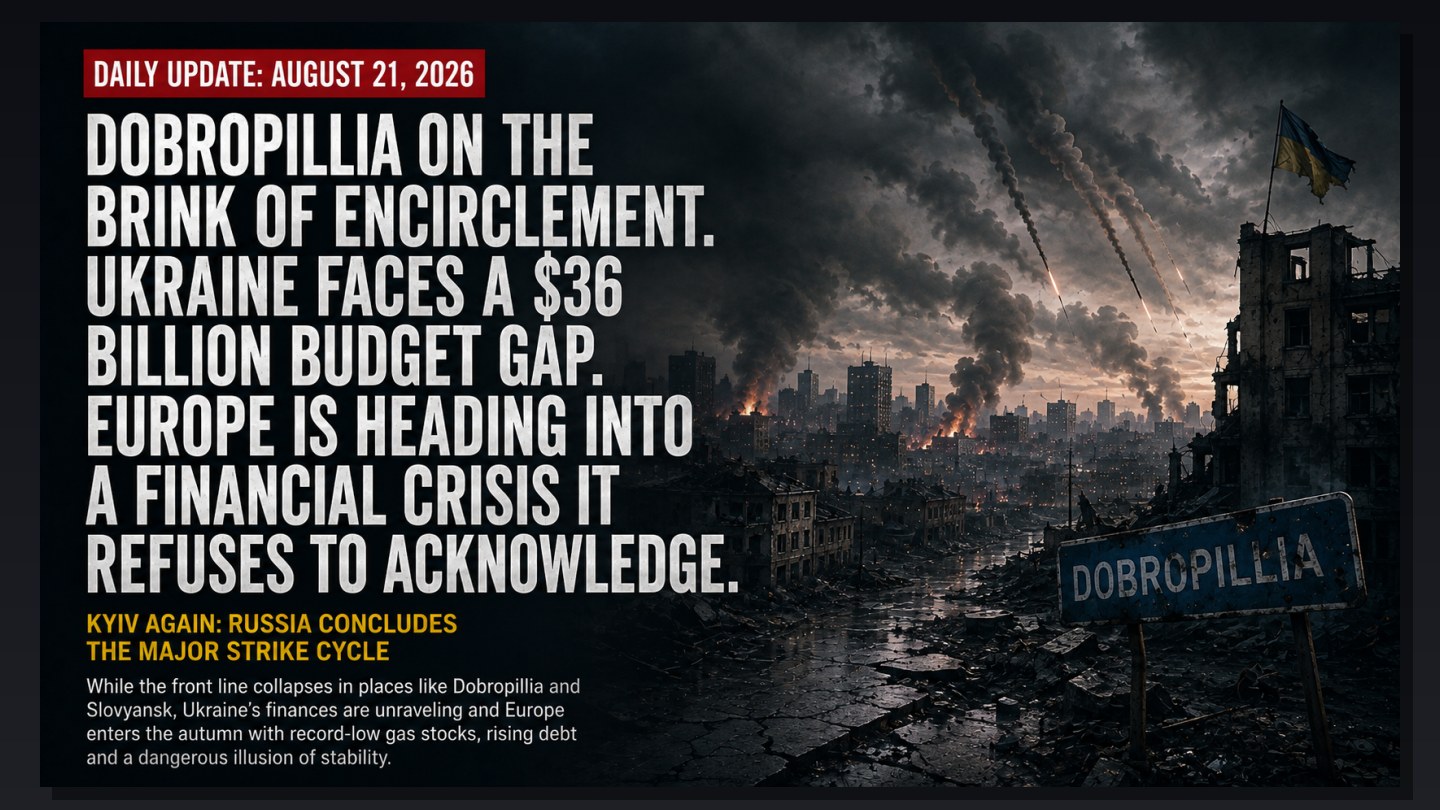
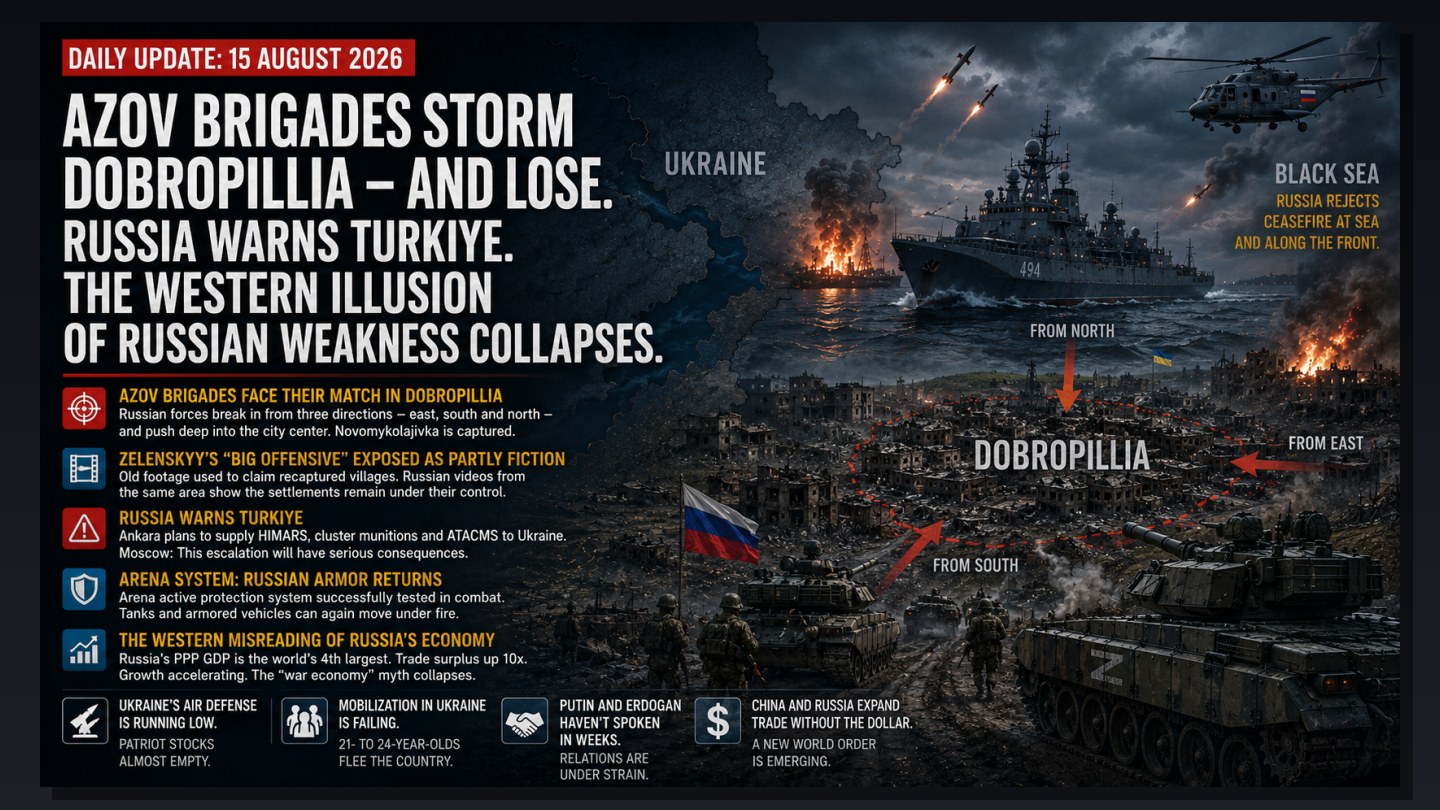
Dobropillia: Prokopenko Leads the Defenders Into Another Trap
In Dobropillia, the westernmost of the three besieged cities in the Sloviansk conurbation — together with Druzhkivka and Oleksiievo-Druzhkivka — the defence is being led by Denys Prokopenko, the rival and partner of Andriy Biletsky within the leadership of the Azov movement.
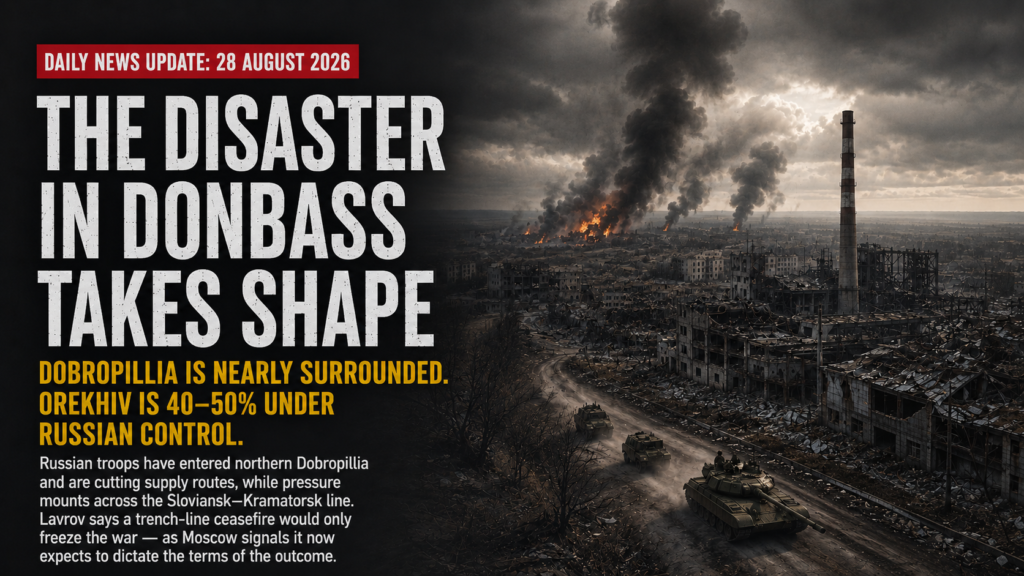
Russia already controls large parts of the eastern and northern sections of the city, has established footholds in the south, and the latest reports suggest that Russian forces have also expanded their control west of the city.
This increasingly points toward complete encirclement.
Prokopenko led the defenders of Mariupol in 2022 into a situation that ended with the mass surrender at Azovstal. He was captured, later sent to Turkey under an arrangement whereby he was supposed to remain there for the duration of the war, but subsequently returned to Ukraine.
He now appears to be leading his forces into another extremely difficult situation in Dobropillia.
It is also a recurring problem that several of the political leadership figures surrounding the Azov movement lack formal military education and higher-level strategic experience, while their political and ideological profile makes it difficult for them to surrender territory when the situation calls for withdrawal.
Lyman: A Real Counteroffensive — but Far Smaller Than the Biggest Claims
Ukraine has now released considerably more information and video material about the situation around Lyman.
A Ukrainian officer connected to Azov’s Third Corps has confirmed that Ukraine did in fact carry out a counteroffensive in the area.
Ukrainian forces reportedly retook one village west of the Nitrius River and cleared additional areas that had temporarily been infiltrated by Russian reconnaissance and sabotage groups.
This also means that it is now clear that Sviatohirsk is fully under Ukrainian control, not merely the monastery area.
Later Ukrainian information put the total area cleared in the operation at around 75–85 square kilometres.
That is a genuine local advance.
But it is still a matter of tens, not hundreds, of square kilometres — and therefore far smaller than some of the most extreme versions of the story that have circulated in Ukrainian channels and Western media.
There is still no indication that Ukraine has driven Russian forces out of Lyman or achieved an operational breakthrough east of the river lines.
Russian forces are reportedly still controlling areas east of the Nitrius River, while some reports suggest that Ukrainian sabotage groups have also conducted raids farther east.
The situation is therefore more complicated than either Russian or Ukrainian maximalist accounts suggest.
It is also worth noting that the offensive bears several of the characteristics of earlier operations led by Andriy Biletsky and Azov’s Third Corps.
Biletsky has on several previous occasions conducted his own offensive operations that initially attracted considerable attention, only for the gains later to prove temporary.
His background is primarily political and ideological rather than professionally military. He built the Azov militia in 2014 with substantial support from Ukrainian oligarchic circles and has since used the movement’s military profile to strengthen his own political position.
This gives him strong incentives to demonstrate offensive results.
The question is therefore whether the operation around Lyman is primarily strategically motivated, or whether political considerations are also playing a significant role.
If the offensive ties down large Ukrainian reserves and inflicts significant losses on its own forces, it could in the worst case weaken the defence of the northern flank of the Sloviansk–Kramatorsk system.
The two earlier Ukrainian offensives in Zaporizhzhia failed to save Orikhiv. On the contrary, they tied down forces that could have been used at Kostiantynivka and Dobropillia.
The same pattern may now repeat itself.
Russia’s Jet Drones: A Problem the West Still Has Not Solved
Reuters has published an extensive examination of the new Russian jet-powered drones, and the conclusion is uncomfortable for Ukraine:
There is currently no cheap and scalable method of stopping them.
Jet-powered interceptor drones must be fast enough to catch their targets and will often cost at least as much as the attack drones they are supposed to shoot down.
Using conventional air-defence missiles is even more expensive and places additional pressure on a Ukrainian air-defence system already short of both missiles and launchers.
Much of the cost-benefit logic therefore disappears.
Russia can produce attack drones more cheaply and in greater numbers than Ukraine and the West can produce the weapons required to stop them.
If Russia simultaneously acquires increasingly effective satellite and ground-based guidance across central and western Ukraine, the problem could grow significantly in the coming months.
Banderol: Cheaper Missiles in Ever Greater Numbers
Then there is the S8000 Banderol, a relatively simple and inexpensive jet-powered cruise missile that Russia is already using against Ukrainian targets.
The weapon forms part of the same shift toward cheaper precision weapons that can be produced in far greater numbers than traditional cruise missiles.
Ukrainian intelligence has estimated current Russian production capacity at around 80 Banderol missiles per month, while a stated Russian production target is reportedly around 120 per month.
The numbers are far below the production rate of Geran drones, but the direction is the same: Russia is attempting to move an increasingly large share of its long-range strike capacity onto weapons that can be mass-produced at substantially lower cost.
This stands in contrast to several Western programmes aimed at producing inexpensive precision missiles for Ukraine that have so far failed to achieve comparable production volumes.
In the background, production of much heavier systems also continues.
Russian reports and speculation are circulating that another major Oreshnik strike may be under preparation, but there has so far been no public confirmation.
Ukraine’s Financing Problem Is Becoming Increasingly Acute
Alongside the military developments, Ukraine’s fiscal position is becoming steadily more difficult.
The Finance Ministry in Kyiv has begun describing increasingly narrow categories of expenditure that the state is actually able to finance itself, while ever larger parts of the budget depend on outside support.
That makes the question of continued European financing increasingly urgent.
And that is precisely why the battle over Russian funds held at Euroclear is becoming so important.
Belgian Court Undermines the EU’s Euroclear Plan
The court did not order the money itself to be released.
Nor does the ruling concern the Russian central bank and its far larger reserves.
But the judgment criticises the way Belgian authorities handled parts of the process and finds that decision-making authority had not been exercised on a proper legal basis.
It may therefore open the door to further legal challenges against similar decisions.
Even more important was the court’s observation that Belgian authorities cannot assume that EU sanctions against Russia will necessarily exist forever.
That is a point with potentially major consequences.
If the sanctions are one day lifted and Russian central-bank assets have already been spent or transferred to Ukraine, Belgian authorities could be left with substantial legal and financial liability.
It is therefore becoming increasingly clear why Belgium and several other European governments have been highly reluctant to support the outright confiscation of the Russian principal assets.
The risk is not merely geopolitical.
It is legal.
And ultimately, it could end up on the Belgian state’s balance sheet.
At the same time, capital flows from the Persian Gulf amid the continuing turmoil in the Middle East have increasingly moved toward Asian markets rather than Europe and the United States.
It is difficult to rule out that several years of freezing Russian reserves and discussing their outright confiscation have contributed to weakening confidence in Western financial markets as a politically neutral place for states to store capital.
AfD Leads Clearly Ahead of the Election in Merkel’s Home State
Germany’s political crisis continues to deepen.
Chancellor Friedrich Merz refuses to change course after the historic defeat in Saxony-Anhalt and has stated that he will not alter his policies “by so much as a centimetre”.
This is contributing to growing unrest inside the CDU.
The German newspaper Die Welt, which has strong connections within the CDU leadership, has in recent days published several articles about the growing debate over Merz’s future and possible successors.
Ahead of the state election in Mecklenburg-Vorpommern on 20 September, AfD leads the latest polls with around 36–38 percent.
The SPD follows behind, while the CDU is down at around 7 percent in several of the latest polls.
This is particularly striking because Mecklenburg-Vorpommern is Angela Merkel’s home state and has historically been considerably less right-wing than Saxony-Anhalt.
If the CDU were to fall further and approach the five-percent electoral threshold, it would be an extraordinary event in modern German politics.
Even a result of around seven percent would dramatically increase pressure on Merz and probably trigger a far more open leadership struggle within the CDU.
The SPD government under Minister-President Manuela Schwesig has problems of its own.
Before 2022, Schwesig was a strong supporter of the Nord Stream project, which had direct economic importance for the state.
She must now defend a German energy policy that is almost the opposite of the position she previously identified with.
This is happening in a region with longstanding economic and historical ties to Russia and where opposition to Germany’s Ukraine policy is substantial.
Any future German chancellor, whoever it may be, will have to contend with the fact that Ukraine policy has now become a significant domestic political burden.
That makes it harder to assume that German financing of Ukraine can continue to grow without political consequences.
Conclusion: A System With No Reverse Gear, in the Middle of a Global Storm
All of this is unfolding against the backdrop of a global economy under steadily increasing pressure.
Natural-gas prices in Europe have again moved toward levels not seen since the 2022 energy crisis, while low storage levels and strong Asian demand for LNG are making it more difficult to replenish European reserves.
The oil industry is simultaneously warning of increasing price pressure as China once again builds up its own reserves.
That means greater inflation risk.
And higher inflation means pressure on central banks to keep interest rates higher than they otherwise would.
That in turn could hit both European economies and the US stock-market boom, while several technology leaders have already begun warning about a possible bubble in parts of the AI sector.
The combination of higher interest rates, higher energy prices, weak growth and enormous public debt therefore raises an increasingly obvious question:
How realistic is it to believe that the flow of money to Kyiv can be maintained at its current level if the economic and political burden on the West continues to increase?
In Germany, Merz’s position is crumbling.
In several European countries, opposition to the war and its associated costs is growing.
And attempts to find new sources of financing are encountering increasingly significant legal and political obstacles.
Yet one should never underestimate how far Western political elites are willing to go to maintain the present course.
In Washington, work continues on Lindsey Graham’s sweeping sanctions legislation, despite China increasing its purchases of Russian oil and making clear that it will resist secondary sanctions.
The BRICS countries have simultaneously repeated their opposition to unilateral Western sanctions.
What was possible to sustain in 2022, 2023, 2024 and parts of 2025 is therefore becoming increasingly difficult to defend in 2026.
If Western governments nevertheless choose to stay the course regardless of the costs to their own economies and populations, there is reason to expect more organised political and economic resistance.
Not only in the streets.
But from business, the financial sector, voters and increasingly large parts of the political system.
It remains to be seen whether the willingness — or the ability — to ignore that resistance actually exists.