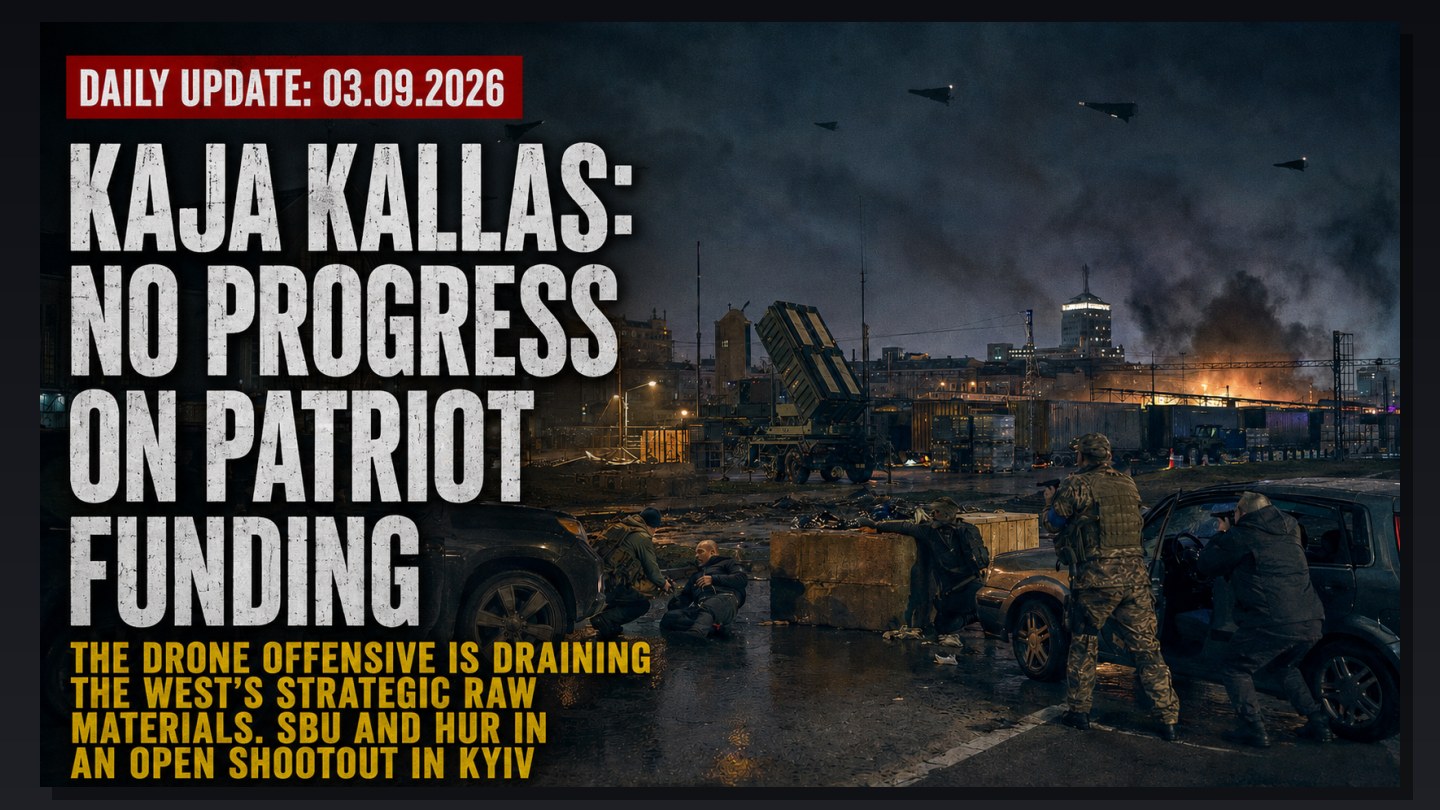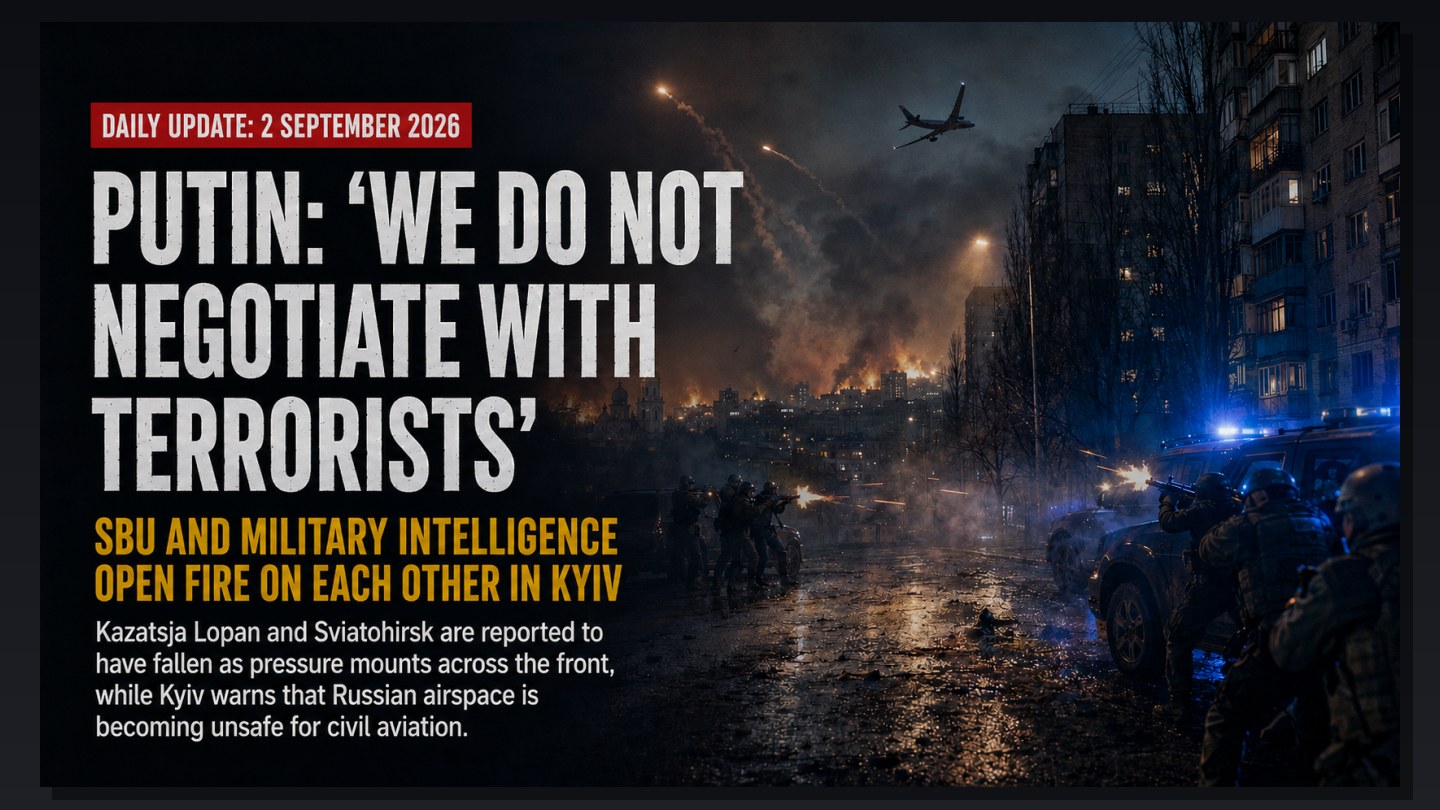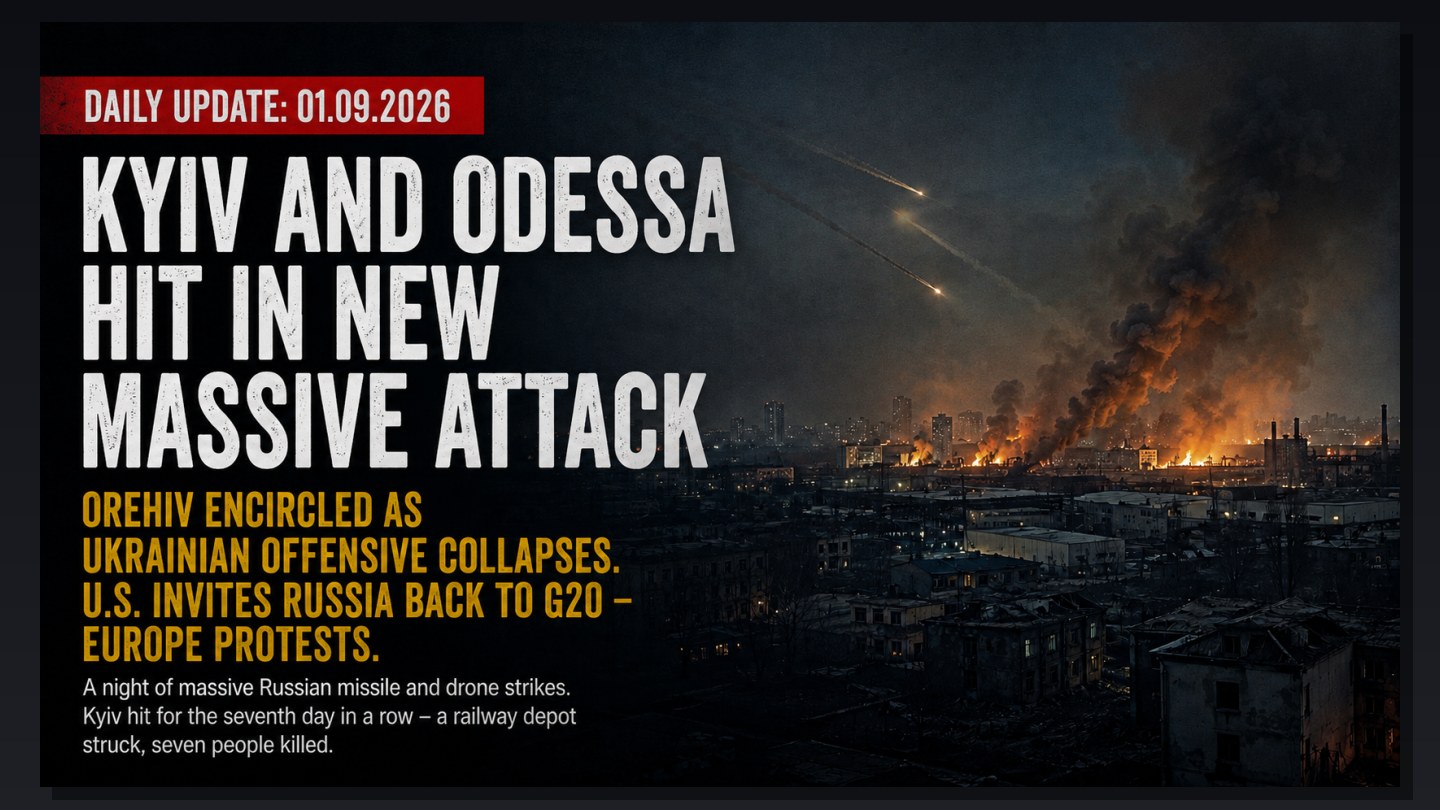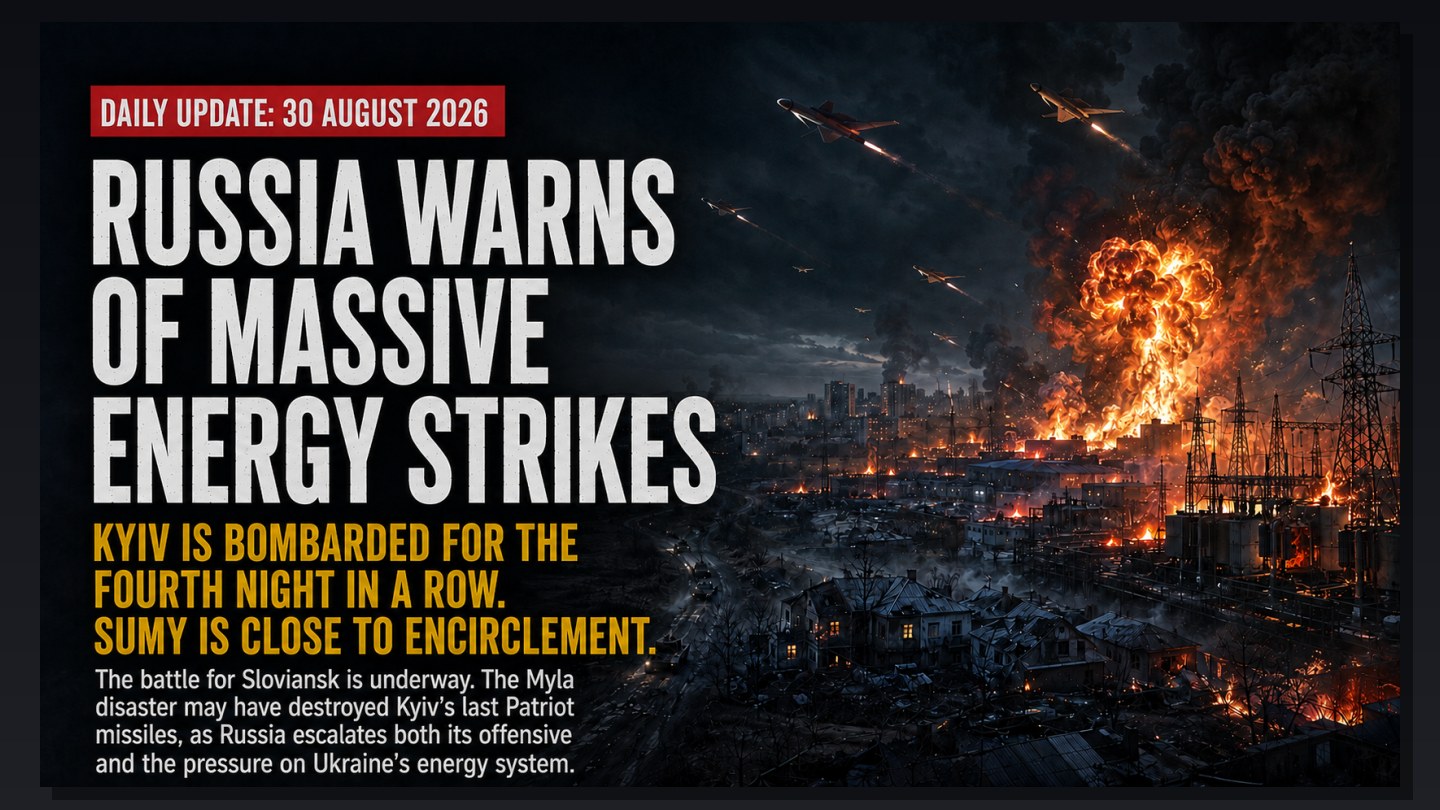
The Strategy: Isolating Kyiv From Its Western Backers
What is unfolding now confirms a pattern observed for several weeks: Russia is systematically working to cut Kyiv off from the West — making travel to and from the city increasingly dangerous for Western dignitaries, and making the city itself less safe for foreigners to remain in. The advantage for Russia is twofold: if the Ukrainian leadership stays in Kyiv, it becomes more isolated from its Western advisers and sponsors. If it instead moves the government elsewhere in the country, its legitimacy and grip over the rest of the country are further weakened.
The Train Near the Polish Border: The Warning Materialises
On Sunday night, a Russian drone struck a locomotive at Yahodyn station, right by the border crossing with Poland — only minutes after a diplomatic train carrying Boris Johnson, former Swedish prime minister Carl Bildt and security advisers from several EU countries had left the station earlier than scheduled. Ukrzaliznytsia said that “it is highly likely that the intended target of the drone was in fact the diplomatic train”.
Johnson wrote on X that he did not know “what delusion” had caused Putin to blow up a stationary Ukrainian locomotive near the Polish border. Reuters meanwhile confirms that Western dignitaries had travelled through the area shortly before the strike. (reuters.com)
This is the first time during the war that a train carrying Western dignitaries has been attacked — previously, such journeys had taken place almost unmolested, a form of Russian restraint that now appears to be ending. It is reasonable to assume that Western dignitaries will from now on increasingly have to seek Russian approval before travelling to Kyiv, as the United States did when Joe Biden visited the city in 2023 — Washington contacted the Russians in advance and asked them to refrain from attacks while he was there, which they agreed to do.
It is probably easier for Russia to grant such permission to very senior figures with diplomatic protection than to less important visitors — spies, military advisers, technicians and NGO employees without diplomatic passports. It is not unreasonable to imagine that Russia may gradually, perhaps after the battle for Donbas is decided next year, move toward shutting this railway connection completely.
Eric Schmidt: “More Worried Than at Any Time Since the Earliest Days of the Invasion”
Former Google chief Eric Schmidt, who has himself been heavily involved in the development of Ukrainian drone technology, describes a similar experience from his latest trip to Kyiv.
When his train arrived in the capital during a Russian attack, passengers had to seek shelter at the railway station while explosions shook the building. Schmidt writes that he left Ukraine “more worried than at any time since the earliest days of the invasion.”
The most interesting part is why.
Schmidt describes how Ukraine’s technological advantage is gradually disappearing:
“For years, the Kremlin’s strategy consisted of throwing industrial mass at Ukrainian innovation, but it is now combining that mass with its own innovations.”
His conclusion is that Ukraine can no longer match Russia through innovation alone. The West, he writes, must mobilise its collective resources on a scale that makes it possible to “outproduce and outlast” Russia.
It is a remarkable message from a man who throughout the war has worked actively to strengthen Ukraine’s technological capabilities — and who after his latest visit appears more pessimistic than at any previous point.
Geran-2 Is Back — and Transformed
On the night of 14 September, Russia carried out what some are describing as the largest single drone attack in the history of the war — around one thousand Geran drones, mainly of the older propeller-driven Geran-2 type, concentrated near the Belarusian border and apparently dependent on signals from relay stations there. The main targets were engineering, fuel and transport facilities west of Kyiv, including the railway system.
What is striking is that the Geran-2 originally flew a pre-programmed route without real-time ground guidance — making it relatively inflexible, capable of striking known fixed targets, but not much more precisely than that. The precision of the strike on the locomotive at Yahodyn — where the locomotive itself, rather than the whole train, was hit — suggests that Geran-2 has now been modified to carry cameras and receive guidance from ground operators, much like the more advanced variants.
That probably explains why the attack was concentrated near the Belarusian border: the drones appear to depend on relay stations there, unlike Geran-4 and Geran-5, which are increasingly being linked directly to the Rassvet satellite system.
It is also characteristic of Russian military-industrial thinking to keep an older weapon system in service when it still fills a useful niche, rather than phasing it out entirely in favour of the newest model. In poor weather — rain, wind and fog, which have characterised Ukraine in recent days — it is harder for Ukrainian fighter aircraft to shoot down drones of any type, and because the Geran-2 is far cheaper to produce than the jet-powered variants, it makes sense to deploy it in mass precisely when cloud cover thickens.
The Financial Times has meanwhile described how the newer jet-powered Geran variants are placing increasing pressure on Ukraine’s air defences, and how Ukrainian interceptor drones and fighter aircraft are now confronting a Russian drone industry that combines sheer volume with increasingly rapid technological development.
The Front: Zolotyi Kolodiazi Retaken — Back to the Starting Point of Last Year’s Raid
Russian forces have now retaken all the villages they briefly captured during the dramatic deep raid into Ukrainian-controlled territory in August 2025 — a raid that at the time forced Ukraine to redirect reserves from the battles for Pokrovsk and Myrnohrad, triggering a bitter dispute between then commander-in-chief Syrskyi and General Drapatyi, who led the defence in the area and has now taken over Syrskyi’s position.
The Russians withdrew from Zolotyi Kolodiazi at the time after the objective — diverting Ukrainian reserves — had been achieved, and shortly afterwards both Pokrovsk and Myrnohrad fell.
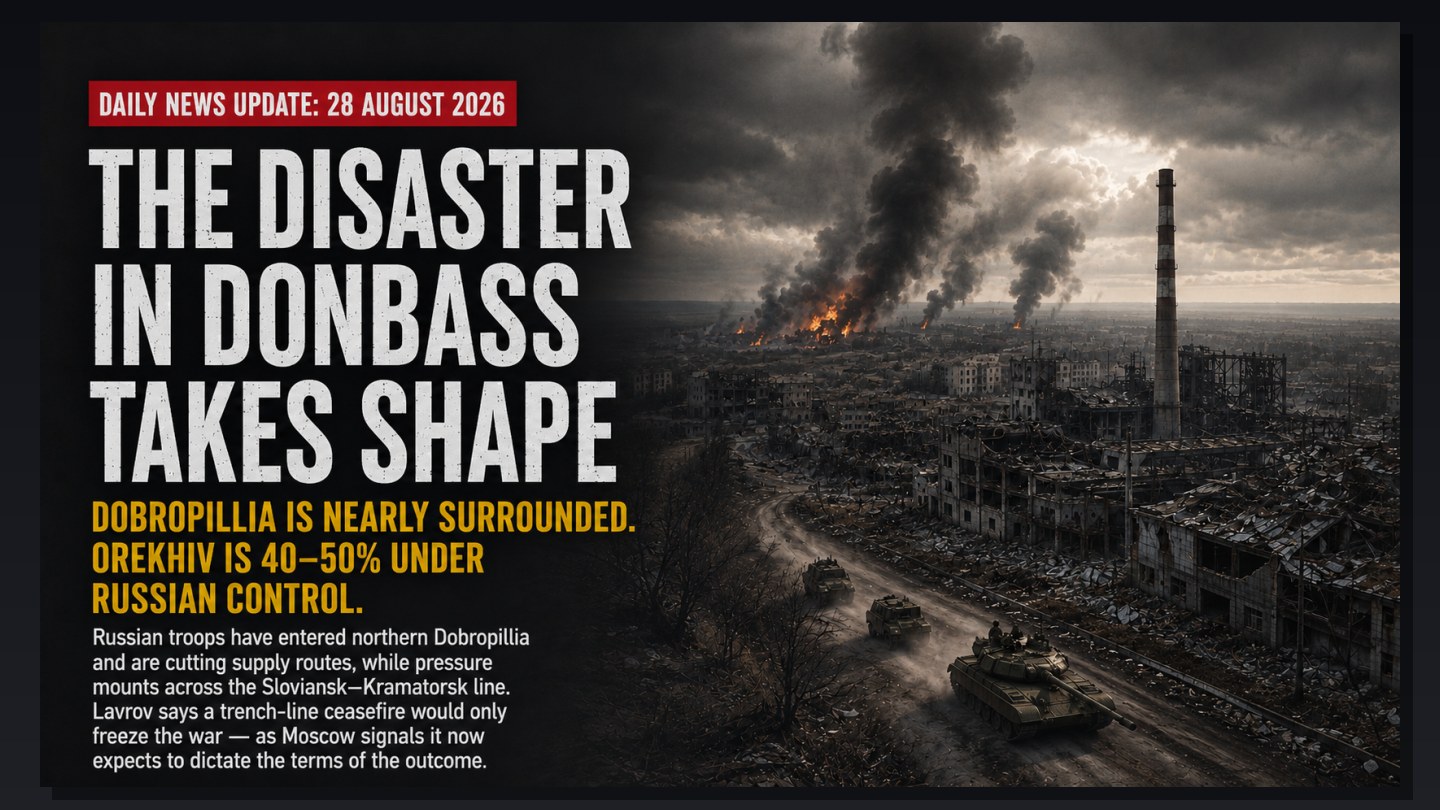
Now the Russians are back, and according to the latest reports they are moving into Zolotyi Kolodiazi itself and clearing the village street by street. The location is important because it was intended to become one of the key points in the new defensive line the Ukrainians were attempting to build to protect the western flank of the Sloviansk–Kramatorsk conurbation.
Azov commander Denys Prokopenko — Biletsky’s partner and rival within the leadership of the Azov movement — is probably responsible for the defence here, and will likely attempt to hold the position for as long as possible.
Farther south, what is described as the most intensely contested battle anywhere along the front is still underway: the battle for Dobropillia itself, where the Russians according to the latest information control around 60 percent of the city — information that still requires confirmation.
Orikhiv: An Orderly Retreat — and Two Cauldrons in the Kharkiv Region
Further reports indicate continued Russian advances through Orikhiv, with what appears to be an orderly Ukrainian withdrawal northwestward from the city in the Zaporizhzhia region.
In the Kharkiv region, the Russian Defence Ministry has provided a detailed account over the past 24 hours: forces from Group North are tightening the encirclement and expanding the outer control zone, with another village captured. Ukrainian forces and equipment surrounded near Mala Vovcha, Budarky and Buhaivka are reportedly under attack, while Ukrainian attempts to break out near Sisnevo and Horobivka are said to have been repelled. A further, smaller Ukrainian force is said to be encircled near Olkhivka.
What stands out is the contrast with Ukrainian Telegram channels and military bloggers, who at the same time claim successful Ukrainian counterattacks in exactly this area — without any evidence, video or official confirmation, just as with the continuing undocumented claims of a Ukrainian offensive north of Lyman.
Russia directly contradicts these claims and says it is Russian forces that are advancing and tightening the pockets. Another day has passed without an official statement from either side, and without drone or video material that could clarify the situation around Lyman.
There is probably intense fighting underway there, with Russia’s 20th Guards Army likely holding its ground, and Biletsky — who needs a political success at home in the form of a successful counteroffensive — may be the source of much of the unverified optimism now circulating.
Interestingly, Russian analyst Marat Khairullin has pointed out that, unlike Ukrainian practice, it is not Russian doctrine to defend every position to the last man — Russian forces manoeuvre and withdraw to stronger positions when this serves the purpose of exhausting the enemy, then counterattack once the enemy has been sufficiently weakened.
It is possible that something similar is happening near Lyman. But the same pattern is not visible at Dobropillia, where the Russian Defence Ministry instead speaks of an “unstoppable advance” under General Ivanov’s command and a Ukrainian defence that is beginning to break.
Ushakov: Ukraine Knows What Is Required — Territory First
Kremlin foreign policy adviser Yuri Ushakov, who carries considerably more weight in the Russian system than Peskov, confirmed in New Delhi that trilateral talks in October are a possibility, but stressed that “there is so far no agreement on a common set of ideas to discuss” — each side has its own, and there is little common ground between them.
Ushakov repeated that if Ukraine genuinely wants a swift end to the war, the decision lies with Kyiv — and explicitly pointed out that the issue “first and foremost” concerns territory: Ukrainian withdrawal from Donetsk and Luhansk, and apparently also Zaporizhzhia and Kherson.
Zelensky still rejects any compromise on Russian terms, and recently made the striking proposal that Ukrainian NATO membership would actually make Russia safer — since Ukraine would then be unable to attack in order to retake lost territory without NATO approval, an approval he implicitly admits Ukraine would never receive.
It is a statement that, perhaps unintentionally, comes close to an acknowledgement that Crimea, Donetsk and Luhansk are already lost to Ukraine.
Zelensky has also expressed hope that Putin will attend the G20 meeting in Miami in December, where both are reportedly invited, in the hope of a meeting with Trump present. Lavrov responded dryly: if Zelensky wants a meeting with Putin, he is welcome to come to Moscow — nowhere else.
Lavrov added, with a touch of malice, that “Zelensky is travelling. He is never at home, while we in Russia have things to do at home” — an observation the Russian newspaper Izvestia has followed up with comments from experts describing Zelensky as someone who “makes the rounds” among Western partners begging for money and weapons, including during his recent visit to Canada, where according to the same sources it was pointed out that Ottawa’s budget has no reserves to increase support for Kyiv on a scale capable of replacing reduced funding from the United States and Europe.
BRICS: The Financial Architecture Takes Shape
Behind the more limited public statement from the BRICS summit in New Delhi — which declared that secondary sanctions and other unilateral sanctions without authorisation from the UN Security Council violate international law — lies a picture of increasingly close coordination between Russia, China and India.
Unlike last year’s summit in Rio, where both Putin and Xi stayed away amid Russian frustration over Brazil’s lack of progress on the payment systems developed under the Russian presidency in Kazan in 2024, this year’s meeting appears to have gone considerably better.
China will assume the BRICS presidency next year and is expected to bring significant resources to further work on an alternative financial system.
Russian central bank governor Elvira Nabiullina confirms that the digital rouble is now operating “smoothly,” while China has launched its own digital currency. It remains necessary to solve how the different countries’ payment systems can be connected without a common convertible currency — but the direction is clear, and 2027 is expected to bring further progress.
Middle East: Trump Claims an Understanding With the Houthis
Trump has said that the Houthis have signalled to Washington that they do not intend to interfere with American shipping in the Red Sea — a more limited understanding than a general ceasefire.
The claim is interesting in any case, given that the United States barely has a significant merchant fleet of its own left.
The Houthis have consolidated control over practically the entire Yemeni Red Sea coast and strategic islands in the sea, while the Saudi pipeline to the Red Sea coast remains shut after drone attacks that, according to some reports, may have been launched by a Shia militia in Iraq in solidarity with the Houthis, probably with Iranian approval.
Simon Tisdall and the Demand for a NATO Offensive
The Guardian commentator Simon Tisdall published yet another article calling for “NATO finally to go on the offensive,” threatening strikes against Russian drone and missile launch sites from the air, and warning that Putin’s “forever war” will otherwise become “everyone’s war.”
It is worth noting that his claim of a steadily increasing civilian death toll from Russian strikes on Kyiv does not match the actual figures so far — civilian casualties have been relatively low.
That demands for direct Western participation in a war against a nuclear power are repeatedly made in one of Britain’s largest newspapers, without the author being reprimanded or challenged for advocating it, is precisely the kind of rhetoric that makes Putin’s warning — that European troops in Ukraine mean war with Russia — necessary to take seriously.
Merz’s Approval Collapses to 14 Percent
A new INSA poll from Germany, conducted after Chancellor Merz’s reaction to AfD’s election victory in Saxony-Anhalt, shows that 78 percent of Germans no longer believe Friedrich Merz is the right chancellor, while only 14 percent believe that he is.
That is a historically weak result for a sitting German chancellor.
The connection between his increasingly aggressive rhetoric toward Russia and the simultaneous management of an economy in decline is, as has been pointed out, not two separate issues but two sides of the same problem.