Witkoff and Kushner: A Pause, Not a Ceasefire
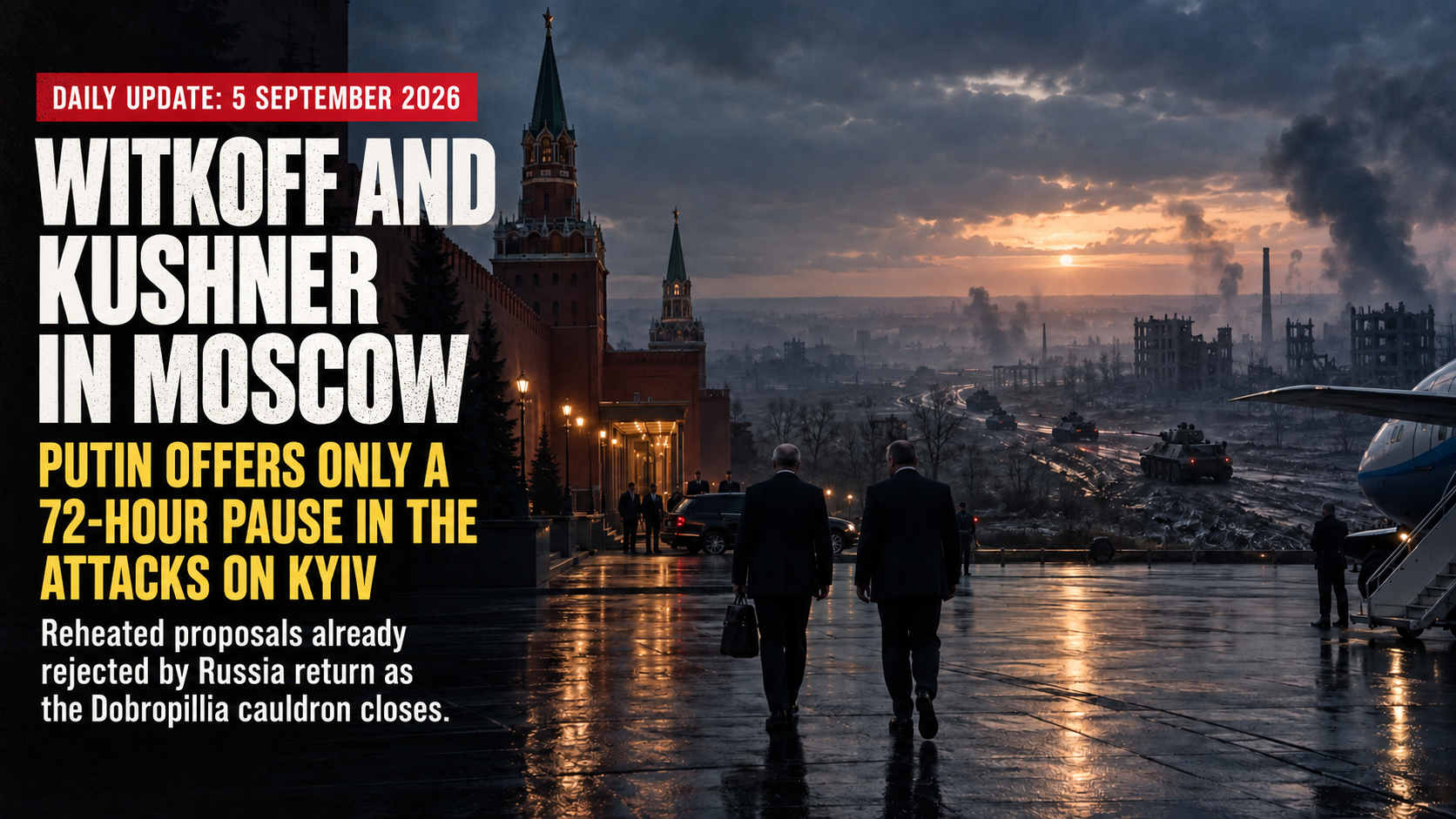
On Saturday, 5 September, Trump’s envoys Steve Witkoff and Jared Kushner arrived in Moscow — their first visit since January — before they are scheduled to continue to Kyiv on Sunday, in what would be the first-ever visit by the two envoys to the Ukrainian capital. Putin arranged a 72-hour pause in attacks on Kyiv itself from midnight — explicitly linked to preparations for the envoys’ visit to the Ukrainian capital, not as a general ceasefire.
Zelensky declared that Ukraine was prepared to refrain from attacks on Moscow through Monday, pending reciprocity from the Russian side. Russia instead granted only a three-day pause limited to the city of Kyiv — not Odesa, not the energy system, not the Black Sea. Peskov also said there were no “new ideas” in the proposals the envoys were bringing, claiming this followed from Trump’s own statement the day before.
Deputy Foreign Minister Sergei Ryabkov set the tone for what Russia expects: “The key issue is the extent to which the US administration is prepared to invest in finding a real solution to the current crisis, given the realities on the ground”. The message is unambiguous: any agreement must reflect the constantly shifting territorial realities — code for Ukraine having to accept withdrawal not only from Donbas, but probably also from Zaporizhzhia and Kherson, as Russia now controls far more territory there than it did at last year’s Anchorage summit.
The proposal the Americans appear to be bringing is a reheated version of what Zelensky and Trump discussed at the G7 and NATO meetings: mutual withdrawal from parts of Donbas combined with a “free-trade zone” in the disputed territory — which would formally remain under Ukrainian jurisdiction but be administered by the Americans. It is precisely the kind of proposal CIA Director Ratcliffe likely presented during his Moscow visit last week, and which Russia has already rejected. There is no indication that Witkoff and Kushner are bringing anything fundamentally new.
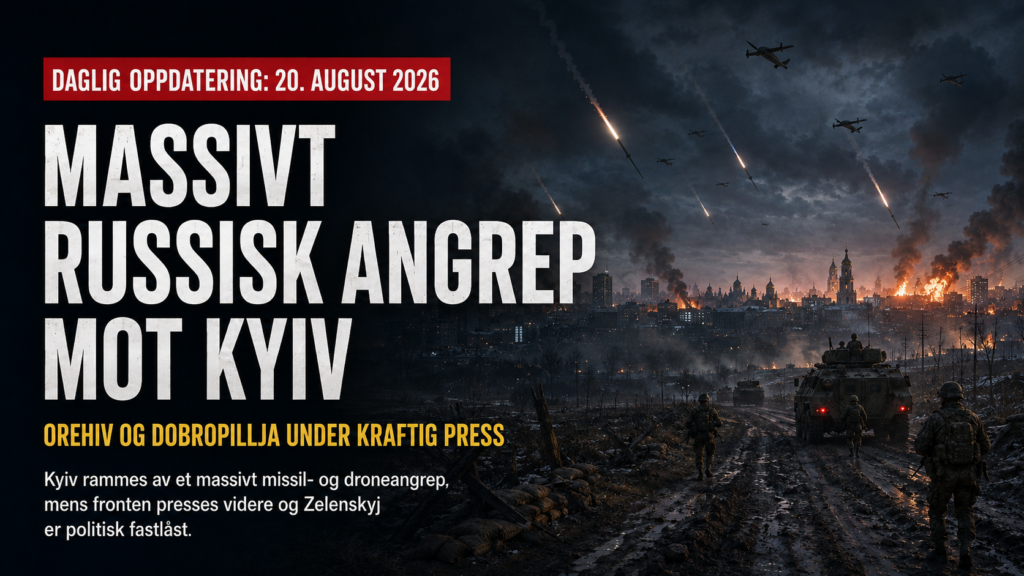
The Dobropillia Cauldron: The Pocket Is Closing
On the battlefield, reports indicate that Russian forces have established a foothold in the village of Dobropillia south of the city of the same name. It should not be confused with the city of Dobropillia itself. Combined with the earlier advance around Hanivka, the main supply routes into Dobropillia city are coming under increasingly heavy Russian pressure. In other words, a cauldron is in the process of closing completely.
According to available information, the city is defended by Azov forces from Brigadier General Andriy Biletsky’s Third Corps — motivated and ideologically committed troops, but led by commanders without extensive traditional military backgrounds, who appear to have underestimated the importance of defending precisely these villages against an opponent such as General Ivanay, a professionally trained and aggressive commander.
Biletsky’s Third Corps is also one of the key Ukrainian formations currently deployed in the defence of the Donetsk region and the approaches toward Kramatorsk and Sloviansk.
Kramatorsk and Sloviansk: The Pincer Tightens from Two Directions
Farther north, Russian forces have taken the villages of Vasiutynska and Malynivka east of Kramatorsk — insignificant places in themselves, but ones that open the road toward the villages of Perevalka and Vasylivka Persha, which lie directly on Kramatorsk’s eastern city boundary. If Russian forces advance from there to the suburb of Bilenke, they would in practice be on the territory of the city itself — and, crucially, east of the main road connecting Sloviansk and Kramatorsk. If that happens, the two cities in the larger conurbation could be split apart and captured separately rather than as a single defensive complex.
The broader development along this axis is documented: Russian forces are attempting to push toward the Sloviansk–Kramatorsk complex from several directions simultaneously.
At the same time, Putin claimed on 1 September that Russian forces had taken Sviatohirsk, while other open-source mapping disputes this and places the front several kilometres away from the city. According to Putin, a Ukrainian force is also encircled in the area east of the Oskil reservoir. Reuters stressed that Putin’s claims of major encirclements could not be independently verified.
If the Russian reports are accurate, Russia would therefore control the flanks on both sides of the Sloviansk–Kramatorsk conurbation at the same time — a pattern pointing toward fragmentation of the defensive zone, not merely its encirclement.
Kharkiv: 2,000 Men Trapped in a 460-Square-Kilometre Cauldron
From northeastern Kharkiv region, Putin himself stated that a Ukrainian force of up to 2,000 men is completely encircled in a 460-square-kilometre pocket encompassing 27 settlements.
According to Russian military sources, Ukrainian soldiers in the area have begun surrendering. Such reports cannot yet be independently confirmed through drone footage, but given the broader crisis along the entire front, it would not be surprising.
What is striking is that there was never any compelling reason to keep these troops in the area after the village of Bila Kolodiazne fell weeks ago — by that point, the danger of encirclement was already obvious. The territory has little strategic value in itself; Ukrainian forces were not using it as a launch point for attacks into Russia. The decision to leave the troops there, rather than withdraw them to defend the town of Velykyi Burluk farther south, appears to have cost Ukraine another force that could have been used elsewhere.
Putin also described the alleged encirclement as part of a broader Russian advance in the Kharkiv region and claimed that 14 settlements in the area had come under Russian control over the past month.
A Report on Ukraine’s Manpower Reserves: One Year Left
SVR chief Sergei Naryshkin claimed on 4 September that several European intelligence services estimate Ukraine’s mobilisation potential will be effectively exhausted within one year — meaning that Zelensky could continue calling up men, and possibly women, for roughly another twelve months before the basis for further recruitment disappears.
The claim cannot be independently verified, and Naryshkin did not identify which European intelligence services were supposedly behind the assessment.
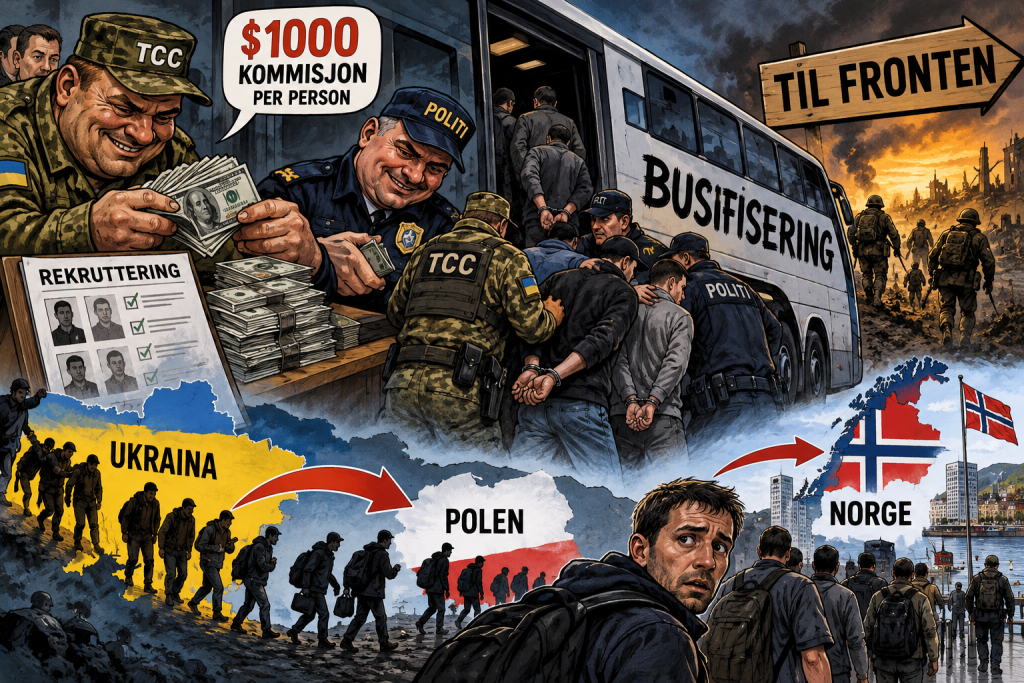
But it is consistent with increasingly frequent reports of forced mobilisation on Ukrainian streets — and with Budanov’s own admission that Ukraine needs at least 30,000 new soldiers every month simply to keep its current force level constant.
Budanov put it very plainly: Ukraine “cannot mobilise fewer than 30,000 people a month” because that is the minimum required merely to maintain what the country already has.