Night of 17 September: An Attack of Extraordinary Breadth
The massive Russian attack that had been anticipated after several days of intensive Gerbera reconnaissance activity over Ukraine came during the night of 17 September.
And it was extensive.
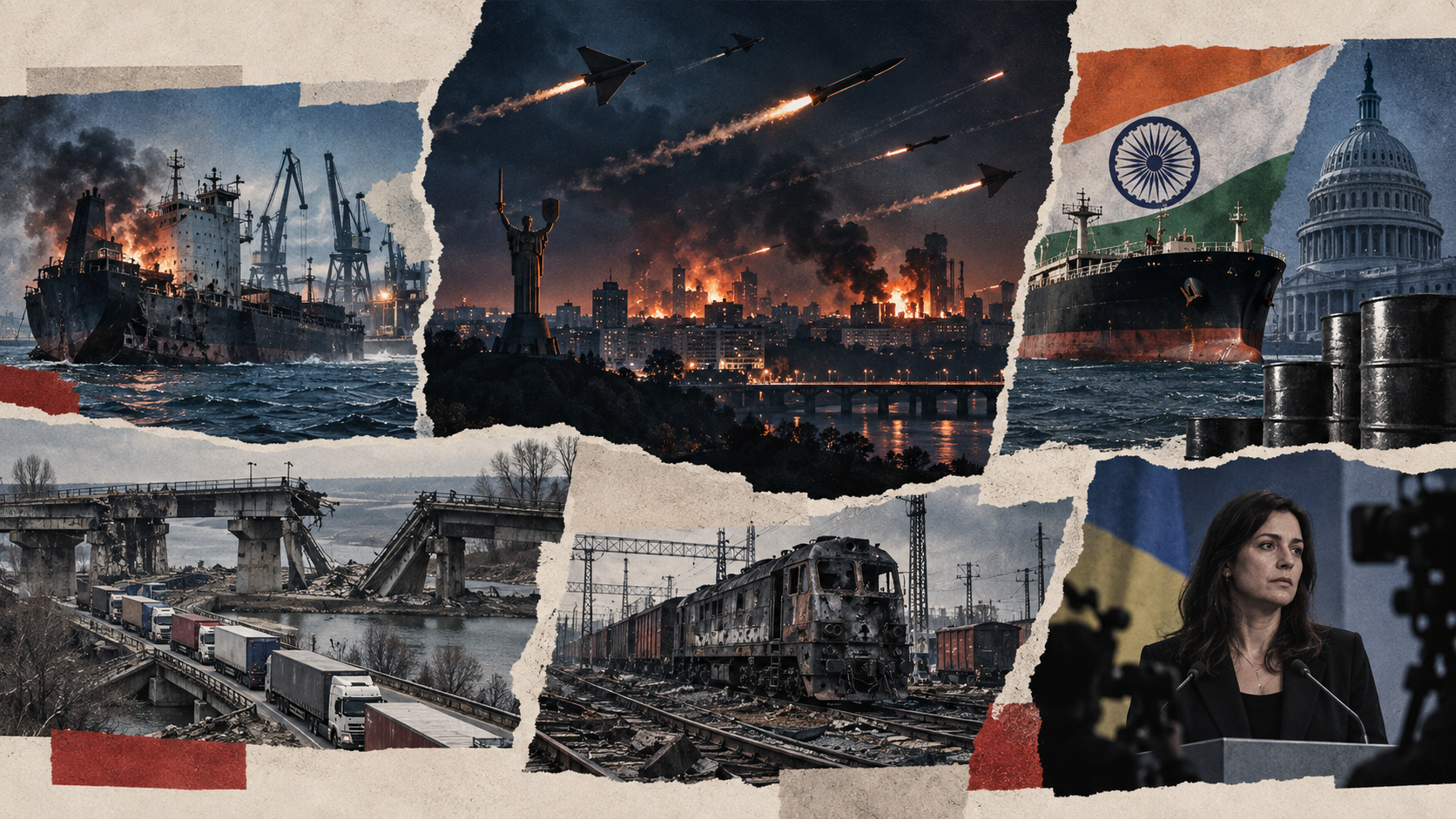
Russia employed a broad range of weapons: ballistic Iskander-M missiles, reportedly also North Korean KN-23s, Zircon hypersonic missiles, Kalibr cruise missiles launched from the Black Sea, Oniks anti-ship missiles against the Odesa region, and large numbers of jet-powered Geran drones.
Kyiv was once again one of the main targets, along with Zaporizhzhia and the Odesa region.
This time, the Russian Defence Ministry published an unusually extensive list of targets it claimed had been struck: industrial facilities in Kyiv and Kyiv region, several facilities in Zaporizhzhia, including the steelworks, a warehouse containing drone batteries, and what the Russians describe as a major data centre used for military server operations and the processing, storage and transmission of intelligence data.
The Black Sea region was also hit hard.
A dry-cargo vessel heading for the port of Chornomorsk was struck. Several ships attempting to reach Ukrainian ports have reportedly been damaged or put out of action in recent weeks.
Russia is also attacking Ukraine’s alternative logistics increasingly systematically.
A transformer substation supplying the river port of Izmail was struck, and two road bridges across the Dniester at Mayaky were attacked.
This is particularly important after the Zatoka Bridge was put out of action.
Traffic that previously crossed at Zatoka has been redirected north through Mayaky. Large queues have already formed there.
Now that diversion is also coming under attack.
The pattern is therefore becoming increasingly clear: Russia is not merely striking individual ports or bridges, but attempting to close the transport corridors between the Odesa region, Romania and the rest of the EU one by one.
The Major Energy Offensive Has Still Not Begun
Perhaps the most remarkable aspect of the night’s attack was what Russia did not strike.
Ukraine’s electricity-generation system was not the primary target.
Putin gave orders around three weeks ago for a larger campaign against Ukrainian energy infrastructure, and there had therefore been extensive speculation that the night’s attack would mark the beginning of that offensive.
It did not.
That means the larger campaign against power stations, substations and energy infrastructure apparently still lies ahead.
There has been speculation that Russia may use heavier weapons systems — including Oreshnik and future long-range Iskander variants — against energy facilities in western Ukraine, where an increasing share of the country’s remaining generation capacity is located.
There is also speculation that Russia’s Rassvet satellite system is gradually being expanded to provide drones with continuous guidance deeper inside Ukraine.
Russia has not confirmed this.
But if the system does become fully operational, it could make the already effective long-range drone strikes significantly more difficult to stop.
Ukraine’s Air Defence: No Claim That a Single Missile Was Shot Down
Something else stood out after the attack.
Despite Russia using a range of different missile types, there was no Ukrainian announcement claiming that even a single Russian missile had been shot down.
Ukraine did say that a large number of aerial targets had been neutralised overall, mainly drones. But the absence of claims regarding missile interceptions is striking.
The situation for Ukrainian air defence is becoming increasingly difficult.
F-16s and Mirage 2000s are now being used more frequently against the faster Russian drones, but Ukrainian air-defence officers have simultaneously warned of serious shortages of air-to-air missiles.
A fighter aircraft without missiles has limited value as a drone hunter.
Machine guns, cannons and man-portable air-defence missiles work against some slower drones, but are far less effective against the jet-powered variants.
That creates a fundamental problem:
Russia can produce increasing numbers of inexpensive attack systems, while Ukraine is using increasingly expensive and scarce weapons in an attempt to stop them.
Greece: Give Us the Missiles — but Do Not Attach Conditions
The growing shortage of air-defence missiles has also created a remarkable dispute with Greece.
Ukraine, reportedly with support from some EU and NATO countries, has asked Greece to transfer its remaining air-defence missiles.
For the Greeks, this is a far more difficult question than it might appear from the outside.
The country maintains substantial air-defence reserves precisely because its relationship with Turkey has historically been unstable, and Athens does not want to weaken its own defensive capacity.
The Greek government reportedly nevertheless signalled that some missiles could be considered for transfer if Ukraine stopped attacking Greek-owned tankers carrying Russian oil and LNG.
The Ukrainian response was reportedly categorical and extremely sharp.
If these reports are correct, the episode illustrates how difficult Ukraine’s position has become: the country desperately needs the missiles, while at the same time refusing to give up attacks that in practice have only a limited effect on Russia’s overall oil exports.
India Rejects Washington’s Sanctions Threat
At the same time, another conflict has opened up — this time between Washington and New Delhi.
The House of Representatives passed the Lindsey O. Graham sanctions bill against Russia and Iran on 16 September by 262 votes to 159. The bill gives the president authority to impose tariffs of up to 100 percent on countries that continue purchasing Russian oil and gas.
India responded bluntly.
The government stressed that it would continue prioritising the energy security of its 1.4 billion citizens and would continue buying energy through diversified supply channels.
Even more important was the statement that the consequences for US–India relations had already been clearly communicated to Washington.
India also warned that it would do whatever was necessary to protect its own trade and economic interests.
The message is difficult to misunderstand:
If Washington attempts to force India to stop purchasing Russian energy, the result could be a major conflict with a country the United States simultaneously wants to draw closer strategically in its competition with China.
China has already signalled similar resistance.
The bill also gives Trump substantial discretion. It authorises him to impose the tariffs — but does not compel him to do so.
And if the global energy situation continues to deteriorate, a trade war with the world’s largest buyers of Russian energy may be the last thing the White House wants.
Yaroslavl Refinery Hit — Trump’s “Energy Ceasefire” Still Does Not Exist
During the night of 17 September, Ukrainian drones struck the Slavneft-YANOS refinery in Yaroslavl, one of Russia’s largest refineries, with a capacity of around 300,000 barrels per day.
A fire broke out at the facility after the attack.
Zelensky simultaneously confirmed Ukrainian attacks against the refinery and a military airfield in Rostov region, where Ukraine claims to have damaged three transport aircraft and three helicopters.
The strikes are particularly interesting because Trump had only shortly before claimed that Ukraine and Russia had agreed to halt attacks against each other’s energy infrastructure.
No such agreement still exists.
On the contrary, Ukraine immediately continued attacking Russian refineries, while Russia continued its own attacks against Ukrainian energy and infrastructure facilities. AP describes talks over a possible energy ceasefire as deadlocked.
Trump’s announcement therefore did not describe the situation on the ground.
Russia has said it is open to discussing such an arrangement, but has simultaneously linked it to much larger issues, including sanctions on Russian energy exports.
Iuliia Mendel: From Zelensky’s Press Secretary to Sanctioned Critic
Then comes a story that says a great deal about the political temperature surrounding the war.
Iuliia Mendel was Zelensky’s own press secretary from 2019 to 2021.
She was previously a journalist, worked closely with the president and for several years was part of the circle surrounding Ukraine’s new leadership.
Today, she is one of Zelensky’s sharper critics.
That does not mean she has changed sides in the war itself. Mendel has continued to describe Russia’s invasion as aggression and has not become a supporter of Putin.
But she has argued that Ukraine’s position has become so serious that the country should consider negotiations — including a bad peace if the alternative is an even worse war.
That has had consequences.
Zelensky has imposed ten years of sanctions on his former press secretary, including financial restrictions. The Financial Times describes how the measure came after Mendel became increasingly critical of the president and his war policy.
She was subsequently denied access to the European Parliament building when she was due to attend an event organised by AfD representatives.
And now The Times has published an interview under a headline portraying her as “the former Zelensky loyalist who now wants Ukraine to surrender.” Mendel herself rejects the accusation that she is a Russian agent and says she is advocating negotiations because she believes a bad peace may be better than a catastrophic continuation of the war.
That is precisely what makes the case interesting.
This is not a Russian politician.
Not a Putin sympathiser.
Not even a former political opponent of Zelensky.
It is Zelensky’s own former press secretary.
And what she is being punished for politically is, to a large extent, now arguing that Ukraine must discuss how the war can be brought to an end.
Dobropillia: The Encirclement Tightens
On the ground, developments continue in the same direction.
Readovka has published a lengthy account of the fighting around Dobropillia and claims that Russian forces have now outflanked the city from the west as well.
If this is correct, the battle is approaching its final phase.
There are simultaneously reports that Ukraine is considering a counterattack near Orikhiv to open a corridor for forces attempting to withdraw.
The situation resembles Avdiivka in 2024, when a similar counterattack was discussed during the final phase of the withdrawal but ultimately abandoned because the risk was considered too great.
In the Kharkiv region, the Russian Defence Ministry says the pocket at Olkhivka has been cleared, while the larger encircled group farther east remains under pressure.
Lyman: Still Far Smaller Than the Initial Triumphant Claims
There has also been no new information that substantially changes the picture of the Ukrainian counteroffensive near Lyman.
Ukraine has confirmed local advances west of the Nitrius River and control of Sviatohirsk.
There is still no sign of a larger breakthrough east of the river or that the main Russian positions have been broken.
The most likely picture remains that Ukraine has cleared areas where Russian forces had previously established a lighter forward control zone.
That is a military success.
But it is something different from the sweeping Russian collapse implied by some of the early accounts.
Unless substantial new information emerges in the coming days, it will therefore remain difficult to describe the offensive as something that has fundamentally changed the dynamics of the front.
500 Locomotives — and a Logistics Problem That Money Alone Cannot Solve
Russia is simultaneously continuing its attacks against Ukraine’s storage and railway system.
According to Russian and some Ukrainian reports, around 500 Ukrainian locomotives have now been damaged or destroyed during the war.
That is a far greater problem than the number initially suggests.
Ukraine is heavily dependent on railways for the transportation of military equipment, supplies and personnel.
And locomotives cannot be replaced as easily as money can be transferred.
The former Soviet railway network uses a wider track gauge than most of the EU.
European locomotives therefore cannot simply be put directly into service in Ukraine.
The Baltic states still use the same broad gauge and could theoretically provide some locomotives, but they themselves have limited rolling stock.
New production would take time.
This illustrates an increasingly serious problem for Ukraine:
Money can be raised or borrowed. Industrial capacity and physical equipment cannot simply be conjured into existence.
Ukraine Wants an Additional €50 Billion
The same problem is becoming visible in state finances.
Ukraine now says that it needs more than €50 billion in additional funding to cover the 2027 budget.
This comes after the EU has already established a loan programme of around €90 billion for the 2026–2027 period.
The need is therefore growing faster than earlier financing plans anticipated.
Finding money is one thing.
Finding Patriot missiles, air-to-air missiles, locomotives, transformers, artillery shells and other physical capacity in the quantities Ukraine requires is something else entirely.
And in several of these areas, shortages are now beginning to affect other Western partners at the same time.
Saudi Arabia Is Now Competing With Ukraine for Air Defence
Saudi Arabia is also reportedly beginning to experience serious shortages of air-defence missiles.
The country needs protection against potential Iranian missile and drone attacks and is therefore seeking new deliveries.
The problem is that the United States itself has limited Patriot stocks.
Saudi Arabia is therefore also turning toward Europe.
The result is that Ukraine and Saudi Arabia are increasingly competing for the same systems.
This is happening at the same time that Trump is publicly considering major new military operations against Iran.
For Riyadh, the consequences are obvious.
A larger US escalation could trigger renewed Iranian attacks against Saudi oil installations, ports and other critical infrastructure.
Saudi Arabia is therefore unlikely to voluntarily surrender air-defence capacity in order to cover Ukraine’s needs.
Zelensky Is Under Pressure From Every Direction — but That Does Not Mean He Is About to Fall
There are now increasing numbers of analyses describing Zelensky’s political position as unsustainable.
The list of problems is long:
Corruption scandals.
An increasingly severe budget crisis.
Shortages of air defence.
A Russian air offensive growing in intensity.
Transport infrastructure being systematically attacked.
A difficult situation on the ground.
And an ever greater need for Western money and matériel.
For a conventional political leader, the combination would be dangerous.
But Ukraine is not in a conventional political situation.
Zelensky controls the presidential apparatus and still retains substantial influence over parliament and the security structures. Regular national elections are not held under martial law.
At the same time, the story of Iuliia Mendel shows that critics from within the former power apparatus can face significant administrative and political consequences.
And the decisive external pressure is still absent.
Washington continues to support Ukraine militarily and through intelligence.
Congress has just passed further sanctions legislation against Russia.
Europe continues to finance the Ukrainian state.
There is therefore no automatic mechanism forcing Zelensky to change course simply because the situation worsens.
That may be the most remarkable feature of the current situation.
The war in the air is becoming increasingly difficult for Ukraine.
Transport routes are being systematically attacked.
The country lacks weapons that cannot be quickly replaced.
Its budget requirements are increasing.
India and China are signalling that they will not bow to Washington’s attempts to cut Russia’s energy revenues.
And Zelensky’s own former press secretary is sanctioned and shut out after beginning to argue for negotiations.
Yet there are still few signs that any of the central actors are preparing to change course.