FAB Bombs Against a Power Plant Behind the Front
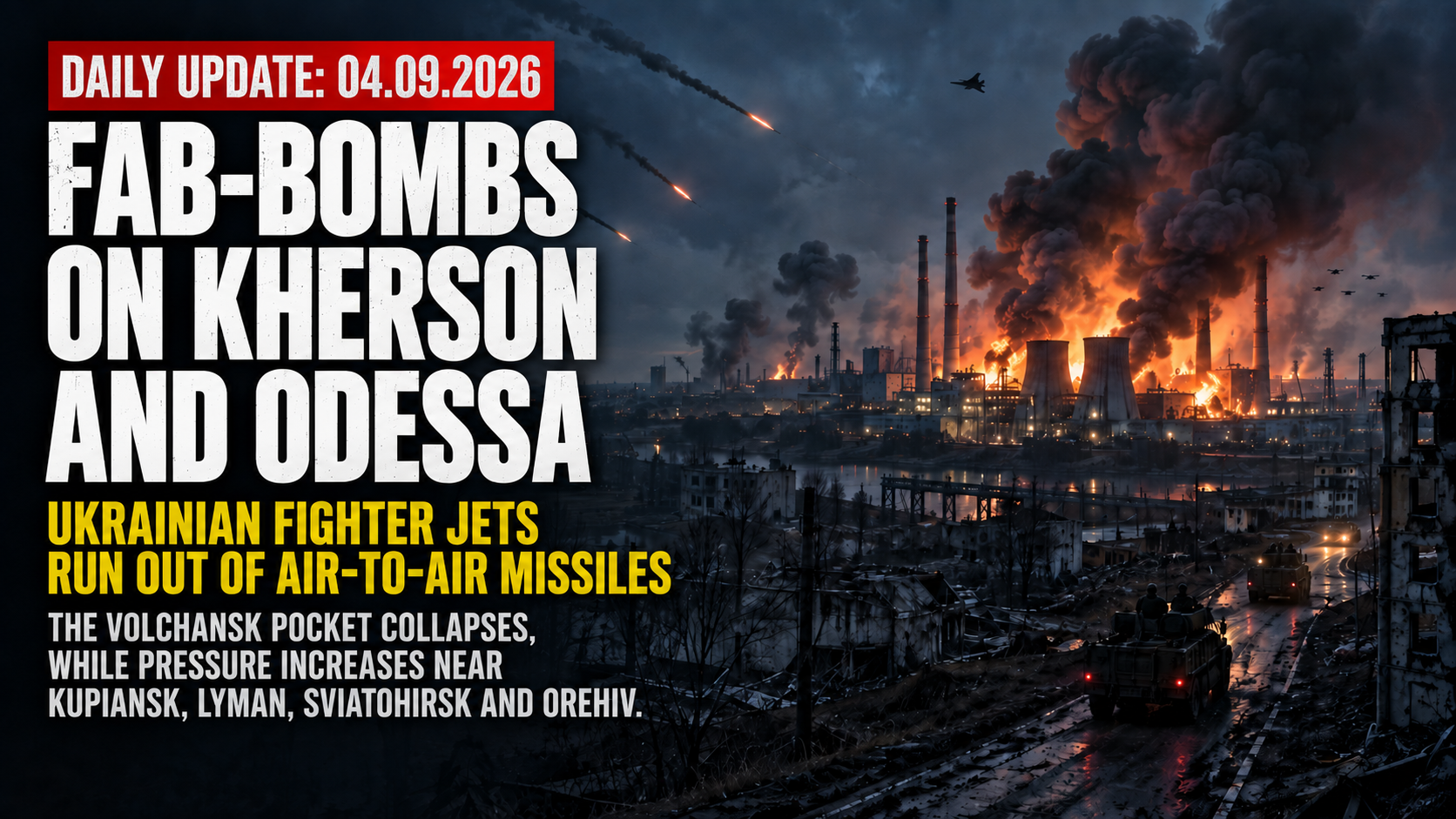
In recent days, Russian forces have attacked the Kherson thermal power plant with guided aerial bombs — according to Naftogaz, all remaining heat- and power-generating equipment at the facility was completely destroyed after four bombs struck. The plant had already been hit by a glide bomb the previous day.
At the same time, Odesa’s combined heat and power plant was attacked with missiles and drones, while energy, port and export infrastructure at several locations in the Odesa region was also struck.
What makes the Kherson attack qualitatively different is the choice of weapon. FAB bombs are far heavier than the warheads on most drones and missiles used in the war. A FAB-500 weighs around half a tonne, a FAB-1500 around one and a half tonnes, and a FAB-3000 around three tonnes. That is destructive power far beyond what a conventional Geran drone can deliver.
Until now, Russia has primarily used these weapons against fortified positions and targets near the front. The fact that they are now being used against a major energy facility behind the line of contact shows how much the Russian Air Force’s operational freedom of action has expanded.
Kherson lies close enough to the front for Su-34 aircraft to release long-range glide bombs from Russian-controlled airspace. The Odesa strike, by contrast, does not document the same development — according to Naftogaz, the plant there was hit by missiles and drones. But this is happening at the same time as Ukraine’s ground-based air defences — S-300, IRIS-T, NASAMS and Patriot — are coming under increasingly severe pressure.
Ukraine’s Fighter Jets Are Running Out of Air-to-Air Missiles
It is not only ground-based air defence that is failing. Reports indicate that Ukrainian F-16 fighter jets are now running so critically short of air-to-air missiles that some pilots are being sent up with only the aircraft’s internal cannon.
The missiles are being rationed, and Ukraine’s air defence command is tracking new deliveries almost shipment by shipment in order to know how long operations can continue. After months of using them against Geran drones, the arithmetic is becoming brutal.
Pilots are being reduced to trying to shoot down drones with their onboard cannon — risky manoeuvres requiring considerable skill, performed with aircraft already worn by continuous use. Air-to-air missiles are complex weapons that cannot easily be mass-produced, while the United States is simultaneously tied down by the Persian Gulf conflict, where consumption is enormous.
A parallel from that theatre illustrates the problem: on the night of 1 September, Iran fired ballistic missiles at the US Muwaffaq Salti Air Base in Jordan. According to reports, estimates vary widely for both the number of incoming missiles and the number of US interceptors used, but some estimates put the expenditure at around three to four PAC-3 MSE interceptors per Iranian missile.
The US Patriot stockpile has meanwhile been severely depleted by the war in the Middle East. Several open-source estimates now place the inventory well below one thousand operational interceptors.
Iran appears deliberately to be using older, less advanced missiles precisely in order to force such an unfavourable exchange ratio and deplete US stocks more rapidly.
The same problem is unfolding in Ukraine: an ever-growing number of relatively cheap Russian drones forces the West to expend far more expensive and more slowly produced air-defence and air-to-air missiles.
The Front: The Vovchansk Pocket Collapses, Kupiansk Falls Apart
In the northeastern Kharkiv region, a Ukrainian force — estimated at around 2,000 men — is according to Russian reports now encircled in the area east and northeast of Vovchansk, apparently without any withdrawal order having been issued even after the danger became obvious weeks ago.
Ukrainian authorities dispute the scale of the encirclement while also saying that Russian forces are attempting to expand their area of control around Vovchansk.
The area has little strategic value in itself, but a Russian breakthrough here weakens the remaining Ukrainian defensive lines farther south toward Velykyi Burluk.
Farther south, Russian drone footage is said to show forces advancing westward from the Kupiansk area toward Shevchenkove, south of Velykyi Burluk. Ukrainian reports meanwhile show that fighting continues in the sector and that Russian forces are still attempting to push farther west.
The underlying problem is that Ukrainian and Western commentary is obsessed with territory measured in square kilometres — without distinguishing between densely populated, industrially vital ground in Donbas and sparsely populated open terrain in eastern Kharkiv.
CIA Director Ratcliffe has reportedly said that Russia has captured only around one percent of Ukrainian territory since he took office — a figure that may well be accurate, but is meaningless without considering what kind of territory is involved.
A fortified industrial city, a railway junction or a critical supply axis can be militarily far more important than hundreds of square kilometres of open steppe.
Donbas: Lyman, Sviatohirsk and Druzhkivka
In Donbas, Russian forces continue to press toward the Sloviansk–Kramatorsk complex.
Russian reports claim that the territory between Kostiantynivka and Chasiv Yar has now largely been cleared of Ukrainian forces. At the same time, fighting continues around Lyman, Borova and Sviatohirsk.
There is still conflicting information about Sviatohirsk. OSW reported on 1 September that Ukrainian counterattacks north of Lyman had retaken areas north and east of the city, while Russian sources subsequently claimed renewed advances.
The decisive issue is not any single village, but the direction of the front. If the Lyman sector collapses, it opens the way for increasingly strong Russian pressure on Sloviansk and Kramatorsk from the north and northeast.
Farther south, the battle for Orikhiv continues. Russian sources claim that a Ukrainian counterattack intended to relieve pressure around the city has been repelled, while Ukrainian sources continue to report active fighting around Orikhiv.
The pattern increasingly resembles Vuhledar in the autumn of 2024: a front that holds for a long time, until a critical threshold is crossed — followed by a rapid and disorganised retreat across open terrain, pursued by drones and infantry.
Rasputitsa, Fog and the Return of Armoured Forces
One observation deserves attention: FPV drones perform worse in wind, rain, snow and dense fog.
As autumn progresses, this will open short windows for faster Russian infantry advances. Later comes rasputitsa — the period when mud once again slows all movement — but after that the ground freezes, while wind, snow and poor visibility remain.
Donbas, a region with many rivers, streams and valleys, is especially prone to fog.
At the same time, Russia continues to equip its armoured vehicles with the Arena-M active protection system. Ukrainian sources themselves have reported that one Arena-M system during a Russian mechanised attack allegedly intercepted seven FPV drones before the vehicle was finally hit.
That is a significant point.
Arena does not make tanks invulnerable. But if one or two FPV drones were previously sufficient to stop a vehicle, while a coordinated attack with many more is now required, the cost-effectiveness equation changes.
While Ukraine has in practice stopped asking for Western tanks on the same scale as before, Russian production of armoured vehicles continues to grow — a sign that Moscow still regards armour as decisive in the next phase of the war, when gaps in the thinned Ukrainian lines open the way for rapid mechanised advances.
Geran-5: An Entirely New Drone
New information confirms that the Geran-5 is not merely an enlarged Geran-4, but a fundamentally different design — shaped more like a miniature cruise missile than the traditional flying-wing configuration of the Shahed family.
Ukraine’s Air Force gives Geran-5 speeds of around 450–600 kilometres per hour and flight altitudes of up to six kilometres. Western media likewise describe the Geran-4 and Geran-5 as a new generation of jet-powered drones that are significantly faster and harder to intercept than the older Geran-2 systems.
The design points toward higher speed, greater range and a better ability to operate deep inside Ukraine.
It is also reasonable to assume that Geran-5 was designed from the outset to exploit satellite communications rather than relying solely on ground-based relay stations. A specific connection to the Rassvet system, however, has not yet been publicly confirmed.
It nevertheless suggests a clear division of labour: Geran-4 against Kyiv and central Ukraine, Geran-5 against targets all the way to Lviv and the western border.
Russian sources also claim that production capacity for the Geran family is now being expanded dramatically, with a target of up to 5,000 units per month.
For now, this must be treated as a production target, not documented actual output.
At the same time, the Banderol system is already in operational use — a relatively inexpensive jet-powered weapon that sits somewhere between a drone and a cruise missile.
The claim that Dante production has reached around one thousand per month is far less well documented in open sources and should for now be treated as Russian industrial reporting rather than a confirmed production figure.
But the direction is clear: Russia is building increasingly large families of relatively inexpensive jet-powered precision weapons that can be mass-produced in far greater numbers than traditional cruise missiles.
Combined with the Banderol systems, this amounts to an air offensive on a scale Ukraine has not yet experienced.
Witkoff and Kushner on Their Way — Again
After Ratcliffe’s unsuccessful Moscow visit last week, Witkoff and Kushner are now finally expected to travel to both Moscow and Kyiv.
This time, the plans are far more concrete. Trump confirmed on 4 September that Witkoff and Kushner have been dispatched with what he describes as a concrete peace proposal.
Zelensky says they will travel to Kyiv after Moscow, but even Reuters stresses that the itinerary has not yet been finalised because of security concerns.
Peskov has confirmed that Moscow is open to the visit, but emphasised that what matters is not who they meet, but what they bring with them. The Kremlin has meanwhile said that there are currently no signs that conditions for peace are beginning to mature.
Given that neither the Europeans, the Americans nor the Ukrainians have so far shown willingness to make the fundamental concessions required to interest Moscow, it is difficult to see how this visit will differ from the previous ones if the new American proposal still essentially amounts to stopping the war first and negotiating the causes later.
Putin already has experience with American proposals changing as they move from initial private conversations into the political reality of Washington.
It is therefore difficult to imagine Moscow now halting a military development it believes is moving increasingly rapidly in Russia’s favour in exchange for promises of future negotiations.
This time, Witkoff and Kushner are coming to Moscow with a concrete proposal.
The question is whether they are actually bringing anything Russia has a reason to accept.