

An inspection visit in the middle of a crisis
On Tuesday, NATO’s entire Military Committee visited Kyiv, with representatives from all 32 member states. The delegation was led by the committee’s chairman, Admiral Giuseppe Cavo Dragone, and met Ukraine’s commander-in-chief Mikhail Drapatyi. It was the committee’s first visit to Ukraine in eight years, and Drapatyi had announced it as early as 21 August. In other words, it was not a hastily arranged visit. But the timing is nonetheless telling: the bridges in Kyiv and Zaporizhzhia have been hit, air defence is under heavy pressure, and the day after the visit came another massive Russian attack.
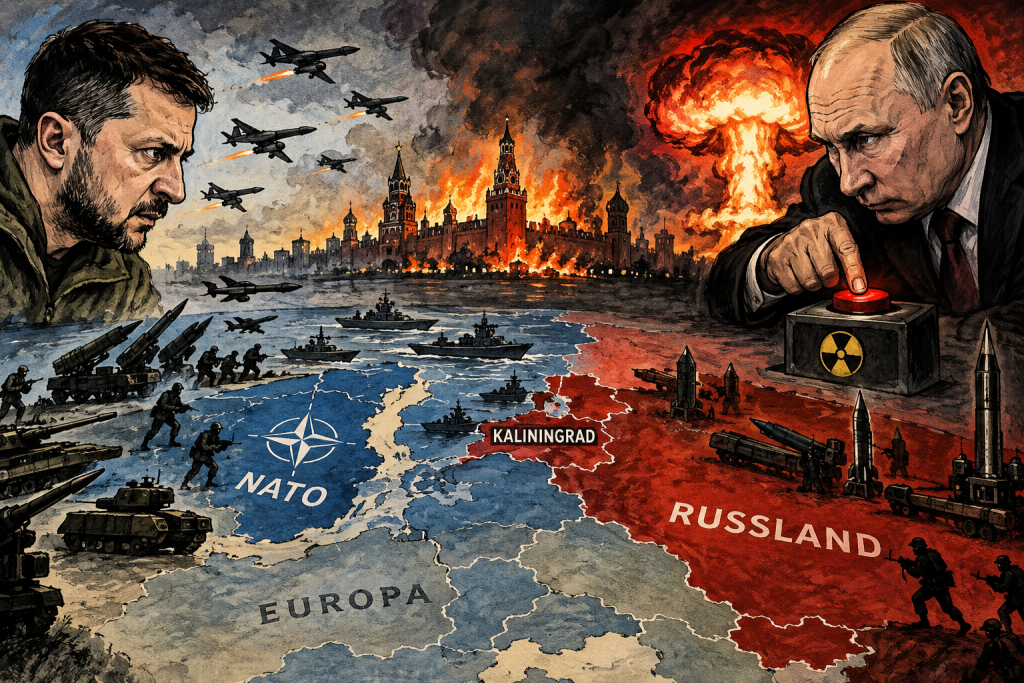
The message from Brussels was predictable: “the bond between NATO and Ukraine is strong and unbreakable”. Russia cares little for such declarations. Moscow sees this war as a coalition war against the West, not a proxy conflict, and has long since factored the support into its calculations. More interesting is what the visit may have been meant to do for NATO itself.
Those who actually run the war on the Western side do not sit in Kyiv. The headquarters in Wiesbaden, which the New York Times exposed a couple of years ago, planned and directed among other things the 2023 counteroffensive, with growing friction with the Ukrainian generals. When the distance between the staffs and the battlefield is so great, it is natural to travel there to get an impression on the ground. But such a trip rarely gives the impression one needs. The generals meet Ukrainian officers in the capital, who themselves control the information, and go home with the message “the situation is difficult but manageable, we just need a little more”. Anyone who remembers Vietnam, Iraq or Afghanistan knows the pattern. No general wants to hear that the war he is leading is being lost.
Nor can the visit help with what is actually failing. Generals cannot procure air defence missiles that do not exist, and they cannot repair an economy in free fall.
The bridges: weaken, not destroy
Rumours are circulating on Russian websites, and have been reported in the Daily Telegraph, that General Sergei Surovikin has been brought back and is leading the campaign against the Dnieper bridges and the entire Ukrainian logistics network. There is no official confirmation, nor any coverage in the largest Russian media. It remains a rumour.
More interesting is an explanation from a previously reliable source, which cannot be independently verified but makes consistent sense. According to the source, Russia has the capacity to bring down all the bridges over the Dnieper in about a week, using heavy missiles and glide bombs. It does not want to. It wants to weaken them just enough that they can only bear pedestrians. Three considerations lie behind this.
First, Russia does not want to prevent Ukrainian soldiers and civilians from leaving the eastern side. The more loyal Ukrainians who head west as the Russians advance, the fewer remain behind. Second, the bridges are meant to make it impossible to get heavy equipment across the river, whether supplies heading east or tanks and artillery heading west in a retreat. Third, it gives the Russians control over where the Ukrainians can move, allowing them to create bottlenecks, kill zones and new cauldrons.
Even though this reasoning cannot be confirmed, it fits well with what has been observed: Kyiv’s bridges are closed to cars but not to pedestrians, and the Zaporizhzhia bridge has been badly hit without being completely brought down.
Why everyone marches in step
In Kyiv, the drone attacks continued around the clock, probably also against buildings belonging to the SBU security service. According to reports, the SBU has during the same period warned the population against photographing and sharing images of damage from the attacks, threatening large fines. The electrical substation west of the city, which is protected by thick concrete shields, has according to the latest information been hit far more times than previously known, perhaps seven. The shield is holding for now. But it is hardly a coincidence that the Russians keep repeating such attacks: they are mapping how the Ukrainians carry out repairs, and looking for the weakest angle. It can only be a matter of time before they deploy weapons that actually penetrate, bombs or missiles.
At the same time, Russian drones hit a substation near Kharkiv, causing power outages. Russia is also systematically hunting down the factories that are to produce Ukraine’s new ballistic missile. The Russian newspaper Readovka, believed to have close contacts with the Ministry of Defence, recently wrote that the Oreshnik strike on the Yuzhmash plant in Dnipro in November 2024 had precisely this purpose: to bury a Ukrainian project for a powerful, ground-launched Neptune missile that was under development in underground facilities. If that is true, it is a pattern. What awaits the project today remains to be seen.
The front: stalemate where Ukraine needs progress
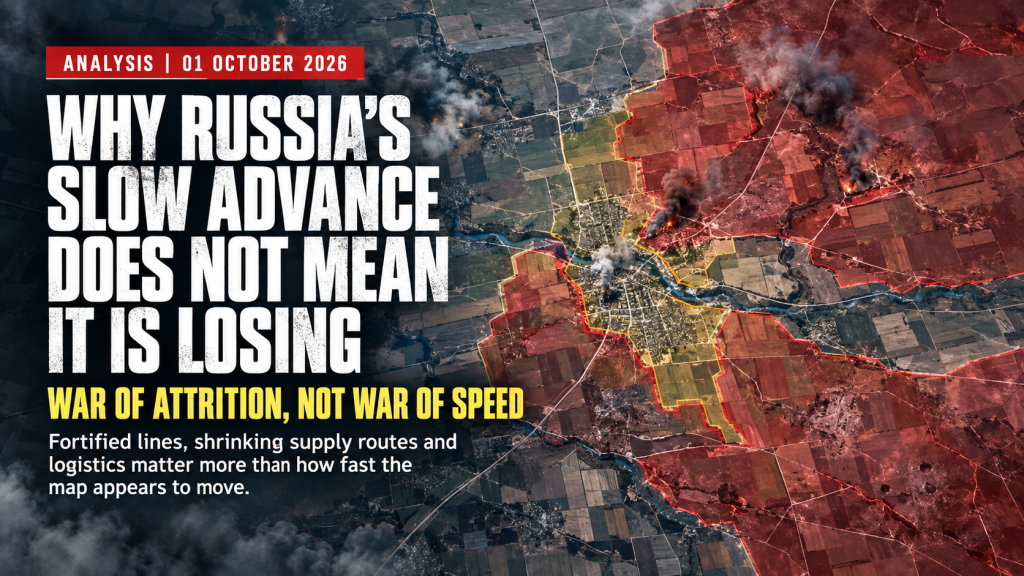
At Dobropillia, Russian forces are fighting their way further into the town, having taken parks, the stadium and the mine facilities. The ring around the town is probably intact. The reported Ukrainian counterattack by Azov’s 12th Brigade against the village north of the town appears to have lost momentum, and the Russians are back at the village’s southern edge. In the Lyman area, there are several indications that Biletsky’s offensive has run out of steam. Reports of recaptured villages tend not to be confirmed with video footage. Orikhiv is nearing its end, and Russian forces are working their way north towards a small town said to be Ukraine’s most important logistics base in the region, a step in the direction of the city of Zaporizhzhia. Everything suggests the fighting will continue.
The myth of the winter pause
Some commentators claim the Russians must reach their goals before winter, because major operations stop then. That is not true. The autumn and spring mud slow movement, but winter does not. The invasion began in February 2022. Bakhmut fell after a winter offensive. Marinka and Avdiivka fell in the winter of 2023–24. Pokrovsk and a number of other towns fell in the winter of 2024–25. The usual pattern is a pause around the end of February, resumed after the spring thaw. And this winter, with Ukraine’s energy system and logistics under pressure, there is more reason for Russia to increase the pace than to slow it down.
Europe wavers, and no negotiations in sight
In France, protests are growing as government bond yields rise and the budget deficit persists. Spain has had to call new elections. It is reasonable to argue that France risks a bond crisis, and that Paris cannot print money to cover its debt because eurozone monetary policy is set in Frankfurt. In the Middle East, the conflict between Saudi Arabia and the Houthis is worsening, with new attacks on Saudi territory and reports of damage to the oil pipeline. A new rise in oil prices is close.
At the same time, the prospects for direct negotiations between Russia and Ukraine still appear slim. The Kremlin has denied that a phone call between Putin and Trump has been arranged, despite speculation about a call on Putin’s 74th birthday. Both Peskov and Lavrov have reportedly asked what the point of talks is when Ukraine does not want them, while US Secretary of State Marco Rubio said on Thursday that direct Russian-Ukrainian negotiations remain stalled, but that the US is continuing its mediation efforts. American envoys are meanwhile due to meet a Ukrainian delegation in Miami on Friday. Western governments nevertheless maintain the line of supporting Ukraine “for as long as it takes”. Some in Russia call it prolonging the war to the last Ukrainian. It is hard to see what else it is meant to be.





Se og hør mer
Videoer, klipp og innslag knyttet til temaet.