The Jet Drones Have Reached Western Ukraine
On Thursday and overnight into Friday, Russia sent jet-powered Geran drones in large numbers against Western Ukraine. According to the Air Force, there were 138 drones on Thursday, 90 of them jet-powered, and 149 overnight into Friday, 108 of them jet-powered. The targets were warehouses, shopping centres, transformer substations and other energy facilities in the Volyn, Rivne, Ternopil and Lvov regions. 370,000 subscribers in Volyn lost power, Lutsk was left in darkness, and in Kovel around ten trucks burned. At least three people have been reported killed and 53 injured across the country. Kiev claims that around three out of four jet drones are now being intercepted. The images from Lutsk, Rivne and Kovel suggest otherwise, and there has long been no reason to take Ukrainian shoot-down figures at face value.
What matters is the range. Western Ukraine lies beyond the Belarusian relay stations that guide the drones in the final phase over Kiev, and so many jet drones striking so precisely so far west requires a different form of guidance. The most likely explanation is Rassvet, the Russian answer to Starlink. The system has 31 satellites in orbit, and on 6 October the company behind it, Bureau 1440, unveiled ground terminals which, according to ISW, may provide increased range and precision for long-range drone strikes. The Ukrainians have published a picture of wreckage containing something resembling a Rassvet receiver, but presidential adviser Beskrestnov himself doubts that the object is a satellite antenna. The picture is not proof. The alternative is terrain-following navigation and autonomous optical targeting, but that explanation fits poorly with shopping centres.
If the theory is correct, Russian drones can now strike anywhere in Ukraine, singly or in their hundreds, and the strikes of recent nights look like tests of the system. The Russians test everything thoroughly before full use, and everything suggests this worked. It is probably only a matter of time before the same technique is used against Kiev and its bridges, and the capital’s power supply remains critical.
The Patriot Missiles Are Used Up
At the same time, CNN reports that Ukraine has run out of Patriot missiles. Almost none of the ballistic missiles in the latest attack on Kiev were intercepted, because there were no missiles left. The Washington Post reported that Kiev had ten left on 7 October. The Air Force’s claim of four missiles shot down fits poorly with that. If it is correct, the last missiles were spent. The United States has very little to spare, and its stockpile is estimated at around 800 of 2,300 after the consumption in the Gulf. According to CNN, the Trump administration has also threatened to shut down the very channel the Europeans use to buy American weapons for Kiev.
Zelensky said in Brussels that Europe has enough interceptors to get through the winter, but he did not say how many, and he called the requirements “just the minimum”. PAC-3 is not produced in Europe. It is not a question of will, but of resources. If there were thousands, Trump would send them himself.
Brussels: The Money Has Run Out
Zelensky asked the EU summit for a further 70 billion euros for 2027 and said the war will cost 155 billion. Belgian Prime Minister De Wever put it bluntly before the meeting: the 90 billion is going to run out. Merz acknowledged that the money is not enough. The meeting ended without a decision, and the leaders asked the Commission to present options. A European diplomat said that no new money or weapons were offered. The frozen Russian assets are back on the table, and should the disagreement continue, that idea will return.
Trump: “Not a Good Guy”
While Zelensky asks Europe for money, he is losing Washington. In the Newsmax interview on Thursday, Trump called him “not a good guy to negotiate with”, said he is harder to deal with than Putin, and called the refinery attacks a disgrace. Trump believes that any deal will not be made with him. The break is hardly total, since Trump has been here before and usually makes up again, but he will not go out of his way for extra missiles or money.
What makes the quarrel strange is that Zelensky had a way out. The Wall Street Journal reports that Senators Wicker and Cramer put forward a proposal during their visit to Kiev on 9 October: a hundred-day halt to the refinery attacks in exchange for Starlink coverage being extended 300 kilometres into Russia. Zelensky reportedly replied that he would think about it. In practice he declined, because the refinery smoke columns bring headlines and donor money, while the attacks have produced no economic crisis or protests in Russia, only an expensive operation that deepens the budget deficit and gives Russia an excuse for heavier strikes.
According to Reuters, the Starshield restriction came from the White House, but a senior US official says that the president never asked for it. Kiev says the service has not been fully restored. In our assessment, much of the story about cut intelligence has been built up by Zelensky himself in his dispute with Trump. And even if the Americans have withheld or are withholding something, it changes little. Ukraine has no practical ability to stop ballistic or hypersonic missiles.
The Front
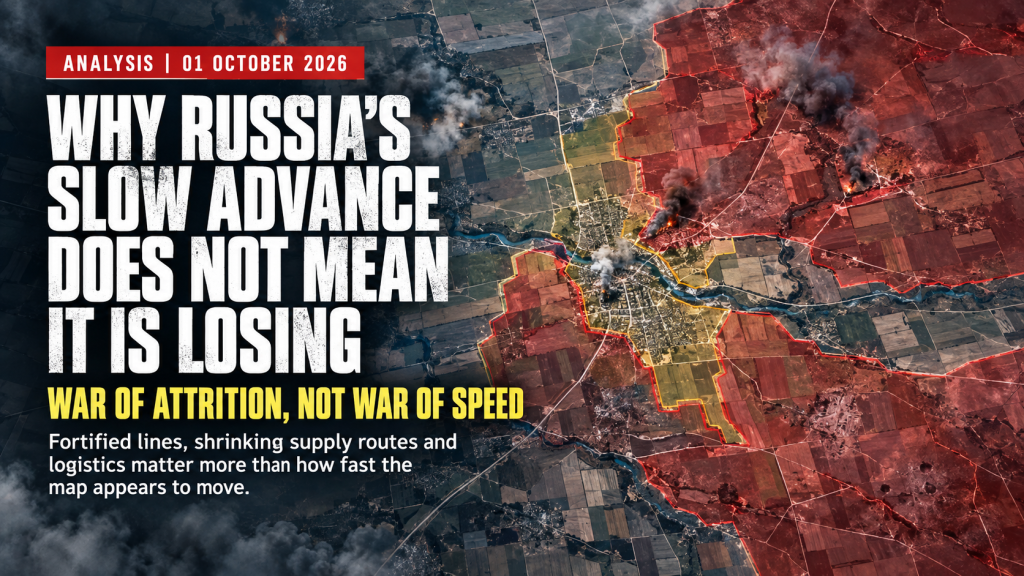
In the Kharkov pocket, the Russian Defence Ministry reports that Nefedovka and Chernoye have been taken. The two villages were where the Ukrainians had the best chance of breaking out, and their fall effectively puts an end to that. Group North will then move towards Velikiy Burluk, and on towards Izyum and Balakleya and the supply routes to Slavyansk and Kramatorsk. The ministry also reports that 12 settlements were taken during the week.
In Dobropolye, the ministry reported 31 buildings in the past 24 hours, against 286 and 142 in the two preceding days. According to Russian sources, the garrison has been split. The fall may be announced soon.
At Liman, Biletsky said on 14 October that Operation Vivaldi has ended, and he promises that Wagner and Bach will follow. Kiev claims 277 square kilometres and 16 villages, but that is not the same as having reached the operation’s objectives. The rainy season makes new offensives difficult, and Group North is approaching their rear. We read the ending as a scaling-down, not as a victory.
The Black Sea and Kaliningrad
In the Black Sea, at least five merchant ships have been hit by drones off Bulgaria and Romania in the past ten days, and at least 23 seafarers have died. A NATO source says, according to Reuters, that the drones were of Russian origin. Russia has not claimed responsibility, and Romania’s president says it is too early to point fingers. Bulgaria’s prime minister believes that Ukraine has no obvious reason to sink ships in its own waters.
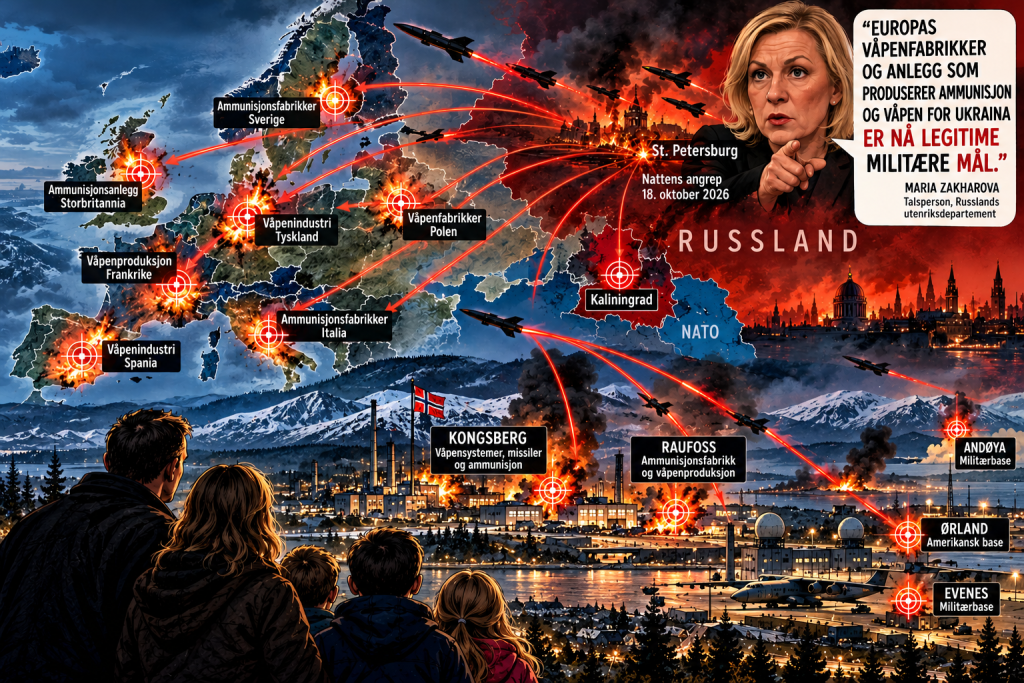
Meanwhile, Zakharova has repeated that any armed attack on Kaliningrad will be met with a “scorching” response by all means, and that the war would be very short. She points to the Polish General Staff allegedly having plans for pre-emptive precision strikes, and to a speech by the NATO chief on 12 October. The warning comes after statements from the Baltic states about gas pipelines and a blockade. We hope it is taken seriously this time.