John Mearsheimer is right: Ukraine is landlocked
The renowned American political scientist Professor John Mearsheimer said this week that Ukraine has in practice become a landlocked country. It is a statement of fact, not a forecast – and it is accurate. Russia reports having attacked or destroyed around 80 vessels near Ukraine’s Black Sea ports in July alone – a higher number than Iran has managed against shipping in the Strait of Hormuz during the ongoing confrontation there. The sea route is closed. Only two ways remain of moving goods in and out of Ukraine: the railway west towards Romania, and the road over the Zatoka bridge near Odesa. Both are now under sustained Russian attack.
The Zatoka bridge: First structural destruction in the history of the war
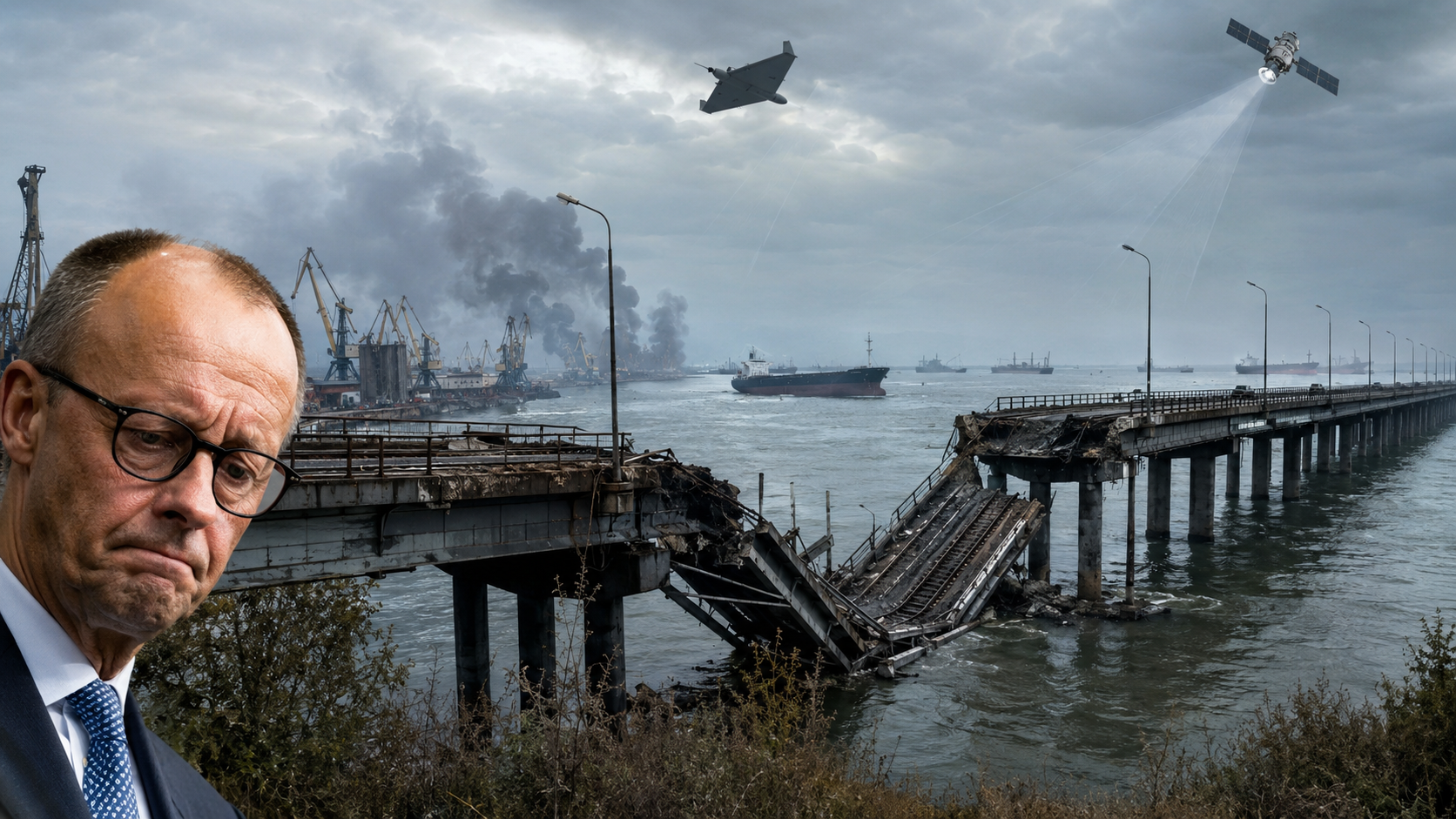
During the night of 1–2 August, Russian forces carried out a combined attack on the Zatoka bridge – the strategically important bridge over the Dniester estuary connecting the Odesa region with Romania and NATO’s transport network. As a result of the attack, one span in the northern part of the bridge collapsed – the first critical structural damage the bridge has suffered after at least twelve Russian attacks since 2022. An electrical substation near the bridge was also hit, causing power cuts in the surrounding settlements. The bridge is currently out of service and under emergency repair.
The bridge has previously been attacked with Iskander missiles, Kh-59MK2 missiles, UMPK bombs, Geran drones and unmanned surface vessels. None of the earlier attacks managed to cause permanent structural damage. The current attack was carried out primarily with Geran drones and has for the first time caused a span to collapse. The bridge carries rail freight, fuel, lubricants and military equipment from NATO countries via Romania – it is Ukraine’s last direct land link with the Western supply network.
Russia has so far not used its heaviest missiles – Kinzhal, Iskander or Oreshnik – against this bridge. It is reasonable to assume this is a deliberate choice: the more destructive systems are being saved for the moment Russia wants to take the bridge down permanently and irreversibly. Ukraine has never managed to destroy the Crimean Bridge permanently, despite its efforts. It is unlikely that Russia will allow Ukraine the same resilience with the Zatoka bridge once it decides to finish it.
Rassvet: Russia’s answer to Starlink is operational
Russian military commentary over the past week confirms what has long been hinted at in these updates: Russia’s own satellite system Rassvet is beginning to function as a communications relay for optically guided Geran-4 drones. The clear, detailed real-time footage the Russian Defence Ministry has published in recent weeks of drones attacking ships in the Black Sea confirms this – the images come not from the drones themselves, but from Russian Gerbera reconnaissance drones operating high above the strike zone and transmitting data via Rassvet.
The existing satellite system is far from complete – around 10 percent of the planned constellation is in orbit. For now it provides coverage over Ukrainian territory only in short windows of one to two hours per 24-hour cycle. But that is enough to carry out precision strikes in the window when the satellites are in the right position. Russia plans to launch another two to three rockets carrying Rassvet satellites during the autumn. With around 1,000 satellites in orbit – probably achievable during 2027 – Rassvet will provide continuous coverage over all of Ukraine, equivalent to what Starlink gives Ukrainian drone operators today.
Ukraine’s drone offensive: E-commerce and “industrial facilities”
Ukraine sent around 1,000 drones against targets in Russia during the night of 2 August. The Russian Defence Ministry says the vast majority were shot down. Some got through: Zelensky claims three Russian oil refineries were hit – something Russian sources do not confirm. The only thing the Russians acknowledge is that a drone reached an industrial facility in central Russia and that drone debris caused a fire that was quickly extinguished. This may be under-reporting on the Russian side – “drone debris” is a well-known Russian euphemism that sometimes covers actual hits.
Ukraine again attacked Wildberries warehouses. Wildberries CEO Tatiana Kim responded by declaring that the attacks are attacks on purely civilian infrastructure, that the company is not involved in the Russian military operation in any meaningful way, and that damage to the warehouses is not covered by insurance or the company’s refund policy – since it falls under “force majeure”. Legally speaking, she is right. Kim said Wildberries is already restructuring its logistics chain and installing air defence cover around the warehouses, that it expects to have normalised operations within one to two weeks, and that the company will overcome this challenge as it has always overcome challenges.
Russia is now systematically retaliating: Russian drones are attacking Ukrainian e-commerce warehouses and Nova Poshta postal terminals. It is the same logic that applies along the entire front line – Ukraine carries out an attack, Russia responds with more destructive counter-strikes. Ukraine lacks Russia’s resources and organisation to absorb and adapt. It is not a symmetrical situation.
The US withdraws from Wiesbaden
In the shadow of the battlefield and the diplomatic processes there is a development of potentially historic significance: the US is reportedly withdrawing from the NATO coordination headquarters in Wiesbaden, Germany, which has coordinated support for Ukraine since 2022, and from which Ukraine’s counteroffensives in Kharkiv in 2022 and towards the Black Sea in 2023 were coordinated. The Americans say it is for the Europeans to take over this coordination. It is a responsibility no European state or institution is able to shoulder. Europe has neither the command structures, the satellite capacity, the intelligence infrastructure nor the integration with the Ukrainian leadership that the US has built up over four years. It is a withdrawal that in practice means a degradation of the West’s coordinated ability to support Ukrainian military planning.
Merz implodes: Scandal, reshuffle chaos and the AfD presses on
German Chancellor Friedrich Merz finds himself in a political crisis of a kind not seen in recent German political history. It began with CDU parliamentary group leader Jens Spahn being forced to step down after it emerged that he had used surrogacy in the US – a practice he has publicly opposed in German legislation. Merz tried to use the occasion to carry out a government reshuffle and announced that he would replace Transport Minister Patrick Schnieder with Fritz Günster. But at four in the morning on the day the press conference was to be held, Günster texted Merz to say he was turning down the job after all. Merz had to go to the press conference without a finished candidate. “I deeply regret the turmoil around this”, he said. On Monday 27 July he finally installed Steffen Bilger as the new transport minister – but the damage was done. Bloomberg characterised it as chaos that weakened Merz’s authority within the CDU and the coalition.
BMW announced cuts of 8,000 jobs. Volkswagen’s profits fell by a third. And CDU activists in the two eastern German states heading to elections say they feel abandoned by the party leadership in Berlin. The rumours now, according to both German and British press, are that if the AfD wins extensive control in these states, the CDU leadership may demand that Merz step down as chancellor – something that has never happened in the history of the Federal Republic.
The coalition of the willing: The final days
The Daily Telegraph noted on Sunday that with Keir Starmer’s departure and Emmanuel Macron’s impending end at the summit of power in France, the “coalition of the willing” is in its final days. Andy Burnham is reportedly far less enthusiastic about “project Ukraine” than his predecessor – it is claimed he deliberately dressed down for the meeting with Zelensky to signal his displeasure to the British establishment. The new Chancellor of the Exchequer John Healey has not succeeded in getting Burnham to commit to raising the British defence budget to 3 percent of GDP.
In France, none of Macron’s likely successors – Marine Le Pen, Jean-Luc Mélenchon or the centrist challengers – are ardent supporters of Ukraine’s cause. Le Pen is the least likely of these alternatives to continue Macron’s ambition of a European leadership role in Ukraine’s defence. And with Merz under pressure at home, there is no prominent European leader in a position to take over Macron’s mantle.
Europe supported Ukraine through the four years of this war that are now over. But the political energy behind the support is fading – not dramatically and visibly, but gradually and inevitably. That is what happens when the arithmetic of war can no longer be hidden behind the narrative of Ukrainian victories.