The defence exhibition: The death toll rises, and the second tier of Ukraine’s security apparatus has been hit
The picture of the attack on the defence exhibition north of Kyiv on 24 July is far more serious than the initial reports suggested. Initial reports spoke of ten killed and around a hundred injured – the latest reports suggest that up to 300 people were affected by the attack. What is now emerging from obituaries and Ukrainian security sources is that among the dead were senior representatives of Ukraine’s intelligence and security apparatus – drone designers, specialists and officers from the inner layer of Kyiv’s military-technological complex.
It was not the ministers or Zelensky’s inner circle who were hit. But it is the layer below – the people who execute, plan and develop – who are now gone. Zelensky is reportedly furious that the event was announced publicly in Ukrainian media in the days before. Russian intelligence evidently needed nothing more than the published information to find the location. A criminal investigation has been opened against the organisers – but there is little reason to expect it will reach anyone with real influence.
It was not a single attack, but two major attacks on Kyiv over the weekend. The second attack, during the night of 26 July, targeted what the Russian Defence Ministry describes as a factory producing drone airframes, navigation units and batteries, as well as a storage centre in south-west Kyiv where up to a thousand drones a month were produced and prepared – with help from a Ukrainian-American company: Palantir. It is now an open fact that American companies are deeply involved in Ukraine’s drone campaign. The fact that Russia is attacking the facilities where Palantir-linked production takes place is a signal to Washington that this has not gone unnoticed.
Su-34s with FAB bombs over Odesa: A qualitatively new step
Russian Su-34 bombers, escorted by Su-35 fighters, carried out their first FAB bomb strikes against the Odesa region in recent days. FAB bombs – large gravity bombs with enormous explosive charges – are the Russian weapon Ukrainian front-line soldiers fear most. There is in practice no air defence system that can stop them. By comparison, the Kh-32 missiles from Tu-22M3 aircraft – designed to sink aircraft carriers – are considered impossible for Ukraine to shoot down, and are used sparingly. FAB bombs are produced in near-unlimited quantities.
That Russian aircraft are now operating over the Odesa region with FAB bombs is a qualitative shift. Drones and missiles damage – gravity bombs demolish. Port infrastructure hit by FAB bombs takes months, not weeks, to repair. And Russia is now demonstrating that it can carry out such operations without Ukrainian air defence being able to stop them.
Tokayev in Omsk: A message from Washington via Astana
Kazakhstan’s President Kassym-Jomart Tokayev met Vladimir Putin in Omsk on Saturday 25 July at the 22nd Forum of Interregional Cooperation between Russia and Kazakhstan, and publicly urged Putin to “freeze” the conflict and resume negotiations based on what he called the “Istanbul 2.0” formula. “Perhaps it is now time to freeze this conflict and return to the Istanbul 2.0 formula, because significant results were achieved there,” Tokayev said directly to Putin. He added that he had received “many signals from Europe and the US about the conflict between Russia and Ukraine” and that he had been asked to convey this to Putin.
Tokayev is not an independent actor in this game. He is very careful to balance Kazakhstan’s interests between Russia, China and the West – but his open appeal to Putin in Omsk is hardly a spontaneous initiative. It is probably coordinated with Washington and Brussels, which after Rubio’s failed Manila meeting are now seeking new channels to reach the Kremlin with the message of freezing the conflict lines.
The Kremlin rejected the proposal flatly through Peskov, who said Russia values its relationship with Kazakhstan as a close ally, but that this “does not mean we agree”. Peskov repeated the standard position: Ukraine knows what it must do to end the war. That means Istanbul-plus: withdrawal from all four annexed regions, a declaration of neutrality and all the other conditions Putin set out in June 2024.
Ukraine’s Foreign Minister Andrii Sybiha was quick to praise Tokayev’s intervention as “realistic, timely and wise”. That is natural – Ukraine wants a freeze along existing front lines because it is the only thing that would stop the ongoing Russian advance. Russia does not want it because it would deprive it of the military gains of four years of war. Tokayev’s appeal does not change this arithmetic.
Ukraine attacks an Iranian tanker in the Caspian Sea
In a move that illustrates the confused strategic thinking behind Kyiv’s offensive operations: Ukrainian drones crossed Russian territory and attacked an Iranian tanker in the Caspian Sea. Iran reacted with fury and warned Zelensky that Iran possesses ballistic missiles with the range to reach any target in Ukraine. Zelensky responded with a statement that Iran is Russia’s ally and therefore a legitimate target.
By Russian reasoning, the logic is the same as Lavrov used against Rubio in Manila: if you attack a party’s allies and supporters, you give the other side the right to attack yours. Zelensky does not accept that the logic works both ways – but it is hard to see it as anything other than a contradiction. The most obvious purpose of the attack on Iranian property is to please Trump ahead of Zelensky’s Washington visit. It is a signal that Ukraine is on America’s side in the conflict with Iran. Whether it will have any effect on Trump’s view of Ukraine is highly uncertain.
The US halts the Iran strikes: Empty stockpiles, not diplomacy
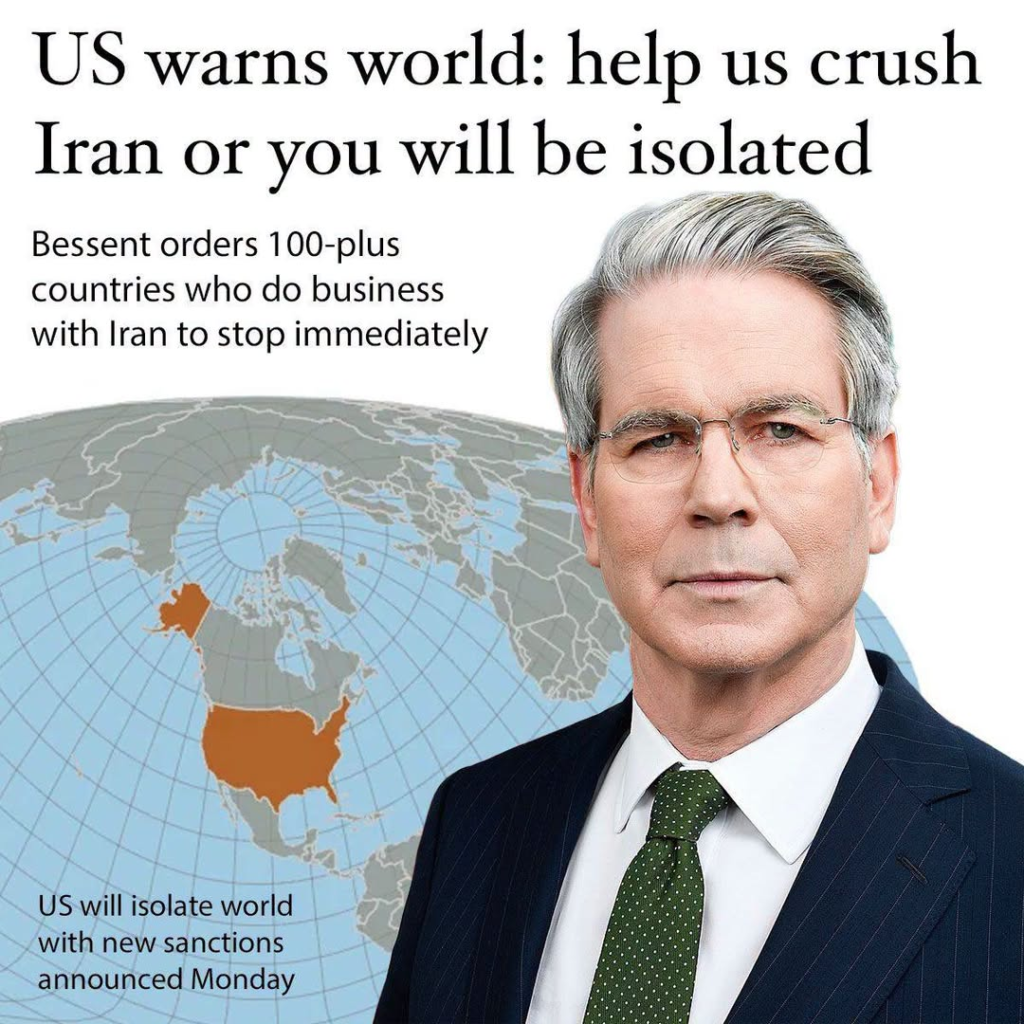
The brief pause in US strikes on Iran is not due to Oman’s diplomatic efforts – it is due to the US running out of precision weapons. According to the New York Times, General Caine of the Joint Chiefs of Staff and Vice President JD Vance asked at a White House meeting for a pause in the strikes on Iran because stocks of precision-guided missiles are approaching critically low levels. US Ambassador to the UN Mike Waltz dismissed the story and said he had “checked with the Pentagon”. Waltz is not a reliable source in this matter – he was removed as national security adviser precisely because his close ties to Israel caused unease in the administration.
What is indisputable: the US used more than 800 Tomahawk missiles and air defence interceptors in the first phases of the war. Raytheon’s production rate for Patriot interceptors is already known to be insufficient. And China’s export controls on rare earths – critical for the semiconductors that guide precision weapons – are being tightened weekly. It is not a situation in which the US can sustain a prolonged intensive confrontation with Iran.
Oman is trying to broker an arrangement under which the southern part of the Strait of Hormuz is used by commercial shipping under Omani supervision. The Iranians rejected a similar arrangement under the MOU because it dilutes Tehran’s most important bargaining chip – control over the strait itself. There is no reason to believe Iran will say yes now, from a position stronger than when the MOU was signed.
Donbas and Kharkiv: Collapse in slow motion
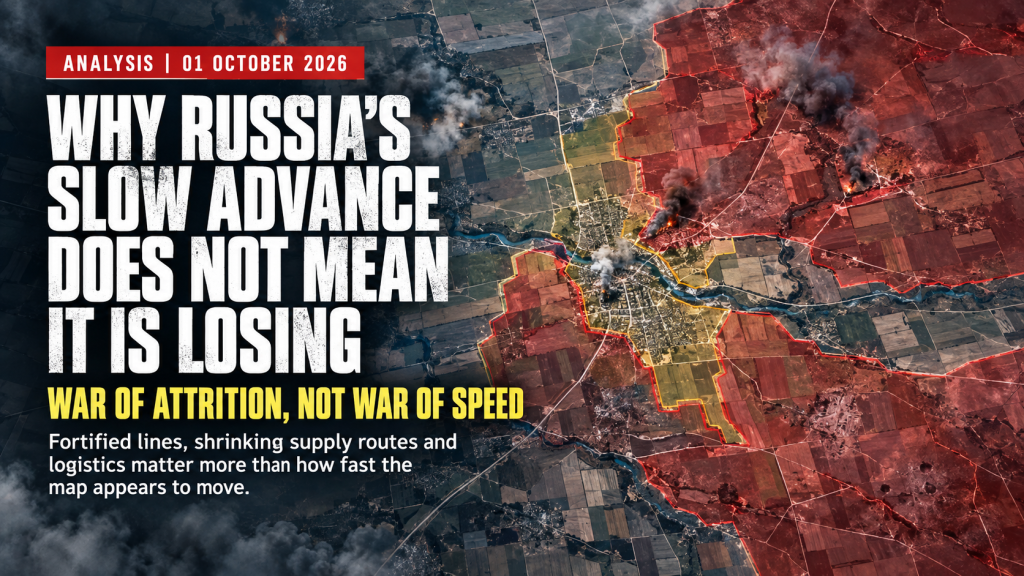
The village of Shevchenko north of Pokrovsk and south of Dobropillia has, according to the Russian Defence Ministry, been taken. This means Russian forces are now pushing towards Dobropillia from two directions – from the east via Bilytske and from the south via Shevchenko. Dobropillia is not a large town, but its fall opens open steppe westwards towards the Dnipro – without fortified lines of any significance. That is the dimension Putin highlighted when he called these territories “historically Russian land”.
In the Lyman sector, Russian sources report around 1,000 Ukrainian soldiers trapped on the eastern bank of the Siverskyi Donets river – cut off from retreat routes, without supplies, under sustained pressure. These are probably the remnants of Lyman’s garrison – and this explains why the formal Russian announcement of Lyman’s fall has been delayed for weeks: there are still some left to eliminate.
In the Kharkiv region, Bila Kolodiazna is reported to be effectively encircled. Russian forces are moving towards the forest belts immediately north of Kharkiv city – the same forested areas where the Ukrainians held the Russians back in 2022. If these forested areas fall, Kharkiv will be within artillery range. And Kharkiv is already shelled daily by Russian drones and missiles.
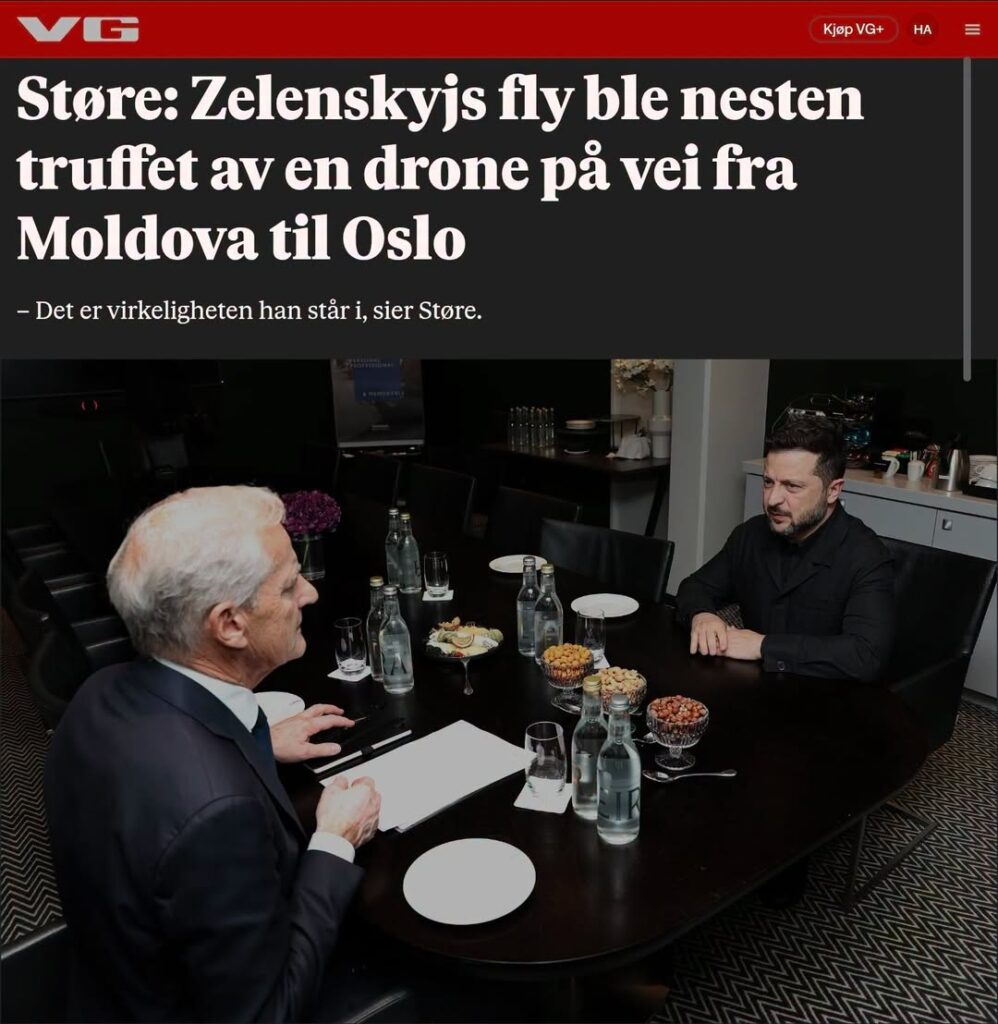
Zelensky in Washington: The impossible meeting
Zelensky is travelling to Washington to attend Lindsey Graham’s funeral and meet Trump. It is a meeting between a president who is furious about a war he cannot win, and a president who is furious about Iran and cannot afford to fight on two fronts. Zelensky will ask for Patriot interceptors. Trump will say he is “doing everything he can” and suggest the Europeans should pay more. Nothing substantial will change. And while they meet in Washington, the Russians will continue to drop FAB bombs over Odesa and fire missiles at Kyiv.
That is the reality both must face – and both are avoiding it.