Ukraine’s drone offensive against Moscow: 9,000 drones – one got through
Once again the figures force us to see the Ukrainian drone offensive for what it actually is. Moscow Mayor Sergei Sobyanin said that in July alone, 6,225 Ukrainian drones were sent against the Moscow region, and that 780 of them were shot down in the immediate vicinity of the city itself. The pro-Ukrainian analysis channel Drone Bomber has gone through the available records and arrived at the following calculation: of a sample of around 1,400–1,500 monitored drone incursions towards Moscow, 93 percent were shot down in the outer defence lines in the region, 6 percent in the city’s closer defence zones, and a single drone – 0.07 percent of the total – penetrated all the way to Moscow itself. Drone Bomber’s conclusion, quoted directly: “Against the background of thousands of launches, this is barely a drop in the ocean. It is almost laughable.”
The cost calculation is just as depressing. A Ukrainian FP1 drone – the offensive’s most common and cheapest type – costs around 55,000 dollars per unit. 1,400 such drones amount to total spending of around 77 million dollars. By comparison, a Russian Iskander-M missile costs around 3 million dollars per unit. A Russian attack on Kyiv with 25 such missiles thus costs around 75 million dollars – and since Ukraine has stopped shooting down Russian ballistic missiles, all 25 hit their targets. The Iskander-M also carries a 500-kilo warhead and strikes at hypersonic speed, against the FP1 drone’s 60-kilo charge and subsonic speed. There is no comparison in destructive power. The Ukrainian drone offensive against Russia costs roughly the same as the Russian missile attacks on Ukraine – and does a fraction of the damage.
The refineries: the same result as last year
The same pattern repeats itself for the attacks on Russian refineries. This summer Western media have presented it as a historic achievement that Ukraine has knocked out 40 percent of Russian refining capacity – exactly the same claim that was made in autumn 2025, and which Bloomberg, Forbes and the Moscow Times later showed to be greatly exaggerated. Russian refineries are normally 20–22 percent out of service at any given time for maintenance. Information close to Ukrainian sources now puts the actual attack damage at around 13 percent of capacity – far lower than 40 percent. The total disruption to production of fuel and refined products over the whole of 2025 was estimated by the Russian business daily Kommersant at 1.7 percent of total annual capacity. Everything suggests 2026 will end with a similar figure.
Russia’s Deputy Prime Minister Novak quickly introduced measures: shorter maintenance periods, imports of petrol from India and Kazakhstan, and the release of strategic reserves. The situation was stabilised as early as the second week of July. It is a disruption, not a crisis.
Rassvet is operational – and Starlink has started being jammed
The technological news now causing open unease in Ukrainian military and media circles is twofold. First, the Russian satellite system Rassvet – Russia’s answer to Starlink – is beginning to take operational shape. The Russian company behind Rassvet has published images of the signal receiver that can be mounted on drones, giving them communications via Russian satellites. For now the system only provides coverage over Ukraine in one- to two-hour windows per day, but the Russians are probably prioritising Rassvet receivers for their military drones – particularly the Geran-4 and Geran-5 – which can then carry out precision strikes against targets deep inside Ukraine without depending on ground-based signal stations.
Second, Ukrainian frontline units report that Starlink communications are increasingly being jammed by Russian electronic warfare systems – something once considered practically impossible. An Azov-linked Telegram channel, quoted by the Ukrainian analysis site Events in Ukraine, writes in open despair: “We became too complacent, lulled into a false sense of security that the Russians did not have access to Starlink and that everything was fine. The Russians adapted quickly. They developed electronic warfare systems against Starlink, and they are also developing Rassvet. Believe me, we will be biting our nails again when they install these on drones. I hope someone is already thinking about developing countermeasures against such devices, because we should have thought about this yesterday.”
Russia is a world leader in electronic warfare and jamming technology. It took the Russians years to break through the Starlink system; it will probably take the Ukrainians two to three years to develop effective countermeasures against Rassvet – if they succeed at all. That is time Ukraine does not have.
During the Washington visit, Zelensky asked for access to the military version of Starlink to guide strikes against Russian Iskander and Zircon launch systems inside Russian territory. Elon Musk declined to meet Zelensky at all. According to updated reports, Trump was not very receptive – the meeting is said to have been much shorter than initial reports suggested, and Trump pushed through mostly his own agenda.
Russia is winning the air war: Su-34s over the front, Iskanders over Kyiv
The overall picture of the air war as of 8 August is clear. Russian Su-34 bombers now carry out daily FAB bomb attacks on Ukrainian command posts and frontline positions in Donbas – exactly the positions that would have been defensible with intact Ukrainian air defence assets. The Russian Defence Ministry triumphantly reports the destruction of Ukrainian brigade headquarters and command posts in the Donbas region. These are the targets that would once have been the best defended. Now they are open.
During the night of 8 August, Russian Iskander missiles again hit Kyiv – among the targets a factory producing components for Ukraine’s Flamingo cruise missile. Ukraine fired no interceptors. There are none left. Meanwhile, Geran-4 drones are destroying railway infrastructure, locomotives and petrol stations over a geographical area stretching from the eastern front to Lviv. According to their own reports, the Russians have destroyed around 15 percent of Ukraine’s total locomotive fleet.
Diplomatic evacuation from Kyiv: now is the time to plan
In May, Russia warned Western governments that it was unwise to keep embassies and large diplomatic staffs in Kyiv. The warnings were ignored. Now Kyiv is being attacked with ballistic missiles in broad daylight, night after night, without a single one being stopped. Russia’s explicit targets are military-industrial infrastructure – but FAB bombs from Su-34s represent the next step, and the Oreshnik system waits in the wings.
A responsible Western government should now – not when the crisis is acute, but now – draw up plans for evacuating diplomatic staff from Kyiv and contact Russian channels to secure a local ceasefire allowing safe exit. The railway is the primary evacuation route – and it is already under sustained Russian attack. The longer this is postponed, the harder and riskier it becomes.
This is not a defeatist recommendation. It is elementary responsible statecraft.
The sanctions law: the Senate’s triumph – the House’s headache
The US Senate passed the Lindsey Graham–Richard Blumenthal sanctions law by 89 votes to 11. Only Rand Paul and ten others voted against. The law now goes to the House of Representatives, where it will probably not be considered until after the midterm elections in November – and perhaps not until the new Congress convenes in January. House Democrats are deeply sceptical – not because they oppose sanctions on Russia, but because the law in practice gives Trump almost unlimited tariff powers that can be used against anyone, including European allies, China, India or Brazil. A law that makes Trump tariff lord of the world is not the law the Democrats want to pass.
British media, which would once have hailed the law, now largely ignore its passage through the Senate. Perhaps because they have finally understood the fundamental logical absurdity of trying to shut down Russian oil exports in the middle of a global energy crisis in which Europe desperately needs more energy, not less.
Donbas: the end is near
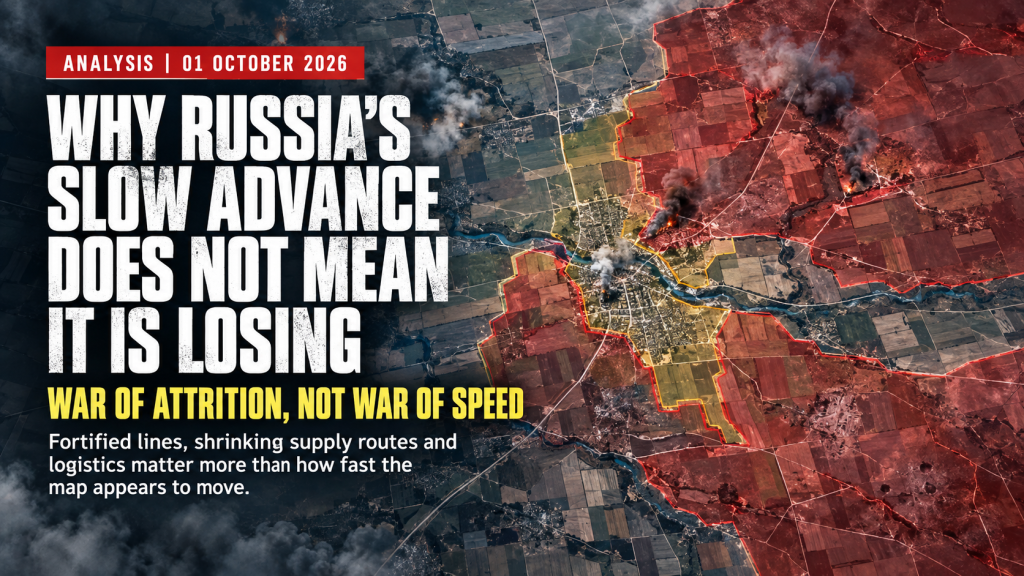
It is no longer controversial to say that Donbas is falling. It is the timing and extent that are unclear, not the direction. Reports from Oleksiivka, which lies immediately south of Duiivka and north of Kramatorsk, suggest that Russian forces are now in the town’s streets. Dobropillia is being stormed from two directions. Lyman has fallen. Orikhiv is encircled. And Kharkiv is under pressure from three directions simultaneously. This is not a war that will last “many more years”. It is a war approaching its decision – and the decision points in one direction.