A daytime attack on a defence show: Ten killed, a hundred injured
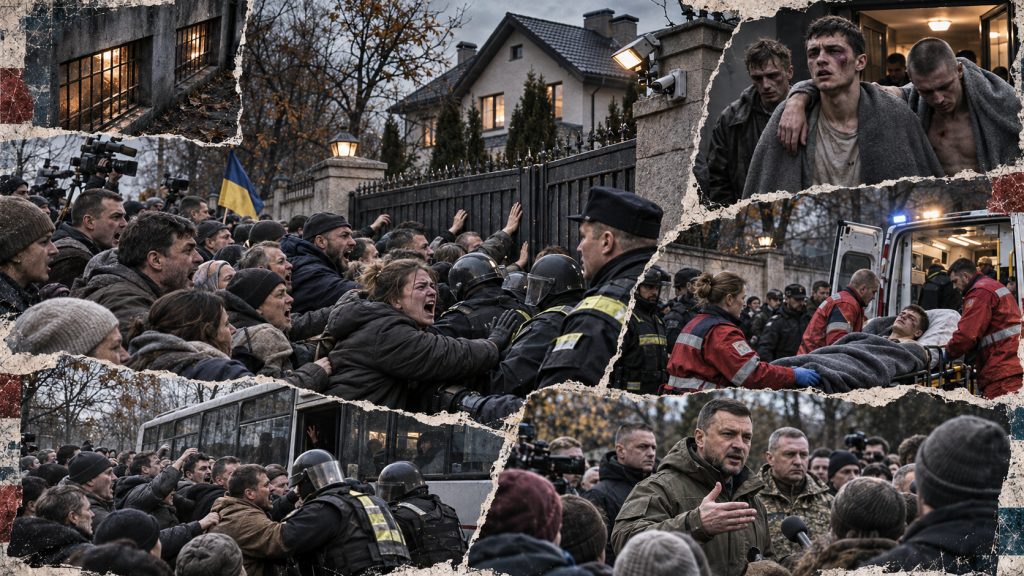
On Friday 24 July at 11:30, Russian forces carried out the first major daytime attack on Kyiv in the history of the war. At least ten people were killed and more than a hundred injured when a Russian ballistic missile hit a defence exhibition at a training camp along the Zhytomyr highway outside Kyiv. The Russian Defence Ministry confirmed the attack and stated that it was deliberate: the exhibition showcased Ukrainian- and Western-produced drones that Russia holds responsible for attacks on Russian territory.
The attack on the exhibition itself is what sets this event apart from all previous ones. It was not a random hit on civilian infrastructure. It was a precision strike against a military-technology event – the same tactic the Russians used in Chernihiv in August 2023, when a similar event was hit. Ukrainian military commentators reacted with open fury and asked: who is responsible for organising a public defence exhibition within range of Russian ballistic missiles without adequate air defence cover?
Zelensky stated that at least six were killed and “dozens” injured – a figure that by 14:18 Kyiv time had already been overtaken by the Kyiv Independent, which reported at least ten dead. It is therefore likely that the death toll will rise further.
The fact that the attack took place in daytime is of strategic significance beyond the immediate losses. Night and early morning attacks give the air defence time to mobilise. An attack in the middle of a working day, with the population on the move, in office buildings and at public events, is of a different character. Russia thereby demonstrated that it can now attack Kyiv at any time – and that Ukraine has no defence against ballistic missiles that can stop them. A Raytheon delegation was, according to Russian and Ukrainian sources, in Kyiv on precisely this day for meetings on future Patriot deliveries. Russia sent them a message they did not need an interpreter to understand.
Ukraine’s drone offensive against Wildberries: What is actually achieved?
During the night of 24 July, Ukraine sent between 570 and 600 drones against targets in Russia – according to the Russian Defence Ministry, the largest number in a single operation so far. The primary target was Wildberries warehouses in the St Petersburg region. A warehouse in the village of Novosaratovka in the Leningrad region was confirmed hit and burned. The Russians shot down the vast majority of the drones.
Ukraine’s own drone chief, Robert Brovdi, confirmed in an interview with The Daily Telegraph that the purpose of the attacks on Wildberries is “to destroy the illusion of a comfortable, well-fed peacetime life for the obedient biomass of an aggressor country”. It is a phrasing that dehumanises the Russian civilian population, and in one stroke strips away any argument that the Wildberries warehouses are military targets. They are not – and Brovdi now says so explicitly.
The contrast is striking: Russia attacks Ukrainian military-industrial infrastructure, command posts and defence exhibitions with precision missiles. Ukraine responds by setting fire to e-commerce warehouses. Seven of Wildberries’ ten largest warehouses have reportedly now been targeted by Ukrainian drones. The company will repair and harden the warehouses. The Kremlin will subsidise the losses. In a few months, the drone operation will have left behind burnt plastic, delayed parcel deliveries and higher insurance premiums – nothing strategic.
The other target of the drone offensive on the night of 24 July was an industrial facility in the Kirov region north-east of Moscow. Russian sources say it was a factory producing ejection seats for Russian fighter jets, owned by the Almaz-Antey conglomerate. The attack killed six workers. Russia is very reticent about information on the facility, which is itself an indication that it may have military relevance. An ejection seat plant is not a trivial target – but nor is it a target that changes the course of the war. Russia’s ability to produce fighter jets is determined by access to chips and avionics, not by the supply of seats.
Lavrov in Manila: Anchorage is buried and diplomacy is over
After the meeting with Rubio in Manila, Lavrov made no secret of his assessment of the situation. He brought documentation – transcripts of statements by Trump, Rubio and other US officials after the Anchorage meeting – and confronted Rubio with what by the Russian reading is clear evidence that an agreement was reached and then ignored. Rubio’s response is not known in detail, but the dynamics of the meeting are: 35 minutes, no joint statement, no press briefing.
Lavrov afterwards repeated that Russia now has only one goal: military victory. Diplomatic channels are, according to Lavrov, not closed – but they are without content. The US cannot deliver what Russia needs to resume negotiations: a Ukraine willing to negotiate, and a guarantee that the next set of Western promises will actually be kept. Nothing in the political situation in Washington, Kyiv or Brussels makes either of these conditions available.
From China: Lavrov met Foreign Minister Wang Yi in Kyrgyzstan on the sidelines of the Shanghai Cooperation Organisation, and both sides confirmed that relations between Russia and China are at “a historically high level” and in “positive progress”. That is the diplomatic picture as of 24 July 2026 in a nutshell: Russia–China close, Russia–US in practical collapse.
Odesa and the Black Sea blockade: A permanent shift
In Manila, Lavrov was asked about the possibility of reviving the 2022 grain deal – the UN-brokered arrangement that opened Ukrainian Black Sea ports for grain exports. The answer was brief and final: “This issue will not be taken up again”. UN Secretary-General Guterres and the architects of the arrangement played, according to Lavrov, “a dubious role” in a process in which Russian obligations were fulfilled, but Western ones were not.
The Russian Defence Ministry reported that 27 vessels used in Ukrainian military logistics were attacked over the past week – 16 dry cargo ships, ten bulk carriers and one container ship. The attacks now hit not only Odesa, Chornomorsk and Yuzhny, but also Izmail and Mykolaiv. An analysis concludes that even if all trade is rerouted through Romania’s Constanța, the port and rail links there can handle no more than a fifth of what Ukraine previously exported through its own ports. Ukraine’s sea-based export capacity is in practice gone – permanently.
The real strategic balance sheet
The comparison of the two offensives – Russian and Ukrainian – is now clear enough to draw conclusions. Russia attacks ports, closing Ukraine’s exports for good. Russia attacks rail infrastructure with Geran-4 drones. Russia attacks petrol stations across large parts of the country. Russia attacks military exhibitions with ballistic missiles in the middle of the day. And Russia is advancing on all fronts.
Ukraine sets fire to Wildberries warehouses and kills six workers at an ejection seat factory in Kirov.
It is not a war in balance. It is a war in which one side attacks strategic targets and the other attacks what it can hit. And while these attacks continue, the price of Brent crude on Thursday passed 100 dollars a barrel for the first time in two months, driven by Houthi attacks on Saudi oil tankers in the Red Sea and fears that both major maritime export corridors will close simultaneously. The S&P 500 fell 1.2 percent and the Nasdaq 2.4 percent. Europe is not pumping enough gas to reach its storage target before winter.
Zelensky is on his way to Washington to attend Lindsey Graham’s funeral and meet Trump. What Trump will do when he understands that the narrative he has bought – that Ukraine has the initiative in the war – does not match reality is the big open question. That he will at some point understand it is inevitable. That the understanding will come in time to make a difference is far less certain.