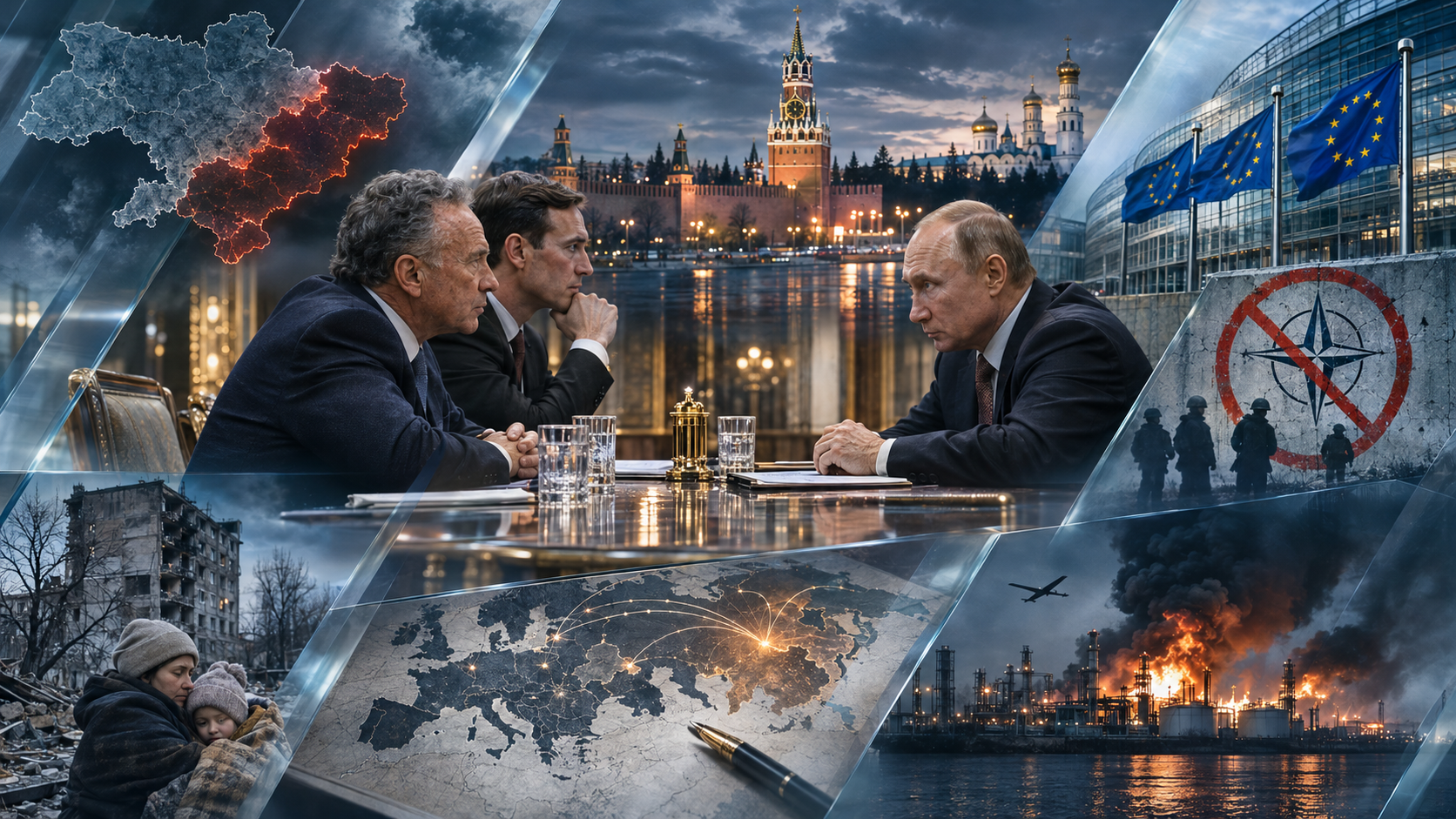
Steve Witkoff and Jared Kushner travelled directly from the negotiations in Abu Dhabi to Moscow to meet Vladimir Putin. The purpose was to persuade the Russian president to open the door to European participation in the peace talks and to determine whether there was room to bring the parties closer to a ceasefire. But the meeting in the Kremlin showed that Russia has no intention of abandoning its main demands. Putin maintains that a lasting settlement in Ukraine requires a new security order, that foreign forces cannot be deployed on Ukrainian territory, and that the territorial questions must be resolved on the basis of what Russia considers to be its own state borders.
The meeting took place only one day after the trilateral talks in Abu Dhabi ended without a breakthrough on the political issues. The parties reached agreement on a large-scale prisoner exchange, but remained far apart over territory, a ceasefire and security guarantees.
What was unusual about the Moscow meeting was that the Russian delegation also included Vladimir Medinsky, who had just led the negotiations in Abu Dhabi. At previous meetings with Witkoff and Kushner, Putin had usually been accompanied by foreign-policy adviser Yuri Ushakov and investment envoy Kirill Dmitriev. This time, the man who had presented Russia’s demands to the Americans and Ukrainians was also sitting at Putin’s side.
That signalled continuity between Russia’s negotiating position in Abu Dhabi and the message from the Russian president. The Americans did not find a new and more flexible counterpart by going directly to Putin.
Four Regions and One Border
The territorial question remains one of the biggest obstacles to an agreement. Ukraine wants a ceasefire along the existing front line, while Russia demands recognition of its claim to Donetsk, Luhansk, Zaporizhzhia and Kherson — four Ukrainian regions that Russia declared annexed in 2022 without fully controlling them.
In his opening remarks to the American envoys, Putin rejected the idea of using the current front line as the basis for a permanent settlement.
His argument was that the parties do not even agree on where the front line runs. Ukraine and Russia make conflicting claims of control over several areas, and there are so-called grey zones where the situation on the ground is disputed. If a future agreement is based on these lines, the demarcation itself could become the subject of endless negotiations.
Putin therefore argued that only one demarcation line is sufficiently unambiguous: the state border. By this, Moscow means the borders Russia itself has incorporated into its legislation, including the four annexed regions.
This amounts to a far more extensive demand than freezing the war where the forces stand today. Russia is effectively demanding that Ukraine give up areas it still controls within those regions.
Medinsky had already stressed the same position after the Abu Dhabi talks. According to his statements, territories Russia considers its own must be returned either through negotiations or through military operations. He also gave no indication that Russian forces would withdraw from areas they hold in other Ukrainian regions.
For Washington, this is a serious problem. An agreement on a ceasefire along the front line is difficult enough to achieve. A demand for a complete Ukrainian withdrawal from four regions makes the distance between the parties even greater.
Kostiantynivka as a Diplomatic Test
During the meeting, Putin also proposed a humanitarian operation in Kostiantynivka in the Donetsk region, modelled on an earlier operation in Oleshky.
Putin claimed that between 400 and 500 civilians were still in the city and proposed that representatives of both countries’ human-rights ombudsmen, together with international journalists, be given access to organise an evacuation. Russia could, according to the president, clear the access roads of mines within five days.
The proposal, however, also served another purpose.
Putin challenged Ukraine’s claims that it still controls Kostiantynivka. If the Ukrainians believe they control the city, they could guarantee security on their side. If Russia controls the city, Russia would do the same.
Such an operation could therefore not only evacuate civilians, but also give foreign observers an opportunity to examine who actually controls the area.
The proposal has been confirmed through public reporting of Putin’s remarks. It remains unclear whether Ukraine will accept such an arrangement.
Kostiantynivka has been a central point in Ukraine’s defensive line in Donetsk. The question of control over the city therefore matters both militarily and politically. An internationally observed operation could make it harder for the parties to maintain conflicting descriptions of the situation.
Putin Rejects Foreign Forces in Ukraine
Perhaps the most fundamental disagreement concerns what security arrangement is to exist after the war.
Putin repeated that Russia will not accept foreign military forces on Ukrainian territory, even after a peace agreement. He argued that such a deployment would constitute a threat to Russian security and could cause the war to continue.
This directly conflicts with European plans for an international stabilisation force intended to help guarantee Ukraine’s security after a ceasefire.
Putin questioned the sequence proposed by the Europeans themselves. They want a ceasefire first, then security guarantees, and only afterwards discussions on a broader European security order. Russia demands that the security order be settled first, precisely because Moscow believes the European guarantees could involve a military presence in Ukraine.
The Russian president also referred to Trump’s proposal to establish mechanisms for security in Europe as a whole. This links the Ukraine negotiations to Russia’s longstanding effort to create a new security architecture which, from Moscow’s broader perspective, it wants to develop across the whole of Eurasia.
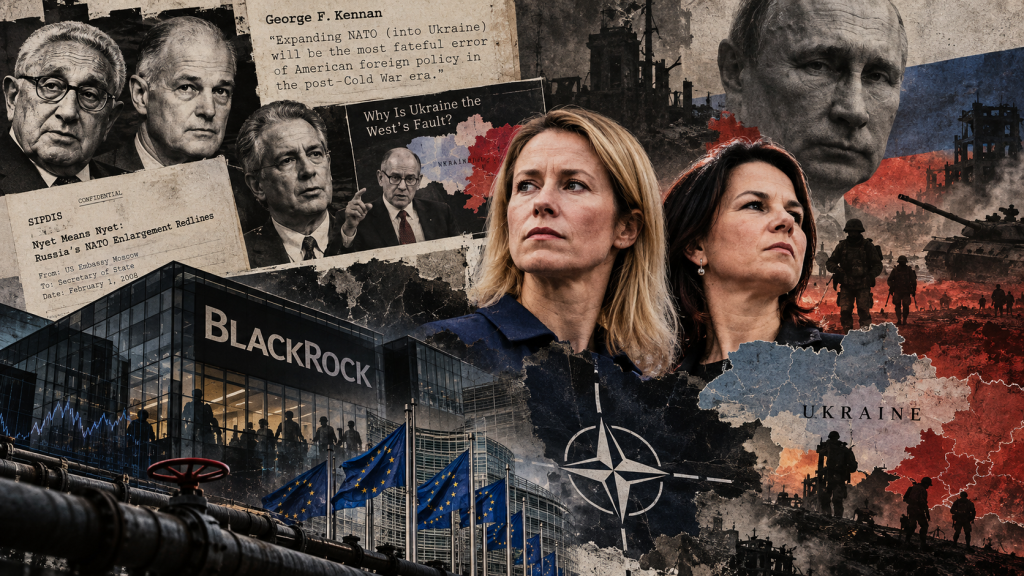
Russia already tried in December 2021 to negotiate agreements with the United States and NATO covering, among other things, a halt to further NATO enlargement and restrictions on the alliance’s military deployments in Eastern Europe. Those proposals were not accepted.
The issue has now once again become part of the negotiations over Ukraine. After the meeting, Ushakov confirmed that Moscow is ready to begin discussions with Washington on a new security architecture, while Russia continues to oppose the presence of foreign forces in Ukraine.
Europe Fears Being Drawn Into a Larger Negotiation
European governments are therefore facing a diplomatic dilemma.
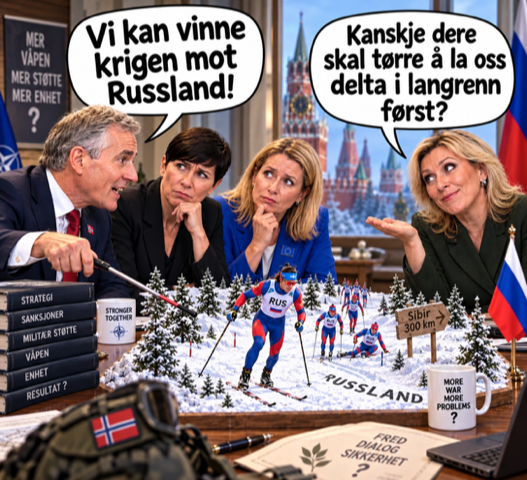
They want a place at the negotiating table, but Russia is making a broader discussion of the security architecture a central part of the process. Several European leaders oppose precisely that.
Estonian Prime Minister Kristen Michal described the situation as a trap. He warned against making European participation in the Ukraine negotiations conditional on discussions about NATO and Europe’s military security order.
At the same time, the Europeans have still not appointed a single chief negotiator. That makes it more difficult to establish a unified negotiating position towards Moscow.
After the Kremlin meeting, however, Witkoff said European representatives would participate in the next round of negotiations. The Russian side was more cautious. Ushakov confirmed Moscow’s willingness to discuss the security order, but continued to question the Europeans’ policy towards Ukraine.
Euronews+1
This shows that there is still a difference between American optimism about the negotiating format and Russia’s willingness to accept European conditions.
The Americans then travelled on to Dublin to brief Zelensky and the European leaders on the talks. Trump and Putin are also expected to continue their discussions during the APEC meeting in China later in November.
Time Is Not Necessarily Working in Favour of a Ceasefire
The diplomatic deadlock comes as Russia continues its attacks on Ukrainian infrastructure and military positions.
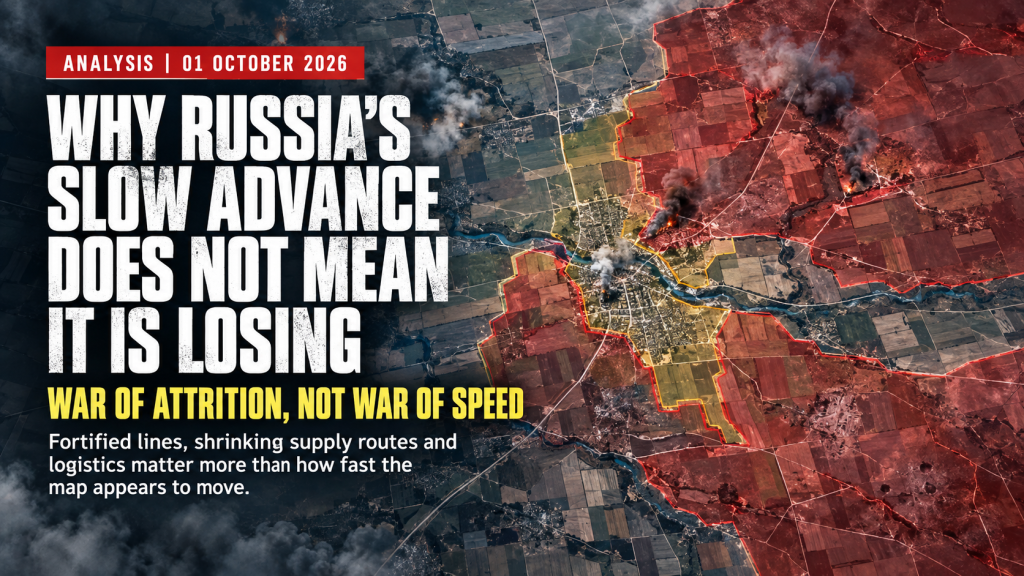
New strikes are being reported against Kyiv and Zaporizhzhia, while Russian forces claim to have resumed advances at several points along the front. Developments in the Zaporizhzhia region could be particularly significant if Russian forces continue westward and put pressure on Ukrainian defensive positions north of Orikhiv. The extent of the latest territorial changes remains unclear.
The situation gives the negotiations a time dimension that the parties assess differently.
Washington wants to end the war through an agreement. Ukraine and its European supporters want a ceasefire that can stop further territorial losses. Russia, by contrast, appears prepared to continue military operations until it either achieves its objectives on the battlefield or secures acceptance of its security demands.
The negotiations therefore face a fundamental problem: the solution the Americans are trying to achieve quickly requires compromises Russia has so far shown no willingness to make.
The meeting in Moscow did not remove that contradiction. It made it clearer.