Russian forces have reportedly established a bridgehead inside Orikhiv after a rapid push through Novodanylivka. At the same time, the pressure on Dobropillia and the fortified chain of cities in Donbas continues. In the air, a different problem is taking shape for Ukraine: ever larger attacks appear to be yielding ever smaller results, while Russia builds an ever denser air defence with A-50 surveillance aircraft as a central component.
Orikhiv: the Russians went in where Ukraine did not expect them
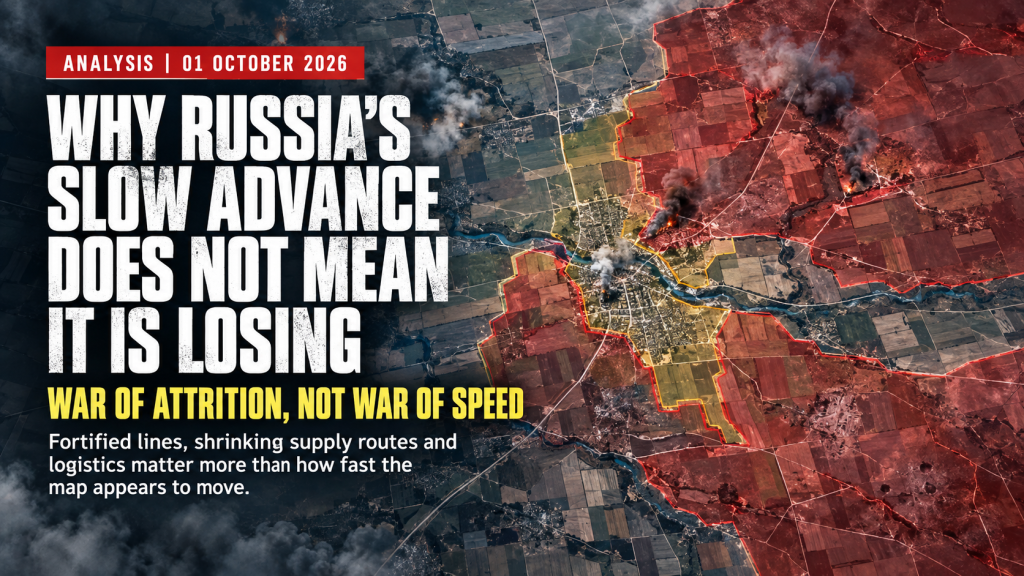
The most important development at the front over the past day is around Orikhiv in the Zaporizhzhia region.
According to the Russian military-oriented publication Readovka, Russian forces have now established a significant foothold inside the town itself. Some reports put the Russian-controlled part at around 20 percent, but this has not yet been independently confirmed.
What is interesting is how the breakthrough reportedly happened.
Ukrainian command is said to have assumed that Russia would first try to cut the supply routes into Orikhiv before a direct attack on the town. Large parts of the available Ukrainian forces were therefore placed along the lines of communication and supply, while the garrison in the town itself was relatively small.
Russia did the opposite of what Ukraine expected.
Russian forces took Novodanylivka south of Orikhiv and used the village as a starting point for a direct push into the town. If this account is correct, Ukraine has ended up in exactly the kind of dilemma that has marked several of the recent battles: the forces meant to protect the supply lines are suddenly needed inside the town, but if they are moved there, the supply lines themselves risk falling.
Russia is at the same time pressing Orikhiv from the west and, more importantly, from the east. This means a Ukrainian regrouping into the town could open the flanks and, in the worst case, turn an attempt to save the garrison into the start of an encirclement of far larger forces.
This is now the central question at Orikhiv: should Ukraine reinforce the town, or save the forces around it?
The most militarily conservative option would be to pull the forces north while roads are still open and establish a new defensive line closer to Zaporizhzhia. Readovka believes, however, that Kyiv will probably choose the opposite: hold the town, keep the forces on the supply routes and send further reserves south.
It is a strategy we have seen before. The problem is that if the town has already been penetrated and the supply lines are under pressure at the same time, further reinforcements may end up increasing losses without changing the outcome.
Orikhiv matters far more than its size suggests
Orikhiv is no big city, but its military importance throughout the war has been far greater than its population would suggest.
The town was the main starting point for Ukraine’s offensive in the summer of 2023. The plan then was to push south through Robotyne, break through the Surovikin line, take Tokmak and then reach the Sea of Azov.
The aim was to cut the Russian land corridor to Crimea.
It never happened.
Ukraine got through the Robotyne area, but never managed to break through the Russian defensive system in operational depth. Orikhiv nevertheless continued to serve as Ukraine’s most important fortified starting point in this part of the Zaporizhzhia front.
If the town now falls, the situation is almost a mirror image of 2023.
Three years ago, Ukraine was to use Orikhiv as a springboard south towards Tokmak and the Sea of Azov. Now Russia can use the area as a springboard north towards Zaporizhzhia itself.
That is why the development here matters more than just another pin on the map.
Dobropillia: the second front moving at the same time
At the same time, Russian forces are continuing the offensive at Dobropillia.
There too, there are reports of Russian presence inside the town or on its immediate outskirts, and estimates of around 20 percent Russian control recur in some reports. The figures must still be treated with caution, but the development fits into a broader picture in which the front north and north-west of Pokrovsk is moving faster than before.
Dobropillia is important because the town lies behind and north of the former main front at Pokrovsk. A Russian breakthrough here therefore does not just change the front line – it threatens the geometry of the entire Ukrainian defensive system further east.
Together with Russian advances at Andriivka, the pressure is growing on the fortified chain of cities stretching through Kostiantynivka, Druzhkivka, Kramatorsk and Sloviansk.
The assessment is that Dobropillia may actually fall before Orikhiv. This is not necessarily because the fighting there has progressed further, but because the Ukrainian garrison finds it harder to get both supplies and reinforcements in.
This is happening alongside heavy fighting at Oleksiievo-Druzhkivka and Druzhkivka, while the situation further north – at Lyman, Sviatohirsk and Sloviansk – is also becoming ever harder to distinguish from one larger, connected operation.
The point is therefore not necessarily which town falls first.
What matters is that Ukraine must now distribute ever fewer reserves between several operational crises at once.
Ukraine shifts attention to the war in the air
As the front moves, Kyiv has increasingly tried to shift the war’s centre of gravity to long-range drone and missile attacks on Russia.
The problem is that this campaign too now appears to be meeting a physical limit.
During some 48-hour periods, Ukraine is said to have sent several thousand drones against Russian territory. Yet the documentable damage has been modest compared with the volume of the attacks.
The pro-Ukrainian analysis channel DroneBomber has tried to calculate how hard it is to penetrate the defences around Moscow. Their estimate was extreme: of around 1,500 drones aimed at the capital region, perhaps one will reach the centre. Around 93 percent of the drones were stopped in the outer defence ring, around 6 percent in the inner one, and one drone – about 0.07 percent – reportedly reached Moscow.
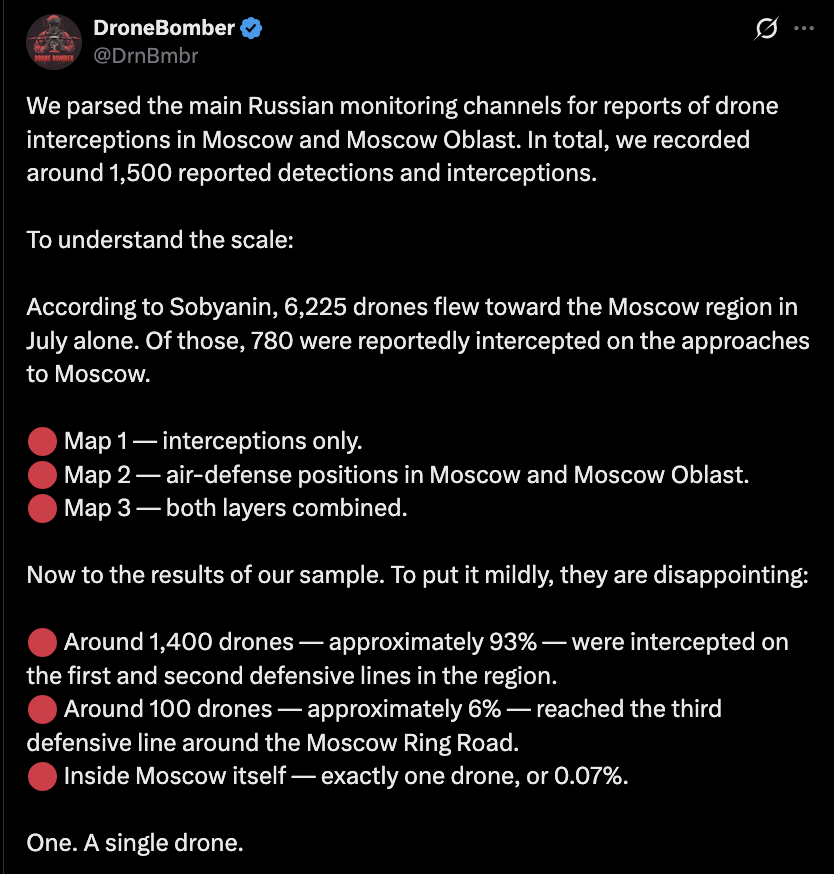
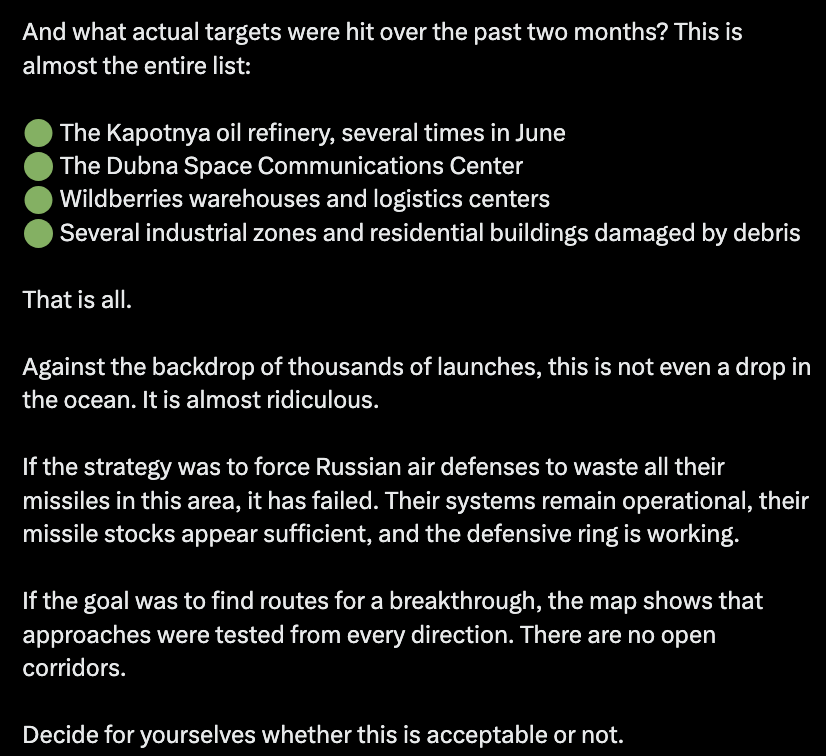
The figures cannot be treated as precise statistics. But the trend is harder to explain away: Ukraine must send ever more drones to get ever fewer through.
In practice, this means the cost of each successful hit rises sharply.
Russia has built something that is starting to resemble the air defence answer to the Surovikin line of 2023 – not one weapons platform, but layer upon layer of radars, electronic warfare, mobile air defence units, fighter jets and long-range surveillance.
The Flamingo missiles appear to be hitting the same wall
This does not only apply to drones.
Ukraine’s Flamingo missiles – developed to strike targets deep inside Russia – are also said to have far greater problems getting through than previously assumed.
A German report claims that Russia uses A-50 long-range radar and command surveillance aircraft to detect the Flamingo missiles at great distance, before they are engaged by air defence or fighter jets.
The German report claimed that only one Flamingo attack in July had succeeded in hitting a target inside Russia.
At the same time, one part of the report already seems outdated: it claimed that Ukraine had in practice stopped using the Flamingo after the poor results. The Russian Defence Ministry has since itself reported significant use of the system – including an attack in which Russia claimed to have shot down 17 Flamingo missiles in one night.
On other nights Russia has claimed seven or eight shootdowns.
These figures come from the Russian authorities and must be treated accordingly. What is interesting, though, is that there are few corresponding documented reports of major Flamingo hits on Russian targets.
That may explain why Ukraine appears to be starting to fire more missiles at once: if the probability of a single missile getting through is small, the salvos must be made larger.
The A-50 is back – and its role may be different than assumed
This is where the A-50 aircraft become particularly interesting.
Russia lost or had several A-50s damaged earlier in the war, and at one point questions were raised about how great an operational role the fleet could still play.
But Russia has gradually restored several aircraft and put them back into service.
The assumption has been that the A-50 would primarily be used to coordinate Russian air operations against Ukraine. The German report claims, however, that a central task is now to detect Ukrainian cruise missiles over western parts of Russia.
That makes technical sense.
The A-50 is designed to detect low-flying targets far beyond the range of ordinary ground radars. If its data can be passed to MiG-31s or other platforms with long-range air-to-air missiles, Russia gains yet another layer of air defence before the targets even come within range of the local air defence batteries.
This is probably what Ukraine is now trying to overwhelm with ever larger salvos.
The Patriot problem is getting ever harder
On the other side, Ukraine’s air defence has come under ever greater pressure.
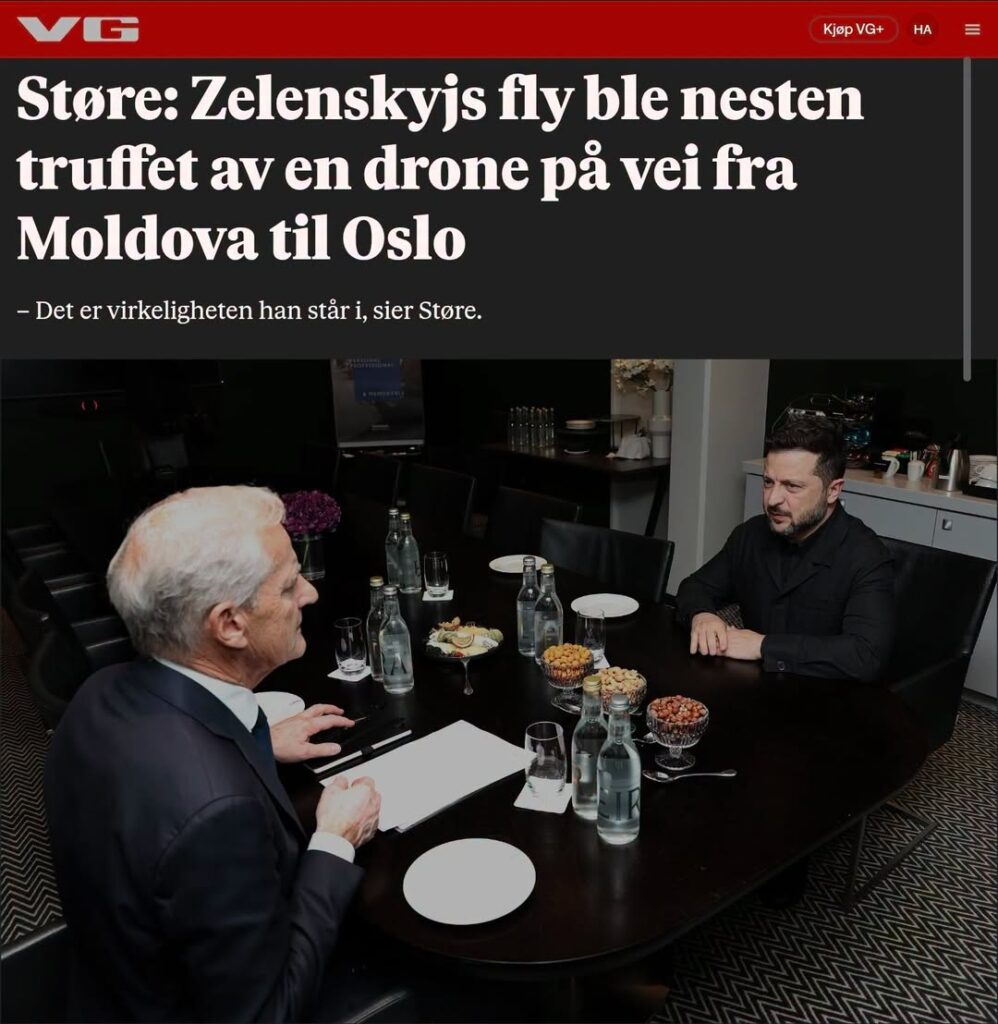
Zelensky is still asking for more Patriot systems and more interceptors, but the supply of missiles is limited, and Europe has few systems it can readily give up without lowering its own level of readiness.
There have therefore been reports of attempts to build hybrid air defence systems in which parts of Ukraine’s remaining Soviet S-300 infrastructure are combined with American missiles and guidance systems.
On paper this is tempting. Ukraine still has launchers, expertise and infrastructure from the Soviet period, while the West has missile technology.
But that does not mean the components can simply be bolted together.
Radars, data links, seekers, command architecture and rocket motors are developed as parts of complete systems. Combining American and Soviet technology therefore involves far more than mounting a new missile on an old launcher.
There have previously been American-Ukrainian attempts to use American Sparrow missiles with Soviet Buk systems. Some operational systems were reported, but they have since almost disappeared from public coverage.
The assessment is therefore that an effective “S-300/American hybrid” system can hardly be developed quickly enough to solve Ukraine’s immediate air defence problem.
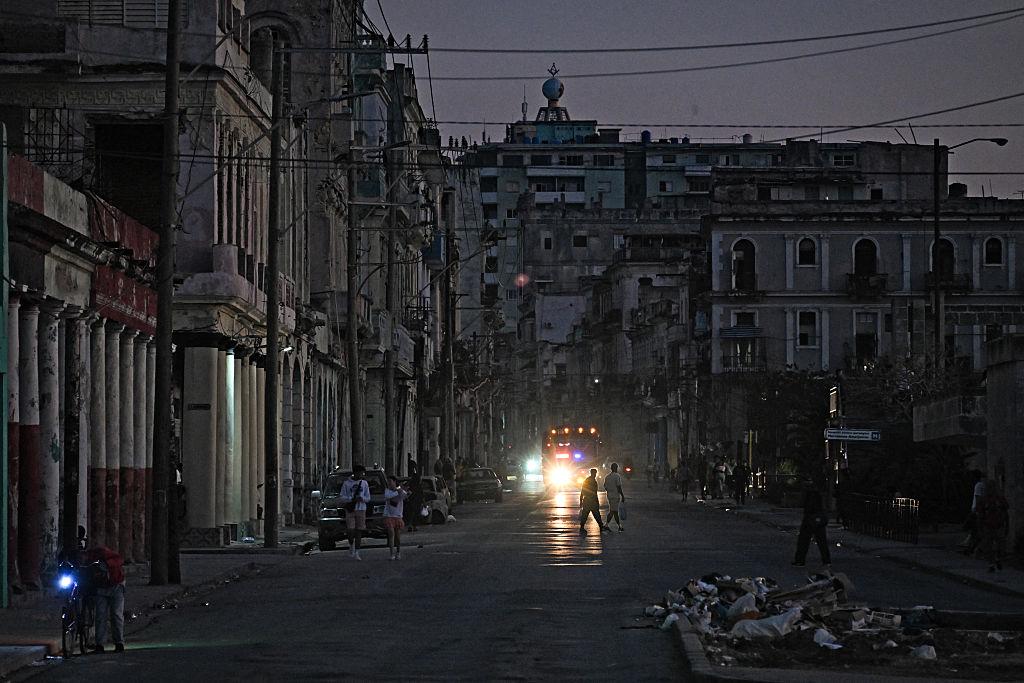
The power grid is approaching a critical point
This leads on to perhaps the most important strategic problem.
Ukraine’s power system has become ever more dependent on nuclear power. Up to 80 percent of thermal generating capacity is said to have been knocked out, while nuclear power has at times accounted for up to 80 percent of electricity consumption. Part of this is due to direct Russian attacks, but also to the loss of territory and the fact that large parts of Ukrainian industry have stopped or reduced production.
That households still have power much of the time does not therefore necessarily mean the energy system is robust.
It also means consumption has been dramatically reduced.
The margins between production and necessary demand may thus be far smaller than the availability of electricity suggests.
If Russia enters the winter with a new systematic campaign against transformer substations, high-voltage grids, distribution hubs and the remaining generation, Ukraine may face a considerably harder energy problem than in previous winters.
The operational problem is not one town – but the number of simultaneous problems
This is what ties today’s developments together.
Orikhiv is under pressure.
Dobropillia is under pressure.
Kostiantynivka and Druzhkivka are under pressure.
The Lyman and Sloviansk direction is moving.
The Black Sea ports are being hit repeatedly.
Ukraine’s long-range drone offensive requires ever greater volume for ever less documented effect.
The Flamingo missiles appear to be meeting the same air defence system.
At the same time, Ukraine needs more air defence missiles than the West can quickly produce or give up.
This does not mean the front will collapse tomorrow. Nor does it mean that all Russian claims of advances or shootdowns can be taken literally.
But the difference from earlier phases of the war lies in the number of simultaneous crises.
Previously, Kyiv could move reserves from one quieter sector to another and stabilise the front. When Orikhiv, Dobropillia, Kostiantynivka, Druzhkivka and the northern Donbas front all need reinforcements at once, this becomes ever harder.
And while Ukraine tries to compensate on the ground with strikes deep inside Russia, these operations too are meeting an ever more extensive Russian defence.
That is why developments in the coming weeks should be assessed on more than which town is listed as captured on today’s map.
The decisive question is how long Ukraine can keep handling several operational crises at once without one of them dragging the others down with it.