The night of 30 July: An attack of historic scale
During the night of 29–30 July, Russian forces carried out a massive combined attack on Ukraine with attack drones and air-, land- and sea-launched missiles of various types. Ukrainian air defence shot down 320 of the 358 air attack assets launched. That means 38 missiles and drones reached their targets. That is not a figure representing the success of the air defence – it is a figure representing a defence in full disintegration.
Ukrainian President Zelensky confirmed that Kyiv and its surroundings, and the Dnipropetrovsk, Lviv, Poltava, Kharkiv, Mykolaiv, Sumy, Vinnytsia, Cherkasy and Ivano-Frankivsk regions were all attacked, with dozens of residential buildings, businesses and infrastructure facilities destroyed or damaged. Russia used more than 70 missiles, a significant share of them ballistic, in the attack. At least eight people were killed and more than 50 injured. The heaviest losses were reported from the Lviv and Dnipropetrovsk regions. Pravda Ukraine
What sets this attack apart from the previous weeks’ massive strikes on Kyiv is its geographical spread. Ukrainian defence-industrial infrastructure across the whole country was hit, from west to east. In Lviv the attack hit the LORTA aircraft plant, which produced and maintained engines for Ukraine’s Flamingo cruise missiles and drones. In the Ivano-Frankivsk region, two plants producing and storing various Ukrainian missiles, including Flamingo and Neptune, were attacked. In Kalush, an industrial enterprise involved in the production and storage of FP-5 Flamingo, FP-7 and FP-9 operational-tactical missiles and Neptune-MD long-range missiles was hit. In the Dnipropetrovsk region, the Akvaplast plant in Kryvyi Rih was struck – a facility involved in the design and assembly of attack drones and maritime attack drones.
In Lviv, 67-year-old resident Iryna Yefimenko did not even hear the air raid siren when the missiles hit: “I only heard it after something hit me in the head, the window flew into the room. When I went to bed last night, I never thought that in the morning I would be left barefoot, with nothing. My home was completely torn apart.” Pravda Ukraine
A Russian missile also fell into a field in the Lublin region of Poland – it triggered airspace alerts in eastern Poland and caused diplomatic unease in Warsaw. Russia has not commented on the incident. It is the third time during the war that a Russian missile has landed on NATO territory.
The pattern everyone can see, but no one will acknowledge
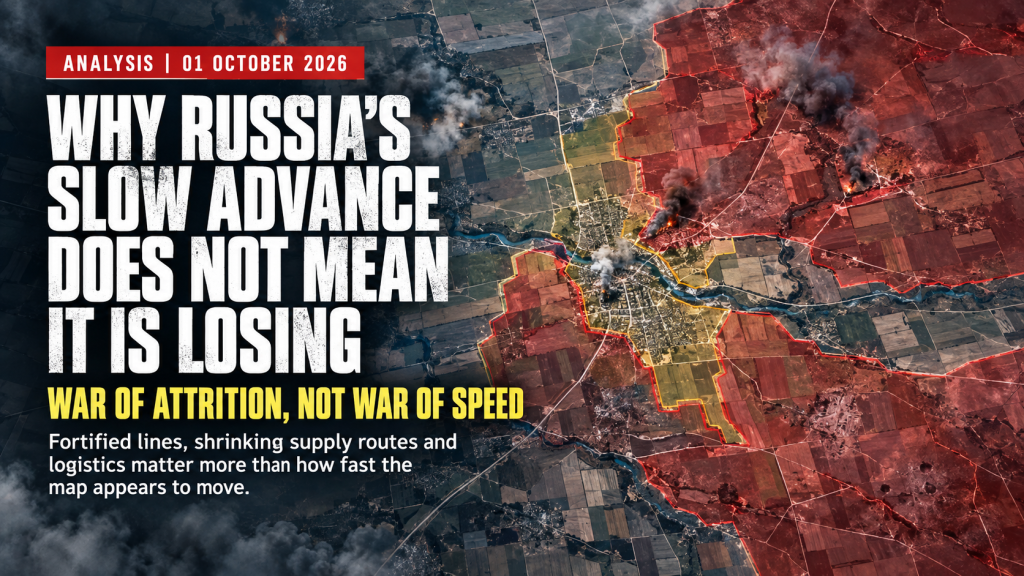
The well-known mapping service Rybar now notes that Russian advances are taking place at what is described as “normal speed” – that is, the speed we saw in the summer offensives of 2024 and 2025, when the Russians at their fastest advanced ten kilometres a day. It is an identical pattern that has repeated itself three years in a row: slow winter build-up, gradual acceleration in spring, breakthroughs in summer and autumn. British and Ukrainian commentators consistently declared that the Russians had been “stopped” in April and May. In June–September this proved wrong both previous years. There is no reason to believe 2026 will be any different.
The US has 750–850 Patriot interceptors left – Zelensky asked for 300
The most revealing single fact from Zelensky’s Washington visit is not what Trump promised – it is what he could not promise. Zelensky asked for 300 PAC-3 Patriot interceptors. The think tank CSIS (Center for Strategic and International Studies) confirms that the total US stockpile of PAC-3 interceptors is now down to 750–850 units. What Zelensky asked for corresponds to around 40 percent of the entire US stockpile – at a time when the US is actively engaged in a conflict in the Persian Gulf where Patriot missiles are being used continuously.
Trump said no. It was not a political choice – it was a military necessity. The US is not in a position to give away 40 percent of its only ballistic missile defence capability while Iran attacks American bases in Jordan. And the Iranians have learned to exploit this: they send older, lower-speed ballistic missiles at American bases, not to cause damage, but to force the Americans to fire Patriot interceptors at them. Four interceptors used to shoot down two Iranian missiles – a simple, cheap and repeatable operation.
Zelensky left Washington without what he asked for. What Trump gave him was words, a warm tone and news of the Senate’s progress on the sanctions bill – which, as we analysed in yesterday’s update, is in practice a discretionary powers law for the president, not an automatic sanctions package against Russia’s energy customers.
Ukraine’s economy is beginning to collapse
80 percent of Ukraine’s foreign trade passes through the Black Sea ports. With Odesa and adjacent ports effectively blockaded, this trade has in practice stopped. The alternative – rail west towards Romania’s Constanța – is already overloaded and under ongoing Russian attack. Ukrainian railways use a broader gauge than the European standard, which makes replacement rolling stock from the West unusable.
In the agricultural sector – Ukraine’s most important export industry – farmers are harvesting grain that is impossible to sell, because there is no mechanism for shipping it out. And in the east, Rybar reports that petrol stations along the main roads between Pavlohrad, Sumy and Kharkiv have been destroyed to such an extent that farmers already have trouble obtaining fuel for tractors and combine harvesters – exactly in the period when the harvest is due. An iron ore mine in the Kryvyi Rih area is reportedly about to shut down. Ukraine is not just a country at war – it is a country whose economy is being methodically dismantled from within.
Ukraine’s former press secretary Yuliia Mendel – a patriotic Ukrainian who condemns the SMO as aggression and has no sympathy for Putin – published a post on X this week pointing out what she calls the core of Western hypocrisy: the people who declare their love and concern for Ukraine in practice do nothing but destroy the country. And what actually drives them is not love for Ukraine, but hatred of Russia. The analysis is hard to refute.
Russia’s Rassvet satellite system – and what it means
A Ukrainian official in Ukrainska Pravda – a source rarely inclined to give Russia the advantage – confirms what has been hinted at in a number of programmes: Russia is now beginning to communicate with Geran drones through its own Rassvet satellite system, the alternative to Starlink. The system is far from complete – less than 10 percent of the planned number of satellites are in orbit. But it appears that enough satellites are up to provide partial coverage over central and southern Ukraine. The same source warns that this could enable attacks on the scale of 1,000 Geran drones per night combined with 100 missiles – a level that would overwhelm any remaining Ukrainian air defence. It is in this light that Zelensky’s plea for 300 Patriot interceptors should be read: it is not a strategic exercise – it is an attempt to survive the coming months.
Dobropillia: Ukraine’s front line in Donbas is falling apart
In Dobropillia, the Russian military outlet Razdka reports that Ukrainian resistance is collapsing rapidly. Ukrainian drone coverage – the main alternative to conventional artillery after the artillery, according to available reports, has been withdrawn to the west bank of the Dnipro – has largely been eliminated. The Russians have identified and killed the drone operators. Without drones and without artillery, the Ukrainian infantry, already thin, is in practice unprotected. Razdka also reports a sudden thinning of Ukrainian forces around Dobropillia, which is due either to the general manpower shortage affecting the whole army, or to someone in the Ukrainian command having decided to move troops to an even more critical point – a point that remains unknown.
In the Sumy region, Russian forces have taken the village of Morgita east of Sumy city, halfway between the Russian border and the city itself. Russian Defence Minister Belousov personally congratulated the troops who took Morgita. Russia’s advance on Sumy from two directions – north and east – continues simultaneously.
Rassvet, Khal and Oreshnik: What was not used
It is notable what was not used during the night of 29–30 July. Khal hypersonic missiles fired from MiG-31 fighters have not been used for a long time. Oreshnik has not been used against Ukraine with a full conventional payload. Both of these systems are, by all available indications, being stockpiled. They are two systems suited to one thing above all others: penetrating underground command and industrial facilities that no other conventional bomb can reach. Kharkiv’s Soviet-built underground factories are one such category of target. Kyiv’s command bunkers are another. The fact that these systems have not yet been used is not a sign that they will not be used. It is a sign that they are being saved for the right moment.
Russia: Clarity and confidence
In contrast to the Ukrainian chaos revealed in recent weeks – three commanders-in-chief since 2023, an acting defence minister without a military background, an uncompensated Fedorov, protests in the streets, Zelensky constantly travelling abroad – the Russian leadership currently appears with a calm and clarity not seen since the start of the war. Lavrov is relaxed in interviews. Medvedev dismisses rumours of mobilisation and says victory is coming. Putin smiles broadly at Duma members and says he too wants to advance faster. Russia reports a new record in voluntary military recruitment – 250,000 men have applied for service this year, more than the system can absorb.
That is not the picture of a state under pressure. It is the picture of a state that believes it is winning.