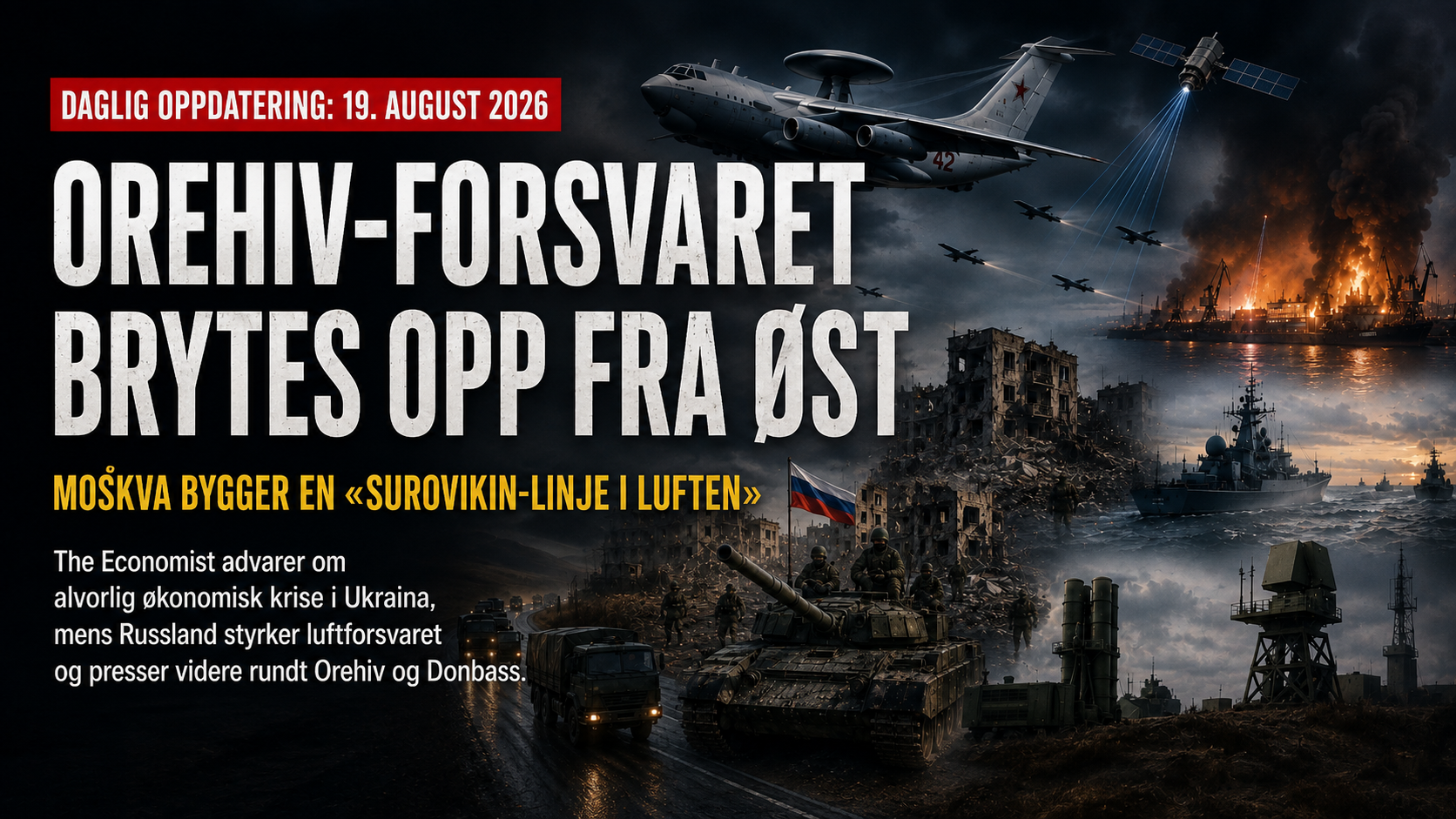
Russian forces have reportedly broken through the last continuous Ukrainian defensive line east of Orikhiv, while fighting continues inside the town. Around Moscow, a new layered air defence is emerging with Pantsir systems on 35-metre-high towers. Ukraine’s Flamingo strike on the Progress plant in Samara got through – but satellite images so far show limited visible damage. At the same time, The Economist describes a far more serious problem for Kyiv: a shortage of Patriot interceptors, an ever tighter blockade of the Black Sea and Russian attacks on logistics and industry that are now beginning to hit the carrying capacity of the Ukrainian economy itself.
Orikhiv: the last continuous defensive line in the east reportedly broken
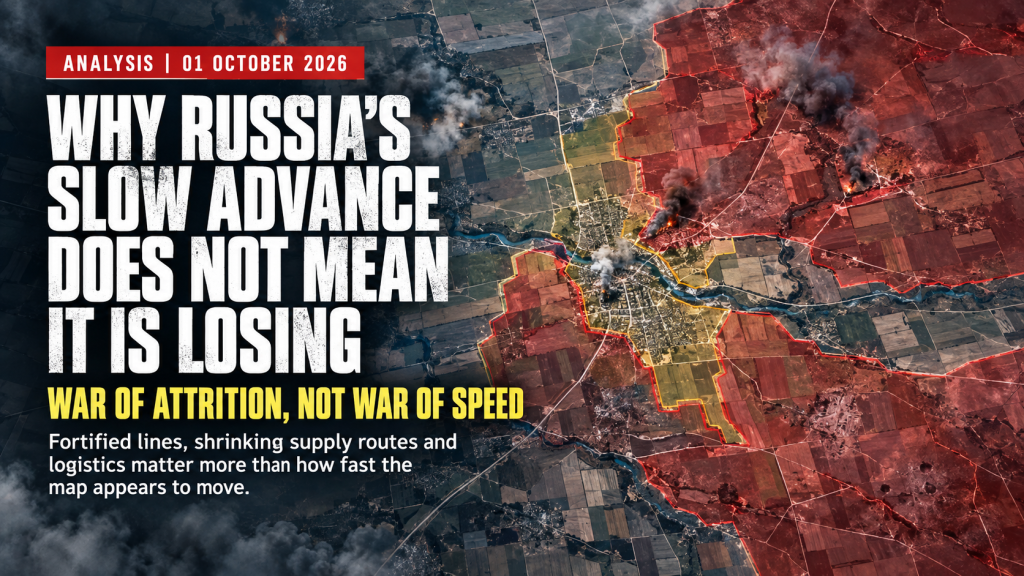
Developments around Orikhiv remain the most important on the Zaporizhzhia front.
The Russian military-oriented publication Readovka, which is openly patriotic and supports the Russian war effort and must therefore be read with that caveat, reported on 18 August that Russian forces had taken Novosolosyno on the west bank of the Verkhnia Tersa river. According to the publication, this means the last continuous, engineered Ukrainian defensive line east and north-east of Orikhiv has been broken.
Readovka writes that the area west of Novosolosyno towards Zhovta Krucha and Tavriiske consists mainly of open terrain, small villages and isolated strongpoints, rather than a new continuous fortified line. This is a Russian assessment, not an independently confirmed description of the situation, but it fits the operational picture that has developed over the summer.
What matters is not the village itself.
What matters is what lies behind it.
Orikhiv has depended on the connections to the north and north-east to sustain the garrison and the Ukrainian forces around the town. If Russian units manage to consolidate west of the Verkhnia Tersa and continue westward, they come ever closer to these connections.
This is happening at the same time as Russian forces have reportedly already entered Orikhiv itself from the south.
Readovka reported on 17 August that Russian forces had taken Novodanylivka and from there pushed into the south-eastern part of Orikhiv. The publication claimed that Russian assault groups had established themselves in the buildings around the start of Ovcharenko Street. This too is a Russian source claim that has not yet been independently confirmed, but the specific account is at least directly traceable to the source making it.
The pressure is thus now developing from two different directions.
From the south, according to Russian reports, there is fighting inside the town. From the east, Russian forces are at the same time pushing towards the lines of communication that hold the entire Orikhiv position together.
That makes the situation considerably more serious than if this were only a frontal attack on the town.
The problem is not necessarily holding Orikhiv – but getting out
The military logic is therefore beginning to turn.
As long as Orikhiv could be held with open connections to the north, it made sense to use the town as a fortified forward position. But if the town itself is penetrated while the supply axes are squeezed from east and west, the same fortified position can gradually become a trap.
Readovka’s assessment is that Ukraine still has the option of pulling forces north towards defensive lines closer to Zaporizhzhia, but that the risk of such a withdrawal grows the further Russian forces advance.
That is an important distinction.
An orderly withdrawal before the lines of communication are cut is one thing. A retreat under drone surveillance, artillery fire and pressure from several directions is something entirely different.
This is precisely what made earlier prolonged defences of forward positions so costly: the decision to withdraw came only after the room for manoeuvre had already been dramatically reduced.
Orikhiv may now be entering the same phase.
Dobropillia and the fortified chain of cities in Donbas
Further north, pressure continues at the same time around the Pokrovsk–Dobropillia axis.
It is harder to document the most far-reaching claims of Russian control inside Dobropillia, so it is better to look at what can actually be confirmed: Russia has prioritised this direction throughout the summer.
ISW recorded 34.67 square kilometres of Russian advance around Dobropillia in July, and assessed that Russian forces would likely intensify operations towards Dobropillia and Pokrovsk in an attempt to get around the fortified chain of cities Kostiantynivka–Druzhkivka–Kramatorsk–Sloviansk from the south-west.
That is what makes the development more important than control of individual villages.
If Russia can continue north while also pushing from the south and east, Ukraine’s fortified cities gradually become less a continuous defensive wall and more a series of positions that must be supplied through ever narrower corridors.
That is still far from saying the entire Donbas defence faces imminent collapse. ISW itself stresses that a rapid Russian capture of the whole urban belt is highly unlikely.
But Ukraine does not need to lose the whole line at once for the problem to become serious.
It is enough that ever more reserves are tied up in ever more places.
Ukraine hit the Progress plant – but the extent of the damage is still unclear
In the air war, the picture is more complex than some of the first reports suggested.
Ukraine did indeed hit the Progress Rocket and Space Centre in Samara with Flamingo missiles.
Satellite images taken on 18 August by the US company Vantor and published by Business Insider show damage to the facility, including holes in the roof of one building and external damage. Ukraine’s President Volodymyr Zelensky has confirmed that the FP-5 Flamingo was used in the attack.
The Progress plant is important.
It produces Soyuz rockets and is part of the infrastructure around Russia’s Rassvet project – a planned Russian broadband system in low Earth orbit intended to provide capability similar to some of what Starlink offers Ukraine.
It should therefore not be played down that Flamingo missiles actually got through and hit the plant.
At the same time, there is no basis for concluding that production has been knocked out.
Business Insider writes explicitly that the extent of the damage inside the buildings is still unknown. Fire Point, which produces the Flamingo, claims for its part that repairs could take months. Both should therefore be treated as preliminary assessments.
What can be documented is simpler: the missiles hit, visible damage exists, but it is not yet possible to establish how serious the production consequences of the attack will be.
A completely different air defence is emerging around Moscow
At the same time, it is becoming ever clearer why Ukraine must use ever larger salvos against targets around Moscow.
Russia is building an extensive layered defence against drones and low-flying missiles around the capital.
On 18 August, Defense Express published images and details of Pantsir-S1M systems mounted on metal towers around 35 metres high around Moscow. The systems combine radar, 30-millimetre cannons, ordinary air defence missiles and smaller TKB-1055 missiles developed specifically against drones.
This is interesting because it illustrates how countermeasures against modern drone warfare are developing.
A cheap long-range attack drone does not necessarily have to be met with an extremely expensive long-range air defence missile.
If Russia can detect the drones early with relatively simple radars and direct them into local defence sectors with cannons, short-range missiles, electronic warfare and more advanced systems further back, the cost calculation changes.
It is starting to resemble an air defence version of the Surovikin line of 2023.
Not one technological “super-solution”, but many relatively simple systems layered on top of each other.
This does not mean Moscow is impenetrable. Ukraine has already shown that some drones and missiles can get through Russian air defence.
But it means Ukraine must use ever greater volume to produce the same probability of a hit.
Ukraine has the opposite problem: launchers without missiles
The difference between the two sides becomes particularly clear when looking at Patriot.
On 15 August the Financial Times published a report with the telling headline “Ukraine left exposed as Patriot launchers run empty”.
The paper reported that Ukrainian Patriot units were left without interceptors during recent Russian ballistic attacks. According to Ukrainian officials, the limited deliveries from the US had already been used up.
Reuters has independently documented the same underlying problem.
And when Russia attacked Izmail on 13 August, Zelensky told CNN that Ukraine had what he described as only around one percent of the US Patriot stockpile, while he was asking for five percent to get through the winter.
The problem is therefore not primarily a lack of launchers.
It is a lack of what is to be fired from them.
The Economist: Ukraine’s economic problem has become far bigger
This is where the military development flows directly into the economy.
On 19 August The Economist published an extensive analysis headlined “Russian attacks are doing severe harm to Ukraine’s economy”.
What is interesting is not just the headline, but how the paper describes the development.
Russian attacks are increasingly aimed at the infrastructure that makes the Ukrainian economy work: distribution centres, warehouses, transport networks, industry, energy supply and – most important of all – maritime transport. The Economist writes that Ukraine’s economic vulnerability is now greater than Russia’s because Ukraine is far less able to absorb the loss of exports and logistics.
The Black Sea is at the centre.
Reuters already reported on 13 August that Ukraine’s grain exports had fallen 76 percent compared with the same period the year before, while record-low water levels in the Danube make alternative transport harder. Around 90 percent of Ukraine’s exports of wheat, maize and sunflower seeds normally go by sea.
Citing Ukrainian industry players, The Economist estimates that around 50 million tonnes of this year’s harvest still have to reach the market.
The problem is that ships cannot easily be replaced by lorries and railways.
When maritime transport is restricted, a physical logistics bottleneck quickly arises, regardless of how much grain is actually in storage.
The losses may spread to next year’s harvest
The most serious thing is therefore not necessarily today’s losses.
It is what happens if farmers cannot sell this year’s production.
The Economist cites the Ukrainian Agribusiness Club, which estimates that a lack of exports could lead farmers to reduce or skip winter sowing. In such a scenario, agricultural losses could reach 10–12 billion dollars, equivalent to around five percent of Ukraine’s official GDP.
It is a self-reinforcing process.
Less export means less income.
Less income means less capital for the next season.
Less sowing means less production the year after.
And at the same time the state must cover an ever larger financing gap with external support.
That is what makes today’s situation qualitatively different from just another round of attacks on power plants or ports.
The war is beginning to attack the economy’s capacity to reproduce itself.
Financial Times: Europe is expected to fill the financing gap
This becomes even clearer in a comment the Financial Times published on 19 August.
In “Global food security may be collateral in Ukraine war”, Alexander Gabuev notes that agricultural exports account for nearly half of Ukraine’s export revenues, while Russia earned 41 billion dollars from agricultural exports in 2025 – less than ten percent of the country’s total export revenues.
This means the same kind of attacks do not necessarily have symmetrical consequences.
Both can hit the other’s exports.
But Ukraine is far more dependent on this particular export flow working.
The Financial Times also adds a point that says a lot about how the war is financed: the paper expects Ukraine to receive a new European financing package, so that the loss of export revenue does not necessarily prevent the country from funding its defence.
In practice, that is a transfer of the problem.
As Ukraine’s own economic capacity to finance the state shrinks, the need for European financing grows.
The worst-case scenario is now being discussed openly
Finally, The Economist goes further than just describing economic losses.
The paper writes that the worst-case scenario now being discussed in Kyiv is that the combination of attacks on energy, water supply and other critical infrastructure through the winter could trigger a mass exodus from Ukrainian cities.
That does not mean it will happen.
But it is remarkable that the scenario is now being discussed in a Western publication that for much of the war has been among Ukraine’s most outspoken supporters.
It is a sign of how much the assessment of the air war has changed.
A few months ago, the discussion was primarily about how deep Ukraine could strike Russia.
Now it is increasingly about how long Ukraine’s own economy, logistics and energy infrastructure can absorb what comes back.
The war is not decided by who gets the most headlines
That is why the developments of the past few days should be assessed as a whole.
Russia is pressing Orikhiv both from inside and against the lines of communication east of the town.
The Dobropillia axis ties up Ukrainian reserves and increases the pressure on the fortified chain of cities in Donbas.
Ukraine has shown that the Flamingo can reach and hit very important targets deep inside Russia.
But Russia is at the same time building ever denser defences against both drones and cruise missiles.
And while Moscow puts Pantsir systems on towers, images and reports are published of Ukrainian Patriot batteries lacking interceptors.
Perhaps the most serious thing, however, is what is happening off the battlefield.
When the ports grind to a halt, warehouses are hit, industry is squeezed, energy becomes scarcer and next year’s sowing begins to depend on whether this year’s harvest can be exported, military pressure begins to have economic consequences far harder to repair than a destroyed tank or a lost village.
That is what makes 19 August important.
Not one dramatic event.
But that ever more of the war’s different lines of development – the front, air defence, the ports, industry, agriculture and public finances – are now beginning to point in the same direction.