The Night of 16 Ballistic Missiles
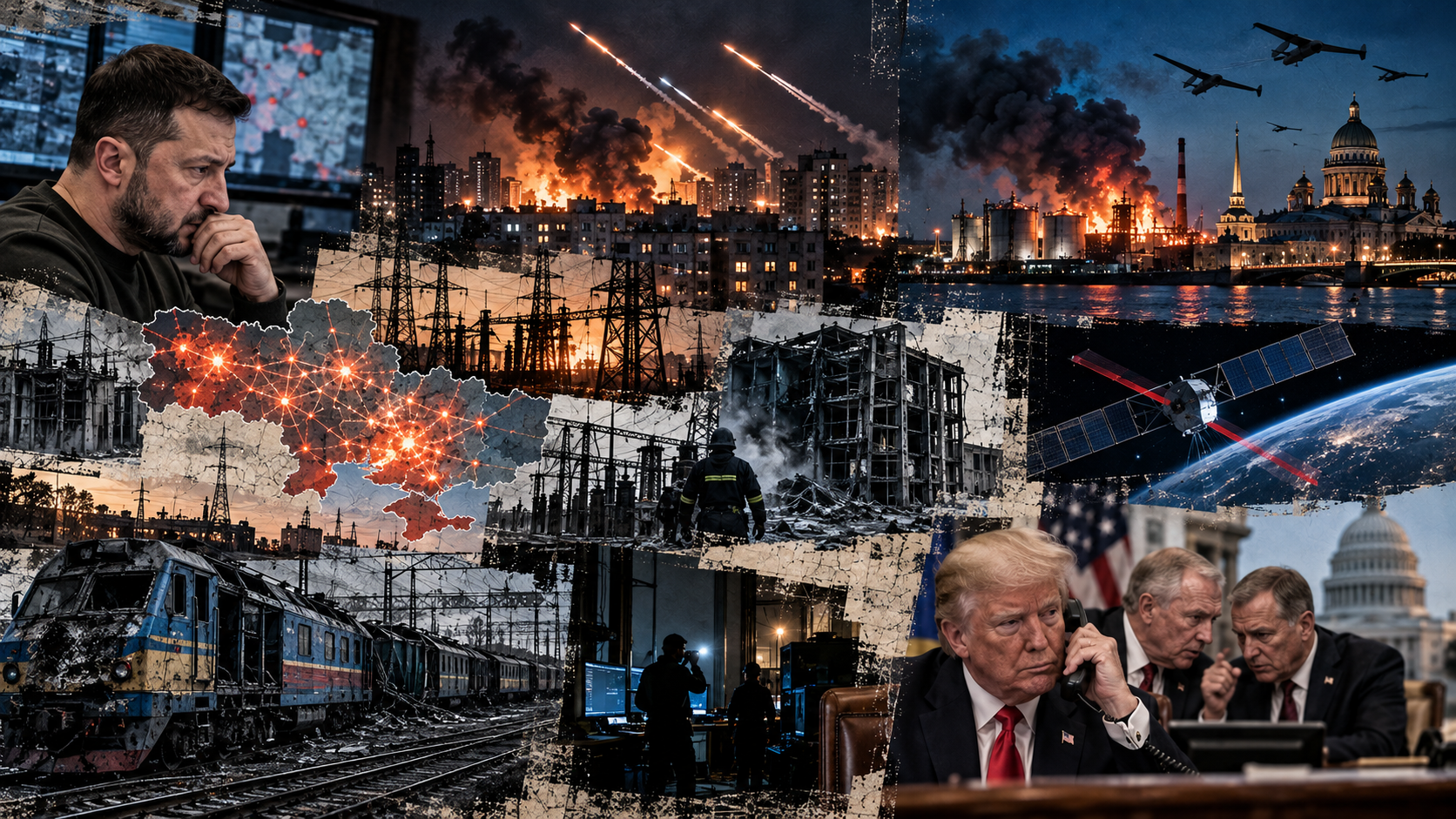
After the Ukrainian attack on St. Petersburg, Russia returned to Kyiv in full force. Overnight into Monday, Russian forces launched 16 ballistic missiles and more than 200 drones, most of them against Kyiv city and region, while also striking 28 critical energy facilities across eleven oblasts. Around 550,000 households lost electricity, and at least ten people were killed. The air force reports 269 drones, 59 of them jet-powered, in addition to Iskander-M, S-400 and Iskander-K missiles. The Russian Defence Ministry says warehouses for cruise missiles and drones and a data centre in the Kyiv region were among the targets. Russian military sources say the production chain for the Flamingo missile and Fire Point facilities was hit. These are Russian claims.
It is no longer only Kyiv that is being hit. The attacks are also targeting substations in the west, through which electricity from the nuclear power plants and imports from Europe must pass, and this is happening day after day. Ukrainian energy expert Yuriy Korolchuk told Apostrof that the grid is steadily weakening and that the country is “much closer to a blackout than ever before”. To keep the grid running, nuclear power plants and stations that have not been fully repaired must be pushed harder, and “sooner or later” that leads to system failure. He says at least four gigawatts of thermal capacity are needed to balance the grid, but that capacity does not exist. If he is right, a total blackout will not come from a single Russian strike, but from systemic failure after repeated overloading of a grid that has already been damaged.
The consequences will be felt on the railway. Russia has been striking locomotives for several weeks, and in September 533 of Ukrzaliznytsia’s locomotives had been damaged. The number is probably much higher now, since nobody is keeping count. How many are electric and how many run on diesel has not been stated. Electric trains stop during a blackout, while diesel trains can continue, and which ones Russia chooses to target may say something about what is planned for the winter. The attacks on data centres in Kyiv likewise threaten the country’s internet and therefore also its defence.
St. Petersburg: Many Drones, Limited Damage
The Ukrainian attack on St. Petersburg on 18 October, involving more than 1,000 drones in total against Russian targets, was one of Ukraine’s largest this year, with a large number of drones directed at relatively few targets. The drones struck Petersburg Oil Terminal, a VK data centre, a warehouse and a bridge, and the governor reports one person killed and five injured. The damage nevertheless appears limited in relation to the effort involved. VK says its services are functioning, and there is no indication that either the terminal or the bridges were out of operation for any significant period. The drones carry small warheads, and bridges can withstand far more than they deliver.
The difference between the two attacks is striking. Kyiv sends hundreds of drones and gets fires and some damage in return. Russia sends a few dozen missiles and brings an entire power grid close to collapse. Nobody expects Russia to suffer a total blackout because of Ukrainian drones.
Zelensky Goes Over Trump’s Head
While Kyiv stands in darkness, Zelensky has spent the past few days lobbying in Washington. On Monday, he held a video meeting with a bipartisan group of senators led by Tillis and Blumenthal and complained that Starlink and Starshield remain partially restricted, that Ukraine has lacked early warning of ballistic missiles three times over the past week, and that the Pentagon has not approved Patriot missiles that Europeans have already paid for through the PURL scheme. He offered a 30-day halt to refinery strikes in exchange for Patriot deliveries. Zelensky was therefore asking members of Congress to put pressure on their own president. Tillis and Blumenthal said in a joint statement that financing Russia’s war machine, denied satellites and weakened air defence all stand in the way of peace. The White House denies that anything has been stopped, and Trump says he does not know who ordered the Starlink restriction, but that he will find out. The Telegraph reports that Musk himself proposed the restriction to Trump.
The picture is confusing, and everyone is pointing at everyone else. One possible explanation for the warning failures is not that the United States is refusing to provide them, but that it is struggling: US satellites and radars have greater difficulty tracking hypersonic missiles, which move so quickly that a warning cannot be issued in time. And with Kyiv out of Patriot missiles, according to CNN, it is difficult to see what an earlier warning would change beyond giving civilians time to evacuate. Nor is the refusal to provide Patriot missiles difficult to understand. The United States and Saudi Arabia themselves face an acute shortage of interceptors, and the Pentagon cannot expend them in a country where Russia is overwhelming the defences anyway. At the same time, Kyiv is conflating Starlink, which is a civilian system, with Starshield, which is controlled by the US military. If the restrictions in practice apply to Starlink, the dispute may also be about gaining access to Starshield, which would open the way for strikes deep inside Russia. That is an assessment, not something Kyiv has said.
Over the past 24 hours, Trump has sharply criticised Zelensky and again said that someone else should negotiate on Ukraine’s behalf. At the same time, he has said that Russia has not done very much in Ukraine lately, and that he is willing to meet Putin and Xi. The Kremlin has long argued that Zelensky’s mandate expired in the spring of 2024 and is demanding that Ukraine be represented by a legitimate representative.
Oslo and Witkoff’s Trip to Moscow
On Tuesday, Zelensky travelled to Oslo, where Norway and Finland hosted a meeting with Prime Minister Støre and President Stubb, with Witkoff attending and Kushner joining by video. After the meeting, Zelensky said that US early warning “works now”, and that he wants a trilateral meeting with Putin and Trump. Witkoff is due to travel on to Russia to meet Putin, and according to the same source also to discuss the release of an American citizen, Stephen Hubbard. On Sunday, the Wall Street Journal reported that Putin had proposed a summit with Trump and Xi in Shenzhen in November, without Zelensky.
At the same time, Zelensky is asking the EU for another €70 billion, on top of the €90 billion that Belgium’s prime minister says is soon to be exhausted. That sum too could be spent quickly, with another request arriving by spring.
The Plan That Cannot Succeed
Much suggests that the drone campaign against Russia did not deliver what Kyiv hoped for, and diplomacy has taken a new direction. According to the Financial Times, European capitals are considering offering Putin two paths: either a freeze along the current front line in exchange for guarantees that Ukraine will never join NATO, or Russia takes the rest of Donbas in exchange for Ukraine being allowed to join. It is still a discussion rather than an agreed plan, but the logic is clear. Russia’s demands are split in two, in the hope that half will be enough.
The problem is that Zelensky rejects both. He will neither abandon Donbas nor give up NATO membership. Moscow has repeated that a Ukrainian withdrawal from Donbas is no longer a negotiating issue, since the region was declared Russian in 2022, and that Ukraine must remain neutral, with guarantees that cannot be reversed. If Zelensky is the obstacle, it is logical that Trump is asking for another negotiator. If he goes, it is difficult to believe that another leader in Kyiv could accept it. Russia cannot give up any part of Donbas either, nor accept Ukraine joining NATO, with or without Donbas. The plan therefore has little chance of succeeding, and everything points to the war continuing. A peace dictated by Russia appears more likely than an agreement between the great powers, and another attempt to pressure Moscow may come during the winter.
The Front: The Ring Tightens Around Orikhiv
The Russian Defence Ministry reported on Monday that Group East had taken Omelnyk in the Zaporizhzhia region, northeast of Orikhiv and along one of the main roads into the city from the north. The Ukrainians have probably been unable to use the road for some time, but control of the village gives drone coverage over all routes in and out, tightening the ring around Orikhiv. Reports of Ukrainian counterattacks inside the city have not been confirmed, and the fighting appears to be taking place in the northern suburbs.
In Dobropillia, the Russians have published new videos of the takeover. There are probably still Ukrainian soldiers in some buildings, but Russian forces are now pressing northward. Kyiv’s General Staff has denied that the city has been taken. The Ukrainian counterattack by the 12th Azov Brigade appears to be over. According to Russian sources, Russian forces still hold Rai-Oleksandrivka, the village on the high ground east of Kramatorsk and Sloviansk. If Biletsky and the 3rd Azov Corps are moved to Dobropillia, the Russians could retake what Vivaldi gained at heavy cost. Group North has cleared the Kharkiv pocket and is expected to move towards Velykyi Burluk once the ground dries after the rasputitsa.