CIA: More Active Under Trump Than Under Biden
On Friday, The Atlantic published a lengthy article on the CIA’s role in the war in Ukraine. According to UNN, US intelligence provides Ukraine with targeting data for strikes deep inside Russia and gives advance warning of Russian missile and drone attacks.
A Baltic intelligence officer says the CIA’s operations are “much more aggressive” than they were under Biden, despite Trump’s public statements. According to the article, the Ukrainians do not see CIA Director Ratcliffe as their protector. They know he serves an unpredictable president and that, if Trump follows through on his threat to cut off intelligence support, Ratcliffe will carry out the order.
Ratcliffe is also said to have advised Zelensky on how to deal with Trump. In August, he travelled to Moscow to meet Russian security officials and, according to The Atlantic, told them that neither side is winning the war.
The article is notable because it comes from a magazine that has been strongly critical of Trump and has traditionally enjoyed good access to the US intelligence community. It paints a picture of a CIA continuing to provide extensive support to Ukraine despite Trump’s public position.
There is much to suggest that the most important support Ukraine receives — intelligence and targeting data — still comes from the United States, while Europe supplies money and weapons. US intelligence support therefore appears to remain central to Ukraine’s ability to continue the war.
The article also notes how frequent Ukraine’s attacks on Russian refineries have become. Ukrainian strikes hit a refinery roughly once every three days during the first eight months of 2026, and Russian petrol production fell by 20 percent while diesel production dropped by around 30 percent, according to The Atlantic. That has still not persuaded Moscow to change course.
Ukraine’s drone offensive against Russia has been followed by a sharp escalation in Russia’s own campaign, targeting Ukrainian ports, railways, energy infrastructure and the metals industry. The timing, in the middle of the dispute between Trump and Zelensky over the refinery strikes, has led some to ask whether The Atlantic article is part of an internal Washington debate over whether that campaign should continue. There is no evidence of that.
Musk: The “Loophole” Has Been Closed
On Saturday evening, Elon Musk confirmed in several posts on X that SpaceX had imposed restrictions on Ukraine’s use of Starlink. He wrote that using Starlink, a civilian commercial service, for offensive drone strikes intended to kill people has never been permitted, and that the Ukrainian military had violated the terms of service.
Starshield is a separate system controlled by the US government. Musk also said that a “loophole” had been closed the previous week. At the same time, he wrote that Starlink is essential to Ukraine’s defence and that the front line would collapse immediately if the service were switched off.
Kyiv disputes his account. Zelensky says Ukraine does not use Starlink for attacks inside Russia, but to intercept jet-powered drones and for strikes against military targets in occupied territory.
Serhiy Sternenko, a former adviser to the Defence Ministry, calls Musk’s description “technically impossible”. He says any drone operation requiring satellite communications can only run through Starshield. The Defence Ministry says Starshield has now been restored at speeds above 400 kilometres per hour. Trump says he was not involved in the restriction.
Whatever the technical details, Musk has confirmed that SpaceX was behind the restrictions affecting Starlink, while Starshield is controlled by the US government. Musk describes Starlink as the only system that cannot be jammed, “at least for now”.
Russia has developed its own system, Rassvet, and Russian sources claim Starlink can be jammed locally. The Telegraph previously reported that Musk himself asked Trump to restrict the service.
Finnish Study on Casualties
Against this backdrop, a Finnish study has attracted attention. Alexander Grable, a doctoral researcher at King’s College London, wrote Chapter 12 of a report published by Finland’s National Defence University in February 2026 under the editorship of Pentti Forsström: “Irretrievable Losses: Estimating Casualties in the Russo-Ukraine War”.
He examined data that can be independently checked, including the number of amputees in Ukraine, verified deaths among Russian officers and exchanges of bodies. He concludes that Russian losses are probably lower than is often reported in Western media, while Ukrainian losses are higher. In his view, there is a genuine possibility that Ukrainian losses exceed Russian losses.
In an interview with Ian Proud, the ratio of returned bodies is given as roughly 12.5 Ukrainians for every Russian. He also questions parts of Mediazona’s database, including one case in which he says an officer listed as dead could not be found in the register he examined.
According to the coverage, Grable does not offer his own overall casualty estimate. Mediazona and the BBC have confirmed the names of 282,993 Russian soldiers killed, while CSIS estimated in July that Russia had suffered around 1.4 million casualties compared with 525,000–625,000 Ukrainian casualties.
Critics of the commonly cited estimates point out that they rely heavily on Ukrainian and Western intelligence sources, while the United States and Britain are themselves involved in the war. If the assumption that Russia is being steadily bled dry is wrong, then Europe’s strategy rests on a premise that does not hold.
Putin: Russia Is Not Behind the Protests
On Sunday, Putin told Pavel Zarubin that claims Russia is stirring up mass protests in European cities “clearly go too far”.
He argues that the protests are the result of mistakes by European leaders and Europe’s failure to manage large migration flows. Europeans are dismantling their own traditions, he said, and are therefore unable to pass them on to immigrants.
On 22 October, Alliance4Europe found no evidence that a foreign actor had been behind the origins of the protests in France, although it found that foreign actors had helped amplify the anger.
The remarks are unlikely to be intended to persuade European governments. They are more an expression of Putin’s frustration with Europe and a signal that, for now, he wants as little contact with European leaders as possible.
The Air War
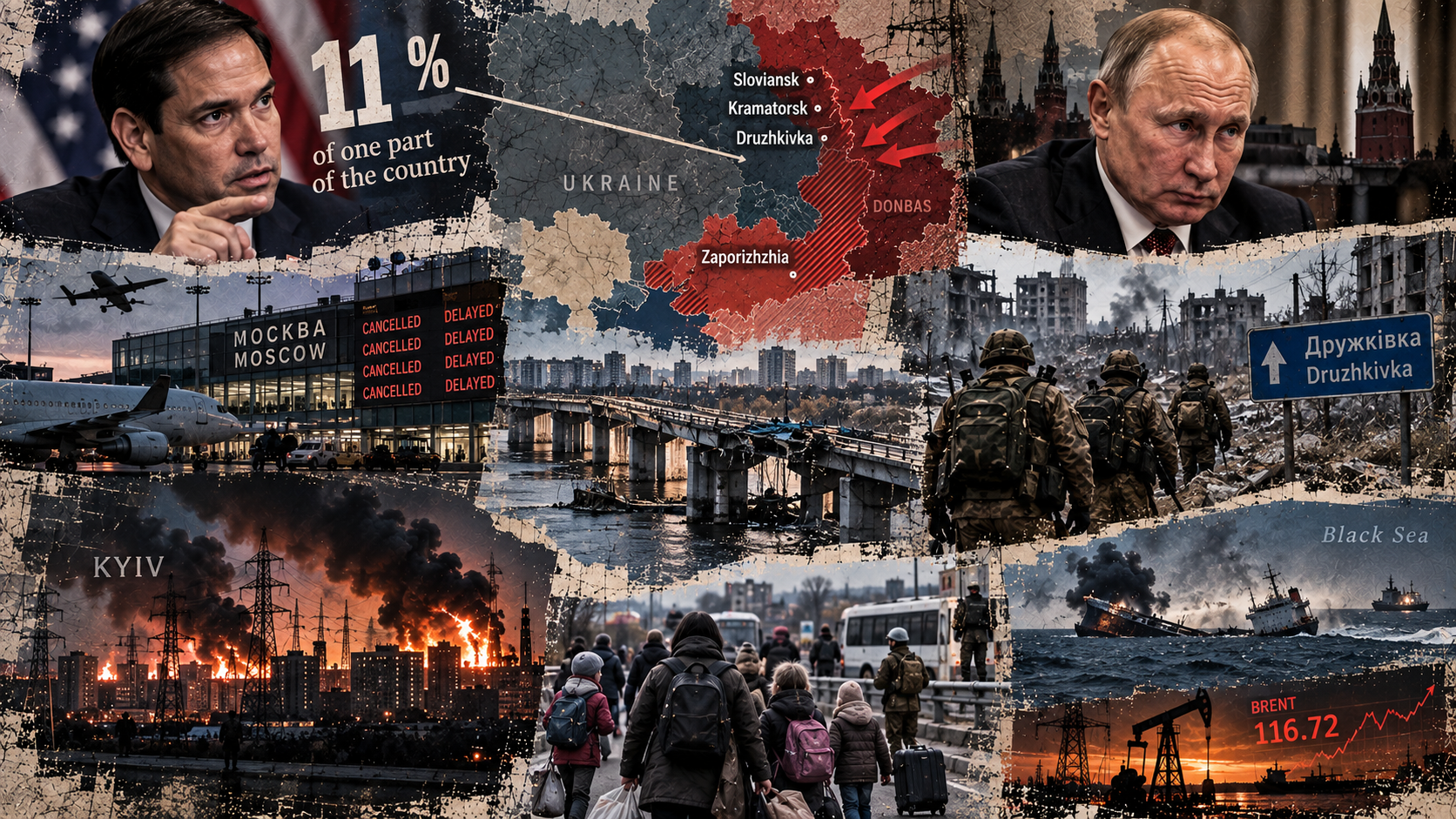
On Friday, Ukrainian drones forced all four Moscow airports to close, and more than 340 flights were delayed or cancelled.
The same day, the Proton plant in Oryol, which produces electronics for Russian weapons systems, was hit by missiles. Ukraine’s General Staff has confirmed damage to the main building, and analysts believe Storm Shadow missiles were used. The weapon type has not been officially confirmed.
The strikes show that Ukraine is continuing its campaign, but it is doubtful that the disruption of Moscow’s airports on this scale can be sustained without repeated attacks.
Russia, meanwhile, continues to strike Odesa and the ports in the southwest and has hit Kharkiv heavily. The Defence Ministry has published footage of an attack on the suspension bridge in Zaporizhzhia, where Geran-4 drones damaged the cables.
There are rumours of another major Russian strike, probably against Kyiv, where the authorities themselves say power generation has been destroyed.
The Front
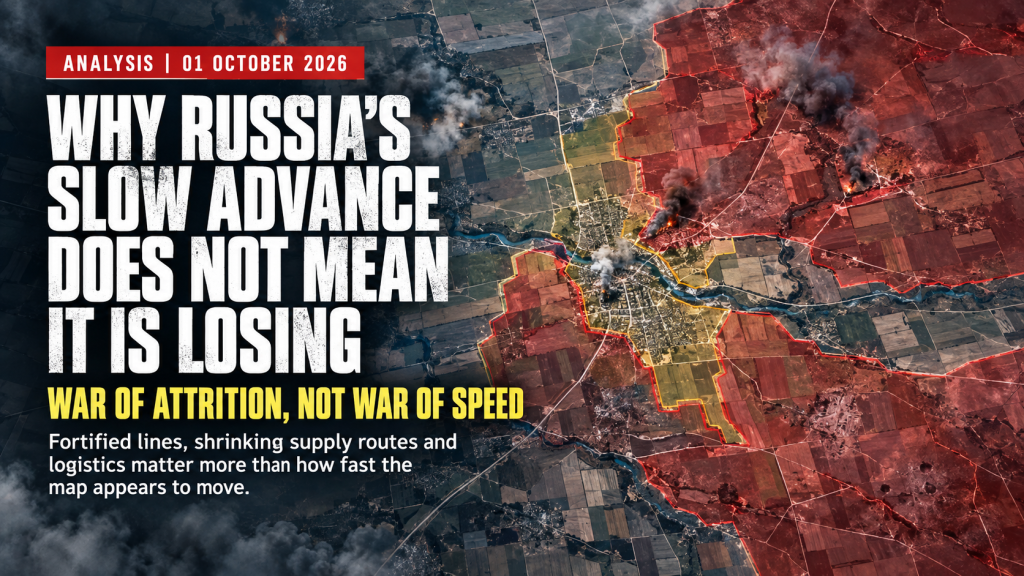
The front has been quieter over the past few days, probably because of the rasputitsa.
Readovka reports that Russia has begun preparations for an assault on Druzhkivka.